
Last Update: June 9, 2026
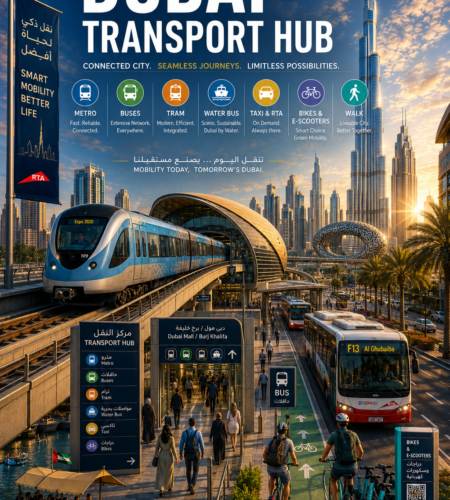
Dubai is one of the easiest Gulf cities to move around if you understand its transport logic before you arrive. The city is built around fast arterial roads, air-conditioned Metro corridors, feeder buses, taxis that are available almost everywhere, and a growing network of tram, marine, bike and future rail options.
For visitors, the main transport hubs are Dubai International Airport (DXB), Al Maktoum International Airport (DWC), the Red and Green lines of Dubai Metro, key bus stations such as Al Ghubaiba and Ibn Battuta, Dubai Tram in the Marina and Al Sufouh corridor, marine stations along Dubai Creek, Dubai Marina and Dubai Water Canal, and cruise access around Port Rashid and Dubai Harbour.
This guide brings the whole system together in one practical place: airport arrivals, Metro connections, Nol card fares, buses, trams, taxis, ride-hailing, intercity travel, water transport, cruise terminals, car rentals, Salik road tolls, accessibility, contacts, FAQ and travel planning tips.
All prices are in UAE dirhams (AED). Transport rules, fares, app booking fees, airport arrangements and event timetables can change, especially during Ramadan, public holidays, New Year, major exhibitions and roadworks. Always confirm your final route with the official RTA, Dubai Airports, Dubai Taxi Company or transport operator before travelling.
Quick Answer: Best Transport Choices
If you are visiting Dubai for the first time, the easiest transport combination is:
- Dubai Metro for airport-to-city trips from DXB Terminal 1 and Terminal 3.
- Nol Silver Card for most Metro, bus, tram and marine public transport journeys.
- Taxi or Careem/Uber/Bolt for late-night rides, luggage-heavy arrivals, families and hotel-to-hotel trips.
- Dubai Tram for Dubai Marina, JBR, Al Sufouh and connections toward Palm Jumeirah.
- Abra or Dubai Ferry for scenic water routes around Dubai Creek, Dubai Marina and the Water Canal.
- Rental car only if you plan to visit Abu Dhabi, Hatta, desert resorts, multiple emirates or places outside the Metro corridors.
Best airport choice:
- Use DXB for most international arrivals, Emirates, flydubai and central Dubai access.
- Use DWC mainly if your airline or event itinerary specifically uses Al Maktoum International Airport.
Best airport-to-hotel logic:
- Staying near Downtown, Business Bay, DIFC, Deira, Bur Dubai, Dubai Marina or JLT: Metro often works well from DXB if luggage is manageable.
- Staying on Palm Jumeirah, Jumeirah Beach, Dubai Creek Harbour, Dubai Hills, JVC, Jumeirah Village Triangle, Madinat Jumeirah or desert resorts: taxi or ride-hailing is usually simpler.
- Arriving at DWC: expect a bus-plus-Metro connection or a longer taxi ride.
Dubai Transport Snapshot
Dubai’s transport system is highly integrated, but it is not one single network. Think of it as several layers:
| Layer | Best For | Main Operator or Platform |
|---|---|---|
| Metro | Airport access from DXB, long north-south trips, avoiding traffic | RTA |
| Tram | Dubai Marina, JBR, Al Sufouh, Palm Monorail connection | RTA |
| Bus | Local neighborhoods, airport terminals, intercity routes | RTA |
| Taxi | Door-to-door travel, luggage, late nights | Dubai Taxi Company and licensed operators |
| Ride-hailing | App-based rides, premium cars, airport pickup | Careem, Uber, Bolt |
| Marine | Creek crossings, Dubai Ferry, Water Taxi, tourist-friendly waterfront routes | RTA Marine |
| Bike share | Short rides in selected districts | Careem Bike |
| Car rental | Road trips, business schedules, Abu Dhabi, Hatta, families | Rental agencies |
| Etihad Rail | Future UAE intercity passenger rail | Etihad Rail |
Dubai is not a small walking city in the European sense. Distances can be bigger than they look on a map, heat can be intense, and highways often separate neighborhoods. The best travel days usually combine Metro for the long section and taxi, tram, bus or walking for the last mile.
Main Airport Hubs
Dubai has two major passenger airports:
| Airport | Code | Best For | Public Transport Notes |
|---|---|---|---|
| Dubai International Airport | DXB | Most global flights, Emirates, flydubai, central Dubai | Metro Red Line serves Terminal 1 and Terminal 3. Buses serve terminals. Taxis operate 24/7. |
| Al Maktoum International Airport | DWC | Selected flights, events, future airport expansion | No direct Metro station at the terminal. Use bus, taxi, or connect via Expo 2020 / Ibn Battuta. |
DXB: Dubai International Airport
DXB is the primary arrival point for most visitors. It has three passenger terminals:
- Terminal 1: many international airlines.
- Terminal 2: many regional and low-cost flights, including a large flydubai operation.
- Terminal 3: Emirates and selected partner or flydubai flights.
DXB is close to Deira, Bur Dubai, Dubai Creek, Downtown Dubai and Business Bay. Depending on traffic, taxi trips to central neighborhoods can be quick, but Sheikh Zayed Road congestion can add time during peak hours.
DWC: Al Maktoum International Airport
DWC is located in Dubai South, near Expo City Dubai and the Jebel Ali side of the emirate. It is important for Dubai’s long-term airport strategy and some airline/event operations, but for visitors it currently requires more planning than DXB.
Dubai Airports states that the F55 bus links DWC with Expo Metro Station and N55 connects DWC to Ibn Battuta bus and metro stations. Both routes are listed as operating every 30 minutes on the DWC transport page. Confirm timings in the RTA app before you rely on them, especially for late-night arrivals.
DXB Airport Connections
DXB by Metro
Dubai Metro is the most reliable public transport option from DXB if your destination is near a Metro station.
Metro access:
- Terminal 1: Red Line airport station.
- Terminal 3: Red Line airport station.
- Terminal 2: no direct Red Line airport station at the terminal; use bus, taxi, ride-hailing, or connect through nearby RTA services.
Typical useful Metro destinations from DXB:
- Deira City Centre
- Union
- BurJuman
- Financial Centre
- Burj Khalifa / Dubai Mall
- Business Bay
- Mall of the Emirates
- Dubai Internet City
- Sobha Realty
- DMCC
- Ibn Battuta
- Expo 2020
Airport Metro tips:
- Buy or top up a Nol card before entering the Metro.
- Travel light: Dubai Airports notes that guests can travel with up to two pieces of luggage, including hand luggage.
- Avoid peak commuter times if you have large bags.
- Use Gold Class only if you buy the right Gold fare or card.
- Respect Women and Children cabins.
DXB by Bus
RTA buses serve dedicated stands at Arrivals in Terminals 1, 2 and 3. Dubai Airports notes that a Nol card is required because cash payments are not accepted on public buses.
Airport buses are useful when:
- Your hotel is not right on the Metro.
- You are arriving at Terminal 2.
- You are connecting to a local district served by bus.
- You want the lowest-cost route and are comfortable checking schedules.
Always use the RTA journey planner or S’hail app for live route planning because bus routes and stand details can change.
DXB by Taxi
Dubai Taxi Company taxis are available 24/7 at designated ranks in each terminal. Dubai Airports lists the airport taxi starting fare as AED 25, with additional charges based on distance.
Taxi is best from DXB if:
- You land late at night.
- You have heavy luggage.
- You are travelling with children.
- Your hotel is on Palm Jumeirah, Jumeirah Beach, Dubai Creek Harbour, Dubai Hills, JVC, JVT or a resort area.
- Your destination requires multiple public transport transfers.
Airport taxi tips:
- Use the official taxi rank.
- Confirm that the meter is running.
- Expect Salik tolls to be added when passing toll gates.
- Pink-roof taxis are designated for ladies and families.
- Keep your receipt in case you need to report a lost item.
DXB by Ride-Hailing
Uber, Careem and Bolt operate in Dubai. Dubai Airports notes that ride-hailing services are available and that passengers should follow signs to the pickup point.
Ride-hailing is useful when:
- You want app-based tracking.
- You need a larger vehicle.
- You want a premium car.
- You prefer cashless payment through an app.
Airport pickup areas can vary by terminal and operator, so check the app instructions after booking.
DXB by Rental Car
DXB has car rental services across the airport ecosystem. Dubai Airports lists rental providers such as Europcar, Dollar and National in its services directory, with availability across terminals.
Renting a car from DXB is useful if:
- You will visit Abu Dhabi, Sharjah, Ras Al Khaimah, Hatta or desert resorts.
- You are travelling as a family with luggage.
- Your itinerary is not Metro-friendly.
- You need business flexibility.
For a soft planning option, compare rental availability in advance through:
<a href=”https://www.discovercars.com/?a_aid=Valsoray” rel=”sponsored noopener” target=”_blank”>DiscoverCars</a>
Driving in Dubai is modern but fast-paced. Read the Salik and parking notes below before renting.
DWC Airport Connections
DWC by Bus
DWC is not directly connected to the Metro at the terminal. Public transport relies on bus connections.
Official Dubai Airports information lists:
- F55: DWC to Expo Metro Station.
- N55: DWC to Ibn Battuta bus and metro stations.
- Frequency: both listed as every 30 minutes.
Use this option if:
- You are comfortable with a bus-plus-Metro transfer.
- Your destination is near Expo 2020, Jebel Ali, Dubai Marina, JLT or Ibn Battuta.
- Your arrival time fits the route schedule.
DWC by Taxi
Dubai Taxi Company is the exclusive taxi provider at both DXB and DWC. DWC taxi service is available through official airport taxi ranks.
Taxi is usually the simplest DWC option if:
- You are landing late.
- You have luggage.
- Your hotel is in Downtown, Business Bay, Deira, Palm Jumeirah, Jumeirah or Dubai Marina.
- You do not want to manage a bus transfer after a flight.
DWC to DXB Transfer
Dubai Airports advises passengers connecting between DWC and DXB to clear passport control, collect baggage and arrange onward transport. Options include Dubai Taxi directly or public transport via Metro to Ibn Battuta Metro Station, where a dedicated bus service connects onward.
Practical advice:
- Do not plan a tight DWC-DXB self-transfer.
- Allow time for immigration, baggage, road traffic and check-in.
- If flights are on separate tickets, add a large buffer.
- Taxi is usually the safest option for time-sensitive transfers.
Nol Card, Zones and Public Transport Fares
Nol is Dubai’s public transport smart card. It works across Dubai Metro, buses, Dubai Tram and several marine transport services. It can also be used for some parking and selected retail/payment services.
Where Nol Works
Nol can be used on:
- Dubai Metro
- Dubai Tram
- Dubai Bus
- selected RTA marine transport
- RTA paid parking
- selected retail and service partners
Where to Buy a Nol Card
RTA states that Nol cards can be purchased at:
- Ticket offices
- Ticket vending machines
- RTA authorized sales agents
- Nol Pay app / virtual Nol options
For visitors, the easiest places are Metro stations, airport Metro stations, ticket machines and some bus stations.
Nol Zones
Dubai’s public transport fare map is divided into 7 zones. Your fare depends on how many zones your journey passes through.
RTA transfer rules matter:
- You can transfer between Metro and bus within the allowed transfer window.
- RTA notes that transfer between two different modes must be done within 30 minutes.
- Maximum journey duration listed by RTA is 180 minutes.
- Maximum transfers allowed are 3.
Standard Nol Fares
Official RTA fare comparison lists the following public transport fares:
| Journey | Silver / Personal Card | Gold Card | Red Ticket Regular | Red Ticket Gold |
|---|---|---|---|---|
| Within 1 Zone | AED 3 | AED 6 | AED 4 | AED 8 |
| 2 Adjacent Zones | AED 5 | AED 10 | AED 6 | AED 12 |
| More than 2 Zones | AED 7.50 | AED 15 | AED 8.50 | AED 17 |
Important fare notes:
- Gold fares apply for Gold Class on Metro and Tram.
- Children aged 5 and below travel free according to RTA fare notes.
- People of Determination can travel free with eligible Nol Blue card arrangements.
- Students, Social Affairs categories, senior Emiratis and citizens may qualify for concessions through personal card categories.
Minimum Balance
RTA’s Nol card guidance says to ensure a minimum balance of AED 7.50 before check-in. This matters because a card with low balance can be rejected at gates or bus validators.
Which Nol Card Should a Tourist Choose?
Most short-stay visitors should choose:
- Nol Silver Card if staying several days and using public transport repeatedly.
- Red Ticket if making only one or two simple rides.
- Gold Card only if you specifically want Gold Class Metro/Tram cabins.
For most visitors, Silver is the simplest balance of convenience and fare value.
Dubai Metro
Dubai Metro is the backbone of public transport in the city. It is clean, driverless, air-conditioned and easy to use once you understand the lines.
Metro Lines
Dubai Metro currently operates two core lines:
- Red Line: runs through DXB Terminal 1 and Terminal 3, Deira, Downtown, Business Bay, Sheikh Zayed Road, Dubai Marina/JLT, Jebel Ali and Expo 2020 branches.
- Green Line: serves older central areas such as Deira, Bur Dubai, Union, BurJuman and Creek.
RTA lists Red Line service between centrepoint and Expo 2020 / Life Pharmacy, and Green Line service between e& and Creek.
Key Interchange Stations
Important interchange points:
- Union: Red Line and Green Line.
- BurJuman: Red Line and Green Line.
- Sobha Realty / DMCC area: Metro to Tram interchange corridor.
Metro Operating Hours
RTA and Dubai Airports list Metro station opening hours as:
| Day | Metro Opening Hours |
|---|---|
| Monday to Thursday | 05:00 AM – 12:00 AM |
| Friday | 05:00 AM – 01:00 AM next day |
| Saturday | 05:00 AM – 12:00 AM |
| Sunday | 08:00 AM – 12:00 AM |
Hours may extend during public holidays, New Year, citywide celebrations and major events. Always check RTA before travelling late.
Best Metro Stations for Visitors
Use these stations as common anchors:
- Airport Terminal 1: DXB Terminal 1.
- Airport Terminal 3: DXB Terminal 3.
- Union: Deira and line interchange.
- BurJuman: Bur Dubai and line interchange.
- Dubai Mall / Burj Khalifa: Downtown Dubai, Dubai Mall, Burj Khalifa.
- Business Bay: Business Bay hotels and offices.
- Financial Centre / Emirates Towers: DIFC and Sheikh Zayed Road.
- Mall of the Emirates: mall, hotels, Ski Dubai area.
- Sobha Realty: Dubai Marina / tram connection.
- DMCC: JLT and Dubai Marina access.
- Ibn Battuta: mall, bus hub, DWC-related connections.
- Expo 2020: Expo City and DWC bus connection.
Metro Comfort Rules
Useful rules:
- Do not sit in Gold Class unless your fare allows it.
- Respect Women and Children cabins.
- Eating and drinking in prohibited areas can lead to fines.
- Carrying alcohol on public transport is listed by RTA among fineable offences.
- Children below 8 should not use public transport without adults, according to RTA’s unaccompanied minors policy.
Dubai Tram and Palm Monorail
Dubai Tram
Dubai Tram is useful for the Marina and Al Sufouh side of the city. RTA describes it as a 10.6 km network with 11 stations, linking Dubai Metro and the Palm Monorail while running along Al Sufouh Road and Jumeirah Beach Road.
Use Dubai Tram for:
- Dubai Marina
- JBR
- Marina Mall area
- Al Sufouh
- Media City side connections
- Palm Jumeirah Gateway connection
RTA lists tram opening hours as:
| Day | Tram Opening Hours |
|---|---|
| Monday to Saturday | 06:00 AM – 01:00 AM next day |
| Sunday | 09:00 AM – 01:00 AM next day |
Palm Monorail
Palm Monorail is not the same as Dubai Tram or Metro. It is a separate system on Palm Jumeirah. Visitors often use it for Atlantis, The Palm and The Pointe / Palm attractions, depending on current station access and event operations.
Important:
- Nol fare integration can differ from Metro/Tram expectations.
- Check Palm Monorail fares separately.
- Taxis can be faster for hotel-to-hotel travel on the Palm.
Dubai Buses and Intercity Buses
Dubai’s bus network is extensive and useful once you are comfortable with RTA route planning. RTA states that the Dubai bus network covers 87% of the urban area and includes internal lines, Metro-linking lines, intercity lines, internal routes and fast lines.
When to Use Buses
Buses are useful for:
- Areas away from Metro stations.
- Terminal 2 access.
- DWC airport connections.
- Local neighborhood trips.
- Intercity routes to other emirates.
- Budget travel.
Important Bus Hubs
Common visitor-relevant bus hubs include:
- Al Ghubaiba Bus Station: historic Dubai, Bur Dubai, marine connections and some intercity links.
- Ibn Battuta Bus Station: western Dubai, Abu Dhabi route connections, DWC-related movement.
- Union Bus Station / Union area: Deira and Metro interchange access.
- Gold Souq Bus Station: Deira and older Dubai routes.
- Al Sabkha / Baniyas areas: Deira bus and creek-side movement.
- Mall of the Emirates Bus Station: hotel and neighborhood feeder routes.
- Expo 2020 station area: Expo City and DWC connections.
Intercity Bus Travel
RTA provides intercity bus ticket booking through its official platform. Intercity buses can be useful for Abu Dhabi, Sharjah and other emirate connections, depending on current route status.
Visitor tip:
- Abu Dhabi buses are popular and affordable, but taxis or rental cars may be faster for families or tight itineraries.
- For Sharjah, traffic can be heavy during commute times.
- Confirm the route number, station, fare and last departure before travelling.
Taxis, Ride-Hailing and Airport Taxi Rules
Dubai taxis are one of the city’s greatest transport strengths. They are regulated, metered and generally easy to find at hotels, malls, airports and attractions.
Dubai Taxi Company
Dubai Taxi Company provides official airport taxi service at DXB and DWC. Dubai Airports states taxis are available 24/7 at designated ranks in each DXB terminal and lists a starting fare of AED 25 at the airport.
DTC’s own airport taxi page lists service fees for Dubai Airports and Port Rashid, with per-kilometre rates and notes that Salik charges can apply.
Taxi Fare Notes
Always treat taxi fare examples as estimates because:
- Distance matters.
- Traffic matters.
- Salik toll gates may be added.
- App-based booking can have time-based fees.
- Event locations and New Year’s Eve can affect trip fares.
- Waiting time can be charged.
Officially confirmed points from Dubai Airports and DTC include:
- Airport taxi starting fare from airport ranks: AED 25 listed by Dubai Airports.
- Dubai Taxi Company airport taxi service exists at Dubai Airports.
- Additional Salik fares apply when passing toll gates.
- Waiting fare is listed by DTC as 50 fils per minute for all vehicle types.
- An extra charge can apply when passing through Sharjah, according to DTC fare notes.
Ride-Hailing Apps
Common options:
- Careem
- Uber
- Bolt
Use ride-hailing when:
- You want to choose vehicle class.
- You need app receipts.
- You want clear pickup instructions.
- You prefer cashless payment.
- You are in a location where street taxis are less visible.
Taxi or Metro?
Choose Metro if:
- You are near a Metro station.
- It is daytime or evening before closing.
- You have light luggage.
- Your destination is near Red or Green Line.
- You want predictable cost.
Choose taxi if:
- You are landing late.
- You have children or heavy bags.
- You are going to Palm Jumeirah, Jumeirah Beach, Dubai Hills, Dubai Creek Harbour, JVC/JVT or desert locations.
- It is very hot and the walk from station to hotel is long.
- You are splitting the fare with 2-4 people.
Marine Transport: Abra, Ferry and Water Taxi
Dubai’s water transport is both practical and scenic. RTA marine services include traditional and modern Abras, Dubai Ferry and Dubai Water Taxi.
Abra
Abra is the most classic Dubai transport experience. It is especially useful around Dubai Creek, where short crossings connect historic districts, souks and waterfront areas.
RTA describes Abra as one of the city’s most traditional transport modes and lists different types of modern and traditional Abras.
Useful Creek areas:
- Bur Dubai
- Deira Old Souq
- Al Fahidi
- Baniyas
- Al Seef
Dubai Ferry
Dubai Ferry is better for scenic routes and planned trips than spontaneous commuting. RTA’s timetable page lists Dubai Ferry routes including Dubai Water Canal, Al Ghubaiba, Dubai Marina Mall, Bluewaters, Palm Jumeirah / Atlantis round trips, and Sharjah Aquarium connections, depending on schedule.
Use Dubai Ferry for:
- Marina skyline views.
- Creek and old Dubai views.
- Bluewaters and coastal sightseeing.
- A slower, more memorable alternative to road travel.
Water Taxi
Water Taxi is useful for premium marine point-to-point movement, especially around waterfront districts. It is usually more expensive than Abra or Ferry, but can be memorable and practical for specific routes.
Marine Travel Tips
- Check the RTA marine timetable before going to a station.
- Some routes are on demand.
- Weather, visibility, sea conditions and events can affect services.
- Arrive early if you need a specific ferry departure.
- Use marine transport as part of sightseeing, not only as transport.
Cruise Terminals and Port Access
Dubai is a major cruise hub in the region. Visit Dubai describes Dubai Cruise Terminal at Mina Rashid as one of the largest and most modern in the region, and notes that Port Rashid welcomes international cruise lines with modern facilities, duty-free shops and shuttle connections.
Main cruise-related zones:
- Port Rashid / Mina Rashid: traditional cruise terminal area, close to old Dubai and the QE2 hotel.
- Dubai Harbour: cruise and marina development near Dubai Marina / Bluewaters / Palm Jumeirah side.
Getting from Cruise Terminal to City
Likely options:
- Taxi from terminal rank.
- Cruise line shuttle if provided.
- Pre-booked private transfer.
- Ride-hailing if pickup rules allow.
- Rental car if continuing a UAE road trip.
For most cruise passengers, taxi or shuttle is easiest. Public transport may require a taxi first because cruise terminals are not usually as simple as stepping onto a Metro platform.
Car Rental, Driving, Parking and Salik
Dubai can be easy to drive in because roads are modern and signs are usually clear. It can also be stressful because traffic is fast, interchanges are large and missed exits can add time.
When Renting a Car Makes Sense
Rent a car if:
- You plan Abu Dhabi day trips.
- You are going to Hatta.
- You will visit desert resorts or remote beach areas.
- You are travelling with family and luggage.
- You have business meetings spread across the emirate.
- Your hotel has easy parking.
Do not rent a car just for:
- A first-time Downtown and Marina itinerary.
- A short layover.
- A hotel beside a Metro station.
- A trip focused on malls, Burj Khalifa, Dubai Marina and Old Dubai.
Rental Car Planning
Useful documents may include:
- Passport.
- Valid driving licence.
- International Driving Permit if required for your nationality/licence.
- Credit card in the driver’s name.
- Insurance details.
Compare rental options:
<a href=”https://www.discovercars.com/?a_aid=Valsoray” rel=”sponsored noopener” target=”_blank”>Compare Dubai car rentals with DiscoverCars</a>
Salik Road Tolls
Salik is Dubai’s electronic toll system. For rental cars, tolls are usually tracked by the rental agency and charged to you later with possible admin fees.
Official Salik information confirms variable toll pricing and notes that from June 1, 2026 a 5% VAT applies to toll tariffs and tag activation fees.
Practical visitor notes:
- Ask your rental agency how Salik is billed.
- Expect tolls on major corridors.
- Peak periods can cost more than off-peak periods.
- Salik is barrier-free; you do not stop to pay.
- Keep your rental agreement and final invoice.
Parking
Dubai has paid public parking zones, mall parking, hotel parking and private lots. Some malls offer free hours and then charge. Hotels may offer valet or self-parking.
Parking tips:
- Check hotel parking before booking a rental car.
- Do not park in unauthorized sandy lots or private access roads.
- Use RTA parking payment channels where available.
- Watch signs carefully: zones, timings and rules vary.
- Around beaches and Downtown, parking can become busy on weekends and evenings.
Bikes, E-Bikes and Last-Mile Travel
Dubai is becoming more bike-friendly in selected areas, but heat and road design matter.
Careem Bike
Careem Bike operates e-bike sharing in Dubai and Abu Dhabi. Careem’s official help page lists Dubai bike subscription options including:
- Pay as you go: AED 1 to unlock, then per-minute fees.
- Single trip pass: AED 19, including one 45-minute ride, then AED 10 per extra 30 minutes.
- One day pass: AED 29, with free minutes included, then extra time charges.
- One week pass: AED 59.
- One month pass: AED 99, with 60 unlocks and a free 45-minute ride each.
Careem says tourist users currently have access exclusively to Pay as you go. Check the app for current tourist eligibility and prices before riding.
Where Bikes Work Best
Bike share is best for:
- Dubai Marina
- JLT
- Downtown / Dubai Mall area where docks exist
- Jumeirah Beach areas
- Dubai Canal
- Selected leisure tracks
- Short last-mile trips in cooler months
Bike tips:
- Avoid midday heat.
- Use dedicated bike lanes where available.
- Wear a helmet and reflective gear.
- Do not ride on fast roads.
- Dock the bike correctly to end the ride.
- Watch extra time charges.
E-Scooters
E-scooter rules in Dubai are regulated and area-specific. Use only approved areas and follow RTA permit/rules where applicable. Because enforcement and permitted zones can change, confirm current scooter rules on RTA before renting or riding.
Future Rail: Etihad Rail and Dubai Metro Blue Line
Dubai’s rail story is changing, but visitors should separate current options from future projects.
Etihad Rail Passenger Services
Etihad Rail has announced the UAE’s passenger railway network, with first-phase passenger services planned for 2026. Official Etihad Rail updates list planned stations in Abu Dhabi, Dubai, Sharjah, Fujairah and other cities, forming an integrated national passenger railway system.
As of this article’s verification date, treat Etihad Rail as an upcoming intercity travel option to verify before relying on it for a fixed itinerary. Do not plan a same-day flight connection around Etihad Rail unless ticketing, station access and operating schedules are officially confirmed.
Dubai Metro Blue Line
RTA states that the Dubai Metro Blue Line project is a 30 km route with 14 stations, planned to link key areas including Dubai Creek Harbour, Dubai Festival City, International City, Dubai Silicon Oasis and Academic City. It is scheduled for completion in 2029, coinciding with Dubai Metro’s 20th anniversary.
Until then, these districts may still require bus, taxi, ride-hailing or car travel.
Best Routes for Common Visitor Trips
DXB to Downtown Dubai / Burj Khalifa
Best budget route:
- Take Red Line from Airport Terminal 1 or Terminal 3.
- Exit at Burj Khalifa / Dubai Mall station.
- Walk through the station connection or use onward local transport depending on hotel location.
Best comfort route:
- Take official airport taxi or ride-hailing.
Choose taxi if you have bags or are staying away from the Metro/Dubai Mall side.
DXB to Dubai Marina / JBR
Best public transport route:
- Red Line from DXB Terminal 1 or 3.
- Exit at Sobha Realty or DMCC depending on destination.
- Walk, taxi or use Tram for Marina/JBR access.
Comfort route:
- Taxi or ride-hailing direct from airport.
Note: Metro is cost-effective but the ride is long because DXB and Marina are on opposite sides of the city.
DXB to Palm Jumeirah
Most practical:
- Taxi or ride-hailing.
Public transport option:
- Red Line to a Marina-area station.
- Connect to Tram.
- Connect to Palm Monorail.
- Continue by taxi/walk depending on final hotel.
This is possible but not ideal with luggage.
DXB to Deira or Bur Dubai
Best options:
- Metro for many hotels near Union, BurJuman, Al Rigga, Deira City Centre or nearby stations.
- Taxi for door-to-door convenience.
Old Dubai is one of the easiest parts of the city to combine Metro, walking and Abra.
DWC to Dubai Marina
Budget route:
- F55 or N55 depending on time and destination.
- Connect via Expo 2020 or Ibn Battuta.
- Continue by Metro, Tram or taxi.
Comfort route:
- Taxi or ride-hailing direct.
Dubai to Abu Dhabi
Options:
- Intercity bus from RTA station, depending on current route.
- Taxi or private transfer.
- Rental car.
- Future Etihad Rail when passenger service is operational and ticketing is confirmed.
For Sheikh Zayed Grand Mosque, Louvre Abu Dhabi or Yas Island, rental car or private transfer can be easier for groups.
Dubai to Sharjah
Options:
- Intercity bus routes depending on current schedule.
- Taxi or ride-hailing.
- Rental car.
Avoid peak commuter hours if possible because Dubai-Sharjah traffic can be heavy.
Dubai Creek Day
Suggested route:
- Metro to Al Fahidi, BurJuman, Union or Baniyas depending on your plan.
- Walk through Al Fahidi Historical Neighbourhood.
- Use Abra across Dubai Creek.
- Visit spice and gold souks.
- Return by Metro or taxi.
This is one of Dubai’s best low-cost transport experiences.
Dubai Marina and Bluewaters Day
Suggested route:
- Metro to DMCC or Sobha Realty.
- Use Tram or walk depending on weather.
- Consider Dubai Ferry or marine routes if schedule fits.
- Taxi back if late.
Accessibility and Travel Comfort
Dubai has invested heavily in accessible transport, but trip comfort still depends on station, route, heat and distance.
Public Transport Accessibility
RTA notes that Metro includes accessibility services such as tactile guidance paths and platform alerts. Dubai Airports and DWC pages also note accessible features for buses and airport services.
Useful accessibility tips:
- Use official apps to check step-free route details.
- Ask station staff for help if transferring with mobility needs.
- Avoid long outdoor walks in summer.
- Use taxi for door-to-door travel when heat or distance is an issue.
- Confirm hotel entrance and drop-off access before arrival.
Travelling in Summer
Summer travel tips:
- Build itineraries around indoor transfers.
- Avoid long walks between noon and late afternoon.
- Carry water, but respect public transport rules about where eating/drinking is allowed.
- Use taxis for the last mile if the walk is exposed.
- Choose hotels close to Metro if relying on public transport.
Travelling During Ramadan and Public Holidays
During Ramadan, Eid, New Year, major exhibitions and citywide events:
- Metro hours may change or extend.
- Taxi demand can surge.
- Some roads may close.
- Salik timings and special traffic measures can change.
- Marine and ferry schedules may vary.
Check RTA and Dubai Airports before travelling.
Useful Contacts
Emergency Numbers
The UAE Ministry of Interior lists these emergency numbers:
| Service | Number |
|---|---|
| Police | 999 |
| Ambulance | 998 |
| Civil Defence / Fire | 997 |
Dubai Airports
Dubai Airports contact centre:
- Phone: +971 4 224 5555
- Contact page: https://dubaiairports.ae/contact-information
- Lost and found: https://dubaiairports.ae/lost-and-found
- DXB official site: https://dubaiairports.ae/
- DWC official site: https://dwc.dubaiairports.ae/
RTA Dubai
RTA contact details:
- UAE call centre: 800 90 90
- Overseas callers: +971 4 605 1414
- Telephone: +971 4 284 4444
- Email: ASK@rta.ae
- Website: https://www.rta.ae/
Use RTA for:
- Metro schedules
- Bus routes
- Nol fares
- Tram information
- Marine transport
- Public transport lost and found
- Parking and road service questions
Dubai Taxi Company
Use Dubai Taxi Company for:
- Airport taxi service
- DTC taxi information
- Ladies and family taxis
- People of Determination taxi service
- Fare guidance
Website: https://www.dubaitaxi.ae/
Salik
Use Salik for:
- Toll rates
- Toll gate information
- Variable pricing
- Tag and account questions
Website: https://www.salik.ae/
Careem Bike
Use Careem support for:
- Bike pass questions
- Dock locations
- Ride charges
- Lost/damaged e-bike issues
Help centre: https://help.careem.com/
Travel Planning Tools
These partner links can help readers plan the non-transport parts of a Dubai trip. They should be placed naturally in the article body or sidebar, not as aggressive pop-ups.
Mobile Data
Dubai is app-heavy: RTA, S’hail, Careem, Uber, Bolt, airline apps, hotel maps and digital tickets are all easier with mobile data.
<a href=”https://yesim.app/?partner_id=1973″ rel=”sponsored noopener” target=”_blank”>Check Yesim eSIM options for Dubai</a>
Hotels and Flight Packages
If readers are comparing Dubai hotels near Metro stations, airport areas, Downtown, Marina or Palm Jumeirah:
<a href=”https://expedia.com/affiliates/hedonism/cloud” rel=”sponsored noopener” target=”_blank”>Compare Dubai hotels and travel deals on Expedia</a>
Tours and Transfers
Dubai works well with planned experiences: desert safaris, Burj Khalifa tickets, yacht trips, Abu Dhabi day tours and private airport transfers.
<a href=”https://www.viator.com/?pid=P00282913&mcid=42383&medium=link” rel=”sponsored noopener” target=”_blank”>Browse Dubai tours and transfers on Viator</a>
Car Rental
For Abu Dhabi, Hatta, desert resorts or multi-emirate road trips:
<a href=”https://www.discovercars.com/?a_aid=Valsoray” rel=”sponsored noopener” target=”_blank”>Compare rental cars with DiscoverCars</a>
Travel Insurance
For medical cover, delays and longer trips:
<a href=”https://safetywing.com/?referenceID=26541585&utm_source=26541585&utm_medium=Ambassador” rel=”sponsored noopener” target=”_blank”>Review SafetyWing travel medical insurance</a>
Optional widget placement for a travel insurance sidebar:
<div class="safetywing-price-widget" data-safetywingaffiliateid="26541585" data-scale="1.0"></div> <script type="text/javascript" src="https://storage.googleapis.com/safetywing-static/widget/safetywing-price-widget.js"></script>
Support the Project
If readers find the guide useful and want to support more independent travel research:
<a href=”https://www.patreon.com/HEDONISMcloud” rel=”sponsored noopener” target=”_blank”>Support HEDONISMcloud on Patreon</a>
FAQ
What is the best way to get from Dubai Airport to the city?
From DXB Terminal 1 or Terminal 3, Dubai Metro is often the best budget choice if your hotel is near the Red Line. Taxi is best for late arrivals, heavy luggage, families, Palm Jumeirah, Jumeirah Beach, Dubai Creek Harbour and hotels far from Metro stations.
Does Dubai Airport have a Metro station?
Yes. DXB Terminal 1 and Terminal 3 are served by Dubai Metro Red Line stations. Terminal 2 does not have the same direct Red Line terminal station access, so travellers usually use bus, taxi, ride-hailing or a connection through nearby transport.
Is there a Metro to DWC airport?
No direct terminal Metro station. Dubai Airports lists bus connections from DWC to Expo Metro Station and Ibn Battuta. Taxi is usually simpler if you have luggage or a tight schedule.
How much is Dubai Metro from the airport?
The fare depends on zones and card type. With a Nol Silver or Personal card, RTA lists fares as AED 3 within 1 zone, AED 5 for 2 adjacent zones and AED 7.50 for more than 2 zones. Red Ticket and Gold fares cost more.
Do Dubai buses accept cash?
No. Dubai Airports states that a Nol card is required for bus travel because cash payments are not accepted.
Which Nol card is best for tourists?
For most tourists staying more than one day, a Nol Silver Card is the easiest choice. It works across Metro, bus, tram and many public transport services and has lower fares than Red Ticket single-use travel.
Can I use the same Nol card for Metro and bus?
Yes. Nol works across Metro, bus and Tram. RTA transfer rules allow trips across modes to count as one journey if transfers are made within the allowed transfer window and journey rules.
Is Dubai Metro open 24 hours?
No. RTA lists Metro operating hours by day. Typical hours are Monday to Thursday 5:00 AM to midnight, Friday 5:00 AM to 1:00 AM next day, Saturday 5:00 AM to midnight and Sunday 8:00 AM to midnight. Hours can change for holidays and events.
Are taxis expensive in Dubai?
Compared with many global cities, Dubai taxis are often reasonable for door-to-door convenience, especially for groups. However, airport start fares, distance, traffic, Salik tolls, app booking fees and event surcharges can increase the final price.
Is Uber cheaper than taxi in Dubai?
It depends on time, demand, vehicle class and route. Official taxis are metered and widely available. Uber, Careem and Bolt are convenient for app tracking and vehicle choice. Compare in the app before booking.
Can I travel from Dubai to Abu Dhabi by public transport?
Yes, intercity buses are commonly used, but schedules and routes should be checked with RTA before travelling. Taxi, private transfer or rental car can be easier for groups, luggage or multiple Abu Dhabi stops.
Is there a train from Dubai to Abu Dhabi?
Etihad Rail passenger service is planned for the UAE and official updates describe passenger operations launching in phases in 2026. Treat it as an upcoming option and verify official ticketing and schedules before relying on it.
What is the easiest way to visit Old Dubai?
Use Metro to BurJuman, Al Fahidi, Union or Baniyas depending on your route, then walk and use Abra across Dubai Creek. Old Dubai is one of the best areas for combining public transport and heritage sightseeing.
Should I rent a car in Dubai?
Rent a car if you plan Abu Dhabi, Hatta, desert resorts, multiple emirates or family travel away from Metro lines. Do not rent just for a simple Downtown-Marina-Old Dubai itinerary unless your hotel parking and comfort needs justify it.
What should I know about driving in Dubai?
Traffic is fast, roads are wide, exits can be complex and tolls are electronic. Ask your rental agency how Salik tolls and parking fines are billed. Use navigation and avoid peak-hour cross-city drives when possible.
Is Dubai transport accessible?
Major systems such as Metro and airport services include accessibility features, but the practical experience depends on station, destination, heat and walking distance. Taxis are often the best door-to-door solution for travellers with mobility needs.
Final Word
Dubai is not difficult to navigate; it is a city that rewards choosing the right mode for the right trip. Metro is excellent along the Red and Green corridors, taxis solve the last-mile problem, Nol keeps public transport simple, marine routes make old Dubai and the waterfront memorable, and rental cars unlock the wider UAE.
For most visitors, the smartest Dubai transport strategy is simple:
- Use Metro from DXB when your hotel is near the line.
- Keep a Nol Silver Card for public transport.
- Use taxis or ride-hailing for luggage, heat and off-line districts.
- Plan DWC transfers carefully.
- Use Abra or Ferry at least once for the experience.
- Rent a car only when the itinerary genuinely needs it.
Dubai moves quickly, and its transport network keeps expanding. Check official sources before travel, especially for fares, airport transfers, Etihad Rail, Metro Blue Line construction, Salik tolls and holiday timetables.
Sources Checked
- Dubai Airports – DXB Metro: https://dubaiairports.ae/transport/metro
- Dubai Airports – DXB Bus: https://dubaiairports.ae/transport/bus
- Dubai Airports – DXB Taxi: https://dubaiairports.ae/transport/taxi
- Dubai Airports – Contact Information: https://dubaiairports.ae/contact-information
- Dubai Airports – Lost and Found: https://dubaiairports.ae/lost-and-found
- DWC – Bus: https://dwc.dubaiairports.ae/transport/bus
- DWC – Metro: https://dwc.dubaiairports.ae/transport/metro
- DWC – Taxi: https://dwc.dubaiairports.ae/transport/taxi
- DWC – Transfers: https://dwc.dubaiairports.ae/information/transfers
- RTA – Public Transport: https://www.rta.ae/wps/portal/rta/ae/public-transport
- RTA – Timetables: https://www.rta.ae/wps/portal/rta/ae/public-transport/timetable
- RTA – Nol Fares: https://www.rta.ae/wps/portal/rta/ae/public-transport/Nol-Fares
- RTA – Nol How: https://www.rta.ae/wps/portal/rta/ae/public-transport/nol/nol-how
- RTA – About Nol Card: https://www.rta.ae/wps/portal/rta/ae/public-transport/About-Nol-Card
- RTA – About Dubai Metro: https://www.rta.ae/wps/portal/rta/ae/public-transport/metro/about-metro
- RTA – Marine Transport: https://www.rta.ae/wps/portal/rta/ae/public-transport/marine/about-marine
- RTA – Contact Us: https://www.rta.ae/wps/portal/rta/ae/home/about-rta/contactus
- Dubai Taxi Company – Airport Taxi: https://www.dubaitaxi.ae/en/our-services/airport-taxi
- Dubai Taxi Company – Taxi Services: https://www.dubaitaxi.ae/en/our-services/taxi
- Salik – Variable Toll Rates: https://www.salik.ae/en/Toll-Gates/variable-toll-rates
- Careem Bike – Subscription Plans: https://help.careem.com/hc/en-us/articles/360040968093-What-are-the-subscription-plans
- Careem Bike – Available Locations: https://help.careem.com/hc/en-us/articles/4412032949779-Available-locations
- Visit Dubai – Getting to Dubai: https://www.visitdubai.com/en/plan-your-trip/getting-to-dubai
- Visit Dubai – Dubai by Cruise: https://www.visitdubai.com/en/beyond-dubai/dubai-by-cruise
- Etihad Rail – Passenger Railway Network: https://www.etihadrail.ae/en/post/ahead-of-the-launch-of-the-first-phase-of-passenger-train-services-in-2026-etihad-rail-reveals-details-of-the-uaes-full-passenger-railway-network
- Etihad Rail – Passenger Train Project Update: https://www.etihadrail.ae/en/post/etihad-rail-board-of-directors-reviews-developments-of-the-national-rail-network-and-passenger-train-project
- UAE Ministry of Interior – Emergency Contact: https://moi.gov.ae/en/about.moi/content/emergency.contact.aspx
Comments