
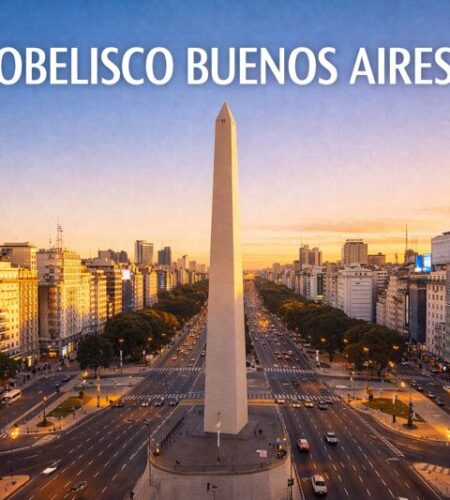
The Obelisco Buenos Aires is the city’s most recognizable landmark—standing in the middle of the wide Avenida 9 de Julio at Plaza de la República, right by the Avenida Corrientes intersection. It’s free to see from the street, easy to reach by Subte, and (now) you can also book a timed visit to the Mirador Obelisco for panoramic views.
Why the Obelisco Buenos Aires is worth your time 📍
Even if you’re only in Buenos Aires for 24–48 hours, the Obelisco is a perfect “anchor” stop because:
- It’s central (you’ll likely pass near it anyway).
- It’s surrounded by iconic city scenes: theaters, Corrientes nightlife, and the epic scale of 9 de Julio.
- It’s a top photo spot both day and night (the avenue lighting makes it pop).
Quick facts you can drop into your itinerary ✅
According to the official tourism site, the Obelisco is 67.5 meters tall, sits at Plaza de la República, and is one of the city’s most emblematic monuments.
A bit of history (in 60 seconds) 🏛️
The Obelisco was inaugurated in 1936 and is closely tied to Buenos Aires’ identity and major civic moments. The city government’s “Obelisco” page covers its origin and key historical notes (including 1936 construction/inauguration details).
Best times to visit (photos + vibe) ⏱️
For photos:
- Golden hour (late afternoon): warm light + less harsh shadows.
- After dark: illuminated avenue traffic lines + dramatic skyline feel.
For the calmest experience:
- Early morning is quieter, especially on weekdays.
⚠️ Common mistake: people underestimate how wide/fast Avenida 9 de Julio feels. Use crosswalks/subway passages—don’t “rush it” between lanes.
How to get to the Obelisco Buenos Aires 🚇🚌🚖
By Subte (fastest + simplest) 🚇
The Obelisco is served by multiple central Subte stations around 9 de Julio/Corrientes:
- 9 de Julio (Line D)
- Diagonal Norte (Line C)
- C. Pellegrini (Line B)
🕒 Subte service start times (all lines):
- Mon–Fri: 5:30
- Sat: 6:00
- Sun & holidays: 8:00
Paying for transit (SUBE) 💳
For public transport you’ll want a SUBE card. The national government site explains where to get it (online or at official points) and the current card cost is listed there.
Subte fares (official city pricing) 💳
Buenos Aires publishes a tiered (“escalonada”) Subte fare depending on how many rides you’ve taken in the month and whether your SUBE is registered. Here are the official values shown on the city site (check the same page for the latest updates):
| Monthly ride count | SUBE registered (Subte) | SUBE not registered (Subte) |
|---|---|---|
| 1–20 rides | 1,206.00 | 1,917.54 |
| 21–30 rides | 964.80 | 1,534.03 |
| 31–40 rides | 844.20 | 1,342.28 |
| 41+ rides | 723.60 | 1,150.52 |
✅ Bonus: the city also notes new payment options (credit/debit/prepaid/NFC/QR) are available at identified turnstiles across the Subte network.
By Tourist Bus (easy “see a lot” option) 🚌
The official tourism site describes Buenos Aires’ hop-on hop-off style Bus Turístico routes, schedules, and what neighborhoods/attractions they cover (including Av. 9 de Julio).
By taxi/ride-hail 🚖
Best if you’re short on time or carrying shopping/luggage. In central areas, a short ride to “Obelisco / 9 de Julio y Corrientes” is usually straightforward—just watch traffic at peak hours.
Visiting the Mirador Obelisco (inside the Obelisk) 🔭
Yes—there’s a Mirador Obelisco experience you can book.
What the official tourism page says:
- Open daily 9:00–21:00
- The visit is about 20 minutes
- You go up by elevator (with a glass side) and finish with 35 steps to reach the viewpoint
- Not recommended for people with reduced mobility, because there are stairs (including steps at the entrance)
🎟️ Tickets: the Mirador is a ticketed, scheduled visit (the official page includes the ticket section and conditions).
✅ Street-level visit (walking around, photos) is free any time.
Practical tips (and what people do wrong) ✅⚠️
1) Don’t treat 9 de Julio like a normal street ⚠️
It’s huge. Plan your crossing with crosswalk timing or use underground passages near the Subte entrances.
2) Pick your photo angle on purpose 📸
- Classic shot: stand slightly off-center so you capture both the Obelisk and the “river” of lanes.
- Night shots look best if you wait for traffic light cycles (headlights = light trails).
3) Use official route planning tools 🗺️
If you need a reliable door-to-door public transport plan, the city recommends using its official map tools (“Cómo llego / mapa”).
✈️ Airport connections to the Obelisco Buenos Aires
Buenos Aires’ official tourism site explains that from Ezeiza (EZE) and Aeroparque (AEP) you can use shuttles/transfers, taxis, remises, or public buses (public transport requires a SUBE card).
A practical, low-stress strategy:
- From EZE: take a prebooked shuttle/transfer into the city (the tourism site mentions services to central areas like Puerto Madero), then taxi/Subte to the Obelisco.
- From AEP: taxi/ride-hail is usually the simplest for a first-time visitor; public options exist but vary by route/time.
FAQ ❓
Is the Obelisco Buenos Aires free?
Seeing it from the street is free. The Mirador Obelisco (inside) is a ticketed, scheduled visit.
What are the Mirador Obelisco hours?
Daily 9:00–21:00 (per the official tourism page).
Which Subte stations are closest?
9 de Julio (Line D), Diagonal Norte (Line C), and C. Pellegrini (Line B) are the key stations in the Obelisco area.
Do I need a SUBE card?
For public transport, yes—SUBE is the standard card and the government site explains how to buy it.
Conclusion
The Obelisco Buenos Aires is one of those landmarks that’s both iconic and practical: central location, easy Subte access, great photos, and now a proper viewpoint experience via the Mirador. If you plan it right—Subte in, quick photos, maybe a Mirador slot—you can fit it into almost any Buenos Aires day without stress.
Comments