
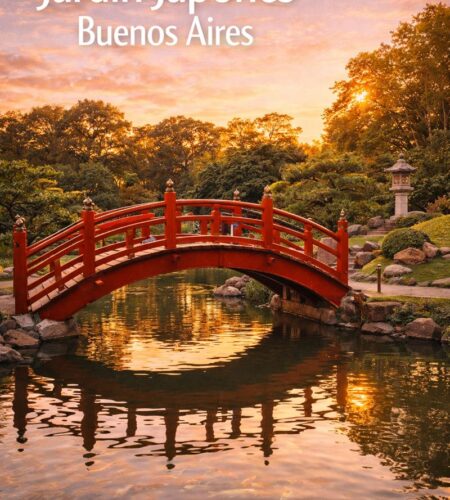
Jardín Japonés Buenos Aires is one of the calmest, most photogenic places in the city: arched bridges over koi ponds, manicured paths, and Japanese landscaping designed for balance and harmony. It’s located in Palermo, next to the green spaces of Parque 3 de Febrero, and it’s an easy add-on to a “parks + museums” day.
What makes Jardín Japonés Buenos Aires special ✅
A peaceful “reset” inside the city 🌿
Buenos Aires’ official tourism site describes the garden as a relaxing attraction built around harmony—bridges, waterfalls, koi ponds, and Japanese-inspired design elements.
A meaningful origin story (and a classic Palermo stop) 🏯
The tourism listing notes the garden was inaugurated in 1967, linked to a visit by Japan’s future emperor Akihito and Michiko.
It’s open every day (including holidays) ⏱️
The official Jardín Japonés site states it’s open daily, including weekends and holidays, with clear closing times and ticket-office hours.
Quick planning table 📍 (save this)
| What you want | Best plan | Time needed |
|---|---|---|
| Photos + bridges + koi ponds 📸 | Quick loop + bridges + pond viewpoints | 45–75 min |
| Slow peaceful visit 🌿 | Full loop + sitting spots + cultural details | 1.5–2.5 hrs |
| Culture add-on 🎎 | Visit + guided visit (when available) | 2–3 hrs |
Guided visits are published on the official site.
What to see inside Jardín Japonés Buenos Aires 📍
1) The bridges (your best photos start here) 🌉
The red arched bridges are the garden’s signature look. Do them twice: once for photos, once slower to enjoy the view.
Best photo trick ✅
Stand slightly off-center on the bridge so you can capture: bridge curve + water + greenery in one frame.
2) Koi ponds and viewpoints 🐟
Tourism info highlights koi carp as part of the classic experience (often you’ll see people stopping to watch them for a while).
⚠️ Tip: follow on-site rules about feeding and where it’s allowed—don’t assume.
3) Paths, greenery, and “slow moments” 🌿
This isn’t a place to rush. The garden works best when you walk slowly, stop, and let the details do their thing.
4) Cultural activities (if timing matches) 🎌
The garden often hosts cultural programming; the official site also lists guided visits on Saturdays, Sundays, and holidays at 11:00 (check updates before you go).
How to get there 🚇 🚌 🚖
Address / entrance 📍
The official site lists the entrance at Av. Casares 3500 (between Av. Berro and Av. Libertador), inside the Palermo / Parque 3 de Febrero area.
By Subte (metro) 🚇
The official site recommends Subte Line D to Plaza Italia, then walk to the entrance.
✅ Practical note: the site also mentions the walk is roughly 8 blocks along Ecoparque.
By bus (colectivo) 🚌
The official Jardín Japonés site lists many bus lines that reach the area, including: 10, 15, 37, 59, 60, 67, 93, 95, 102, 108, 110, 118, 128, 130, 141, 160, 188.
By taxi / ride apps 🚖
If you’re short on time or it’s very hot, taxi/ride apps are the simplest. Use “Jardín Japonés, Av. Casares 3500.”
Hours and operating times ⏱️
The official site states:
- Open every day: 10:00–18:45 (including weekends and holidays)
- Ticket office (boletería): 10:00–18:20
- The garden does not close for rain
⚠️ Common mistake: people arrive too late. If you show up near closing, you may miss ticket sales because the ticket office closes before the garden closes.
Tickets / prices / entry rules 💳
Ticket prices (official) 🎟️
The official site lists:
- Argentine residents: 6,000 ARS (with DNI)
- Non-residents: 18,000 ARS
Free entry categories (official) ✅
The site also lists free entry for:
- Children under 12 (with DNI, accompanied by an adult)
- Argentine citizens & permanent residents 65+ (with DNI)
- People with disabilities (with the appropriate certificate)
⚠️ Practical tip: if you qualify for resident pricing or free entry, bring the required ID/certificate—it’s explicitly tied to presenting documentation.
Rules and etiquette (don’t get surprised) ⚠️
The official site lists several important rules, including:
- No alcohol
- No smoking/vaping (smoke-free space)
- No pets (except certified assistance animals)
- No picnics
- No drones
- Avoid loud speakers / amplified sound
✅ Why this matters: this place is popular because it stays calm—help keep it that way.
The best time to visit 📸🌤️
For photos
- Morning = fewer people + cleaner shots
- Late afternoon = warmer light, more atmosphere
For a quieter vibe
- Weekdays usually feel calmer than weekends (especially around midday).
Suggested itineraries ✅
Option A: “Quick iconic loop” (60–90 min) 🚶
- Enter → bridge photos
- Pond viewpoints (koi)
- Full loop path → exit
Option B: “Palermo green day” (half-day) 🌿
- Jardín Japonés
- Walk toward parks / lakes in Parque 3 de Febrero area
- Finish with a museum stop nearby (Palermo is full of options)
Option C: “Culture timing” (2–3 hours) 🎌
- Arrive early
- Do the garden loop
- Add a guided visit if your day matches the schedule (Sat/Sun/holidays 11:00).
FAQ ❓
Is Jardín Japonés Buenos Aires open every day?
Yes—officially open daily 10:00–18:45, including weekends and holidays.
When does the ticket office close?
The official site lists ticket office hours until 18:20.
How much are tickets?
Official prices: 6,000 ARS for Argentine residents (with DNI) and 18,000 ARS for non-residents.
What Subte line goes closest?
The official site recommends Line D to Plaza Italia, then walking to the entrance.
Does it close when it rains?
The official site states it does not close for rain.
Conclusion
Jardín Japonés Buenos Aires is a high-value stop because it’s beautiful, peaceful, and easy to plan: clear daily hours, straightforward tickets, and simple access via Subte Line D (Plaza Italia) plus a walk. Go early for photos, arrive before the ticket office closes, and treat it like a quiet sanctuary—not a rushed checklist stop.
Comments