
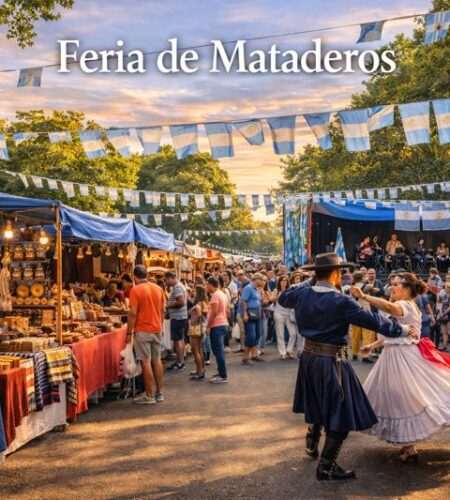
The Feria de Mataderos Buenos Aires is the city’s best “one-stop” introduction to Argentine traditions—folk music and dance, regional crafts, leatherwork, and classic comfort food—all in an open-air fair that feels local (not staged). It’s officially known as the “Feria de las Artesanías y Tradiciones Populares Argentinas”, and it runs in the Mataderos neighborhood at Av. Lisandro de la Torre & Av. de los Corrales.
If you want a real Sunday plan—what time to go, what to buy, what to eat, and how not to waste half your day in transit—this guide is built for that. ✅📍
Why Feria de Mataderos Buenos Aires is worth it ✅
It’s a living folklore “show,” not a museum
Every fair day, you’ll typically find a stage with folk singing and dancing, plus workshops and sometimes gaucho skills demonstrations. Many activities are described as free/open on the official city tourism listing.
It’s one of the biggest tradition-focused fairs in the city
Buenos Aires’ official culture site describes it as a major Sunday gathering centered on crafts, regional products, and a food patio, with programming updated week to week.
You can eat your way through Argentina 🍖🥟
The official tourism page explicitly calls out typical fair foods like empanadas, locro, choripán (“choris”), grilled meat, pastelitos, tortas fritas, tamales and more.
Quick facts (save this) 📍⏱️
- Location: Av. Lisandro de la Torre & Av. de los Corrales (Mataderos)
- Typical season: March–December (official tourism listing)
- Weather note: Suspended if it rains (official tourism listing)
- Time from the center: described as about 45 minutes from the centre (official English tourism page)
- Roots: created in 1986 (Buenos Aires culture site)
What you’ll find at the fair 🧉🎶🧵
1) Crafts & regional products (what to buy) 🛍️
The official tourism description highlights “hundreds of stalls,” including items like:
- Silverwork (platería)
- Mate gear
- Ponchos, blankets, woven textiles
- Facones (traditional knives)
- Leather goods
Smart shopping tip: If you’re buying leather, check stitching, edge finishing, and hardware (zippers/buckles). Good handmade pieces look “clean” inside as well as outside.
2) Live folklore + dance circles 💃🪗
On many Sundays, performers from across the country take the stage for guitar sessions, traditional dances, and concerts, and sometimes you’ll see gaucho skill displays.
3) Workshops you can join 🎸🧶
The tourism listing notes you can join workshops (examples mentioned: guitar, folk dance, loom/weaving, sikus).
What to eat (a practical “must-try” list) 🍖🥟☕
The fair is famous for “simple, hearty, delicious.” The official tourism page lists a very real menu landscape—use it to build your order strategy:
Go-to classics ✅
- Empanadas 🥟
- Locro (stew) 🍲
- Choripán 🌭
- Carne al asador (grilled meat) 🍖
- Tamales 🌽
Sweet + snack moments 🍩
- Pastelitos
- Tortas fritas (perfect with hot chocolate)
Common mistake: eating the biggest grilled plate first. Better: snack + wander → lunch → sweets later.
How to get there 🚇🚌🚖
The key reality: no “easy Subte stop”
Mataderos is not a quick “two stations and done” area. Most visitors do bus (colectivo) or taxi/ride apps, and that’s normal.
By bus (colectivo) 🚌
The fair’s official Facebook page lists many bus lines that reach it, including: 55, 63, 80, 92, 97, 103, 117, 126, 145, 155, 180, 185.
(Use your maps app to pick the fastest option from your exact neighborhood.)
By taxi / ride apps 🚖
Use the destination:
“Feria de Mataderos – Av. Lisandro de la Torre y Av. de los Corrales”.
Best timing for transport ⏱️
If you go on a sunny Sunday, expect more traffic. The official English tourism page frames it as roughly 45 minutes from the centre, but real time depends on traffic and where you start.
Hours / operating times ⏱️
You’ll see different “official” schedules depending on the source and programming:
- Official tourism listing: March–December: Sunday 11:00–19:00, and suspended if it rains.
- Buenos Aires culture site: “All Sundays and patriotic holidays, 11:00–18:00” (it may reflect stage/program hours).
✅ Best practice: plan your visit around 11:00–18:00 as the “safe core,” and confirm the same-week update on official channels if you’re aiming for late afternoon.
Tickets / prices / cards 💳
Entry is free—the fair is presented by official city sources as an open public event, with many workshops and shows described as free/open.
You’ll pay only for what you buy (food, crafts).
Best time to go (so it feels amazing, not crowded) ✅
If you want the most “local” vibe
- Arrive close to opening (around 11:00) and do crafts first, food later.
If you want dancing + music energy
- Aim for midday to mid-afternoon (often best for performances). Programming varies week to week.
If you want photos 📸
- Go earlier for cleaner shots of stalls; late afternoon for warmer light (but confirm hours if you plan to stay late).
Tips & common mistakes ⚠️✅
✅ Do this
- Check the forecast: it can be suspended by rain.
- Bring cash + card (some stalls are cash-only; others accept digital—varies).
- Wear comfortable shoes: you’ll walk and stand a lot.
- Eat in “waves”: snack → browse → lunch → dessert.
⚠️ Avoid this
- Don’t arrive “late-late” assuming it runs deep into the night—official schedules cluster around late afternoon/early evening.
- Don’t shop first thing without one lap: prices and quality vary stall to stall.
- Don’t treat it as a quick stop: transit time is real (plan a half-day).
FAQ ❓
Where exactly is Feria de Mataderos?
At Av. Lisandro de la Torre & Av. de los Corrales, Mataderos.
Is Feria de Mataderos free?
Yes—entry is free, and official sources describe many activities as open/free; you pay for food and shopping.
What days does it run?
Official tourism info focuses on Sundays (March–December); the city culture site also mentions patriotic holidays.
What should I eat there?
Empanadas, locro, choripán, grilled meat, tamales, tortas fritas, pastelitos—these are explicitly listed on the official tourism page.
Conclusion
Feria de Mataderos Buenos Aires is one of the most authentic “Argentina in a few hours” experiences you can do in the city: crafts you’ll actually want to buy, food that feels like a real Sunday tradition, and live folklore that’s easy to enjoy even if you don’t speak Spanish. Go early, plan transport, watch the weather, and build your visit around the core 11:00–18:00 window for the smoothest experience.
Comments