
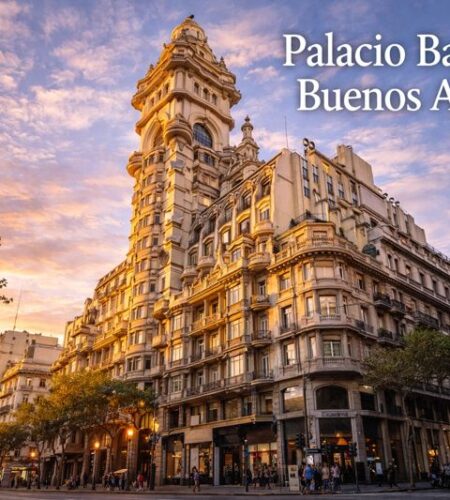
If you want one “wow” building that mixes Buenos Aires architecture + hidden symbolism + a real lighthouse viewpoint, put Palacio Barolo Buenos Aires on your list. Rising from Avenida de Mayo, this early-20th-century masterpiece was designed by Italian architect Mario Palanti and commissioned by businessman Luis Barolo, with the entire concept inspired by Dante’s Divine Comedy.
Why Palacio Barolo Buenos Aires is worth visiting ✅
1) It’s a “vertical story” inspired by Dante 📖
The building is famously structured around the idea of moving through Inferno → Purgatory → Paradise as you climb—an architectural narrative that becomes very clear on the guided visit.
2) The lighthouse viewpoint is the big finale 🔦🌆
At the top, you reach the glass dome area where the lighthouse (“Faro”) sits—roughly around 100 meters up, with sources describing the beacon point at about 103 m. This is the “money moment” for city views over Avenida de Mayo toward the historic core.
3) It’s officially protected heritage 🏛️
Palacio Barolo is officially listed as a Monumento Histórico Nacional under Decree 437/1997.
Palacio Barolo Buenos Aires: Quick facts (save this) 📌
| Detail | What to know |
|---|---|
| Address | Avenida de Mayo 1366/70/80 (commonly referenced as Av. de Mayo 1370) |
| Architect | Mario Palanti |
| Concept | Symbolism tied to Dante / Divine Comedy |
| Structure | Reinforced concrete “skyscraper” for its era |
| Lighthouse | Restored/put in value (noted in tour info) + powerful lamp mentioned by operator |
Visiting Palacio Barolo Buenos Aires: Tours and what you’ll actually do 🚶♂️🕯️
Guided tours are the standard way to visit
Buenos Aires’ official tourism site notes that a private operator runs guided tours, including access to the lighthouse viewpoint.
What the classic daytime tour includes (high level)
- Start in the lower “Inferno” section (passage/hall)
- Ride elevators up for major sections
- Continue upward toward terraces and tower viewpoints
- Finish with the top ascent to the lighthouse area (weather permitting)
Daytime tour schedule + duration ⏱️
Duration: about 1 hour 30 minutes.
Typical start times (as published):
- Mon / Wed / Thu / Fri: 10:00, 15:00, 18:00
- Saturday: 11:00, 12:00, 13:00, 14:00, 15:00, 16:00
- Sunday: 14:00, 16:00, 18:00
Night tour (what’s different) 🌙🍷
The official tour operator also promotes a night experience that emphasizes the city lights from the balconies/dome and includes an “end of tour” vibe (they describe wine + atmosphere).
Tickets / Prices for Palacio Barolo Buenos Aires 🎟️💳
The tour operator publishes pricing by category (amounts shown in ARS):
- General admission: $16,800 ARS
- Argentine residents (with DNI): $9,600 ARS
- Students & retirees (Argentine residents, with proof): $7,100 ARS
- Students & retirees (non-residents, with proof): $12,700 ARS
⚠️ Prices can change—use the official booking page as the source of truth when you’re ready to reserve.
How to get there (Palacio Barolo Buenos Aires) 🚇🚌🚖
By Subte (metro) 🚇
A very common, simple approach is:
- Take Line A and get off at Sáenz Peña (it’s directly associated with nearby landmarks including Palacio Barolo).
- Another nearby station often mentioned is Lima (also Line A).
By bus (colectivo) 🚌
Multiple bus routes run along/near Avenida de Mayo; practical route planning apps list many lines serving the area.
Paying for public transport: SUBE card 💳
Buenos Aires’ official tourism site advises that to travel by bus or Subte, you generally use a rechargeable SUBE travel card.
By taxi / ride-share 🚖
Fastest door-to-door option, especially if you’re short on time or traveling with kids. Use Av. de Mayo (Barolo) as the destination reference.
Tips & common mistakes (read this before you go) ✅⚠️
These are straight from how the tour operator runs the visit:
- Arrive early: they instruct visitors to show up about 15 minutes before with the reservation confirmation and any documents for discounts.
- Don’t be late: after the tour has started (they mention 10 minutes), you may not be allowed to join, and no refund.
- Expect stairs: they note you’ll go up 14 floors by elevator, and the last 8 floors are by stairs, through narrow areas. Wear good shoes.
- Bring water: they recommend hydration during the climb.
- Weather can change the ending: in heavy rain/electrical storms, the final ascent to the lighthouse can be suspended for safety.
- Language: the daytime tour is described as bilingual (Spanish–English).
FAQ (Palacio Barolo Buenos Aires)
Do I need a guided tour to go up?
Practically, yes—official city tourism points visitors to guided tours operated by a private provider, including lighthouse access.
How long does it take?
About 1h 30m for the standard daytime tour.
Is the tour difficult physically?
Plan for a climb: elevators help, but the upper section requires stairs and some narrow passages.
Can the lighthouse part be canceled?
Yes—safety/weather conditions can suspend access to the lighthouse level.
Is it a protected historic site?
Yes—listed as a Monumento Histórico Nacional under Decree 437/1997.
Conclusion
Palacio Barolo Buenos Aires is not just a pretty façade—it’s a full experience: a symbolic ascent through Dante’s universe, finished with one of the most memorable viewpoints in the historic center. Book a time slot, arrive early, wear comfortable shoes, and treat the lighthouse climb as the grand finale. 🔦🌆
Comments