
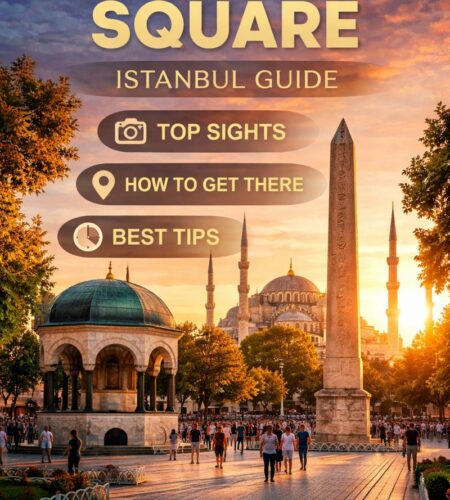
Sultanahmet Square is the historic “open-air museum” heart of Istanbul—the place where you can stand on the footprint of the ancient Hippodrome of Constantinople and, within minutes on foot, reach the city’s most iconic landmarks. The square is free, walkable, and packed with monuments you can enjoy without buying a ticket—perfect for a first day in the Old City.
Why Sultanahmet Square is worth your time ✅
Think of Sultanahmet Square as your “base camp” for the Historic Peninsula:
- 📍 You’re standing on real imperial history: the old chariot-racing stadium became today’s ceremonial square and park-like public space.
- 🏛️ Major monuments are literally in the square (not behind walls, not hidden): you can see them in one loop in 20–30 minutes.
- 🚇 It’s one of the easiest Old City areas to reach by public transit, thanks to the T1 tram stop named Sultanahmet.
Sultanahmet Square history in 90 seconds 🕰️
Sultanahmet Square covers the former Hippodrome—once a massive arena that could hold huge crowds and hosted spectacles like races, parades, and public events. Over centuries, the ceremonial square survived and became a calm public space lined with monuments that originally stood on the Hippodrome’s central spine.
What to see in Sultanahmet Square 📸
Below is a “no-ticket” checklist you can do on foot. Most of these are best photographed early morning or around sunset.
1) Obelisk of Theodosius 🗿
The towering Obelisk of Theodosius is one of the square’s headline monuments—originally Egyptian, later re-erected in the Roman era and set on a carved plinth.
Quick tip: walk around the base—details are easy to miss if you only shoot it from one side.
2) Serpent Column 🐍
The Serpent Column is a memorial monument with ancient origins and a dramatic story; it’s one of the oldest monuments in the city.
3) The “Brick/Walled” Obelisk 🧱
Often overlooked because it’s less “Instagrammable,” the brick obelisk is part of the Hippodrome’s layered timeline and helps you visualize the old arena line.
4) German Fountain ⛲
The ornate German Fountain sits at the entrance area of the square and is a well-known meeting point. It was officially opened in the early 1900s and is decorated with mosaics inside its dome.
Photo tip: step slightly back toward the gardens so you can frame the fountain cleanly.
Nearby highlights within easy walking distance 🚶♂️
Sultanahmet Square is famous because the “big names” are close enough to do without transport:
- Hagia Sophia
- Blue Mosque
- Topkapi Palace
- Basilica Cistern
- Grand Bazaar
(Each attraction has its own rules/hours—plan those separately. Sultanahmet Square is the “connector” that makes them easy to combine.)
How to get to Sultanahmet Square 🚇🚌🚕 (the practical part)
Best public-transport option: T1 tram (Sultanahmet stop) 🚋
If you’re coming from most tourist areas, the simplest plan is: get onto the T1 tram and exit at Sultanahmet—the stop is named exactly what you need. The T1 line’s stations list includes Sultanahmet, and it runs from morning until midnight.
T1 useful operational notes (official):
- Operational hours: 06:00–00:00
- High frequency during peak times (useful when you don’t want to wait long).
From Taksim: fastest “tourist classic” route 🚇➡️🚋
- Start at Taksim Square
- Take the Metro İstanbul F1 funicular to Kabataş (very short ride).
- Transfer to T1 tram toward the Old City and exit at Sultanahmet.
Why this works: it’s simple, mostly rail-based, and avoids traffic.
From the Asian side: ferry + tram (scenic + efficient) ⛴️🚋
If you’re staying around Kadıköy, a classic route is:
- Take a Şehir Hatları ferry to Eminönü or Karaköy. (Timetables are published on the operator’s site.)
- From Eminönü/Karaköy, hop on T1 and exit at Sultanahmet.
Bonus: this route gives you Bosphorus views without paying for a “tour.”
By taxi / ride-hail 🚕
- ✅ Good when you have luggage, bad weather, or late-night arrival after tram hours.
- ⚠️ Expect slow traffic in peak hours around the Historic Peninsula—rail can be faster.
✈️ Airport Connections to Sultanahmet Square
From Istanbul Airport (IST)
Most straightforward for visitors: use Havaist airport buses. The airport’s official transportation page points you to Havaist timetable information and notes Havaist operates multiple routes into the city.
On the Havaist site, you can run a route search (IST → your destination) and see live schedules; it also notes credit cards are accepted on buses.
Practical playbook:
- Take Havaist into the city to a central hub (choose by your hotel area).
- Continue by rail: aim to connect to T1 and exit at Sultanahmet.
From Sabiha Gökçen International Airport (SAW)
The airport’s official page states that HAVABUS shuttles connect SAW with major hubs—Kadıköy and Taksim—and explains where to find the buses.
Two easy onward routes:
- SAW → Taksim → (F1) Kabataş → T1 → Sultanahmet
- SAW → Kadıköy → ferry to Eminönü/Karaköy → T1 → Sultanahmet
Tickets, prices, and cards 💳
Istanbulkart basics
For almost all public transport, you’ll typically use an Istanbulkart or passes (available at stations and vending machines).
Official fare snapshot (Metro Istanbul):
- Anonymous (standard) fare shown as 35 ₺
- Electronic tickets (single/multi-pass) are listed (e.g., 1-pass, 2-pass, etc.)
Why this matters for Sultanahmet Square: you’ll most likely use T1 (and maybe F1), and both are part of the same integrated transit ecosystem.
Hours / operating times ⏱️
- Sultanahmet Square: open public space—visit anytime (early morning is best for photos and fewer crowds). The official tourism description frames it as today’s open square/park-like area built over the old track.
- T1 tram: 06:00–00:00
- F1 funicular (Taksim–Kabataş): 06:15–00:00
- Ferries: check the published timetables (they vary by pier/day).
Best route cheatsheet (quick table) 📋
| Start point | Best route to Sultanahmet Square | Notes |
|---|---|---|
| Taksim area | F1 → Kabataş → T1 → Sultanahmet | Simple + avoids traffic at peak hours |
| Kadıköy (Asian side) | Ferry → Eminönü/Karaköy → T1 → Sultanahmet | Scenic + practical |
| IST airport | Havaist → connect to T1 → Sultanahmet | Always check current route/timetable |
| SAW airport | HAVABUS → Taksim (then F1+T1) or Kadıköy (then ferry+T1) | Hubs are official: Kadıköy & Taksim |
Tips & common mistakes (save yourself time) ✅⚠️
- ✅ Do the square first, museums later. Use Sultanahmet Square as orientation: monuments → photos → then choose one major site nearby.
- ⚠️ Avoid peak tram crowding on T1 if you have luggage—go early or later in the evening. (T1 is a backbone line with heavy daily ridership.)
- ✅ Pick one “photo moment.” Best light is early morning; best atmosphere is after sunset when the area is lit.
- ⚠️ Don’t underestimate walking. Distances are short, but crowds and lines make everything feel longer.
- ✅ Use the German Fountain as a meetup point if you’re with friends (easy landmark).
FAQ
Is Sultanahmet Square free to visit?
Yes—Sultanahmet Square is a public square/park-like area.
What’s the #1 thing to see in Sultanahmet Square?
If you want one must-see: the Obelisk of Theodosius (iconic + central), then loop past the Serpent Column and German Fountain.
What tram stop should I use?
Use the T1 stop named Sultanahmet.
What time do the tram and funicular stop running?
T1 runs until 00:00 and F1 until 00:00 (official operating hours listed by the operator).
Can I come here at night?
Yes—the square is a public space and is a popular evening walking/photo spot.
Coming from the Asian side—ferry or not?
If you’re near Kadıköy, the ferry is both scenic and practical, with published timetables.
Conclusion
Sultanahmet Square is the easiest “first win” in Istanbul: it’s free, central, packed with history from the old Hippodrome, and perfectly positioned for a full day of landmarks. Start here to get your bearings, tick off the monuments, then branch out to nearby icons—using the T1 tram as your main transit backbone for the Historic Peninsula.
Comments