
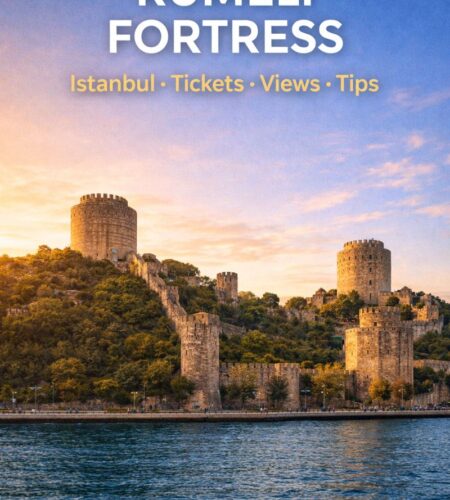
Rumeli Fortress Istanbul is one of the most dramatic viewpoints on the Bosphorus Strait: huge stone walls, three powerful towers, and the feeling that you’re standing exactly where history “clicked” into place before the conquest of Constantinople. Built in 1452 under Sultan Mehmed II, it was designed to control ship traffic at the narrowest part of the strait—today, you visit for the architecture, the climb, and the postcard-level panoramas.
Why Rumeli Fortress is worth visiting ✅
Most Istanbul attractions are “flat walking” (palaces, bazaars, squares). Rumeli Fortress is different:
- 🏰 Real fortress energy: steep stone stairways, towers, battlements, defensive angles.
- 🌊 Bosphorus views that feel unreal: you’re looking straight across the water toward the Asian side.
- 📸 One of the best photo backdrops in the city (especially late afternoon).
- 🧭 Less tourist-saturated than central Old City landmarks—still popular, but not the same constant crush.
If you like places that are both scenic and historically meaningful, this is a top-tier Istanbul stop.
Quick facts 📍 (save these)
- Address: Rumeli Hisarı, Yahya Kemal Cad. No:42, 34470 Sarıyer / Istanbul
- Closed day: Monday
- Ticket price: 6€
- Summer hours (1 Apr–31 Oct): 09:00–18:00
- Winter hours (31 Oct–1 Apr): 09:00–17:00
- Box office closes earlier: Summer 17:00 / Winter 16:00
A bit of history (in plain English) 🏛️
The fortress was built in 1452—in a very short build window—specifically to control and restrict Bosphorus traffic ahead of the conquest of Istanbul. After the conquest, it later served roles like a checkpoint and prison as its strategic “frontline” importance changed over time.
What makes the visit special is that the setting still does the “explaining” for you: once you see the narrow waterway and the fortress placement, the strategy becomes obvious.
What to see inside 🏰
Rumeli Fortress is mostly an open-air visit (no “museum galleries” vibe). The highlights are:
1) The towers and walls
- The famous three large towers are the fortress’ signature silhouette.
- Walking along the walls gives you shifting angles over the water and the city.
2) Bosphorus viewpoints 🌊
Even if you don’t climb every section, you’ll get multiple “stop and stare” view moments—this is one of the best places in Istanbul to feel the geography.
3) The courtyard / grounds
You’ll see historic elements displayed outdoors and enjoy a surprisingly green, breezy atmosphere in parts of the grounds.
⏱️ Time needed:
- Fast visit: 60–90 minutes
- Comfortable visit (photos + slow climbing): 2 hours
How to get there 🚇 🚌 🚖
Rumeli Fortress is on the European side, north of central tourist areas. The official visitor guidance gives you a few straightforward routes:
From Sultanahmet (Old City) — easiest “tourist-friendly” route 🚋➡️🚌
- Take T1 tram toward Kabataş.
- From Kabataş bus stops, take bus 22 or 25E to the Rumeli Hisarı stop.
From Taksim Square — quick transfer option 🚇➡️🚋➡️🚌
- Take the F1 funicular down to Kabataş.
- Then bus 22 or 25E to Rumeli Hisarı.
Alternative from Taksim: buses 40 / 40T / 42T also serve the Rumeli Hisarı stop (useful if you prefer a single ride).
From Levent — modern rail + funicular combo (nice and efficient) 🚇➡️🚠➡️🚶
You can use M6 metro plus the newer F4 funicular (Hisarüstü–Aşiyan) and then reach the fortress area from the Bosphorus coast side.
Taxi / ride-hailing 🚖
Good if you’re short on time, but the Bosphorus road can be slow. If it’s rush hour or weekend afternoon, public transport can be more predictable.
✈️ Airport connections
From Istanbul Airport (IST)
IST’s official transport info highlights the metro connection (via Gayrettepe link on the airport metro line). A practical plan is: IST → metro toward city connections → reach T1 to Kabataş → bus to Rumeli Hisarı.
From Sabiha Gökçen Airport (SAW)
Two solid options:
- M4 metro from SAW toward Kadıköy, then connect onward to the European side and use the Kabataş/bus route.
- HAVABUS shuttle directly to Taksim (easy), then you can do F1 → Kabataş → bus.
Hours and tickets ⏱️ 💳
Opening hours
- Summer (1 Apr–31 Oct): 09:00–18:00
- Winter (31 Oct–1 Apr): 09:00–17:00
- Closed: Monday
Ticket price
- 6€
Box office closing (important!)
- Summer: 17:00
- Winter: 16:00
✅ Real-life advice: aim to arrive at least 60–90 minutes before the box office closes so you’re not forced into a rushed “run through.”
Tips & common mistakes ✅ ⚠️
✅ Wear proper shoes.
This is a fortress with steep steps and uneven stone—fashion shoes will ruin your day.
✅ Bring water in summer.
The climb + sun can be deceptively intense.
✅ Best light for photos:
- Morning: cleaner, calmer
- Late afternoon: warmer “golden stone” look over the water
⚠️ Don’t arrive late.
People often show up near closing and discover the box office closes earlier than the site.
⚠️ Plan the route back.
After sunset, it’s easy to lose time waiting for buses—check your return plan before you climb.
✅ Pair it with a Bosphorus half-day
The official route notes you’ll pass scenic neighborhoods like Ortaköy, Kuruçeşme, Bebek, Arnavutköy on the way. That’s a hint: this area is made for a “fortress + waterfront stroll + café” kind of day.
FAQ
Is Rumeli Fortress good for kids?
Yes (especially for “castle energy”), but expect lots of stairs. Strollers are not practical inside.
How long does the visit take?
Most people spend 1–2 hours, longer if you’re photographing and climbing more sections.
What’s the easiest way from Sultanahmet?
T1 tram → Kabataş → bus 22 / 25E (very standard and clearly described in the official visitor guidance).
When is it closed?
Mondays.
Conclusion
Rumeli Fortress is one of the best “high impact” Istanbul experiences: big history, big views, and a physical climb that makes it feel like an adventure, not just another stop. Go earlier in the day, respect the early box-office closing, and treat it as part of a Bosphorus shoreline route—you’ll leave with some of your best Istanbul photos.
Comments