
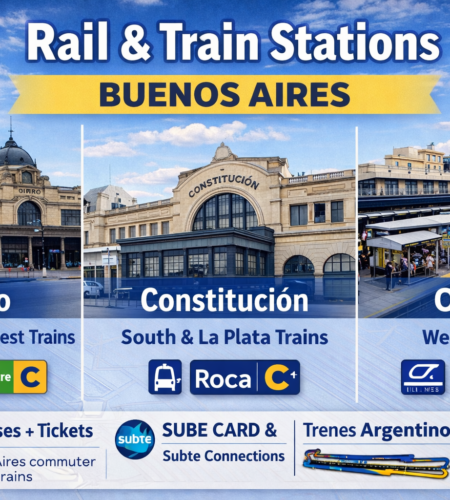
Buenos Aires has one of South America’s busiest commuter-rail networks, and three terminals do most of the heavy lifting: Retiro, Constitución, and Once. If you understand these hubs—what lines depart from each, how they connect to the Subte (metro), and where to buy tickets—you can move around the city (and the Greater Buenos Aires area) fast and cheaply. 🚆🧭
Below is a practical, passenger-first guide with verified addresses, key connections, and official sources for schedules and service changes.
Quick station cheat sheet (the 3 terminals)
| Terminal | Best for | Main rail lines | Fastest Subte connection |
|---|---|---|---|
| Retiro | North / northwest suburbs + transfers | Mitre, San Martín (+ nearby Belgrano Norte) | Line C (Retiro ⇄ Constitución) |
| Constitución | South suburbs + trips toward La Plata | Roca | Line C (Constitución ⇄ Retiro) |
| Once | West suburbs + some long-distance departures | Sarmiento | Line A (Plaza Miserere) + Line H (Once) |
(Details + exact addresses below.)
📍 Retiro Station (Retiro terminal complex)
Address (main access / meeting point)
Av. Dr. José María Ramos Mejía 1430, CABA (Retiro).
What you can do from Retiro
- Ride the Mitre Line (classic commuter routes like Retiro–Tigre and branches).
- Ride the San Martín Line (Retiro → western/northwestern suburbs).
- Connect nearby to Belgrano Norte services (also branded “Retiro” for that line in many passenger references). (Operator and details can vary by service; always confirm signage at the terminal.)
Subte connections from Retiro 🚇
- Subte Line C explicitly links the two big transfer centers Constitución and Retiro.
- Subte Line E also connects at/through Retiro and is designed for transfers there (including to rail at Retiro).
Practical tips at Retiro
- Retiro is huge: arrive early if you’re hunting a platform, especially at peak hours.
- Service patterns sometimes change due to works (example: Mitre branch services can run limited and not always reach Retiro during specific projects).
📍 Constitución Station (Estación Plaza Constitución)
Address
Av. Brasil 1110–1142 (corner Lima 1748–1790), CABA (official monument listing).
A commonly used passenger reference point is Av. Brasil 1128 (main hall area).
What you can do from Constitución
- Ride the Roca Line (the main gateway to the south side of the metro area; includes services like Constitución–La Plata, and multiple suburban branches).
Subte connections from Constitución 🚇
- Subte Line C is the direct metro spine between Constitución and Retiro—the quickest way to transfer between the two major rail terminals.
📍 Once Station (Estación Terminal Once de Septiembre)
Address
Official listing places it around Avenida Pueyrredón 90–110 and surrounding streets near Plaza Miserere, CABA.
What you can do from Once
- Ride the Sarmiento Line (Buenos Aires’ key westbound commuter corridor). (For planning, use the official Trenes Argentinos schedules/tools—see the ticketing section below.)
- Some long-distance services can depart from the Once area depending on route and current operations (always verify on the official long-distance pages).
Subte connections from Once 🚇
- The city explicitly notes that Line A (Plaza Miserere) connects with Line H (Once) and with the Sarmiento railway—this is one of the best rail↔metro transfer points in the whole network.
Other rail hubs worth knowing (if you’re building a “complete” map)
- Federico Lacroze (Chacarita area): important terminal for the Urquiza commuter railway and a major transit node in the city. (Often paired with Subte Line B at Federico Lacroze.)
- Belgrano Sur terminals: relevant for parts of the south/west metro area; Trenes Argentinos provides official line pages for planning.
If you want, I can turn these into a clean “Top 6 stations” section with exact addresses (only from official listings), like we did for bus terminals.
🎫 Tickets and how to pay (what tourists actually need)
1) Get a SUBE card (recommended)
SUBE is the official payment system used across Buenos Aires public transport—buses, trains, and the Subte.
Why it matters: it’s the standard way to pay without cash and it works across modes (useful for transfers).
2) Always check schedules on official pages
For commuter and regional services, Trenes Argentinos publishes official “Horarios, tarifas y recorridos” pages by line. Start here, then pick your line/route:
- Mitre
- San Martín
- Roca
- Belgrano Sur
- The main directory for schedules/fare info is also on the official portal.
3) First/last train planning ⏱️
If you’re catching an early flight or arriving late, Trenes Argentinos also publishes “first and last trains” guidance (useful for rough planning, then confirm your specific branch).
🚇 Transfers between train and Subte: the easiest patterns
- Retiro ⇄ Constitución: use Subte Line C (it’s literally described as connecting these two transfer centers).
- Once area ⇄ downtown: use Subte Line A (Plaza Miserere) and/or Line H (Once); the city describes this as a major rail connection point.
- Retiro transfers: Line E and Line C both integrate at Retiro (good for moving between rail, metro, and Microcentro).
✈️ Airport access from rail terminals (AEP & EZE)
Buenos Aires airports aren’t “rail-to-terminal” airports in the way some European cities are. Most travelers do:
- Airport ⇄ city by bus/shuttle/taxi/ride-hail
- Then connect to Subte + trains via Retiro / Constitución / Once depending on where you’re going.
If you tell me which airport (AEP or EZE) and your destination area (Palermo, Microcentro, La Plata, Tigre, etc.), I’ll give you the fastest route options and which terminal to target.
🧳 Long-distance trains from Buenos Aires (important warning)
Long-distance routes exist, but terminal stations and operations can change. Trenes Argentinos maintains:
- A long-distance service directory + route pages (e.g., Buenos Aires–Mar del Plata departs from the Constitución area).
- A dedicated page for service modifications/interruptions—this is critical because some routes may temporarily change terminal (example: the official updates note changes such as services operating from Colegiales for certain Rosario operations, and interruptions on some routes).
Rule of thumb: Check the “modifications” page the same day you plan to travel long-distance.
🛡️ Safety + “don’t get burned” tips in big terminals
Busy transport hubs attract petty crime in any major city. Official government travel advisories explicitly warn about theft/robberies around major Buenos Aires transport hubs (including Retiro/Once/Constitución areas).
Practical habits that help:
- Keep phone/wallet out of sight when you’re distracted (ticket lines, escalators).
- Wear backpacks in front in crowds; avoid leaving bags on the floor between your feet.
- Use only official ticket windows / machines and ignore “helpers” who approach you unsolicited.
FAQ
Which is the “main” train station in Buenos Aires?
There isn’t just one. Retiro, Constitución, and Once are the three main terminals, each serving different corridors (north, south, west).
What’s the fastest way between Retiro and Constitución?
Subte Line C is the direct connector between those two transfer hubs.
Do I need cash?
It’s strongly recommended to use SUBE, the official payment system for trains/subte/buses.
Where do I verify schedules?
Use official Trenes Argentinos “Horarios, tarifas y recorridos” by line.
Conclusion
If you remember one thing: match the terminal to your direction—Retiro (north), Constitución (south), Once (west)—and use the Subte for quick cross-city transfers (especially Line C between Retiro and Constitución). For anything time-sensitive (early flights, long-distance trains), rely on the official Trenes Argentinos schedules and service updates before you leave.
Comments