
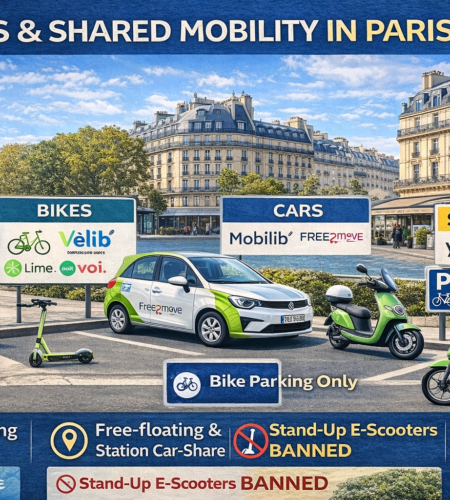
Rentals & shared mobility in Paris can save you serious time—especially when you’re bouncing between neighborhoods, train stations, and day trips outside the city. But Paris also has very specific rules about where you can park shared vehicles and what types of shared vehicles are even allowed. This guide explains the options that work in real life in 2026, plus the mistakes that cost visitors the most time (and sometimes fines).
Why rentals & shared mobility matter in Paris 🗺️
Paris is dense, walkable, and packed with transit—so you don’t need a private car for most trips. The smart move is combining:
- 🚇 Metro/RER for long cross-city jumps
- 🚲 Shared bikes for “last mile” and river-bank rides
- 🚗 Car-share for errands or leaving Paris for a few hours
- 🛵 Shared mopeds (seated scooters) when you want speed without the parking headache
The key is choosing the right tool for the right distance—and knowing what’s legal in Paris today.
Shared bikes: Vélib’ + dockless e-bikes 🚲
1) Vélib’ Métropole (the classic option)
Vélib’ is Paris’s official large bike-share network. It’s the simplest option because it’s integrated into city life and works well around major hubs (train stations, big squares, parks). The City of Paris points riders to the Vélib’ official site for the latest plans, tariffs, and payment methods.
Best for:
- sightseeing at a relaxed pace
- moving between nearby districts (10–25 minutes)
- commuting from a station to your hotel
Reality check: availability can spike around peak commute times and tourist hotspots—open the app and check the nearest docks before you walk there.
2) Dockless shared e-bikes (free-floating) — where the rules tightened
Since October 1, 2025, Paris has allowed three private operators to deploy stationless electric bikes (free-floating). Those operators are Dott, Lime, and Voi.
But the bigger change is parking:
✅ Dockless shared bikes are only allowed to park in designated bike parking spaces (specific reserved areas—some with hoops/stands, some without).
❌ Don’t park on sidewalks. Paris explicitly reminds riders not to ride or park on sidewalks and recommends sticking to dedicated cycling infrastructure.
Best for:
- fast one-way rides (no docking needed)
- late evenings when you want flexibility
- neighborhoods where Vélib’ docks are busy
Shared cars: 2 different systems (free-floating vs “return-to-base”) 🚗
Paris officially describes two major models for shared cars:
A) Free-floating car sharing (Point A → Point B)
This is “grab a car nearby and drop it off in the city” style. Paris cites Free2move as the example operator for this model, noting trips are often short and billed by the minute.
Free2move itself emphasizes there are no rental stations—cars are available 24/7 around the “home area,” unlocked in-app.
Best for:
- short city errands (bulky groceries, quick business trip)
- late-night rides when transit is slower
- avoiding taxi/VTC surge pricing windows
Not great for:
- driving inside central Paris all day (traffic + parking stress)
- tourists who aren’t comfortable with dense urban driving
B) Mobilib’ (loop car-sharing: return the car to its original station)
Mobilib’ is Paris’s “station-based” car-sharing program with reserved parking spaces. It’s explicitly described as autopartage en boucle—meaning you must return the vehicle to the same station you took it from.
The City of Paris lists Communauto and Getaround as Mobilib’ operators (each with their own commercial terms).
Best for:
- planned trips (pick up near your apartment/hotel, return later)
- leaving Paris for a half day / full day
- moving items (some fleets include utility vehicles depending on operator)
Shared scooters in Paris: what’s allowed vs banned 🛴🛵
Rental e-scooters (stand-up “trottinettes”) are gone in Paris
Paris ended rental stand-up e-scooters in the city after a public vote. The City of Paris states the public-space contracts ended and operators had until August 31, 2023 to remove the fleet (Dott, Lime, Tier).
So in 2026:
✅ You can still see private stand-up scooters (personally owned)
❌ But you should not expect rental stand-up scooters to be available on the streets of Paris
Shared mopeds (seated electric scooters) are still a thing
Don’t confuse mopeds (seated scooters) with stand-up e-scooters. Paris lists shared scooters “en trace directe” (free-floating style) and names Yego and Cooltra as operators.
Île-de-France Mobilités also publishes a 2026 list of labelled operators that includes multiple scooter/moped services (e.g., Cityscoot, Cooltra, Yego, Troopy), alongside car-sharing operators.
Best for:
- fast cross-town travel when you don’t want Metro transfers
- riders comfortable with two wheels + traffic rules
- avoiding parking drama (when the operator includes parking rules/coverage)
Safety note: mopeds are quicker and feel effortless—until you hit complex intersections. If you’re not confident, bikes are usually the safer “first step.”
How to get started: apps, onboarding, and the “2-minute setup trap” 📱
Most shared mobility in Paris is app-first:
- Download the operator app(s)
- Add a payment method
- Verify identity if required (often for cars/mopeds)
- Check the map for:
- service zone boundaries
- parking rules
- battery/fuel level (for electric fleets)
The trap: people wait until they’re already outside, rushing, with low signal—then spend 15 minutes on verification. Set up accounts before you need them (hotel Wi-Fi = your friend).
Hours & availability ⏰
- Shared bikes and free-floating vehicles generally operate 24/7 (availability depends on fleet and demand). Paris describes free-floating as stationless and user-initiated via the operator.
- Mobilib’ availability depends on station inventory and reservations.
Tickets, pricing & what it usually costs 💶
Pricing changes frequently (and can vary by promos, passes, and time of day), so the most accurate approach is:
- For Vélib’: Paris directs you to the official Vélib’ site for current tariffs and payment methods.
- For dockless e-bikes: pricing is “see each operator,” per the City of Paris.
- For free-floating car share: typically per-minute/per-hour options; Paris notes minute billing is common, and Free2move provides rate selections in-app.
Practical tips that save time (and avoid penalties) ✅
1) Follow parking rules like they’re traffic lights
Paris introduced clearer rules for dockless shared bikes: park only in the authorized spaces (not on sidewalks).
2) Use bikes for central Paris; use cars for leaving Paris
Inside Paris, cars can be slower than you expect. But for Versailles, Fontainebleau, Giverny, outlet runs, IKEA-style errands—car share or Mobilib’ becomes valuable.
3) Know the vocabulary
- Trottinette = stand-up scooter (rental fleets are banned)
- Scooter in many operator contexts = seated moped (still available via operators)
4) If you want the “official” operator snapshot, use IDFM’s labelled list
Île-de-France Mobilités publishes a 2026 list of labelled operators that covers several car-share and scooter/moped services.
FAQ ❓
Are rental stand-up e-scooters available in Paris in 2026?
No—Paris ended rental stand-up e-scooters after the 2023 consultation and removal deadline.
What shared mobility is easiest for tourists?
Vélib’ + Metro/RER is the easiest combo. For dockless e-bikes, remember parking must be in designated spaces.
What’s the difference between Mobilib’ and free-floating car share?
Mobilib’ is “loop” car sharing: pick up at a reserved station and return to the same place.
Free-floating is one-way in the service area (operator-dependent) and often billed by the minute.
Conclusion 🌟
If you treat Paris like a “mobility toolbox,” you’ll move faster and spend less: Vélib’ + Metro for most days, dockless e-bikes when you need flexibility (park correctly), car share or Mobilib’ when you’re leaving the city or hauling something, and shared mopeds when you want speed and you’re confident in traffic.
The only big “gotcha” in 2026: rental stand-up e-scooters are not part of Paris anymore—so plan around bikes and mopeds instead.
Comments