
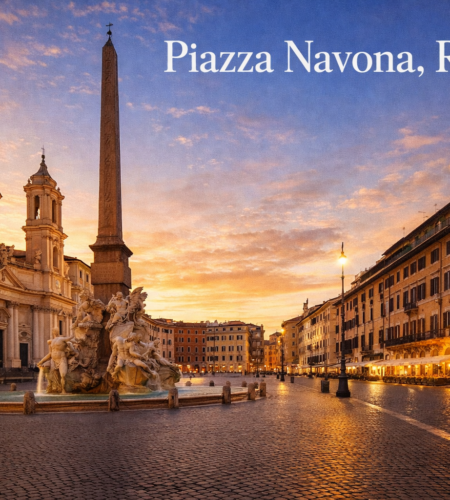
Piazza Navona is Rome’s most iconic Baroque “stage”: a long, elegant square lined with cafés, artists, and three major fountains, set inside a shape that isn’t accidental—it follows the footprint of the ancient Stadium of Domitian.
Piazza Navona at a glance ✅
| Item | Quick info |
|---|---|
| What it is 📍 | One of Rome’s signature Baroque squares, built on the Stadium of Domitian’s perimeter |
| Must-see highlights ⛲ | Fountain of the Four Rivers + Fountain of Neptune + Fountain of the Moor |
| Cost 💳 | Free to visit (public square) |
| Best time ⏱️ | Early morning for photos; evening for atmosphere |
| Nearby metro 🚇 | Spagna or Barberini (Line A) + short walk |
| Extra (paid) 🏛️ | Stadium of Domitian underground site (beneath the square) |
Why Piazza Navona is “stadium-shaped” (and why that matters) 🏟️
The square’s long oval form is the giveaway: Piazza Navona reproduces the perimeter of the ancient Stadium of Domitian, built around AD 86 for athletic competitions (and other spectacles).
Once you know this, Piazza Navona feels different: you’re not just standing in a pretty square—you’re standing inside an ancient venue’s outline, later transformed into a Baroque masterpiece.
What to see in Piazza Navona: the “three-fountain” walkthrough ⛲👀
Turismo Roma describes Piazza Navona as being adorned by three fountains—that’s your simplest route: north → center → south (or the reverse).
1) Fountain of Neptune (north end) 🐙
Often the quietest end for photos. Stand a bit back so you catch the fountain + the square’s long perspective.
2) Fountain of the Four Rivers (center) 🌍
This is the showstopper: Bernini’s Fountain of the Four Rivers, commissioned by Pope Innocent X Pamphilj, built 1648–1651, and designed as a powerful Baroque statement in the very heart of Piazza Navona.
Pro tip: Circle it slowly. The fountain is meant to be experienced “in the round”—different angles reveal different drama (water, rock, figures, and the vertical punch of the obelisk).
3) Fountain of the Moor (south end) 🧜♂️
A classic meeting point and usually full of life (street performers, artists, etc.). It’s also a good place to aim your camera toward the center—your shot will naturally include the square’s stadium-like curve.
The Obelisk in the middle: the vertical “anchor” 🗿
In the center, the Agonale Obelisk is part of the square’s theatrical composition. Turismo Roma notes it was erected again in the mid-17th century under Pope Innocent X, tying the monument to the same era that shaped Piazza Navona’s Baroque identity.
Piazza Navona Underground: Stadium of Domitian (worth it?) 🏛️⬇️
If you want the “wow, this is really a stadium” moment, go below street level.
What it is
The underground visit takes you into the remains of the Stadium of Domitian, located about 4.5 meters below today’s square.
What you’ll see (and why it’s cool)
- Ruins and structure of a Roman athletics stadium (rare for Rome)
- The real geometry behind Piazza Navona’s outline
- A more “archaeology-first” experience compared to the surface crowds
Entrance, hours, and tickets 🎟️
From the official site:
- Entrance: Via di Tor Sanguigna 3
- Typical timetable: open daily 10:00–19:00
- Normal Tour tickets: Full €9, Reduced €7, Junior €5, free up to 7
- Exclusive Tour tickets: Full €14, Reduced €12, Junior €10
- Seasonal note: the site states August openings may be limited to Sat/Sun (10–19), so always double-check before you go.
How to get to Piazza Navona 🚇🚌🚕🚶
Metro 🚇
There’s no metro stop on the square, but it’s an easy walk from Line A:
- Spagna or Barberini → walk to Piazza Navona
Bus / route planning 🚌
Routes and schedules change—ATAC recommends using its route planner and maps for the latest info.
Taxi 🚕
Fastest if you’re short on time or visiting at night. For drop-off, ask for the closest accessible street near Piazza Navona (since the area is heavily pedestrian and controlled).
Walk 🚶
Best option if you’re already central:
- From the Pantheon: very close (easy combo)
- From Campo de’ Fiori: also close (great evening pairing)
Hours / operating times ⏰
- Piazza Navona (the square): always accessible (public open space).
- Underground Stadium: ticketed hours (see above).
Tickets / prices 💳
- Piazza Navona: free.
- Stadium of Domitian underground: paid (from €9 standard adult on the official site).
Rules & common mistakes (don’t get fined) ⚠️
Rome enforces decorum rules around historic monuments and fountains. The City of Rome’s notices about the Urban Police Regulation explicitly mention sanctions for things like bathing in fountains, with fines typically in the €160–€450 range depending on severity.
Practical translation into behavior at Piazza Navona:
- ✅ Take photos, admire, enjoy
- ❌ Don’t climb, sit “inside” fountains, or put feet in the water
- ❌ Don’t treat fountain edges like a picnic seat when enforcement is present
Tips for the best Piazza Navona visit ✅
- Go early (before 9:00) for clean photos and a quieter vibe.
- Do a “three fountains” walk: Neptune → Four Rivers → Moor.
- Add the underground stadium if you want a deeper story and fewer crowds.
- Evening atmosphere: Piazza Navona is spectacular after dark—lights + performers + reflections.
FAQ ❓
Is Piazza Navona free to visit?
Yes—Piazza Navona is a public square (free). The underground Stadium of Domitian is ticketed.
Why is Piazza Navona shaped like a long oval?
Because it follows the perimeter of the Stadium of Domitian, built around AD 86.
How many fountains are in Piazza Navona?
Three major fountains, including Bernini’s central Fountain of the Four Rivers.
Which metro stop is best for Piazza Navona?
Spagna or Barberini (Line A), then walk.
Can I go into the underground stadium?
Yes—official info lists entrance at Via di Tor Sanguigna 3 with ticketed access.
Conclusion
Piazza Navona is one of those Rome places that rewards you twice: once for the surface beauty (fountains, façades, Baroque drama), and again when you realize the entire square is literally shaped by an ancient stadium beneath your feet. Combine an early-morning stroll with a quick underground visit, follow fountain rules, and you’ll get a “Rome at its best” experience in under two hours.
Comments