
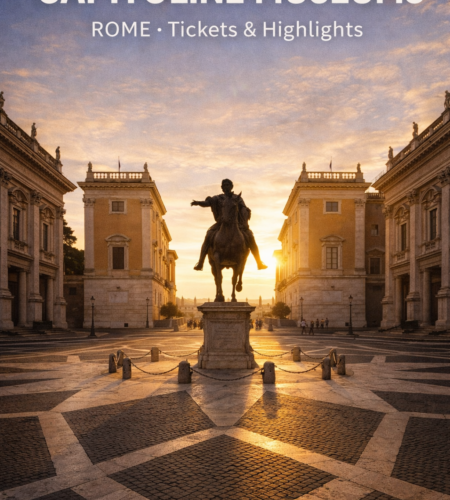
If you want one museum visit that feels like a masterclass in ancient Rome, the Capitoline Museums deliver—without the “maze fatigue” of bigger complexes. Set on Piazza del Campidoglio (Capitoline Hill), the museums combine iconic bronzes, Roman portraits, imperial fragments, and carefully curated halls that make it easy to understand how Rome presented itself to the world. Practical bonus: they’re open daily with clear last-admission rules and straightforward ticket options.
What are the Capitoline Museums, exactly? 🏛️
The Capitoline Museums are a group of collections housed in historic palaces on Capitoline Hill—most famously Palazzo dei Conservatori and Palazzo Nuovo—connected by galleries and organized by themes (major bronzes, portrait busts, key sculptures, and more).
This is a “high signal” museum: instead of endless rooms, you get a dense lineup of works that show Rome’s power, identity, and artistic taste across centuries.
Must-see highlights inside the Capitoline Museums ✅
Here’s a practical “don’t miss” list you can actually follow in 2–3 hours.
1) The Capitoline She-Wolf (Lupa Capitolina) 🐺
One of the most recognized symbols of Rome, the Capitoline She-Wolf is a bronze dated on the museum’s own record to the 5th century BC.
2) Equestrian Statue of Marcus Aurelius 🐎
The museum catalog lists the equestrian statue of Marcus Aurelius (bronze, 161–180 AD) and places it in the Marcus Aurelius Exedra, alongside other major Capitoline bronzes and the famous fragments of Constantine’s colossal bronze.
3) Colossal bronze fragments of Constantine 👑
You’ll see the head, hand, and globe fragments referenced directly in the Marcus Aurelius hall listing—massive pieces that make imperial propaganda feel very real.
4) Capitoline Venus (Venere Capitolina) 💎
The Capitoline Venus is cataloged as a marble sculpture “from an original by Praxiteles (4th century BC)” and is one of the museum’s star classical nudes.
5) The Capitoline Gaul / “Dying Gaul” (Galata) ⚔️
In Palazzo Nuovo, the museum describes the “Galata morente” as a notable and celebrated work, displayed at the center of its hall.
Quick “what to prioritize” table 📌
| If you love… | Go first to… | Don’t miss… |
|---|---|---|
| Ancient bronzes | Palazzo dei Conservatori | She-Wolf + Marcus Aurelius hall |
| Classical sculpture | Palazzo Nuovo | Capitoline Venus + Galata hall |
| Big “wow scale” moments | Marcus Aurelius Exedra | Constantine fragments |
How to get there 🚇🚌🚶♂️
Address: Piazza del Campidoglio, 1 (Rome).
🚇 By metro
- The closest metro station commonly used is Colosseo (Line B), then you walk (roughly 10–15 minutes) up toward Piazza Venezia and the Capitoline Hill area.
🚌 By bus
- Aim for stops around Piazza Venezia / Ara Coeli and walk up to the square.
🗺️ Planning tip
Use ATAC’s official maps (city centre + metro/rail) when you’re stitching together routes from Termini/Trastevere/Vatican areas.
Opening hours ⏱️
From the museum’s official practical information page:
- Every day: 09:30–19:30
- Last admission: 1 hour before closing
- Dec 24 & Dec 31: 09:30–14:00
- Jan 1, 2026: 11:00–20:00
- Closed: May 1 and Dec 25
✅ Tip: If you arrive after ~18:30, you may be too late (because last admission is one hour before closing).
Tickets & prices 💳
The official “Tickets and videoguides” page provides the standard (no exhibition) rates and how presale works.
Ordinary admission (no exhibitions)
Same-day purchase at ticket office (no presale fee):
- Adults: €15.00
- Concessions: €9.50
- Free admission for Rome + Metropolitan City residents (with valid proof)
- Free admission with MIC Card
Pre-purchase (online / call center / ticket office for later days): presale fee €1.
Capitoline Card (bundle)
A Capitolini Card (valid 7 days) is listed as including Musei Capitolini + Centrale Montemartini, with prices shown on the same page.
- Adults: €15.50
- Concessions: €11.50
Free admission rules (very important) ✅
The museum’s official concessions page states:
- Free for everyone on the first Sunday of each month (special ticket issued)
- Starting from February 2026: free for residents in Rome + the Metropolitan City (with ID/proof)
A simple itinerary (so you don’t waste time) 🧭
Option A: 2 hours (fast, iconic)
- Marcus Aurelius Exedra → Marcus Aurelius + Constantine fragments
- Capitoline She-Wolf
- Cross to Palazzo Nuovo → Capitoline Venus
Option B: 3–4 hours (the “proper” visit)
- Do Option A + add the Galata hall and slow down in the portrait/statue rooms in between.
Tips & common mistakes ✅⚠️
✅ Do this
- Arrive before 17:30–18:00 so you’re not squeezed by last admission rules.
- If you qualify for free/resident admission, bring proof—the rules explicitly require it.
- If there’s a temporary exhibition, check whether it changes ticket structure (the ticket page notes integrations may apply if exhibitions aren’t included at time of purchase).
⚠️ Avoid this
- Planning the museums as a “quick add-on” after 18:00—last admission is one hour before closing.
- Assuming “resident free entry” applies without documents—official rules say proof is required.
FAQ ❓
Are the Capitoline Museums open every day?
Yes—official hours list “Everyday 9.30–19.30,” with specific holiday exceptions and closures.
What time is last entry?
Last admission is one hour before closing.
How much is a standard ticket (no exhibition)?
Official “ordinary admission” lists €15.00 adult and €9.50 concessions for “Only Musei Capitolini.”
Is it free on any day?
The official concessions page states free for everyone on the first Sunday of each month (special ticket issued).
Is it free for Rome residents?
Yes—official pages state that starting February 2026, admission is free for Rome and Metropolitan City residents with valid ID/proof.
Conclusion
The Capitoline Museums are one of Rome’s best “high-impact” museum choices: you get signature bronzes (She-Wolf, Marcus Aurelius), monumental imperial fragments (Constantine), and classical sculpture highlights (Capitoline Venus, Galata) in a setting that’s historic and easy to navigate. Just time your arrival around the last-admission rule, and check ticket conditions if you’re visiting on a free Sunday or using resident/MIC benefits.
Comments