
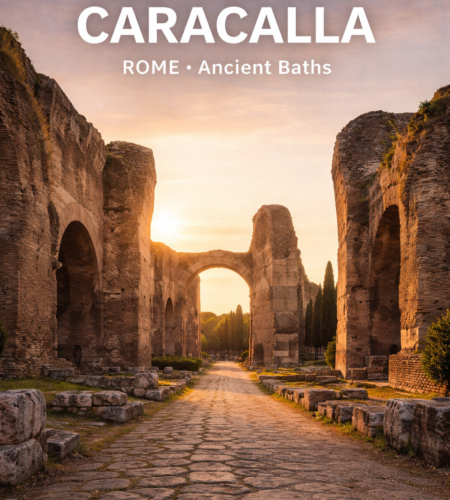
The Baths of Caracalla are one of the most impressive “scale” sights in Rome: massive walls, soaring arches, and a layout that still makes it easy to imagine how an imperial mega-spa actually worked. Built on the initiative of Emperor Caracalla and inaugurated in 216 AD, the complex wasn’t just for bathing—it was a social, athletic, and cultural hub with libraries, promenades, and vast technical underground corridors powering the whole machine.
Below is a practical, visitor-first guide: what’s worth seeing, how to get there, the real seasonal hours, ticket rules, and the common mistakes that waste time.
What makes the Baths of Caracalla special ✅
It’s a “city within a building”
Official descriptions emphasize the classic plan of the great imperial baths: a huge rectangular enclosure around a central block—not only for bathing and sports, but also for walking and study.
You can still read the blueprint of Roman engineering
The main axis sequence (hot → warm → cold → open-air swim) is still legible on site: calidarium, tepidarium, frigidarium, and the natatio (the open-air swimming area).
The underground is the “secret sauce”
The Soprintendenza (official site authority) calls the underground the operational heart of the complex—kilometers of service galleries with heating furnaces/boilers, water systems, a mill, and the Mithraeum (one of the largest preserved in Rome).
What to see inside the Baths of Caracalla 📍
1) The central halls (for the wow factor)
Even if you’re not an archaeology person, prioritize the largest surviving spaces—this is where the height and geometry hit you first. The ruins reach dramatic heights in places (the site is built for “big-room” moments).
2) The natatio zone (open-air space)
Look for the open-air “pool” area conceptually (even if it’s not filled today). It’s the easiest way to understand how the complex mixed indoor thermal rooms with a huge outdoor element.
3) The “two libraries” idea (history detail that changes how you see it)
The official description notes two symmetrical libraries within the outer enclosure—one more reminder these baths were a complete leisure complex, not just a place to wash.
4) Underground & Mithraeum (if open/accessible during your visit)
If the underground route is available when you visit, take it. The site explicitly highlights the underground galleries and the Mithraeum as integral parts of the complex.
How to get there 🚇🚌🚋
Address: Viale delle Terme di Caracalla, 52 (Rome).
Metro (best overall)
- Metro B: Circo Massimo stop.
- Metro C: Porta Metronia stop.
Tram
- Tram 3: stop Circo Massimo.
Bus
The official site lists these lines toward Circo Massimo:
- Bus 760
- Bus 75
- Bus 628
Practical route idea: If you’re already near the Colosseum/Circo Massimo area, this is a very easy “add-on” stop with minimal transit overhead.
Opening hours (seasonal) ⏱️
The Baths of Caracalla follow seasonal schedules (this matters a lot in winter). The official calendar lists Monday closed and different closing times by period.
Seasonal hours table (official)
| Period | Days | Hours | Last entry / ticket office |
|---|---|---|---|
| 26 Oct – 28 Feb | Tue–Sun | 9:00–16:30 | Last entry & ticket office close 15:30 |
| 1 Mar – 28 Mar | Tue–Sun | 9:00–17:30 | Last entry & ticket office close 16:30 |
| 29 Mar – 31 Aug | Tue–Sun | 9:00–19:15 | Last entry & ticket office close 18:00 |
| 1 Sep – 30 Sep | Tue–Sun | 9:00–19:00 | Last entry & ticket office close 18:00 |
| 1 Oct – 25 Oct | Tue–Sun | 9:00–18:30 | Last entry & ticket office close 17:30 |
Monday: closed (standard schedule).
Also note: the ticket point closes one hour before the site closing time.
Tickets & prices 💳
The Ministry of Culture page lists the current base pricing and how ticketing works:
- Full price: €8
- Reduced: €2 (18–25)
- Free: under 18, ICOM members, and other legal categories
- Temporary exhibition supplement: €5 (when applicable)
Where to buy (official)
From 1 May 2024, ticketing is managed via the Musei Italiani portal/app, and tickets can also be purchased at on-site totems (card payments).
Key convenience: if you buy online, you can keep the ticket on your phone and show it at entry (no printing required).
Tips & common mistakes ✅⚠️
✅ Do this (better experience)
- Go early in summer: the ruins are exposed and shade is limited; mornings feel much more comfortable.
- Use the seasonal schedule before you plan your day: winter closes much earlier than people expect.
- Pay attention to the “last entry” time, not just closing time—especially in winter (15:30 last entry in the Oct–Feb period).
- Bring a plastic refillable bottle (avoid glass): the official rules note that glass bottles (and dangerous objects) are not allowed inside.
⚠️ Avoid this
- Arriving late and assuming you can “speed-run” the site: if you enter close to last entry, the visit becomes rushed and the place won’t land.
- Skipping the underground option (if available on your day): it’s one of the most distinctive parts of the complex and explains how it functioned.
- Over-planning in winter: the short daylight/closing window makes “Caracalla + 3 more big stops” unrealistic unless you start early.
A simple visiting plan (choose by time) 🧭
Option A: 60–90 minutes (classic highlights)
- Walk the central axis: identify the sequence of rooms (hot → warm → cold → natatio concept).
- Pause for “scale” photos in the big halls.
- Do a loop around the perimeter to understand the outer enclosure concept.
Option B: 2–3 hours (the “I want the full story” route)
- Option A, slower pace.
- Add the underground segment (if open).
- Spend time reading the site layout and imagining the libraries/promenade functions.
FAQ ❓
Are the Baths of Caracalla open on Mondays?
No—official schedules list Monday closed in the seasonal calendars and weekly hours.
What’s the price of a standard ticket?
The Ministry of Culture page lists €8 full and €2 reduced (18–25), with free categories defined by regulation.
Do I need to print my ticket?
No—official info states mobile tickets can be saved on your phone and shown at the entrance.
Why did the baths stop functioning in antiquity?
The official Soprintendenza history notes the system ceased in 537 AD, when aqueducts were cut during the Gothic War siege of Rome.
Which metro stops are closest?
Official directions list Metro B (Circo Massimo) and Metro C (Porta Metronia).
Conclusion
The Baths of Caracalla are one of Rome’s best “ruins you can actually understand” sites: a readable imperial blueprint, epic scale, and (when available) underground corridors that reveal the engineering behind the luxury. Plan around the seasonal hours, arrive before last entry, and treat it as a slow walk through Roman infrastructure—not just a photo stop.
Comments