
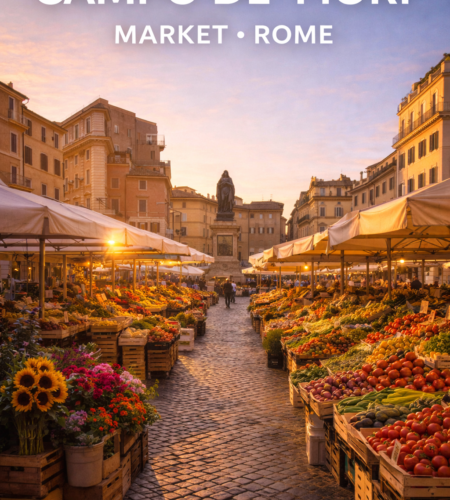
The Campo de’ Fiori Market is Rome at its most everyday and most theatrical: a working morning market set in a historic square that later transforms into one of the city’s liveliest evening hangouts. The market tradition here dates back to the 19th century (it moved from Piazza Navona to Campo de’ Fiori in 1869) and it still runs every morning Monday to Saturday.
Why Campo de’ Fiori Market is worth it ✅
1) It’s a real neighborhood market… in a postcard location
You’re shopping in a Renaissance-era piazza that’s also loaded with stories: the square once had Giacomo Della Porta’s “Terrina” fountain basin (built in 1590) and later made room for the monument to Giordano Bruno.
2) It’s easy to combine with a “Heart of Rome” walk
Campo de’ Fiori is a quick walk from places like Piazza Navona / Pantheon area, making it a practical stop in the middle of a sightseeing day.
3) The vibe changes completely after dark ⚠️
In the morning: produce, flowers, shoppers. In the evening: bars, crowds, noise (fun if you want it; avoid if you don’t).
Campo de’ Fiori Market hours ⏱️
Typical market hours: Mon–Sat, 7:00–14:00 (morning only).
Sunday: no market (the square still “works” as a piazza, just without stalls).
Timing tip ✅: Go early (around 8:00–10:00) for the fullest selection. Expect stalls to start packing up well before closing time.
Quick planning cheat sheet 📌
| When to go | What you’ll get | Best for |
|---|---|---|
| 7:00–9:00 | Freshest produce, calmest vibe | Photos + “local” feeling ✅ |
| 9:00–11:00 | Peak market energy | Shopping + people-watching 👀 |
| 11:00–13:30 | More crowded, some items selling out | Snacks + quick browse 🍓 |
| Evening | Bars + nightlife scene | Aperitivo / nightlife (loud) 🍸 |
What to buy at Campo de’ Fiori Market 🥬🧀🌶️
Think “edible souvenirs + picnic supplies,” but shop smart:
Fresh produce & seasonal fruit 🍅🍊
Best if you’re staying somewhere with a kitchen (or just want fruit for the day).
Flowers (it’s literally “Field of Flowers”) 🌸
Some stalls lean into the name; mornings are the time.
Pantry-style souvenirs (choose carefully) 🫙
You’ll see spices, dried peppers, truffle products, pasta, etc. Some are great—some are tourist-priced. Use the “tips” section below so you don’t overpay.
The real pro move: build a mini picnic 🥖🧀
Buy fruit + a few snacks, then walk toward the Tiber or nearby piazzas for a DIY break.
How to get to Campo de’ Fiori Market 🚶♂️🚌🚋
Campo de’ Fiori is central, but there’s no metro station right on the square. Most people arrive by walking + bus/tram.
Walk (often the best option) ✅
If you’re already in the historic center, walking is easiest and avoids traffic.
Bus (common option from Termini / major hubs) 🚌
A very common approach is taking buses that stop along Corso Vittorio Emanuele II (then walking a few minutes). For example, Rome’s well-known bus 64 corridor includes stops like Argentina and Chiesa Nuova (both are walkable to Campo de’ Fiori).
Tip ⚠️: Bus routes and stops can shift for events/works—double-check on the day.
Tram 8 to Largo Argentina area, then walk 🚋
Tram 8 is often used to reach the Largo Argentina zone (a convenient walking base for Campo de’ Fiori). However, service can be replaced by buses during maintenance periods—ATAC publishes service-change updates, so it’s worth checking if you’re visiting around works.
The Giordano Bruno statue (and why it matters) 🗿
In the center of Campo de’ Fiori you’ll see the monument to Giordano Bruno—and the square is historically linked to his execution. Tourism Rome notes the square’s fountain basin was removed to make room for the statue.
For context, Bruno was burned at the stake in Rome in 1600, and accounts place this at Campo de’ Fiori.
You don’t need a deep history lecture to feel it: it’s one of those Rome moments where “daily life” and “heavy history” share the same cobblestones.
Tips and common mistakes ✅⚠️
✅ Do this
- Go early (seriously): the market is a morning thing, and the best stuff is earlier.
- Ask prices first (especially for packaged goods): don’t assume everything is “local bargain.”
- Bring a tote bag: you’ll buy more than you planned.
- Have small cash: not every stall is equally card-friendly.
⚠️ Avoid this
- Arriving at 13:30 expecting a full market: you’ll catch pack-up mode.
- Buying “souvenir spices” without checking weight/price: some stalls are aimed squarely at tourists.
- Treating it like a nightlife-only square if you want calm: evenings can be loud and crowded.
Mini itineraries that pair perfectly with Campo de’ Fiori Market 🧭
Option A (90 minutes): Market + espresso + one landmark
- Campo de’ Fiori Market (30–45 min)
- Coffee nearby
- Walk toward Piazza Navona / Pantheon area
Option B (Half-day): Market + “old center stroll”
- Market (early)
- Largo Argentina area
- Piazza Navona → Pantheon loop
Option C (Foodie morning): Market + bakery slice
Use Campo de’ Fiori as the anchor for a “Rome snack crawl,” then continue to nearby bakeries/food spots.
FAQ ❓
Is Campo de’ Fiori Market open on Sunday?
No—Campo de’ Fiori’s market is traditionally Monday to Saturday mornings.
What time does Campo de’ Fiori Market open and close?
A commonly listed schedule is 7:00–14:00 (Mon–Sat).
Is it worth visiting if I’m not cooking?
Yes—go for atmosphere, photos, and a simple “fruit + snack” buy.
Is Campo de’ Fiori safe?
Generally yes in the morning like most central Rome areas, but use standard big-city awareness—especially in crowds.
Conclusion
Campo de’ Fiori Market is one of the easiest “Rome wins”: it’s central, vivid, and doesn’t require tickets or planning stress. Go early, shop with your eyes open (some stalls are tourist-priced), and treat it as a living slice of the city—set in a square where everyday commerce and heavyweight history share the same space.
Comments