
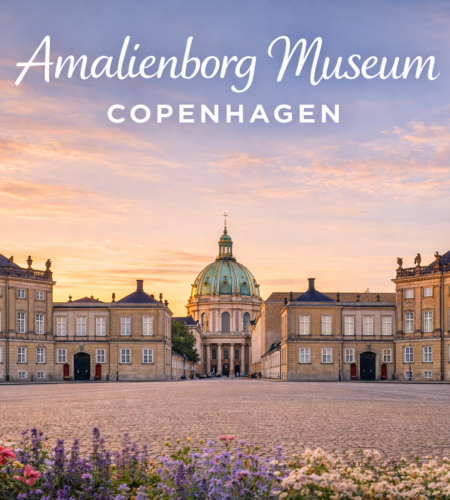
Amalienborg Museum Copenhagen is the place to step inside Denmark’s living monarchy—set in Christian VIII’s Palace at Amalienborg, one of the four palaces where the Royal Family stays when in Copenhagen.
It’s best known for its royal private interiors (last ~150 years), the Gala Hall (Piano Nobile) still used for special occasions, and standout treasures like the Fabergé Chamber.
What Amalienborg Museum Copenhagen actually is 🏰👑
Amalienborg isn’t just “a palace you look at from the square.” It’s a working royal residence, and the museum is your curated entry point into royal life—past and present—inside Christian VIII’s Palace.
A smart way to think about the experience:
- Outside: Amalienborg Palace Square + Changing of the Guard
- Inside: Royal rooms, stories, objects, and high-level craftsmanship you won’t get from the square alone ✅
What to see inside (don’t miss these) 👀✨
The Gala Hall / Piano Nobile 🏛️
This is the “wow” moment—grand, formal, and photogenic. It’s not a recreated set; it’s a ceremonial space the Royal Family still uses on special occasions.
Royal private interiors (the human side of royalty) 🖼️🧾
The museum walk-through is designed to feel personal: studies, drawing rooms, and living spaces that connect major Danish history to real people behind the crown.
The Fabergé Chamber 🥂💎
If you like imperial-level luxury objects, prioritize this section. The museum highlights pieces like a lavish Fabergé champagne cooler gifted to Christian IX and Queen Louise for their golden wedding anniversary (1892), plus other rare decorative objects.
The best way to visit (a practical mini-itinerary) ⏱️✅
The “perfect timing” plan
- Arrive for the Changing of the Guard at Amalienborg
- Go straight into the museum while your “royal mood” is still fresh
This combo makes the visit feel like one connected story—not two separate stops.
Changing of the Guard (what to expect) 🎺🪖
There is a daily changing of the guard at Amalienborg.
If the King’s Guard is established (when the King resides at Frederik VIII’s Palace), the parade departs the Life Guard’s Barracks at 11:27, and you’ll hear music on the square around 12:00.
Tourist-facing guidance also emphasizes that the ceremony happens at 12:00 noon outside Amalienborg.
Tickets and prices 💳
You typically save money buying online (and it can reduce waiting).
Also note: last ticket is sold 30 minutes before closing.
| Ticket type | Price (online) | Price (at door) |
|---|---|---|
| Adult | 125 DKK | 135 DKK |
| Student (valid ID) | 80 DKK | 90 DKK |
| Groups (10+) | — | 116 DKK per person |
| Under 18 | Free | Free |
Copenhagen Card 🎫
The museum accepts Copenhagen Card, but you can’t book entrance time slots online with it—bring the app and request your free ticket at the museum shop/ticket point.
Opening hours / operating times ⏱️
Standard weekly hours are:
- Mon–Fri: 10:00–15:00
- Sat–Sun: 10:00–16:00
From 1 November, Monday is closed, and Tue–Sun follow the same pattern.
There are also special holiday hours (e.g., autumn and Christmas periods), so always double-check the “opening hours this week” before you go.
How to get there 🚇🚶♂️📍
Address / entrance
The museum is in Christian VIII’s Palace at Amalienborg; the entrance is through the gate nearest Frederiksgade.
Metro (easiest) 🚇
The museum’s own visitor info says the nearest Metro station is Marmorkirken (Marble Church).
Official Metro info confirms Marmorkirken station is served by M3 and M4, and lists Amalienborg-area attractions within a short walk.
Walking ✅
If you’re already in central Copenhagen (Nyhavn / Kongens Nytorv area), walking is often faster than waiting for transport—and the architecture in Frederiksstaden is part of the experience.
Parking / drop-off 🚗⚠️
There are no parking facilities at the museum.
Vehicles are not allowed on Amalienborg Palace Square, so drop-off/pick-up happens at Frederiksgade about 50 meters from the entrance.
Practical tips and common mistakes ✅⚠️
Bags & lockers (strict—plan for it) 👜
- Only very small handbags are allowed inside; bags must be worn in front.
- Larger bags/rucksacks go in free lockers.
- No space for suitcases/large luggage.
Food & drink 🚫🥤
No eating or drinking inside the museum.
Photography rules 📸
Handheld photography is allowed; no tripods/monopods.
Strollers / prams 👶
Prams and buggies aren’t allowed inside (you can leave them in the cloakroom area).
Accessibility ♿
Unlike many historic palaces, the museum is set up so wheelchair users and visitors with limited mobility can access every part of the museum using lifts (platform + conventional).
There’s also a wheelchair available to borrow (book in advance).
Guided tours (worth it if you like context) 🎧
A public guided tour example listed by the museum runs about 60 minutes and costs Admission + 30 DKK, in English.
If you want a private guided tour, the museum lists 995 DKK + admission per person.
FAQ ❓
Is Amalienborg Museum Copenhagen inside the real royal residence?
Yes—it’s located in Christian VIII’s Palace, one of the palaces used by the Royal Family when they’re in Copenhagen.
What’s the easiest metro stop?
Marmorkirken is the nearest Metro station according to the museum and Metro operator info.
Can I see the Changing of the Guard daily?
Yes—there is a daily changing of the guard at Amalienborg; the main ceremony is around 12:00.
Can I bring a backpack?
Plan to store it—only very small handbags are allowed inside; lockers are available for larger items.
Conclusion
If you want a royal experience that’s actually practical (not just “pretty buildings”), Amalienborg Museum Copenhagen delivers: watch the guard ceremony, then go inside to see how Danish monarchy has lived, worked, and represented itself—right in the heart of the real royal residence.
Comments