
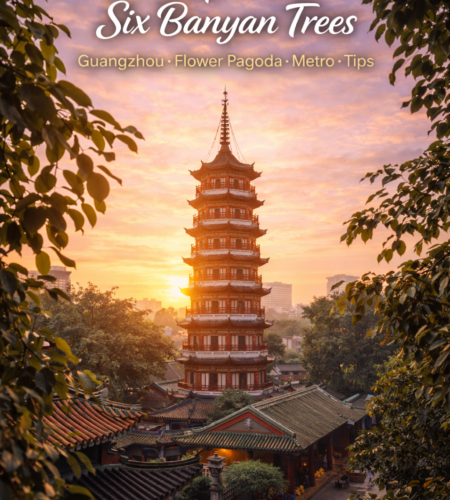
Temple of the Six Banyan Trees (Liurong Temple / 六榕寺) is one of the best “classic Guangzhou” stops if you want a peaceful Buddhist temple experience right in the city center—with its most famous landmark, the Flower Pagoda, rising above the rooftops. It’s a compact visit (often ~1 hour), easy to reach by metro, and very photogenic thanks to the pagoda’s layered octagonal silhouette and the temple’s quiet courtyards.
Below is a practical guide: what to see, how to get there, realistic timing, and the common mistakes that make people miss the best parts.
Temple of the Six Banyan Trees at a glance 📍⏱️💳
| What you need | Practical answer |
|---|---|
| Name | Temple of the Six Banyan Trees / Liurong Temple (六榕寺) |
| Address (commonly listed) | No. 87 Liurong Road, Yuexiu District (use “六榕寺” in maps) |
| Opening hours (typical) | Often listed around 08:00–16:30/17:00 (varies by source; confirm onsite) |
| Nearest metro | Gongyuanqian Station (Metro Line 1 or Line 2), then short walk |
| Time needed | ~1 hour (quick) or 1–2 hours (slow + photos) |
| Ticket | Sources disagree (free vs small fee). Plan for a small admission fee and/or pagoda add-on, and verify at the entrance. |
Why it’s worth visiting ✅
1) The Flower Pagoda is the star 🏯
The temple’s iconic pagoda (often called the Flower Pagoda) is what most visitors come to see—an instantly recognizable Guangzhou silhouette.
2) It’s a calm “reset” in the middle of the city 🌿
Even though it’s central, the temple grounds feel quieter than nearby shopping streets—perfect between busier stops like Beijing Road, Yuexiu Park, or Zhujiang New Town.
3) Easy logistics (metro + short visit) 🚇
This is one of the simplest heritage sights to add to a Guangzhou itinerary: quick metro ride + walk + 60–90 minutes inside.
What to see inside (simple route) 🗺️✅
You don’t need a complicated plan. Just follow this order:
1) Main gate + first courtyard 📍
Start slow and look up—temple details are often above eye level (eaves, carvings, roofline decorations). If it’s crowded, take your wide shots immediately before tour groups fill the courtyard.
2) Main halls (quiet, respectful pace) 🙏
Move through the central axis and treat the halls like living religious spaces, not just “photo rooms.” Keep voices low; don’t push for the perfect angle during worship moments.
3) Flower Pagoda viewpoints 📸
The best photos usually come from:
- low-angle shots that emphasize the pagoda’s height
- frames that include trees/rooflines for depth
- a “courtyard-to-pagoda” composition (leading lines)
4) Details pass (the “secret sauce”) 🔎
Before you leave, do a 10-minute loop focused on small things:
- incense burners
- stonework
- door patterns
- lanterns and calligraphy plaques
This is where your photos start looking “editorial,” not touristy.
How to get there 🚇🚌🚕🚶
By metro (best option) 🚇✅
Many guides route you via Gongyuanqian Station on Guangzhou Metro Line 1 or Line 2, then a short walk to the temple.
Practical tip: save the Chinese name 六榕寺 and the road name 六榕路 in your phone for map accuracy.
By taxi / ride-hailing 🚕
Use the destination name in Chinese:
- 六榕寺 (Liurong Temple)
and/or the commonly listed address No. 87 Liurong Road.
By bus 🚌
Bus lines can change over time, so treat route numbers as “likely,” and rely on a live map app. Some travel references list nearby stops on/near Liurong Road.
Hours / operating times ⏱️
Different sources list slightly different windows, but the pattern is consistent: morning opening and late-afternoon last entry.
- One reference lists 08:00–16:30.
- Others list ~08:00/08:30 to 17:00 with last admission earlier.
✅ Best practice: arrive before 15:30–16:00 so you’re not rushed.
Tickets / prices 💳
This is the only part that can be confusing because sources conflict:
- Some guides state free entry.
- Others list a small ticket price (e.g., a modest entrance fee and sometimes a separate fee for the pagoda).
What to do in real life:
Plan to pay a small amount (cashless/QR often works), and simply follow the signage at the entrance. If your goal is the pagoda, ask specifically whether it’s included in the base entry.
Best time to visit 📷🌤️
✅ Early morning
- fewer people
- softer light
- quieter atmosphere
✅ Late afternoon (not too late)
- warm light for pagoda photos
- but watch last-entry timing
⚠️ Midday on weekends
- can feel crowded
- harder to get clean pagoda shots
Tips & common mistakes ✅⚠️
✅ Shoot the pagoda from multiple distances
Most people only take one close shot. Do:
- close (details)
- medium (pagoda + temple roofline)
- wide (pagoda + trees/sky)
✅ Bring respectful “temple behavior”
Quiet voice, no flash in sensitive areas, don’t block worshippers.
⚠️ Don’t arrive late afternoon and assume you’ll have time
Even if closing is ~17:00, last entry may be earlier.
⚠️ Don’t rely on one source for ticket rules
Because “free vs small fee” differs by reference, treat the entrance signage as final.
✅ Use Gongyuanqian as your navigation anchor
It’s the most consistently recommended metro access point.
FAQ ❓
What’s the nearest metro station?
Most guides recommend Gongyuanqian Station (Line 1 or Line 2) plus a short walk.
How long do I need?
~1 hour is enough for highlights; 1–2 hours if you like photos and details.
Is it free?
Sources disagree; plan for a small fee and verify at the entrance (and ask if the pagoda is included).
What’s the main highlight?
The Flower Pagoda (the temple’s iconic multi-tier pagoda).
Conclusion
Temple of the Six Banyan Trees is one of Guangzhou’s most efficient “heritage wins”: easy metro access, a calm atmosphere, and an iconic pagoda you can photograph beautifully in under two hours. Go early for the best experience, navigate via Gongyuanqian (Lines 1/2), and treat ticket/hours details as “confirm onsite” since listings can vary.
Comments