
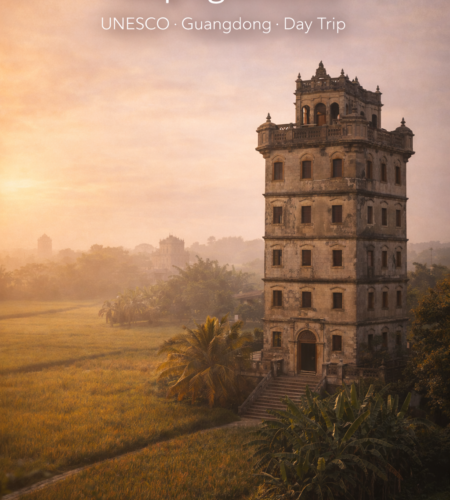
Kaiping Diaolou (Kaiping Diaolou and Villages) are dramatic multi-storey watchtower homes scattered across rural Kaiping (Jiangmen, Guangdong) — built largely in the late 19th and early 20th centuries by overseas Chinese families who returned with new money, new tastes, and a need for security. The result is a rare architectural mash-up: Chinese village layouts + Western decorative styles + defensive tower design. UNESCO inscribed Kaiping Diaolou and Villages as a World Heritage Site in 2007 under criteria (ii)(iii)(iv).
This guide is practical: what “Kaiping Diaolou” really includes, how to get there from Guangzhou, what tickets/hours to expect, the best sites to prioritize, and common mistakes.
Kaiping Diaolou at a glance 📍⏱️💳
| What you need | Practical answer |
|---|---|
| UNESCO status | World Heritage Site (inscribed 2007, criteria ii/iii/iv) |
| What you’ll see | Multi-storey defensive village houses (diaolou) with Chinese–Western fusion design |
| Best “core sites” travelers combine | Zili Village, Li Garden, Majianglong Village, Jinjiangli (often sold as a package) |
| Typical opening window (varies by source/season) | Roughly 08:30–17:30 (common listings) |
| Typical combo ticket reference | Around ¥180 (package tickets are common; prices can change) |
| Time needed | 4–6 hours on site (not counting travel) |
Ticket prices/hours can change seasonally or by ticket type — treat the official ticketing info you see on the day as final. Public info pages still give a good planning baseline.
What makes Kaiping Diaolou special ✅
A defensive home — not just a “tower”
UNESCO describes diaolou as multi-storeyed defensive village houses, built in a period when banditry and unrest made protection a real concern.
A global story in rural Guangdong 🌍
What makes these towers visually unique is the fusion of Chinese and Western structural/decorative forms, reflecting the role of Kaiping emigrants (South Asia, Australasia, North America) who returned and built “hybrid” homes that broadcast both wealth and global influence.
It’s not one place — it’s a landscape
UNESCO highlights four groups of diaolou and notes that twenty representative towers were inscribed — meaning your experience depends heavily on which villages/gardens you choose.
Best Kaiping Diaolou sites (what to prioritize) 🗺️
If you have limited time, focus on a mix of “village context” + “signature architecture”:
1) Zili Village (self-contained diaolou village feel)
Zili is widely considered one of the strongest “walk through a living village with towers” experiences — you get multiple diaolou in one rural setting rather than a single isolated building.
2) Li Garden (polished, photogenic “estate” vibe)
Li Garden is typically presented as a more curated/landscaped attraction among the Kaiping set — great if you want a “designed” visit with strong photo composition (and an easier walk).
3) Majianglong Village (scenic lanes + cluster atmosphere)
Often paired in package tickets with the sites above, Majianglong is chosen for “village lanes + towers” ambience.
4) Jinjiangli (iconic single-tower shots)
A common add-on for people who want that “one hero tower” photo and a different angle vs. Zili/Majianglong.
✅ Best first-timer combo: Zili + Li Garden + one village cluster (Majianglong or Jinjiangli).
How to get there from Guangzhou 🚇🚌🚕
Kaiping is doable as a long day trip from Guangzhou, but plan transport carefully because the diaolou sites are spread out and rural.
Option A: Direct bus to Kaiping (simple + budget) 🚌
Rome2rio lists frequent buses from Guangzhou to Kaiping Bus Station with travel time around ~1.5 hours (pricing varies).
From Kaiping Bus Station, you’ll still need taxi/ride-hailing (or a hired car) to reach the village sites.
Option B: Rail + transfer (often fastest-feeling, but needs local hop) 🚇🚄
Many travelers use high-speed/intercity rail into the broader Jiangmen/Kaiping area, then taxi onward to rural sites. (Exact station choice depends on the day’s schedules and your route.)
Option C: Private driver / day tour (best if you hate logistics) 🚗✅
Because the attractions are rural and scattered, the “hidden cost” is time spent arranging transport between sites. A driver makes the day smoother, especially if you want 3–4 stops.
Pro navigation tip: save Chinese names in your map app:
- 开平碉楼 (Kaiping Diaolou)
- 自力村 (Zili Village)
- 立园 (Li Garden)
- 马降龙 (Majianglong)
- 锦江里 (Jinjiangli)
Opening hours ⏱️
Many public listings place the general visiting window around 08:30–17:30 (with variations by site).
Because last-entry times can be earlier than closing, arrive early and avoid tight schedules.
✅ Practical rule: arrive at your first site by ~09:00.
Tickets / prices 💳
You’ll often see:
- Package/combo tickets that cover multiple sites (common reference: around ¥180)
- Individual tickets per site (Li Garden, Zili, etc.), sometimes bundled as partial combos.
⚠️ Prices vary by season and ticket type; treat the day-of ticketing info as final. Public info sources are best used to estimate your budget before you go.
The perfect one-day Kaiping plan (realistic) ✅🗓️
Fast-but-good day trip (from Guangzhou)
- Early departure (aim to reach Kaiping area mid-morning)
- Zili Village (1.5–2 hours)
- Li Garden (1–1.5 hours)
- Choose one: Majianglong or Jinjiangli (1–1.5 hours)
- Return before it gets too late (rural transport is slower at night)
If you only have time for two stops
Do Zili + Li Garden. It gives you “village context” + “signature curated site” without rushing.
Tips & common mistakes ✅⚠️
✅ Start early (seriously)
Your biggest enemy is not walking — it’s the time between sites.
✅ Plan transport between villages before you arrive
If you assume you’ll “figure it out on the spot,” you can lose 60–90 minutes easily.
⚠️ Don’t underestimate photo conditions
- Bright midday = harsh shadows inside tower openings
- Late afternoon = best warm tones, but you risk missing last entry
Best compromise: late morning + early afternoon.
✅ Bring water + snacks
Rural sites have fewer convenience options than Guangzhou CBD.
⚠️ Trying to do 5+ sites in one day
It becomes a car day instead of a heritage day. Stick to 2–3 core sites.
FAQ ❓
Why are Kaiping Diaolou UNESCO-listed?
They represent a rare cultural landscape of defensive village houses showing a strong Chinese–Western architectural fusion, reflecting overseas Chinese history and local social needs.
When were Kaiping Diaolou inscribed as World Heritage?
2007, under criteria (ii)(iii)(iv).
How long do you need for Kaiping Diaolou?
On-site: 4–6 hours is comfortable for 2–3 main stops. Add travel time from Guangzhou.
Conclusion
Kaiping Diaolou is one of the most visually distinctive heritage trips you can do from Guangzhou: rural villages, dramatic watchtowers, and a genuinely global story embedded in architecture. Keep the plan tight (2–3 sites), start early, and treat transport as the main “strategy” so the day feels calm instead of rushed.
Comments