
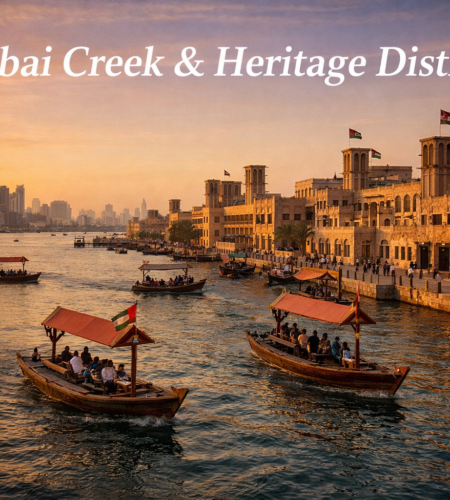
Visiting Dubai Creek & Heritage District is the fastest way to understand Dubai before the skyscrapers: trading dhows on the water, spice-scented alleys in Deira, wind-tower architecture in Bur Dubai, and modern museums in Al Shindagha. A simple plan (Metro → abra → souks → heritage lanes) delivers a full “Old Dubai” day without needing a car.
What counts as “Dubai Creek & Heritage District” (and what to focus on) 📍
Think of it as three connected zones around the creek:
- Bur Dubai side (Heritage lanes): Al Fahidi Historical Neighbourhood + textile/souq area + creek promenades.
- Deira side (Souks): Gold/Spice/Perfume souk vibe + classic abra landings near Old Souk area.
- Al Shindagha (museum district): Al Shindagha Museum and creekfront heritage houses—great if you want a structured, museum-quality story.
✅ If you have limited time, prioritize: Abra crossing + one souk + Al Fahidi lanes.
Top things to do in Dubai Creek & Heritage District ✅
1) Cross the creek by abra (the “must-do” move) 🚤
For AED 1, you can cross the creek on a traditional abra between Bur Dubai and Deira—simple, iconic, and surprisingly scenic.
2) Walk Al Fahidi Historical Neighbourhood (wind towers + galleries) 🏛️
Al Fahidi is one of the best-preserved heritage pockets near the creek, built around narrow lanes and traditional architecture. Dubai Culture lists working hours daily 7am–8pm.
3) Do the souks properly (without wasting time) 🧭
Use the creek as your “navigation line”:
- Deira side for classic spice / perfume / gold browsing
- Bur Dubai side for textiles and a calmer stroll after the souks
Visit Dubai’s official souk guide is a solid reference for what each souk is best for.
4) Al Shindagha Museum (best for the “story of Dubai”) 🎟️
If you want context (trade, creek life, culture) in a modern museum format, Al Shindagha Museum is the anchor. Dubai Culture lists 10am–8pm with last entry 7pm.
Abra: how it works (stations, timings, frequency) 🚤⏱️
The classic crossing to plan around
The most useful abra route for visitors is Al Fahidi ↔ Deira Old Souq (CR5). RTA publishes timings + frequency blocks by day.
CR5 timings (summary)
| Direction | Mon–Thu | Fri | Sat | Sun |
|---|---|---|---|---|
| Al Fahidi → Deira Old Souq | 08:15–23:20 | 08:45–23:50 | 08:45–23:45 | 09:30–23:45 |
| Deira Old Souq → Al Fahidi | 08:00–23:20 | 08:30–00:00 | 08:30–23:55 | 09:30–23:55 |
How often do abras run?
It varies by time of day; on CR5, RTA lists frequencies that tighten to every ~6 minutes during peak blocks and loosen to 10–30 minutes at other times.
✅ Practical move: if a line looks long, it usually clears fast when frequency drops to the “every few minutes” blocks.
How to get there (Metro, bus, taxi) 🚇🚌🚕
By Metro (most predictable) 🚇
Dubai Creek & Heritage District is easiest by Dubai Metro Green Line (Deira ↔ Bur Dubai). Use RTA’s official Metro/Tram stations map to pick your closest station to where you’re starting.
Dubai Metro opening hours (all lines):
- Mon–Thu: 05:00–00:00
- Fri: 05:00–01:00
- Sat: 05:00–00:00
- Sun: 08:00–00:00
✅ Common approach: Metro into the area → walk to the creek → abra crossing → continue on the other side.
By taxi / ride-hailing 🚕
If you’re short on time (or it’s hot), taxi is the fastest way to hop between Al Fahidi, souks, and Al Shindagha without long walks.
Hours & tickets for key heritage spots ⏱️💳
Al Fahidi Historical Neighbourhood ⏱️
Dubai Culture lists working hours 7am–8pm daily. (Many lanes may feel “open” outside that, but plan your visit inside these hours if you want staffed sites/events to be running.)
Al Shindagha Museum ⏱️🎟️
- Hours: 10am–8pm
- Last entry: 7pm
Dubai Culture’s official brochure also lists Daily 10:00–20:00, with last ticket sale 19:00, plus planning notes like Al Ghubaiba Metro Station as the nearest metro stop.
Tickets: the official online ticket portal shows options starting “from AED 20” depending on ticket type/date.
Dubai Museum / Al Fahidi Fort (status check) 🛠️
If you’re planning around the historic fort museum: recent reporting says the fort is scheduled to reopen in the first half of 2026 after restoration/modernization work. Re-check close to your travel date.
Tips & common mistakes (save time + avoid tourist traps) ✅⚠️
✅ Do the abra as transport, not as a “tour.”
The public crossing is the authentic experience—quick, local, and cheap (AED 1).
⚠️ Don’t ignore day-specific timings.
RTA abra schedules vary by day; if you’re out late, check the CR5 end times (some directions run close to midnight on Fri/Sun).
✅ Plan souks earlier or late afternoon.
Midday heat + crowds can make Deira feel exhausting. Early/late keeps it enjoyable.
⚠️ Don’t assume every museum/heritage site shares the same hours.
Example: Al Shindagha Museum has a specific last entry time (7pm).
✅ Use the creek as your itinerary spine.
One-day official itineraries around Dubai Creek are built around exactly this logic (Creek → abra → souks → heritage).
FAQ ❓
Is the abra crossing really AED 1?
Yes—Visit Dubai explicitly states you can hop on for AED 1.
Which abra route should tourists use?
The easiest classic crossing is CR5 Al Fahidi ↔ Deira Old Souq, with published timings/frequencies from RTA.
What are the official hours for Al Fahidi Historical Neighbourhood?
Dubai Culture lists 7am–8pm daily.
What are Al Shindagha Museum hours?
Dubai Culture lists 10am–8pm with last entry 7pm.
What time does the Dubai Metro run?
RTA lists Metro opening hours for all lines (Mon–Thu 05:00–00:00; Fri until 01:00; Sun starts 08:00).
Conclusion
Dubai Creek & Heritage District is the most efficient “Old Dubai” day: arrive by 🚇 Metro, do the abra as your crossing, browse one or two souks, then slow down in Al Fahidi (and add Al Shindagha Museum if you want a museum-level story). The big win is planning around published timings—especially abra schedules and museum last entry—so your day feels smooth, not chaotic.
Comments