
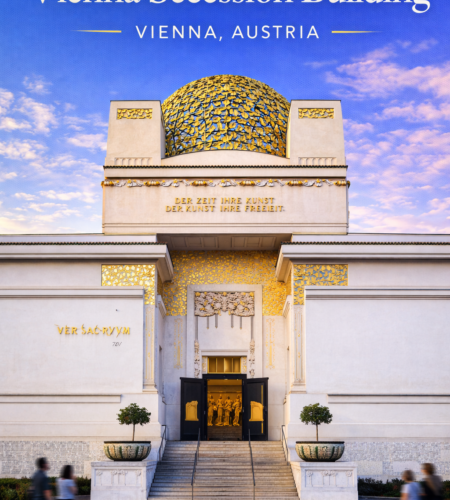
If you’re planning an art-focused day in central Vienna, the Vienna Secession Building is one of the city’s most rewarding “small but legendary” stops. It’s an Art Nouveau icon with a golden laurel dome, a rotating program of contemporary exhibitions, and—most famously—Gustav Klimt’s Beethoven Frieze in the basement. 🎨✨ The visit is easy to fit into almost any itinerary because the Secession sits minutes from Karlsplatz, the State Opera, and the Naschmarkt.
Below is a practical 2026 guide: what you’ll actually see, how tickets work, the best time to go, and the common mistakes that make people leave disappointed.
Why the Vienna Secession Building is a must-see ✅
It’s a landmark of Viennese Art Nouveau
The Secession commissioned architect Joseph Maria Olbrich (then barely 30) to design a dedicated exhibition building. The foundation stone was laid April 28, 1898, and the building was completed October 29, 1898—a fast build for a structure that became a modernist symbol.
The “golden cabbage” dome is not a myth 🌿
The laurel dome is literally made up of 2,500 gilded leaves and 311 berries—a detail the Secession itself highlights in the building history.
Klimt’s Beethoven Frieze is a once-in-a-lifetime work 🎼
Vienna’s official tourism site describes the Beethoven Frieze as 34 meters long, created for a 1902 exhibition, and a virtuoso interpretation of Beethoven’s Ninth Symphony—viewable in the basement level.
What to see inside the Vienna Secession Building 📍
1) The Beethoven Frieze (your #1 priority) 🎨
If you’re short on time, go straight to the Beethoven Frieze. It’s the “anchor” experience and the reason many people visit at all. Vienna’s tourism site emphasizes it’s located on the basement level and highlights its scale (34 m) and concept connection to Beethoven’s Ninth.
Practical tip: The Frieze is in the second underground level (per Secession’s building description), so don’t expect it upstairs in the main hall.
2) Contemporary exhibitions upstairs 🧠
The Secession is not just a historic building—it’s an active contemporary art venue with multiple exhibition spaces (main hall, graphic cabinet, basement rooms).
Reality check (important): During installation phases, only the Beethoven Frieze may be accessible. If you care about seeing contemporary shows, check the exhibitions page before you go.
3) The building itself (don’t rush the entrance hall) 🏛️
Even if you’re not deeply into exhibitions, the Secession is worth it for:
- the Art Nouveau atmosphere
- the “temple-like” exterior
- the iconic dome and façade details
- the feeling of stepping into a “movement” rather than just a museum
Vienna Secession Building opening hours ⏱️
Tuesday–Sunday: 10:00–18:00
Closed: Monday
Installation phases note: During exhibition changeovers, only the Beethoven Frieze can be seen.
Vienna Secession Building tickets and prices 💳 (official)
The Secession’s official ticket page lists prices for “Beethoven Frieze & current exhibitions”:
| Ticket type | Price |
|---|---|
| Regular admission | €13.00 |
| Seniors 65+ | €10.00 |
| Pupils/students under 26 | €7.50 |
| Visitors with disabilities + 1 assistant | €7.50 |
| Children under 12 | Free |
Free admission days (very useful in 2026) ✅
The Secession offers free admission on the first Wednesday of every month, and it publishes the specific 2026 dates (e.g., 4 Mar 2026, 1 Apr 2026, 6 May 2026… through 2 Dec 2026).
Audio guide + guided tours 🎧
- Audio guide: €3.00 (Vienna City Card holders: complimentary)
- Guided tours: Every Saturday 11:00 in English and 14:00 in German; tour fee €3.00 (not including admission)
Pro move: If it’s your first visit and you want context fast, the Saturday overview tour is a great “no research needed” option.
How to get there 🚇🚋🚌
Address: Friedrichstraße 12, 1010 Vienna
The Secession lists the most convenient public transport options as:
- 🚇 Metro: U1, U2, U4 → Karlsplatz
- 🚋 Tram: D, 1, 2, 62, 71 → Opernring
- 🚌 Bus: 59A → Opernring
- 🚋 Badner Bahn: Opernring
Vienna public transport ticket basics (2026) 💳
Wiener Linien states a single ticket (paper) is valid for one journey in one direction, becomes valid for 80 minutes after validation, and you may transfer but not interrupt the journey.
From 1 January 2026, the single ticket price is €3.20 (discounted child single €1.60).
Best time to visit the Vienna Secession Building ✅
For fewer people 😌
- Weekday morning (Tue–Thu) tends to feel calmer than weekends.
For the best “two-in-one” day plan 📍
Pair the Secession with nearby stops:
- Naschmarkt (food + browsing)
- Karlskirche (architecture + views)
- Vienna State Opera area (classic central Vienna walk)
The Secession itself notes it’s right by Naschmarkt and a few minutes from the State Opera and Karlsplatz.
For maximum value 💡
Go on a Free Wednesday (first Wednesday of the month).
Tips and common mistakes ✅⚠️
Do this ✅
- ✅ Start with the Beethoven Frieze so you don’t miss it if the building is busier than expected.
- ✅ Check whether you’re in an installation phase (when only the Frieze is visible).
- ✅ Use Karlsplatz as your transit “anchor” (U1/U2/U4), then walk over.
Avoid this ⚠️
- ⚠️ Don’t show up on Monday (closed).
- ⚠️ Don’t expect a “Klimt museum.” The Secession is primarily a contemporary exhibition space—Klimt’s Frieze is the historic jewel, not the whole program.
- ⚠️ Don’t assume full accessibility without checking: the Secession notes the Beethoven Frieze and parts of exhibitions are barrier-free, and there’s an elevator on the left side—ring the bell or call staff for help.
FAQ ❓
How long do I need for the Vienna Secession Building?
Plan 45–90 minutes for Frieze + a quick exhibition look. Add time if you’re doing a guided tour.
Is the Beethoven Frieze included in the ticket?
Yes—official admission is listed as “Beethoven Frieze & current exhibitions.”
When is the Secession free?
Free admission is offered the first Wednesday of every month, with a published list of 2026 dates.
What are the opening hours?
Tue–Sun 10:00–18:00; closed Monday.
How do I get there by metro?
Take U1/U2/U4 to Karlsplatz, then walk.
Conclusion
The Vienna Secession Building is a compact, high-impact stop: iconic Art Nouveau architecture, a world-famous Klimt masterpiece (the 34 m Beethoven Frieze), and rotating contemporary exhibitions that keep the venue alive and relevant. Plan it smartly—go Tue–Sun, check for installation phases, and use Karlsplatz as your transport hub—and you’ll get one of Vienna’s most memorable art experiences without needing a full museum day.
Comments