
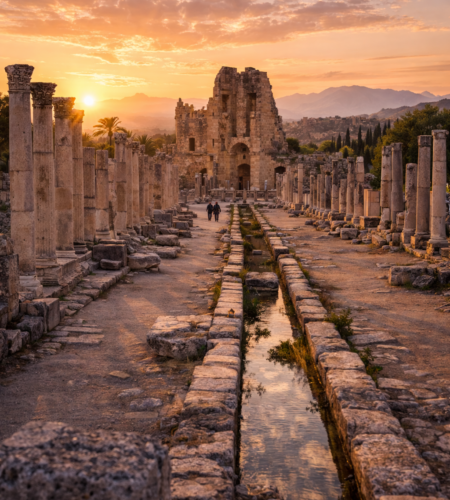
Perge Ancient City is the easiest “big archaeology day” from Antalya: a vast Roman-era city plan you can still read on the ground—gates, stadium, baths, colonnaded streets, fountains, and early Christian basilicas. 📍 UNESCO describes Perge as a long-established city of the Pamphylia region located 18 km east of Antalya (and excavated systematically since 1946).
If you want one ancient site where you can walk through a real Roman city layout (not just one monument), Perge Ancient City is the pick.
Why Perge Ancient City is worth it ✅
Perge was a major urban center in ancient Pamphylia, and today it’s one of the best places near Antalya to understand how a Roman city actually functioned—public buildings, water infrastructure, sports venues, and ceremonial entrances.
Two official points make the visit especially meaningful:
- The Turkish Ministry’s Perge listing describes key Roman-era public structures you can still see on-site, including the Theatre, Stadium, City Gate, Agora & Macellum, Palaestra, plus baths, water canals, and monumental fountains.
- The Culture & Tourism portal notes Perge is famous for architecture and marble sculpture, and that finds from Perge helped make Antalya Museum one of Türkiye’s important sculpture museums.
✅ Practical takeaway: Perge isn’t a “quick photo ruin.” It’s a full ancient city walk.
Perge Ancient City at a glance (what you’ll actually experience) 📌
| What you’ll see | Why it matters | Time needed |
|---|---|---|
| Hellenistic/Roman gates & towers | The city’s “ceremonial entrance” feeling | 20–40 min |
| Stadium | One of the signature structures mentioned in official site info | 20–35 min |
| Colonnaded main street + water channel | The “Roman city plan” moment (most photogenic walk) | 30–60 min |
| Baths + palaestra + fountains | Shows daily life + engineering (water everywhere) | 30–60 min |
| Agora / Macellum | The commercial and civic center | 20–40 min |
| Early Christian basilicas | Perge’s later historical layers | 15–30 min |
(Your real “wow” is the sequence—gate → street → water/fountains → public buildings.)
What to see at Perge Ancient City (don’t miss these) 🏛️📍
1) The Hellenistic-era defenses and city entrance ✅
UNESCO’s description notes that Hellenistic-period city walls and gate elements were unearthed (including the South Gate tower area).
This is where Perge starts to feel like a planned city, not scattered ruins.
2) The Stadium (a “scale” monument) 🏟️
The official Perge listing highlights the Stadium as one of the major public structures.
Even if you’re not a sports person, it’s one of the best places to understand how big Perge was—and it’s usually less crowded than the “first gate photo spot.”
3) The Colonnaded Main Street + water channel (Perge’s signature walk) 🚶♂️💧
Official site text specifically calls out the Sütunlu Ana Cadde (colonnaded main street) and related water/fountain features in the Roman building program.
This stretch is Perge’s “movie set” moment: long lines, symmetry, and the sensation of walking a real ancient boulevard.
4) Agora & Macellum (civic + market heart) 🧭
Again, the official listing names Agora & Macellum as core structures.
If you want to understand “where people did business,” this is the zone.
5) Baths, fountains, and water engineering (the underrated highlight) 💦
Perge isn’t just stone—it’s water infrastructure. The official description emphasizes baths, water canals, and monumental fountains as part of the Roman-era city buildout.
If you’re visiting in summer, these areas also tend to have the best shade breaks.
6) Theatre status (important right now) ⚠️
The Ministry’s Perge listing includes a clear note: the ancient theatre is temporarily closed to visitors until restoration work is completed.
✅ Plan your visit assuming you may not be able to enter/approach theatre areas, and focus your time on the street–stadium–agora–fountain circuit.
A simple Perge Ancient City route (works for first-timers) 🗺️✅
2-hour “best of Perge” route
- City gates / towers (entry photos) 📸
- Walk to the Stadium 🏟️
- Colonnaded main street + water channel 💧
- Monumental fountains + baths
- Agora/Macellum
3–4 hour “do it properly” route
Add:
- More time on the colonnaded street (best photos)
- Side paths to quieter ruins + basilicas
- A slower loop back so you see the site in changing light
✅ If you only have one “big ruins day” near Antalya, Perge is a strong choice—especially because it’s relatively close to the city side.
How to get there 🚋🚌🚕✈️
Where Perge is located 📍
UNESCO places Perge 18 km east of Antalya and 2 km north of Aksu.
The official Turkish Museums listing gives the Perge site address in Aksu / Antalya.
By tram (best DIY option) 🚋✅
Antalya’s light rail (AntRay) schedule site lists a corridor that includes EXPO – AKSU – AIRPORT – FATIH, which is exactly the direction you want for the Aksu/Perge side.
From Aksu, you typically continue by short taxi/dolmuş/walk depending on where you get off.
By bus 🚌
Buses change more often than ruins. The safest method is:
- Route to Aksu and then continue to the site entrance area.
Use live routing on the day (Antalyakart planning is usually the most practical approach in Antalya).
By taxi / ride 🚕
The “no-brain” option—especially in summer heat or if you want to arrive early and avoid crowds.
From Antalya Airport (AYT) ✈️
Because AntRay service connects the airport direction with Aksu on the same corridor, Perge is one of the easiest archaeological sites to combine with an “arrive day” if you land early.
Hours / Operating times ⏱️
The official Ministry listing currently shows:
- Opening: 08:00
- Closing: 17:00
- Ticket office closes: 16:30
- Open every day
✅ Pro tip: arrive no later than 15:30 if you want to walk the main circuit without rushing.
Tickets / prices / museum cards 💳
The official Ministry price list (DOSİMM) shows:
- Antalya Perge Örenyeri: €11
The official Perge page also states:
- For Turkish citizens, MüzeKart is valid.
⚠️ Notes that save headaches:
- Turkey’s official price list is often published in EUR, but you may pay the TL equivalent at the gate depending on current practice.
- If you’re counting on seeing the theatre, remember the theatre is currently closed for restoration per the official listing note.
Best time to visit Perge Ancient City 🌞📸
For photos ✅
- Morning (opening time): softer light, fewer tour groups, cooler walking.
- Late afternoon: warmer tones on stone, but watch closing time.
For comfort ⚠️
Perge can feel like an oven in peak summer because it’s a wide-open walking site. Plan:
- Hat + sunscreen + water 💧🧢
- Short breaks in shade near larger structures
- “Less running, more looping” (you’ll see more details)
Tips & common mistakes ✅⚠️
Do this ✅
- Treat Perge like a city walk: slow pace, long sightlines, repeat the main street once.
- Prioritize street + water structures + stadium + agora—they’re repeatedly emphasized in official site descriptions.
- Bring a wide lens / 0.5x for the colonnaded street and big spaces 📸
- Plan your visit around ticket office closing at 16:30.
Avoid this ⚠️
- Showing up at 16:15 thinking you can “do Perge fast.”
- Building your whole plan around the theatre without checking the restoration closure note.
- Underestimating heat: no shade strategy = miserable experience.
FAQ (Perge Ancient City) ❓
Is Perge Ancient City a UNESCO World Heritage Site?
Perge is listed on UNESCO’s Tentative List (“Archaeological Site of Perge”).
How far is Perge from Antalya?
UNESCO states it’s 18 km east of Antalya and 2 km north of Aksu.
What are Perge’s official opening hours?
The official listing shows 08:00–17:00, ticket office closes 16:30, open daily.
How much is the ticket?
The official fees list shows €11 for Perge Örenyeri.
Is the theatre open?
The official Perge page states the ancient theatre is temporarily closed until restoration is completed.
What’s the single best thing to do inside Perge?
Walk the colonnaded street and water/fountain axis—it’s the clearest “Roman city plan” experience, and it’s highlighted in official descriptions of Perge’s key structures.
Conclusion
Perge Ancient City is the most “complete Roman city walk” you can do near Antalya: stadium, baths, agora/market, monumental fountains, and a colonnaded street that still reads like a real urban boulevard. ✅
Plan it smart: arrive early, respect the 16:30 ticket office cutoff, and remember the theatre is temporarily closed for restoration—so build your route around the street–stadium–agora–fountain circuit instead.
Comments