
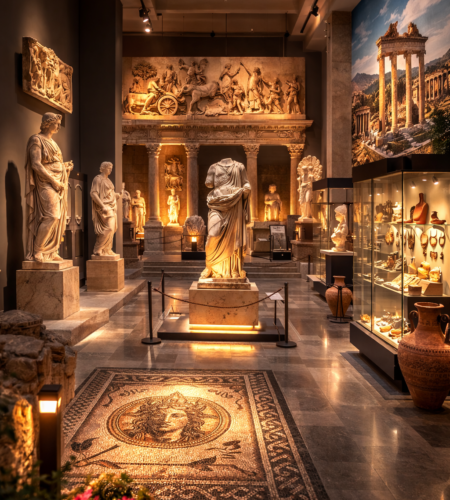
Antalya Museum (Antalya Archaeological Museum) is the city’s flagship archaeology collection—famous for sculptures from nearby ancient sites (especially Perge) and for telling the story of Lycia, Pamphylia, and Pisidia under one roof. ✅ It’s also internationally recognized, having received a major Council of Europe museum award in 1988.
Important right now: Antalya Museum is currently listed as closed to visitors on the official Ministry museum page, and official notices state it has been temporarily closed since July 16, 2025 due to the “new museum construction” and “artwork relocation” project.
This guide shows how to plan smartly (including what to do instead if you arrive and it’s still closed).
Antalya Museum status: is Antalya Museum open right now? ⚠️
Before you build a day around it, check the official status:
- The Ministry’s official museum listing shows “Durum: Ziyarete kapatılmıştır” (closed to visitors).
- TÜRSAB (Association of Turkish Travel Agencies) published an official announcement that the museum was temporarily closed as of 8:30 AM on Wednesday, July 16, 2025 for the new museum construction phase and artifact relocation.
- Reporting on the redevelopment notes the site is being rebuilt and is expected to be completed by the end of 2026.
✅ Practical takeaway: treat muze.gov.tr as the “source of truth” on the day you plan to visit.
Why Antalya Museum is a big deal (when open) ✅🏛️
Even by Türkiye standards, Antalya Museum is a heavyweight:
- It’s positioned as a regional museum covering major ancient cultural regions of Antalya province.
- The museum is especially known for Perge-period Roman sculptures and other excavation finds.
- It received a major Council of Europe museum award in 1988, repeatedly noted in official tourism/cultural sources.
If you want one museum that makes Antalya feel “ancient, not just seaside,” Antalya Museum is the one.
Antalya Museum highlights: what you should not miss inside 🏺✨
Official descriptions lay out the museum’s halls and themes clearly, and these are the “highest payoff” stops:
1) Emperors Hall (Roman power gallery) 👑
A signature hall: statues linked to famous Roman emperors (including Hadrian) discovered in Perge excavations.
2) Gods Hall (mythology in marble) ⚡
A concentrated set of mythological statuary (often Roman-period copies of earlier Greek originals), again strongly tied to Perge finds.
3) Mosaic Hall (don’t rush it) 🧩
Official sources highlight important mosaics, including the well-known “Philosophers Mosaic” from the region.
4) Sarcophagi / Burial culture sections ⚱️
A visually striking area—stonework, reliefs, and burial traditions that explain how people lived (and died) across eras.
5) Coins, Small Finds, Icons (surprisingly addictive) 💠
Coins are displayed chronologically, with broader “small finds” and icon material included.
6) Prehistory & Natural History (the “how far back does this go?” answer) 🦴
Karain Cave and other early material appears in the prehistory narrative described in official museum summaries.
7) The Children’s Section (if you’re traveling as a family) 👨👩👧👦
The museum includes a dedicated children-focused area noted in official overviews.
A practical Antalya Museum visit plan (90 minutes vs 2.5 hours) ⏱️✅
When it reopens, plan like this:
90-minute “core route”
- Emperors Hall
- Gods Hall
- Mosaic Hall
- One burial/sarcophagus area
- Quick finish with Coins/Small Finds
2–2.5 hour “do it properly”
Add:
- Prehistory/Natural History (context)
- More time in sculpture halls
- Outdoor gallery/breaks (if open)
✅ Museum pacing tip: sculpture + mosaics are “high detail.” If you try to do everything fast, you’ll remember nothing.
How to get there 🚋🚌🚕✈️
Antalya Museum address (for maps)
The official listing gives the address as Bahçelievler Mahallesi, Konyaaltı Caddesi No: 88, Muratpaşa / Antalya.
By tram (very convenient) 🚋
The ANTRAY system includes routes that explicitly reference Müze (Museum) as an endpoint in official schedule selections (e.g., “Varsak–Müze” and “Zerdalilik–Müze”).
By bus 🚌
Routes change and vary by season—use the official Antalyakart app to draw routes and see real-time arrivals.
By taxi / ride 🚕
Best if you’re time-constrained, traveling with kids, or coming from a hotel with limited transit access.
From Antalya Airport (AYT) ✈️
Antalya Airport’s official transport info states there are bus and rail (ANTRAY) options to reach the city center and other key nodes.
From the city center, continue toward the museum area using Antalyakart routing.
Hours / operating times ⏱️
Because Antalya Museum is officially listed as closed, the official page currently shows placeholder hours (00:00) alongside the closed status.
✅ Rule: always verify same-day status on the official listing before going.
Tickets / prices / cards 💳
If it’s closed
No ticketing on-site—your plan should switch to alternatives (below).
When it reopens (typical system)
- The official listing notes MüzeKart is valid for Turkish citizens.
- The museum platform also supports e-ticketing and museum card infrastructure at the national level.
- The official Antalya Museum listing notes audio guidance is available (great for a sculpture-heavy museum).
⚠️ Price warning: ticket prices can change (sometimes quickly). Use the official page once it shows active ticketing again.
Tips & common mistakes ✅⚠️
Tips that make the visit better
- Go early if you want calm galleries and cleaner photos (where allowed). 📸✅
- Do sculptures first while your attention is fresh—then mosaics, then small finds. ✅
- Use audio guidance if available; it adds meaning fast. 🎧
Common mistakes
- Not checking closure status and arriving to locked doors. ⚠️
- Trying to “see every hall” in one sprint—this museum rewards selective depth.
- Skipping Perge context: many star pieces are tied to Perge; seeing Perge (or reading about it) makes the museum hit harder.
If Antalya Museum is still closed: best alternatives (same-day save) ✅📍
You can still build a strong “culture day” in Antalya:
1) Antalya Ethnography Museum (often an easy win)
Official museum listing shows it as open and free.
2) Antalya Necropolis Museum (in-situ archaeology)
Listed on the Turkish Museums platform with detailed background info.
3) Perge Archaeological Site (the source of many famous finds)
Perge is officially listed on Turkish Museums and is one of the region’s core ancient sites.
4) Antalya Toy Museum (quick, family-friendly)
Operated by Antalya Metropolitan Municipality and officially described on its own site.
FAQ (Antalya Museum) ❓
Is Antalya Museum currently open?
It is officially listed as closed to visitors, and official notices describe a temporary closure that began July 16, 2025.
Why is Antalya Museum closed?
Official announcements reference the new museum construction phase and artwork relocation project, and reporting describes a major redevelopment/rebuild process.
When will Antalya Museum reopen?
One report states the new museum is expected to be completed by the end of 2026—but you should rely on the official listing for real-time status.
Where is Antalya Museum located?
Konyaaltı Caddesi No:88, Muratpaşa (official listing).
What’s the #1 thing to see inside?
The sculpture halls (especially material linked to Perge) are repeatedly highlighted as a defining strength of the museum.
What should I do instead if it’s closed?
Antalya Ethnography Museum (open/free), Antalya Necropolis Museum, and Perge are the strongest “history substitutes.”
Conclusion
Antalya Museum is one of Türkiye’s most important regional archaeology museums—especially for Roman sculpture and the wider story of Antalya’s ancient civilizations. ✅ But right now, the smartest visitor move is to treat it as a “check status first” site, because official sources list it as closed for a major rebuild and artifact relocation.
If it’s still closed when you visit, you can still salvage a strong culture day with the Ethnography Museum, Necropolis Museum, and Perge. 📍
Comments