
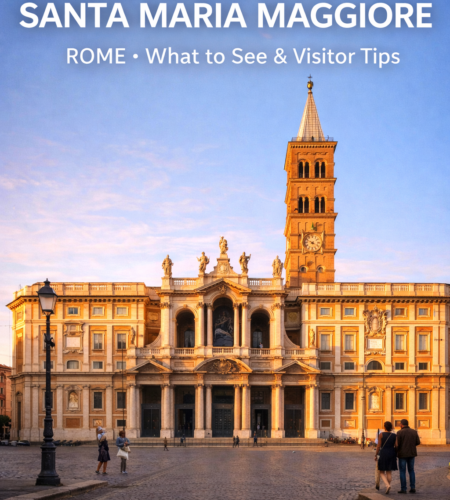
Basilica di Santa Maria Maggiore is one of the four Papal Basilicas in Rome and the city’s most important Marian shrine—famous for its early Christian atmosphere, jaw-dropping mosaics, and treasures like the Salus Populi Romani icon and the Holy Crib relic.
Why Basilica di Santa Maria Maggiore belongs on your Rome list ✅
Even if you’re “not a church person,” Basilica di Santa Maria Maggiore is a must because it combines:
- Big-history Rome (a living monument, not a museum set)
- Master-level art (mosaics, chapels, architecture)
- A calm experience compared to the Colosseum/Vatican rush (most days)
It’s also one of the few places in Rome where you can feel the shift from ancient empire → early Christianity → Baroque Rome… in one walk down a single nave.
What to see inside Basilica di Santa Maria Maggiore 📍
1) The Salus Populi Romani icon (the basilica’s most famous image)
The basilica houses the Salus Populi Romani, described by the official basilica site as its most important Marian icon; tradition links it to St. Luke, and it’s deeply tied to Rome and the Popes.
Tip: Don’t rush—stand back first to “read” the space, then move closer.
2) The Holy Crib relic (Sacra Culla) 🎁
This is one of the basilica’s most meaningful treasures: the relic of the Holy Crib, connected (per the basilica’s official page) to five pieces of sycamore wood associated with the manger of Jesus.
3) The façade + Loggia of Blessings (best exterior detail)
From outside, look for the Loggia of Benedictions framing mosaics (around 1300), and note the façade built for the Holy Year of 1750 by architect Ferdinando Fuga.
4) Bernini connection (yes, that Bernini)
The basilica contains the tomb of the Bernini family in the right lateral nave, and the site highlights Bernini-related works connected to the basilica’s chapels and spaces.
5) The Holy Door (Porta Santa) 🚪
Santa Maria Maggiore has a Holy Door used for Jubilees; the basilica’s official page notes the current bronze door (made in 2000) and describes its Jubilee significance.
Tickets & prices 💳
Main basilica
✅ Entry is generally free (you can walk in like a normal church visit).
Museum complex / terraces / archaeological area (paid)
If you want the “extra layers” (museum spaces + panoramic terraces + underground/archaeological areas), expect paid access.
An official basilica brochure (PDF) lists these per-person fees (use as a planning baseline; confirm before you go):
- Museum areas (Loggia of Blessings, Hall of Popes, Bernini Staircase, Liberian Museum): €7.50
- Archaeological Area: €7.50
- 360° Panoramic Terraces: €4.00
Practical advice: Treat prices like “subject to change,” and check the basilica’s official “Visits / Tickets” pathway (the basilica site points visitors there).
Hours & operating times ⏱️
Basilica access (general planning)
An official Jubilee document listed typical access hours for the papal basilicas (including Santa Maria Maggiore) as 7:00 am – 7:30 pm. Use this as a planning guideline and expect adjustments during liturgies/special events.
Museum complex opening hours (official)
The basilica’s official “Contact Information” page lists:
- Mon–Sat: 8:00 am – 6:30 pm (last entry 6:00 pm)
- Sun: 12:30 pm – 5:00 pm
Mass times (official timetable)
Mass schedules vary by weekday/holiday and location inside the basilica; the basilica publishes a timetable (e.g., weekday Masses in the Pauline Chapel).
How to get there 🚇🚌🚶
Address (official): Via Liberiana, 27, 00185 Rome.
By metro (fastest)
The basilica is near Roma Termini, which connects major metro/rail services. Use ATAC’s official metro/rail map for the most accurate routing by line and station.
By bus
Rome’s bus routes change with works/events, so use ATAC’s official maps or journey planner resources before you go.
On foot (best for first-time visitors)
From Termini, it’s an easy walk—great if you want a calm start before the city gets crowded.
By taxi / rideshare 🚕
Good option early morning or late evening; set destination to “Basilica di Santa Maria Maggiore (Via Liberiana)” to avoid confusion with the piazza.
Dress code, security & rules ⚠️
The basilica’s official visitor guidance is strict about decorum:
- No sleeveless/low-cut tops
- No shorts above the knee / miniskirts
- Hats not permitted
- Large luggage/big backpacks may be refused by security
Common mistake: people plan this as a “quick stop,” arrive in summer outfits, and get blocked at the entrance.
Suggested visit plans (pick your tempo) ✅
| Plan | Time | What you’ll do | Cost |
|---|---|---|---|
| Quick highlights | 30–45 min | Main nave + key chapels + quick icon/crib stop | Free |
| Full experience | 90–120 min | Basilica + museum areas/terraces/underground (where available) | €€ |
| “Photographer timing” | 45–60 min | Exterior + façade/loggia + inside when it’s quieter | Free |
Timing tip: Try to avoid arriving right before major Mass times if you want a quiet, photo-friendly visit. (If you want the atmosphere—do the opposite.)
Tips & “what people do wrong” ✅⚠️
- ✅ Do bring a light layer (indoors can feel cooler than outside).
- ⚠️ Don’t arrive with big luggage—security can refuse entry.
- ✅ Do plan museum/terraces around museum opening hours (not just basilica access hours).
- ✅ Do slow down at the big highlights (Salus icon, Holy Crib)—they’re not “background decorations.”
FAQ
Is Basilica di Santa Maria Maggiore free to enter?
The main basilica is generally free to enter; special areas (museum/terraces/archaeological zones) can require paid access.
What are the museum complex hours?
Mon–Sat 8:00–18:30 (last entry 18:00); Sun 12:30–17:00.
Where exactly is it?
Official address: Via Liberiana, 27, 00185 Rome.
What should I wear?
Dress modestly (knees/shoulders covered). Large bags may be refused.
What’s the single “don’t miss” inside?
The Salus Populi Romani icon and the Holy Crib relic are the core highlights.
Does it have a Holy Door?
Yes—Santa Maria Maggiore has a Holy Door used during Jubilees.
Conclusion
Basilica di Santa Maria Maggiore is one of Rome’s most rewarding “big monuments” because it’s still a living sacred space—packed with art, history, and atmosphere—yet often calmer than the city’s headline attractions. Go early or time it carefully, respect the dress code, and if you want the deeper layers, add the museum/terraces/underground for a complete experience.
Comments