
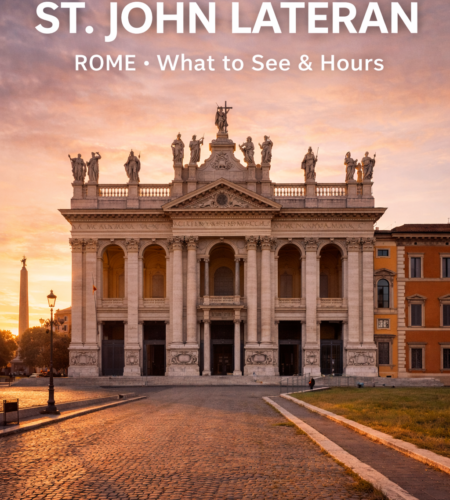
If you’re building a “must-see Rome” list, Basilica of St. John Lateran deserves a top spot—not as an alternative to St. Peter’s, but as a different kind of “Rome essential.” This is the cathedral church of Rome (the Pope’s cathedral as Bishop of Rome) and is traditionally called the “mother and head” of all churches.
Below is a practical, no-fluff guide to visiting the Basilica of St. John Lateran well—what to look for, what to add nearby, and how to time your visit.
Why the Basilica of St. John Lateran is a “big deal” (beyond the photos)
Unlike many famous churches that are “important because they’re famous,” the Basilica of St. John Lateran is structurally important in Catholic Rome:
- ✅ Cathedral of Rome: it’s the official seat of the Bishop of Rome (the Pope).
- 🏛️ Constantinian roots: the basilica’s origins are tied to Emperor Constantine and the early Christian legalization era, with later rebuilds and major Baroque-era redesigns shaping what you see today.
Even if you’re not visiting for religious reasons, it’s one of the clearest places in Rome to feel the “handoff” from imperial Rome to Christian Rome—without the crowds you’ll face in the Vatican area.
What to see inside (a smart, quick route)
1) The main nave: scale, rhythm, and “Rome’s grand church interior”
Walk slowly up the central aisle first. The space is designed to feel ceremonial: long sightlines, monumental proportions, and a strong visual pull toward the apse.
2) The 12 Apostles statues (easy to miss if you rush)
Along the nave, look into the large niches: the Apostles are oversized, dramatic, and meant to read from a distance—this is “Baroque storytelling” in sculpture form.
3) The apse area: the visual climax
Give yourself a minute here even if you’re speed-running. The apse is the “destination” the architecture is aiming at—exactly where your eyes should end up.
4) The Holy Door (especially relevant during Jubilee years)
If you’re in Rome during Jubilee-related events, the Lateran is one of the key basilicas people pair with the pilgrimage rhythm of the city. (Even outside Jubilee context, it’s worth noticing how the Lateran “functions” as a living church, not only a monument.)
Don’t stop at the church: the best add-ons next door
🌿 Lateran Cloister (Chiostro)
A calm, photogenic break from the city—columns, mosaics, and a “quiet museum” vibe. Perfect if you want something beautiful without sensory overload. The official site lists daily opening hours for the cloister.
🕯️ Lateran Baptistery
One of the most historically resonant “side visits” around the basilica complex. Hours are posted officially and can differ from other listings—check before you go.
🧗 Scala Sancta (Holy Stairs)
Across the street area, the Holy Stairs site is a major pilgrimage stop (whether or not you participate religiously, it’s culturally significant).
🗿 Lateran Obelisk (quick exterior win)
Right nearby in the Lateran area, this Egyptian obelisk is described by Turismo Roma as the tallest of Egyptian origin and gives its measurements (including height and total height with base/cross). It’s an easy “add 5 minutes, get a big landmark” stop.
🚇 How to get to the Basilica of St. John Lateran
Metro (best option)
- San Giovanni station is the practical stop.
- It’s on Metro Line A and also Line C (useful depending on where you’re staying).
Walking (nice if you’re nearby)
If you’re coming from the Colosseum/Labicana area, walking can be a pleasant, straightforward route—good for daylight hours.
Taxi / ride-hail
Best if you’re timing a tight schedule (or if you’re coming early/late when transit frequency drops).
⏱️ Hours / operating times (check day-of)
The official Lateran basilica site notes that hours can change and advises checking notices/news for variations.
Here are the officially listed times:
| Area | Typical official hours |
|---|---|
| Basilica of St. John Lateran | Daily 07:00–18:30 |
| Cloister | Daily 09:00–17:00 |
| Basilica Museum | Daily 09:00–17:30 |
| Baptistery | Daily 09:00–19:00 |
⚠️ Note: Turismo Roma also publishes “Lateran complex” times that differ for some sub-sites (e.g., split hours). If you’re planning tightly, trust the on-site notices / official complex updates first.
💳 Tickets / prices / tours
- ✅ Entry to the Basilica of St. John Lateran is free (officially stated).
- 🎟️ Museum / Cloister: these can require tickets and the official site directs visitors to the ticket office for details.
If you’re trying to keep Rome costs down, this is one of the best “high-impact / low-cost” stops: you can have a world-class basilica experience without needing a timed ticket.
✅ Tips & common mistakes (save time + get better photos)
- 🕗 Go early (or later afternoon): you’ll get cleaner interior photos and a calmer atmosphere.
- ⛪ Respect service times: during Mass or active ceremonies, some areas may be restricted and it’s not the right moment for sightseeing behavior. (The basilica publishes liturgy times.)
- 👕 Dress like you’re entering a church: covered shoulders/knees is the safe standard in Rome’s major churches.
- 📸 Cloister = photo win: if you want one “quiet, beautiful” set of images, this is the best add-on.
- 📍 Pair it smartly: Lateran → Appian Way → Catacombs makes a strong themed half-day (early start recommended).
FAQ
Is the Basilica of St. John Lateran the same as St. Peter’s Basilica?
No. St. Peter’s is the most famous, but Basilica of St. John Lateran is the cathedral of Rome and is traditionally described as the “mother church.”
How long do I need?
- Basilica only: ~30–60 minutes
- Basilica + Cloister + Baptistery: ~1.5–2.5 hours (depending on pace)
Which metro stop is best?
San Giovanni (served by Metro A and C).
Is it worth it if I’m not religious?
Yes—architecturally and historically, it’s one of the strongest “Christian Rome” sites with fewer crowds than the Vatican core.
Conclusion
Basilica of St. John Lateran is one of those rare Rome visits that feels both monumental and manageable: big history, real spiritual significance, and practical access—without the “ticket stress” and bottlenecks you’ll face elsewhere. If you add the cloister and a quick look at the Lateran obelisk, you’ve got a compact mini-itinerary that punches far above its time cost.
Comments