
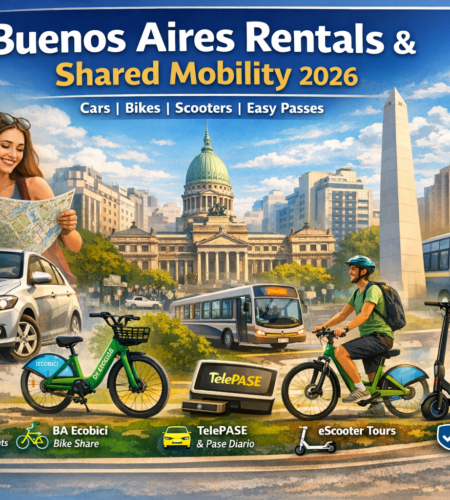
Buenos Aires rentals and shared mobility can be surprisingly simple once you “stack” the right tools: SUBE (or open payments) for daily transit, BA Ecobici for short rides, and TelePASE (or a day pass) for highways and tolls. This guide focuses on practical, verified steps so you can move around the city confidently—whether you’re renting a car, using bike share, or just want the easiest “passes” to avoid hassle.
✅ Quick setup checklist (do this first)
Within 30 minutes of landing, you can be “mobility-ready”:
- Transit: Get a SUBE card or use contactless card / NFC / QR on supported lines (coverage expands—SUBE still works everywhere).
- Bike share: Install BA Ecobici (Tembici) and set up a tourist pass if you plan to ride.
- Tolls (if renting a car): Make sure your rental is set up for TelePASE or arrange a Pase Diario before using Buenos Aires highways.
- Airport transfers: For a stress-free first ride, consider licensed taxis / transfers (avoid random offers).
🚗 Car rentals in Buenos Aires: what to know (before you book)
Where car rental makes sense
A rental car is most useful if you’re:
- Doing day trips beyond the city (e.g., Tigre delta, La Plata, countryside drives)
- Traveling with family + luggage
- Planning multi-stop errands outside central neighborhoods
Inside the city core (Microcentro, Palermo, Recoleta), traffic + parking can be more annoying than helpful—many visitors use taxis/ride-hailing + transit instead.
Documents & requirements (the “no surprises” version)
Most renters should expect to need:
- Passport/ID
- Valid driver’s license
- Credit card in the primary driver’s name (deposits are usually held on a credit card)
Argentina’s official guidance for visitors emphasizes carrying your passport entry plus your driver’s license, which is valid in Argentina if it meets international agreement conditions.
International Driving Permit (IDP): Rules vary by country and circumstance, but a very practical rule is:
- If your license is not in the Roman/Latin alphabet, many rental companies require an IDP.
Even if you might be okay without it, an IDP can save time at the counter.
Car rental “gotchas” in Argentina
- Manual transmissions are common—double-check if you need automatic.
- Insurance language: ask about deductible (often called franchise) and what’s excluded (glass/tires/undercarriage often have special rules).
- Tolls: you must plan for TelePASE / plate billing / Pase Diario (details below).
🚌 “Easy Pass” for the city: SUBE + Open Payments (cards/NFC/QR)
Option A: SUBE card (still the universal baseline)
Buenos Aires’ official tourism site explains that to use buses (“colectivos”) and the subway (“subte”), you typically use a rechargeable SUBE travel card, available at subte stations and many kioskos.
Top-ups: You can load SUBE digitally through official channels (app, ATMs, homebanking, wallets) and then validate when required.
Option B: Pay without SUBE (contactless card / phone / watch / QR)
Argentina’s official SUBE guidance confirms an “open payments” rollout where you can pay by:
- Contactless debit/credit/prepaid (Visa/Mastercard), or
- Phone/watch with NFC, or
- QR generated in the official apps
Important nuance (from official SUBE info):
- The fare can be the same, but discounts/benefits (like social fare and some local attributes) apply only on SUBE, including physical or digital SUBE.
- Availability depends on which lines/areas have updated validators; the official SUBE terms note only listed jurisdictions/lines have it enabled “for the moment.”
- For city-jurisdiction buses in CABA, the rollout expanded broadly (official announcements detail coverage).
SUBE Digital (phone-based)
Official SUBE documentation states SUBE Digital is a feature of the SUBE app that lets you pay from your phone without the physical card—available for Android phones with NFC; QR payment is available via the app on both platforms.
🚲 Bike share: BA Ecobici (best for short rides)
Buenos Aires has an extensive network of cycle lanes, and the city’s bike-share system is widely used for short hops.
What tourists need to register
BA Ecobici’s official FAQ lists requirements for foreign citizens registering by app:
- International credit card
- Valid passport
- Residence address in Buenos Aires
- Phone that can receive SMS and email
Tourist pricing & how it works (official)
BA Ecobici publishes tourist options like:
- 1 Ride (one trip up to 45 minutes)
- 1 Day (unlimited 90-minute trips for 24 hours)
…and per-minute excess charges after limits.
(Prices can change quickly in Argentina—always confirm in the app right before purchase.)
Practical riding tips (Buenos Aires reality)
- Ride in daylight when possible; stick to protected cycle lanes (ciclovías).
- Use a helmet and keep your phone tucked away at stops.
- Don’t assume you can dock anywhere—return to an official station to avoid fees.
🛴 Scooters: what’s available (and what usually isn’t)
Dockless scooter sharing
Unlike some cities, Buenos Aires doesn’t consistently have a large, citywide dockless e-scooter sharing ecosystem available at all times. One recent local guide notes that scooter-share companies are not currently operating in the city in the way travelers might expect.
What you can do with scooters
You’ll still find guided e-scooter tours (good for sightseeing, not commuting).
If scooters matter to your product idea/content angle, the safest wording is: “Scooter tours exist; app-based scooter sharing availability varies and may be limited.”
🛣️ Easy Pass for highways: TelePASE + Pase Diario (avoid toll headaches)
If you rent a car and plan to use Buenos Aires highways, this section matters.
TelePASE (Argentina’s main toll pass)
TelePASE’s official site describes it as a system used across AMBA and on national routes, and it’s the standard way to pay tolls electronically.
The City of Buenos Aires also explains that many toll points use license-plate billing (cobro por patente) and work only with TelePASE / plate recognition, with a post-pay window if you don’t have TelePASE linked.
TelePASE “by plate” + daily pass option (very useful for tourists)
Buenos Aires Tourism explains two tourist-friendly alternatives when you don’t have a sticker/tag:
- TelePASE by plate (register your vehicle plate and payment method; you can use it without a device and later pick up the device for free), and
- Pase Diario (online day pass tied to your plate; must be purchased at least a few hours before entering; limited uses per year).
Best practice with rentals: ask the rental company whether the vehicle is already enabled for TelePASE / plate billing and how they handle toll charges (direct billing vs admin fee).
✈️ Getting around from the airports (EZE & AEP)
Buenos Aires’ official tourism site notes:
- Ezeiza (EZE) is ~32 km from the center, and trips commonly take around ~50 minutes depending on traffic.
- Aeroparque (AEP) is in the city and often ~25 minutes to main hotel areas.
For newcomers: use licensed options (official taxis, reputable transfer desks, or well-known shuttle operators) and avoid unmarked solicitations in arrivals.
🧠 Safety & scam-proof mobility tips (high impact)
- Don’t flash phones at the curb while waiting for rides; keep devices away until you’re inside the vehicle.
- Confirm plates in apps before entering.
- For cash, carry small notes—many drivers won’t break large bills.
- Parking: choose paid lots in busy areas; avoid leaving anything visible.
FAQ
Do I still need a SUBE card if contactless payments exist?
SUBE is still the safest “works everywhere” option. Open payments expand convenience, but official SUBE terms note it’s enabled only where validators are updated and listed.
Is SUBE Digital available on iPhone?
Official SUBE info describes SUBE Digital as an in-app feature for Android with NFC; QR payment via the app is available across platforms.
Can tourists use BA Ecobici easily?
Yes, but you must meet the official requirements (passport + international card, etc.) and buy a tourist pass in the app.
What’s the simplest toll solution for a rental car?
If you’ll use highways: ensure TelePASE/plate billing is set up, or purchase an official daily pass option described by Buenos Aires Tourism.
Conclusion
Buenos Aires rentals and shared mobility are easiest when you build a “three-layer” system: SUBE/open payments for everyday transit, BA Ecobici for short bike trips, and TelePASE (or a daily pass) for toll roads. Add smart airport transfers and a few safety habits, and you’ll move around the city smoothly—without wasting time on queues, cash-only surprises, or toll penalties.
Comments