
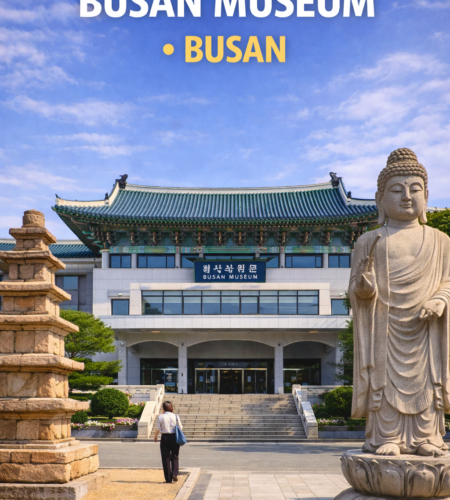
If you want one place that explains how Busan became Busan—from prehistoric settlements to the city you see today—Busan Museum (부산박물관) is the most practical starting point. It’s a city-run museum in Nam-gu with free admission, clear permanent galleries, and an easy transit setup from Metro Line 2 (Daeyeon Station).
Quick facts (save this) ✅
| Item | Details |
|---|---|
| 📍 Address | 63, UN pyeonghwa-ro, Nam-gu, Busan |
| ⏱️ Hours | Tue–Sun 09:00–18:00 |
| 🗓️ Closed | Mondays, Jan 1 (if Monday is a holiday, closes the next day) |
| 💳 Admission | Free |
| 🚇 Nearest metro | Line 2: Daeyeon Station (Exit 3; short walk) |
| ☎️ Phone | +82-51-610-7111 |
| 🌐 Website | museum.busan.go.kr (English available) |
Sources for hours/closure/free admission + address/phone: official Busan Museum info and Korea tourism listings.
Why Busan Museum is worth your time (and who will love it) 🎯
Busan Museum works best for:
- 🧭 First-time visitors who want context before beaches/markets
- 📚 History & culture travelers (artifacts + timelines, not “Instagram-only” exhibits)
- 👨👩👧 Families (free entry, stroller/wheelchair lending available)
- ⏳ People with limited time who still want something “meaningful”
The museum’s mission is to collect, preserve, and display Busan-area cultural heritage, and it’s been operating since the late 1970s.
What to see inside Busan Museum 🏛️
1) The permanent exhibition halls: your “Busan timeline”
The museum’s permanent displays are structured so you can follow history in order—from early periods up to the modern era—across the main exhibition halls. Official museum materials describe permanent exhibitions spanning Paleolithic times through modern history, arranged across their core pavilions/halls.
How to do it fast (best flow):
- Start with the earlier periods (prehistoric → ancient)
- Move forward through dynastic eras
- Finish with Joseon → modern sections (so the city’s “port identity” makes sense)
Practical pacing: most visitors can do a solid visit in 2–3 hours if you focus on the permanent halls + one extra area.
2) Culture Experience Center (hands-on) 🎎
If you’re traveling with kids—or you want something interactive—there’s a Culture Experience Center where visitors can try activities like stone inscription rubbing and traditional costumes. It lists operating hours 10:00–17:00.
3) Special exhibitions (if they’re running) 🖼️
Busan Museum also runs planned/special exhibitions designed around themes not covered in the permanent halls, typically once or twice each year (check current notices on the museum site when you plan).
How to get there (subway, bus, taxi) 🚇🚌🚕
🚇 By metro (recommended)
- Take Busan Metro Line 2 to Daeyeon Station.
- Use Exit 3 and walk a few minutes to the museum.
🚌 By bus (useful from popular areas)
The museum publishes direct bus guidance, including:
- From Busan Station / Nampo-dong: Bus 134 → get off at Busan Museum stop, then walk.
- From Seomyeon / Gaya: Bus 68 or 138 → Busan Museum stop + short walk.
- From Dongnae: Bus 51 → Busan Museum stop + short walk.
- From Haeundae: Bus 139 / 1001 / 1003 → get off at Kyungsung Univ. area, transfer to Bus 51 and get off near Culture Center.
🚕 By taxi
Taxi is simplest if you’re moving as a group or you want to combine multiple stops quickly. (In Busan, taxi is often a practical “time-saver” between attractions—especially outside peak commute hours.)
Hours / operating times ⏱️
Busan Museum is open Tuesday–Sunday, 09:00–18:00, and closed every Monday plus Jan 1 (with a “holiday Monday → closed next day” rule).
Tip: Many museum listings note last admission about 1 hour before closing, so aim to arrive by ~17:00 for a stress-free visit.
Tickets / prices / cards 💳
- ✅ Admission is free.
(If a specific special program or event requires booking, the museum usually posts it on their official pages—worth a quick check before you go.)
Tips + common mistakes (how to enjoy Busan Museum more) ⚠️✅
✅ Do this
- Start earlier in the day if you also want the Culture Experience Center (it ends at 17:00).
- Use the permanent halls as your “Busan timeline”: early → later. It makes the story click.
- Ask about guidance options: the museum lists staff support for foreign visitors and information desk contacts.
- Travel light: it’s much easier to move through galleries without big shopping bags.
⚠️ Don’t do this
- Don’t arrive too late: you’ll rush, and the best part here is the story-building (not a 10-minute photo stop).
- Don’t confuse it with Busan Museum of Art (a different museum in another part of the city).
Accessibility & visitor services ♿🍼
The museum notes free availability of items like wheelchairs and strollers (limited quantities), with inquiries handled at the museum information desk.
FAQ (Busan Museum) ❓
Is Busan Museum free?
Yes—general admission is free.
What day is Busan Museum closed?
It’s closed on Mondays and January 1 (and if a holiday falls on Monday, it closes the following day).
How do I get to Busan Museum by subway?
Take Metro Line 2 to Daeyeon Station and walk from Exit 3.
How much time should I budget?
Plan 2–3 hours for a solid first visit (permanent halls + one extra section like the experience area).
Is there anything interactive for kids?
Yes—the Culture Experience Center offers hands-on cultural activities and is listed as open 10:00–17:00.
Conclusion
Busan Museum is one of the best “high value, low friction” attractions in the city: central enough to reach easily, structured enough to learn quickly, and free—which makes it perfect for a first day in Busan. Go early, follow the timeline from ancient to modern, and you’ll leave with a mental map of the city that makes every other neighborhood (and even the seafood markets and beaches) feel more meaningful.
Comments