
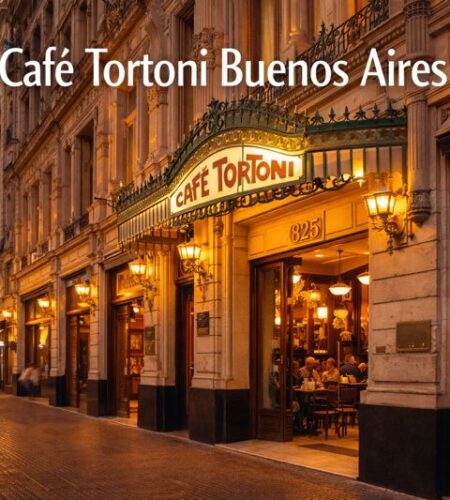
Café Tortoni Buenos Aires is the most iconic “old-school” café in the city—marble tables, wood panels, vintage mirrors, and a living history of writers, artists, and tango culture. Founded in 1858, it’s widely described as the oldest café in Buenos Aires and a classic stop on Avenida de Mayo in the Monserrat neighborhood.
If you want the Tortoni experience without wasting your day in a line, the trick is simple: go early, know what to order, and treat it like a historic café + mini cultural museum, not just “a coffee.” ✅
Why Café Tortoni Buenos Aires is worth it 📍
It’s not just a café—it’s part of the city’s cultural identity 🏛️
The City of Buenos Aires describes Café Tortoni as the oldest coffee shop in Argentina and part of the city’s “Bares Notables” (Notable Bars) heritage group.
The location is perfect for a classic downtown walk 🚶
Café Tortoni sits on Av. de Mayo 825, in the historic center—an easy add-on to Plaza de Mayo/Casa Rosada, Avenida de Mayo architecture, and the old downtown vibe.
Quick planning checklist ✅ (save this)
| Goal | Best time | Time needed |
|---|---|---|
| Quick “iconic café photo + coffee” 📸 | Weekday morning | 30–60 min |
| Full Tortoni experience (room-hopping + order + photos) ☕ | Morning or late afternoon | 60–90 min |
| Culture angle (La Bodega / tango vibe) 🎭 | Ask what’s on / evenings vary | 1–2 hrs |
⚠️ Important: Tortoni is famously popular and does not take reservations (officially stated on its social channels), so lines can happen—plan accordingly.
A short history (the part you’ll actually use) 🕰️
- Founded in 1858.
- The café started at a different downtown corner and later moved; the city notes it relocated in 1880 to its present location, and the façade facing Avenida de Mayo was completed later (end of the 19th century).
- It became a major cultural meeting point—linked with writers and tango legends in Buenos Aires’ collective memory.
What to do inside (so you don’t just “sit and leave”) 📸☕🎭
1) Treat it like a “walk-through museum”
Café Tortoni’s own site describes it as a place with a strong cultural agenda and over 100 artworks on display—so take 5–10 minutes to look around, not only at your table.
2) Ask about La Bodega (the downstairs cultural space) 🎶
The café’s official history page explains that the basement space (“La Bodega”) has been used for artistic/literary gatherings and still hosts cultural events and shows (dance and music).
3) Notice the tango connection 💃
Café Tortoni’s official site also notes that the National Tango Academy is located above the café—a neat detail that explains why tango feels “baked in” here.
What to order at Café Tortoni (classic picks) 🍫🥐🍷
Café Tortoni highlights a few signature “old Buenos Aires” choices:
- Chocolate con churros 🍫
- Picadas (sharing platters) 🧀🥓
- Sidra tirada (they claim to have been the first place to offer it) 🍏
✅ Practical move: if the line is long, go for a quick classic (coffee + medialunas or chocolate + churros), take photos, and keep your “big meal” for somewhere less crowded.
How to get there 🚇🚌🚖
Address 📍
Av. de Mayo 825, Buenos Aires (Monserrat).
By Subte (fastest) 🚇
The easiest approach is Line A:
- Piedras (Line A) is famously right by the café (often mentioned as “in front of” Tortoni).
- Perú (Line A) is also nearby (a short walk).
You can also connect via Line C (downtown) and walk a few blocks along Avenida de Mayo.
⚠️ Subte stations sometimes close temporarily for works—check the official Subte status before you go.
Paying for public transport (SUBE) 💳
If you’re taking buses or Subte often, you’ll likely want a SUBE card (Argentina’s official transport card system).
(If you want, I’ll pull the latest official SUBE “where to buy” + current pricing again for Buenos Aires in your next message.)
By taxi / ride apps 🚖
Say: “Café Tortoni, Avenida de Mayo 825”. In heavy traffic hours, Subte is often faster.
Hours / operating times ⏱️
Café Tortoni’s official site states it’s open:
- Monday–Sunday: 08:00–21:00
⚠️ Common mistake: people arrive near closing and can’t enjoy the atmosphere (or get rushed). If Tortoni is a priority, go earlier.
Tickets / prices / bookings 🎟️💳
Do you need a ticket to enter?
No—this is a café. You’re paying for what you order.
Tango / show tickets?
Shows/events are typically ticketed and schedules can vary. Café Tortoni’s official pages emphasize cultural activities and La Bodega as a venue for shows, so the best move is to ask on-site or contact them directly via the official contact details on their website.
✅ Pro tip: If you specifically want a tango night, message/ask the same day—availability can change quickly in peak season.
Tips & common mistakes ✅⚠️
✅ Go early (or be patient)
Because Tortoni is world-famous and doesn’t take reservations, lines are normal.
Best strategy: arrive shortly after opening on weekdays.
✅ Don’t only sit—look around
The interior art + history is a big part of the value (they describe the café as a kind of museum-like space with many works).
⚠️ Don’t plan Tortoni as your “hungry emergency”
If you’re starving, the line will feel worse. Do Tortoni as a planned stop, not as a last-minute meal decision.
✅ Combine it with an Avenida de Mayo walk
Café Tortoni is a natural stop on an Avenida de Mayo route (historic downtown).
FAQ ❓
Is Café Tortoni really the oldest café in Buenos Aires?
It’s widely described that way by official city/tourism sources, and it was founded in 1858.
What are the Café Tortoni Buenos Aires hours?
Daily 08:00–21:00 per the official website.
Do I need reservations?
No—officially, they don’t work with reservations.
Is there tango at Café Tortoni?
The official site highlights ongoing cultural activities and La Bodega as a show space, and notes the National Tango Academy is above the café. Ask for what’s on during your visit.
Conclusion
Café Tortoni Buenos Aires is worth it when you visit smart: go early, order one classic item (chocolate con churros is a legend), take time to explore the interior like a cultural landmark, and—if you want the deeper experience—ask about La Bodega events. It’s not the “best coffee in the world,” but it is one of the most atmospheric, historic café stops in Buenos Aires.
Comments