
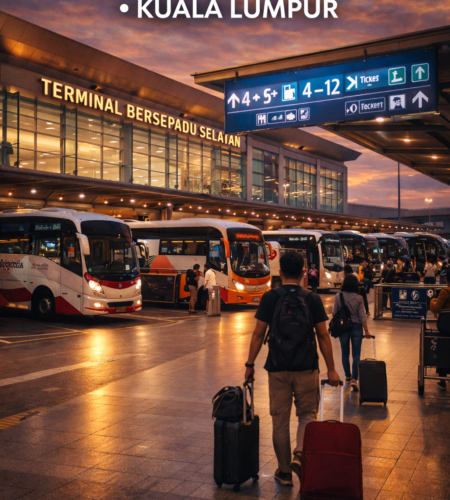
If you search for a Central Bus Terminal Kuala Lumpur, you’ll quickly realize Kuala Lumpur works a bit differently: there isn’t one single “grand central” for every bus. Instead, Terminal Bersepadu Selatan (TBS) is the main hub for long-distance/express buses, while Pudu Sentral remains important for some local/short-distance routes in the city centre.
What is “the” central bus terminal in Kuala Lumpur?
✅ TBS (Terminal Bersepadu Selatan) — the main express-bus terminal
TBS is widely treated as Kuala Lumpur’s primary terminal for intercity express buses and is part of the TBS–BTS integrated transport hub in Bandar Tasik Selatan. Its official address is Jalan Terminal Selatan, Bandar Tasik Selatan, 57100 Kuala Lumpur (customer service phone listed as +603-9051 2000).
Good news for travelers: TBS is integrated with rail, so you can arrive by LRT / KTM Komuter / KLIA Transit and walk into the terminal via the hub connections.
🏙️ Pudu Sentral — city-centre terminal (mainly local service)
Pudu Sentral (formerly Puduraya) is in the city centre on Jalan Pudu and is described as the main local service bus terminus, with long-distance services largely shifted to TBS. It’s also reachable via nearby Plaza Rakyat (LRT) and Merdeka (MRT) connections.
🧭 Important 2025+ note: East Coast routes may use Terminal Bersepadu Gombak (TBG)
In recent years, Kuala Lumpur has been decentralizing terminals. Terminal Bersepadu Gombak (TBG) has been positioned as a key gateway for East Coast trips (Pahang, Terengganu, Kelantan), according to Bernama reporting.
So: always check the terminal printed on your ticket (TBS vs TBG vs Pudu Sentral).
Which terminal should you use? (fast decision guide)
✅ Use TBS if you’re going to:
- Melaka, Johor Bahru, Singapore-bound services (often), Ipoh, Penang (often), many long-distance routes
- You want a cleaner, more organized terminal experience
- You’re coming from the airport by train (KLIA Transit)
✅ Use Pudu Sentral if you’re:
- Staying around the city centre and your route/operator specifically departs there
- Taking certain local/short-distance services
✅ Use TBG (Gombak) if your ticket says it (commonly East Coast focus):
How to get to TBS (Terminal Bersepadu Selatan)
🚆 By rail (the easiest way)
TBS is integrated with Bandar Tasik Selatan (BTS), an interchange station served by:
- KLIA Transit (airport rail link)
- KTM Komuter
- RapidKL LRT Sri Petaling Line
…and it’s described as an intermodal hub integrated with TBS.
✈️ From KLIA / KLIA2 (fast + reliable)
Take KLIA Transit and get off at Bandar Tasik Selatan (it’s an official stop on the line), then transfer into TBS via the hub connection.
Why this is great: you avoid city-centre traffic and arrive directly at the bus hub.
🚖 By taxi / ride-hailing
TBS lists taxi/pick-up facilities and official contact support; if you’re carrying lots of luggage, Grab/taxi can be convenient—just aim for the correct entrance/level for departures.
Hours, late-night travel & what’s open
TBS is promoted as OPEN 24/7 (official TBS social media post/video).
That said, shops/food outlets may not be 24/7, so for very late buses bring water/snacks and arrive early to locate your gate.
Tickets: how to buy, check in, and avoid hassle
🎟️ Buying tickets
For Malaysian intercity buses, you typically buy either:
- At the terminal counters, or
- Online (operator/aggregator) and then present the booking at the departure gate.
Best practice: your ticket should clearly show terminal + operator + departure platform/gate. If it says TBS, do not go to Pudu Sentral (and vice versa).
🧠 Anti-scam tips (very important)
- Ignore random “helpers” offering last-minute tickets or “better buses.”
- Stick to official counters / official booking references.
- Keep your phone and passport secure, especially in crowded departure halls.
(These are general travel-safety practices; TBS was specifically designed to reduce city-centre congestion and centralize long-distance operations away from older terminals. )
How to get to Pudu Sentral (city centre)
Pudu Sentral’s address is Jalan Pudu. It’s described as accessible via Plaza Rakyat (LRT) and Merdeka (MRT), which makes it convenient if you’re staying near Bukit Bintang/Chinatown and your route still departs there.
If you’re visiting UTC (government services) inside the complex, note that UTC has its own posted operating hours (separate from bus operations).
Quick packing list for bus travel in Malaysia (comfort + safety)
- ✅ Screenshot/print your ticket + terminal name (TBS/TBG/Pudu)
- ✅ Light jacket (A/C can be cold)
- ✅ Water + snack for late departures
- ✅ Power bank + cable
- ✅ Small lock (if you use luggage storage)
- ✅ Buffer time: arrive 30–60 minutes early for first-time departures
FAQ
Is there one “Central Bus Terminal Kuala Lumpur”?
In practice, TBS is the main terminal for long-distance buses, while Pudu Sentral serves more local/short-distance routes and some specific operators.
How do I get from KLIA to the bus terminal?
Take KLIA Transit to Bandar Tasik Selatan, which is a listed stop, and the station is integrated with TBS.
I’m going to the East Coast — do I always use TBS?
Not always. Terminal Bersepadu Gombak (TBG) has been described as a key East Coast hub in recent reporting, so check what your ticket says.
Conclusion
For most travelers, the “Central Bus Terminal Kuala Lumpur” you want is TBS (Terminal Bersepadu Selatan)—a 24/7 integrated hub connected to LRT/KTM/KLIA Transit via Bandar Tasik Selatan. Keep Pudu Sentral in mind for city-centre/local routes, and watch for TBG if your destination is the East Coast.
Comments