
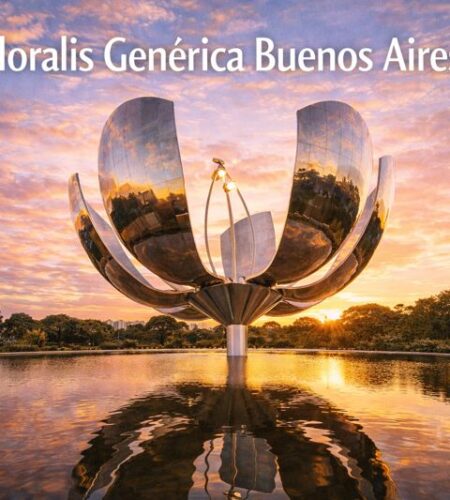
Floralis Genérica Buenos Aires is one of the city’s most memorable “quick wins”: a giant stainless-steel flower in Plaza de las Naciones Unidas that actually moves—opening its petals in the morning and closing them at night. It’s free, outdoors, easy to combine with Recoleta/Palermo sightseeing, and looks completely different depending on light, weather, and whether the petals are open.
Why Floralis Genérica Buenos Aires is worth a stop ✅
It’s kinetic public art (not just a statue) 🌸⚙️
The official city tourism site describes Floralis Genérica as a 20-meter-high, 18-ton aluminium-and-stainless-steel sculpture that opens and closes using hydraulics and photoelectric sensors—a rare example of “engineering + art” in the middle of a park.
It’s designed for the sky (and for photos) 📸
It sits on a reflecting pool, and the metal petals mirror clouds, sunset colors, and surrounding greenery—meaning you can get “wow” shots even with a phone.
Quick facts (useful for your itinerary) 📍
- Location: Plaza de las Naciones Unidas, Av. Pres. Figueroa Alcorta 2301
- Unveiled: 2002
- Creator: Argentine architect Eduardo Catalano (donated to the city)
- Signature feature: petals open/close daily + safety closing in high winds
When to visit Floralis Genérica Buenos Aires ⏱️ (the “petal schedule”)
The official tourism listing gives the most practical detail travelers care about:
- Petals open: 8:00 AM
- Petals close: midnight
- High winds: petals may close to protect the sculpture
- Patriotic holidays: petals remain open all day
Best timing by goal (simple table) ✅
| Your goal | Best time | Why it works |
|---|---|---|
| See it fully open 🌸 | 8:00–10:00 | You catch the opening window + calmer park vibe. |
| The best photos 📸 | Golden hour → blue hour | Reflections + dramatic sky on the metal petals. |
| “Night landmark” vibe 🌙 | Evening (before midnight) | Petals still open until midnight (weather permitting). |
| Avoid crowds 🚶 | Weekday morning | Fewer people in frame. |
⚠️ Common mistake: people arrive late at night expecting it to be open forever—midnight is the normal closing time for the petals.
What to do there (so it’s not just a 2-minute stop) ✅
1) Walk the full loop for different angles 🚶♂️
Floralis is designed to be seen from multiple perspectives. Do one slow lap:
- Front reflection shot from the pool edge (classic)
- Side angle where petals look taller and more “architectural”
- Wide shot from farther back to include skyline/trees
2) Watch for the “mirror” effect 🌥️
On partly cloudy days the petals reflect the sky like giant curved screens. This is when Floralis looks most “alive,” even if it’s not moving.
3) Use it as a “connector stop” for nearby areas 🗺️
Because it’s in Recoleta’s museum/park zone, it’s easy to pair with a longer neighborhood walk (museums, parks, cafés) without adding much travel time.
How to get there 🚇🚌🚖
By Subte (metro) 🚇
The easiest metro strategy is Line H to Fac. de Derecho station. Emova’s official station list confirms “FAC. DE DERECHO” is on Line H.
From there, it’s a short walk to Plaza de las Naciones Unidas and the sculpture.
✅ Pro tip: Before you head out, check the city’s official Subte status page if you want to avoid surprise service changes (it lists line status including Line H).
By bus 🚌
Buses run along the surrounding avenues (Figueroa Alcorta / Libertador area). If you’re already using buses a lot, just route to “Plaza de las Naciones Unidas” or “Floralis Genérica” in your map app and hop off nearby.
By taxi / ride apps 🚖
Use the exact destination:
“Floralis Genérica, Av. Pres. Figueroa Alcorta 2301”.
This is the simplest option at night or in very hot weather.
Hours / Operating times ⏱️
Floralis Genérica is outdoors in a public plaza, so you can see it any time. What matters is the petal schedule:
- Open at 8:00 AM
- Close at midnight
- May close in strong wind
- Patriotic holidays: open all day
Tickets / prices 💳
✅ Free. It’s a public outdoor attraction (no ticket needed). (The official tourism listing presents it as a public landmark in the city.)
Tips and common mistakes (real-world) ✅⚠️
✅ Do this
- Arrive close to 8:00 AM at least once during your trip if you want the “fully open” look in clean morning light.
- Bring a wide lens / use 0.5× on your phone—Floralis is huge and close-up shots can feel cramped.
- Use reflections: step low near the water line to double the sculpture in-frame.
⚠️ Avoid this
- Assuming it’s always open: petals can close in high winds, and they normally close at midnight.
- Planning it as your “only” Recoleta stop: Floralis is best as a highlight inside a bigger neighborhood route (it’s fast—don’t over-allocate time).
- Going mid-day for photos: harsh sun can flatten reflections and blow highlights on the metal (unless it’s cloudy).
Mini itineraries (copy/paste) 🧭
Option A: “Quick landmark” (20–40 min) ✅
Floralis → full lap around the pool → 5–10 photos from different angles → continue walking.
Option B: “Golden hour plan” (60–90 min) 🌇
Arrive before sunset → shoot reflections → wait for blue hour → leave before it gets too late.
Option C: “Museum district walk” (half-day) 🏛️🌿
Start at Floralis in the morning → walk through the nearby green areas → add one museum/café stop (Recoleta/Palermo zone).
FAQ ❓
What time does Floralis Genérica open and close?
The petals open at 8:00 AM and close at midnight.
Does it ever close during the day?
Yes—petals can close in high winds for protection.
Where exactly is Floralis Genérica?
Av. Pres. Figueroa Alcorta 2301, Plaza de las Naciones Unidas.
Who created Floralis Genérica?
It was donated to Buenos Aires by architect Eduardo Catalano and unveiled in 2002.
Is it free to visit?
Yes—it’s an outdoor public landmark.
Conclusion
Floralis Genérica Buenos Aires is the perfect “small effort, big payoff” stop: iconic, free, and visually striking—especially when the petals are open and the sky is dramatic. Plan around the 8:00 AM opening or sunset light, and keep wind in mind, since the sculpture can close for safety.
Comments