
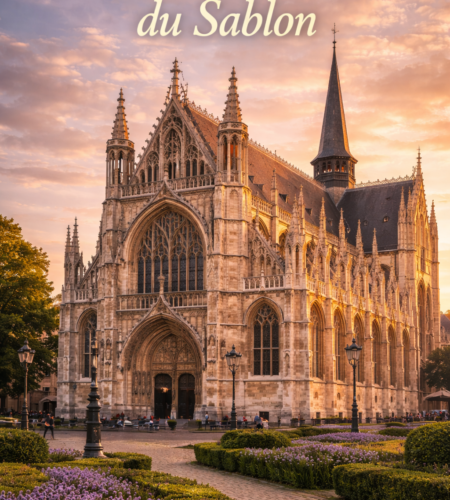
Notre-Dame du Sablon (also known as Église Notre-Dame des Victoires au Sablon) is the church in Brussels that feels “crafted” rather than merely old: airy Brabant-style Gothic proportions, a remarkable stained-glass atmosphere, and a location that drops you straight into the Sablon’s best strolls (antiques, chocolatiers, and small squares). Notre-Dame du Sablon is easy to visit on foot from the city centre, usually free to enter, and genuinely rewarding even if you’ve already seen Brussels’ main cathedral.
Why Notre-Dame du Sablon is worth it ✅
A “textbook” example of Brabant Gothic (but warmer and more intimate)
Visit Brussels describes Notre-Dame du Sablon as a precious example of Brabant “ogival” art and highlights its architecture and numerous stained-glass windows.
Built by Brussels’ crossbowmen—and tied to a long, layered history
The church’s story is tightly linked to Brussels’ medieval guild world. Heritage sources explain that a site here was acquired in 1304 and that a surge in devotion linked to a Virgin statue (traditionally dated to 1348) helped finance the later, larger Gothic church.
The stained glass is the main event (don’t treat it like a “quick peek”)
Inside, the big payoff is the light: tall windows and richly colored panes create an atmosphere that changes hour by hour. Heritage materials note the importance of the large stained-glass windows and that many of the current windows date largely from the 19th–20th centuries (with only rare older fragments remaining).
What to see inside Notre-Dame du Sablon 🗺️
1) The stained-glass windows (take your time) 🌈
Do one slow pass down the nave, then stop and look back toward the light. If the church feels “quietly spectacular,” it’s the windows doing the work.
2) The Thurn und Taxis chapels (Sainte-Ursule + Saint-Marcou) 🏛️
Visit Brussels notes that several members of the Thurn und Taxis family are buried here (notably connected with the Saint Ursula chapel). Heritage descriptions also highlight the two major chapels and their Baroque sculptural richness.
3) “Look for the guild feeling”
This wasn’t designed as a lone monument—it’s a civic-religious space tied to the city’s military guilds and later patrons. Knowing that context makes the interior details feel intentional rather than random.
A practical Notre-Dame du Sablon visit plan (30–75 minutes) ⏱️
| Time | Route | Best for |
|---|---|---|
| 30–40 min | Enter → slow nave pass → stained glass → exit to Sablon squares | “I want one beautiful church” |
| 60–75 min | Add chapels + second stained-glass loop + short sit in a side aisle | Architecture + atmosphere lovers |
| +30–60 min | Pair with Petit Sablon / Grand Sablon stroll | Turning it into a mini-neighbourhood walk |
How to get there 🚇🚌🚶♂️
By public transport (STIB/MIVB) 🚇🚌
The easiest move is to route to the Sablon / Petit Sablon area using STIB’s official trip planner.
Tram tip: trams (including line 92) are commonly used to reach the Sablon zone, but stops can be affected by works—STIB publishes temporary changes (for example, around Rue de la Régence / “Petit Sablon”). Always check the planner on the day.
On foot (often the best experience) 🚶
Notre-Dame du Sablon sits in a very walkable “Upper Town” zone. If you’re already around the historic centre, walking here is part of the charm (and helps you naturally combine it with museums, squares, and chocolate stops).
Taxi / rideshare 🚕
Useful in rain or if you’re moving between districts fast—just note central Brussels traffic/one-way patterns can be slow.
Hours / Operating times ⏱️
According to the church’s own “Friends Fund” site, Notre-Dame du Sablon is open daily, typically:
- Mon–Fri: 10:00–18:00
- Weekends: 09:00–18:00
⚠️ Reality check: churches may restrict tourist movement during services or special events. If you arrive during a Mass, treat it as “quiet observation” time and return later for photos.
Tickets / prices / cards 💳
Entry to Notre-Dame du Sablon
Entry is generally free of charge, and the church site notes it welcomes visitors free (donations appreciated).
Getting there: the one cost most visitors pay (STIB fares)
If you pay contactless on STIB (bank card/phone/watch):
- €2.40 per journey
- Free transfers within 60 minutes
- Daily cap: €8.50
Ticket table (simple choices):
| Option | Price | When it’s best |
|---|---|---|
| STIB 1 journey | €2.40 | Simple one-off rides |
| Contactless (tap to travel) | €2.40 + daily cap €8.50 | Fastest, no ticket machine |
| Brupass 1 journey | €2.70 | If you specifically need Brupass coverage |
(Prices shown in EUR — local currency in Belgium.)
Tips / common mistakes ✅⚠️
✅ Time your visit for the light
If stained glass is your priority, aim for late morning to afternoon when daylight is strong. The church feels completely different depending on sun/clouds.
⚠️ Treating it as a 5-minute stop
Notre-Dame du Sablon rewards a slow pace. Do at least one “walk down → walk back” loop so the geometry and windows register.
✅ Pair it with the Sablon neighbourhood
The church is the anchor; the Sablon atmosphere is the bonus. Plan a small loop: church → nearby squares → coffee/chocolate → continue on foot.
⚠️ Ignoring transport disruptions
Tram stops in the area can be temporarily altered due to works; STIB publishes updates—check the planner before you leave.
FAQ
Is Notre-Dame du Sablon free to enter?
Generally yes—visitor entry is free (donations appreciated).
What’s the #1 thing to see inside?
The stained-glass windows and the way they light the space. Visit Brussels explicitly highlights the windows as a key reason to enter.
How long do I need?
30–40 minutes for a “highlights” visit; 60–75 minutes if you want a proper slow loop + chapels + quiet sit.
Is it historically important in Brussels?
Yes—heritage sources describe it as one of the capital’s major late Gothic buildings, with a history starting from a 1304 site and a major 15th-century reconstruction.
Conclusion
Notre-Dame du Sablon is Brussels at its most refined: a Gothic church built from guild history, shaped by centuries of patronage, and best experienced through its stained-glass light. Keep it simple—arrive when daylight is strong, walk the nave twice, linger by the chapels, then continue your day on foot through the Sablon’s squares.
Comments