
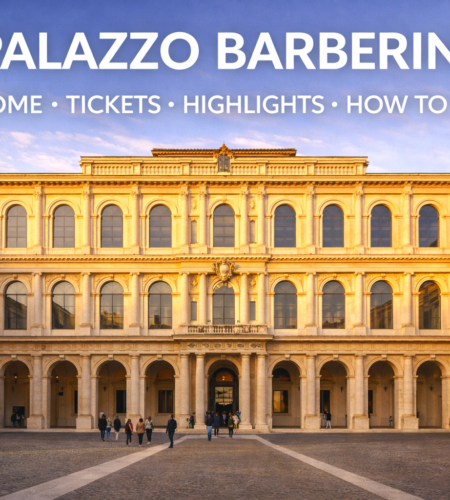
Palazzo Barberini is one of the best places in Rome to do two things at once: experience a landmark Baroque palace and see a world-class painting collection in a setting that was designed to impress. From the moment you step into the grand halls, you’re walking through a building shaped by three giants of 17th-century architecture—Carlo Maderno, Gian Lorenzo Bernini, and Francesco Borromini—and filled with masterpieces spanning centuries.
Below is a practical, no-fluff guide to planning your visit: what to see, how long to stay, how tickets work, and common mistakes to avoid. ✅
Why Palazzo Barberini is worth it ✅
If you’re choosing between Rome’s “big-name” stops, Palazzo Barberini often gets overlooked—and that’s exactly why it can be such a great experience.
What makes it special:
- 🏛️ The building itself is the attraction: an iconic Baroque “prototype” palace with dramatic staircases and grand spaces.
- 🖼️ A serious art collection (13th–18th centuries), including major names like Raphael and Caravaggio.
- 🚶 A central location near Piazza Barberini, Trevi Fountain, and the Spanish Steps—easy to combine in one day. 📍
Palazzo Barberini highlights (what not to miss) 🎯
Palazzo Barberini rewards visitors who come with a simple plan. Use this shortlist as your “must-see” route:
1) The palace architecture (don’t rush the first 15 minutes)
- The palace layout is famously shaped like an “H”, with wings connected by a central hall—an innovative plan that blends an urban palace with a garden-facing villa concept.
- Two contrasting staircases are a highlight:
- Bernini’s grand, square-shafted staircase (monumental, ceremonial).
- Borromini’s oval helicoidal staircase (more intimate, sculptural).
2) Pietro da Cortona’s ceiling fresco 🎨
In the great hall, look up for one of Rome’s most celebrated Baroque ceilings: “The Triumph of Divine Providence”, frescoed by Pietro da Cortona (with his workshop) in the 1630s. It’s a defining example of theatrical Baroque illusionism.
3) Painting “power rooms” 🖼️
The collection includes works ranging from medieval to late Baroque. Official museum materials highlight major masterpieces such as Raphael’s La Fornarina and Caravaggio’s Judith and Holofernes among the standout works associated with Palazzo Barberini.
Suggested visit time ⏱️
Here’s a practical rule of thumb:
| Your style | Time inside | Best for |
|---|---|---|
| “Highlights only” | 60–90 min | You want the palace + a curated art loop |
| Balanced visit | 2–2.5 hrs | Most travelers (recommended) |
| Art-focused | 3+ hrs | You read labels + follow themes/periods |
Tip: If you also plan Galleria Corsini (same ticket validity), split them across different days. 🗓️
How to get there 🚇🚌📍
Address: via delle Quattro Fontane, 13 – Rome
Public transport:
- 🚇 Metro: Line A → Barberini stop (very convenient)
- 🚌 Bus: 53, 61, 62, 63, 80, 81, 83, 160, 492, 590
Walkable combos:
- From Trevi Fountain: ~10–15 minutes uphill-ish.
- From Spanish Steps: ~10 minutes.
- From Termini: doable on foot (~20–25 minutes) or fast by metro/bus.
Hours / operating times ⏱️
Palazzo Barberini is open:
- Tue–Sun: 10:00 AM – 7:00 PM
- Mon: Closed
- Ticket office closes: 6:00 PM
- Closed on: Dec 25 and Jan 1
⚠️ Accessibility note: The official site has posted notices such as “The lift is temporarily out of order” at times—worth checking before you go if you rely on elevator access.
Tickets / prices / what the ticket includes 💳
Standard ticket structure
The official ticket listed for Palazzo Barberini is a combined ticket:
- 🎟️ Full ticket: €15
- 🎟️ Reduced (EU 18–25): €2
- 🎟️ Reduced Metrebus card: €12
- ✅ Ticket includes Palazzo Barberini + Galleria Corsini
- ⏳ Ticket validity: 20 days
Free admission (key rules)
The official site lists multiple free-entry categories (e.g., under-18s; certain students/faculty in relevant fields; people with disabilities + one companion; guides with valid ID; etc.).
Also:
- 🆓 The museum notes free Sundays (first Sunday of the month) and recommends booking in advance for those days and other special free days.
- Some “free Sunday” initiatives may have exhibit exclusions depending on the program (for example, the site notes that certain exhibitions may not be included in free-entry programs).
Practical tips (and common mistakes) ✅⚠️
✅ Do this
- Arrive early (10:00–11:00) for quieter rooms and better photos (where allowed).
- Look up: the ceiling fresco experience is a top-tier “Rome moment.”
- Use the 20-day ticket validity to split Barberini + Corsini across two different days.
- Travel light: cloakroom rules are strict—large bags and umbrellas must be checked, and luggage/suitcases aren’t admitted.
⚠️ Avoid this
- Showing up late thinking you have lots of time: the ticket office closes at 6 PM, and you’ll want at least 60–90 minutes inside.
- Underestimating the palace: many people treat it like “just a gallery” and miss the architecture and staircases.
- Assuming pets are allowed: dogs are generally forbidden except guide dogs (and specific certified cases).
FAQ
Is Palazzo Barberini the same as the National Gallery of Ancient Art?
Palazzo Barberini is one of the sites housing the national collection (often referred to as the national “ancient art” galleries in Rome). The official site presents it as a key venue of the Gallerie Nazionali Barberini Corsini.
Does my ticket include Galleria Corsini?
Yes—Palazzo Barberini + Galleria Corsini are included, and the ticket is valid for 20 days.
What’s the easiest way to get there?
Metro Line A to Barberini is the simplest route for most visitors.
When is the last time I can enter?
The museum lists hours until 7 PM and notes the ticket office closes at 6 PM—plan to arrive well before 6 to actually enjoy the visit.
Are free Sundays available?
The site references free Sundays (first Sunday of the month) and recommends booking ahead.
Conclusion
Palazzo Barberini is one of Rome’s smartest “culture picks” if you want a high-impact museum experience without the crush of the Vatican or the Colosseum. You get architectural drama, a serious painting collection, and a location that fits perfectly into a central Rome walking day—all with a ticket that can also cover Galleria Corsini over the next 20 days.
Comments