
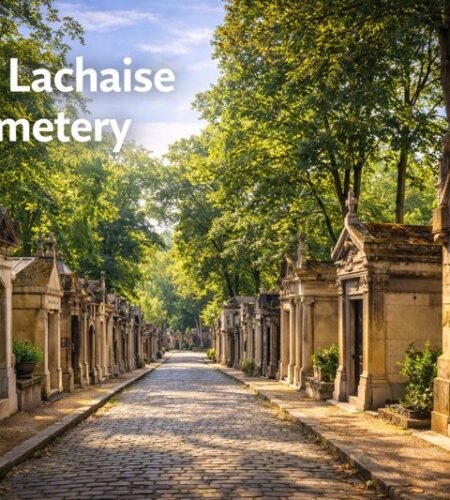
Visiting Père Lachaise Cemetery is one of the most unforgettable “Paris experiences” that isn’t a museum, a tower, or a boulevard. This is a real, active cemetery—quiet, atmospheric, and surprisingly beautiful—where romantic mausoleums, leafy paths, and centuries of history sit side by side. The City of Paris describes it as an official site that hosts around 10,000 funerary ceremonies per year and welcomes around 3 million visitors annually, so it’s essential to treat it with respect while you explore.
Why visit Père Lachaise Cemetery?
Père Lachaise Cemetery is famous for three reasons:
- A “city within a city” vibe 🕯️: winding lanes, chapels, family vaults, sculpture, and hidden corners that feel cinematic.
- Cultural history 📚🎭: it’s often called an open-air “pantheon” because of the many notable figures buried here (writers, artists, musicians, scientists).
- A surprisingly green walk 🌿: the City of Paris notes you’ll be walking real distances—about 15 km of alleys—so plan your time and shoes accordingly.
How to get there (metro, bus, walking) 🚇🚌📍
The cemetery has several entrances, and choosing the right one saves a lot of time (and uphill walking).
Best entrances (practical pick)
Here are the most useful gates for visitors:
| Entrance | Address | Best for | Nearby Metro / Bus |
|---|---|---|---|
| Main entrance (Porte principale) | 28 ter bd de Ménilmontant | First-time visitors, easiest orientation | Metro Philippe Auguste or Père-Lachaise; Bus 61/69/71 (Roquette–Père-Lachaise) |
| Porte Gambetta | 55–57 rue des Rondeaux | Columbarium/crematorium side; useful access | Metro Gambetta; several bus options listed by the City of Paris |
| Porte du Repos | 16 rue du Repos | Close to the cemetery administration (“conservation”) | Metro Philippe Auguste; Bus 61/69/71 |
Accessibility note ♿
The City of Paris explicitly warns that some paths are uneven (old paving stones or dirt) and that Amandiers and Réunion entrances involve stairs and are not accessible for visitors with reduced mobility.
Quick route ideas (no stress)
- From the Louvre: Metro to Père-Lachaise or Philippe Auguste, then walk to the Main entrance (choose the route that minimizes transfers).
- From Eiffel Tower / Trocadéro area: take Metro across the city to Philippe Auguste or Père-Lachaise (Main entrance is the simplest first visit).
- From Gare du Nord: Metro toward Père-Lachaise / Philippe Auguste; it’s usually straightforward with 1–2 transfers depending on line status.
(Tip: once inside, the cemetery is big—picking the closest entrance to the graves you care about matters more than shaving 5 minutes on the Metro.)
Hours / operating times ⏱️
Père Lachaise Cemetery hours vary by season and day of week. The City of Paris publishes date-based schedules; for example, it lists the period 06/11/2025 → 15/03/2026 as:
- Mon–Fri: 08:00–17:30
- Sat: 08:30–17:30
- Sun: 09:00–17:30
Two critical details from the official page:
- Evacuation starts 15 minutes before closing, and no visitors are admitted from that moment.
- The cemetery is described as open 7 days a week year-round, including public holidays (always double-check hours before you go).
Tickets / prices 💳
Good news: entry is free. The City of Paris states that access is “libre et gratuite” (open and free).
If you want a guided experience, the City of Paris also runs reservation-only guided visits/events at times (availability varies).
How to visit Père Lachaise Cemetery (the smart way) ✅
1) Get a map before you wander 🗺️
This is the #1 difference between a “meh” visit and a great one.
The City of Paris highlights:
- Downloadable plans
- An interactive map that can geolocate notable graves and key facilities (toilets, crematorium, etc.)
2) Choose a time budget (realistic routes)
Because it’s huge, plan your visit like a mini-hike.
⏱️ 60–90 minutes (quick highlights)
- Enter at Main entrance
- Pick 3–5 graves/monuments you care about most
- Use the interactive map and don’t try to “see everything”
⏱️ 2–3 hours (best first visit)
- Main entrance → wander through a few themed areas → exit via the closest gate to your last point
- Add time for photos and navigation
⏱️ Half day (for architecture + atmosphere lovers)
- Slow walk, focus on sculpture/chapels + a curated “notables” list
- Include breaks (outside the cemetery—see rules below)
3) Expect hills and uneven paths 👟
Even if you’re not doing a “full loop,” you’ll walk a lot. Wear shoes that handle cobblestones and slopes.
Rules and etiquette (don’t get kicked out) ⚠️
This is an active cemetery, not a park. The City of Paris lists clear prohibitions, including:
- No alcohol
- No picnicking
- No loud music / sound devices
- No pets (even on a leash)
- No bikes or scooters (even walked by hand)
- No jogging / sports
- No “games” like treasure hunts or escape games
Also, it reminds visitors to be discreet because funerals happen daily.
On-site facilities 🚻
From the City of Paris practical info:
- Toilets: yes (including accessible toilets at several gates)
- Wi-Fi: no
- Pets: not allowed
Bring water, but plan to take breaks outside the cemetery (since picnicking is prohibited).
Tips and common mistakes (what people do wrong) ✅⚠️
✅ Tip: Start with “why” (not with a random famous grave)
Before you enter, decide your priority:
- Famous graves 🎸📚
- Funerary art & sculpture 🗿
- Nature + quiet walk 🌳
- Photography 📷 (respectful, no disruptions)
Then build a short list and route around it.
⚠️ Mistake: Arriving too close to closing
Remember: they start clearing the site 15 minutes before closing and stop admissions then.
If you want a calm visit, arrive earlier in the day.
✅ Tip: Use the right entrance for your plan
Want less walking? Choose the entrance nearest your top targets and exit from a different gate if it saves time.
⚠️ Mistake: Treating it like a park
The City of Paris explicitly frames this as a place requiring quiet and respect—avoid “tourist-mode noise,” phone speakers, or staged antics.
✅ Tip: Visit on a weekday morning for the best atmosphere
Weekends can be busy. Weekday mornings tend to feel more contemplative (and you’ll navigate more easily).
FAQ about Père Lachaise Cemetery
Is Père Lachaise Cemetery free?
Yes—entry is free according to the City of Paris.
What are the opening hours?
Hours depend on season and day. The City of Paris publishes schedules by date ranges (and notes evacuation begins 15 minutes before closing).
Which entrance should I use?
For most first-time visitors: Main entrance (Boulevard de Ménilmontant). If you’re planning around specific areas, choose the nearest gate (Main, Gambetta, or Repos are the most practical).
Is it accessible for wheelchairs/strollers?
Parts are accessible, but the City of Paris warns that some paths are narrow/uneven and that certain entrances require stairs (not accessible).
Can I bring food or a coffee?
Picnicking is prohibited, and alcohol is prohibited. Plan breaks outside the cemetery.
Conclusion
Père Lachaise Cemetery is one of Paris’s most powerful places—part history museum, part sculpture garden, part living memorial. Go with a plan (map + entrance choice), give yourself enough time, follow the rules, and you’ll leave with the kind of “quiet Paris” memory that most tourists never find. 🌿🕯️
Comments