
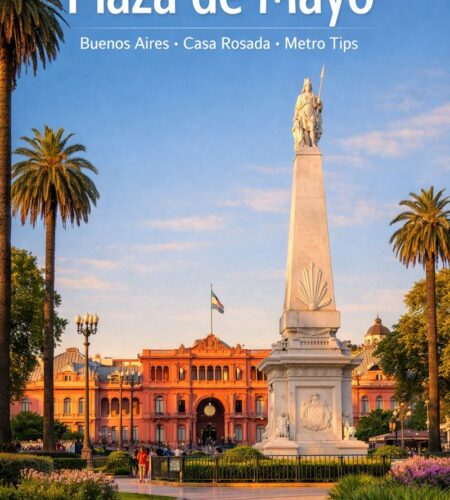
If you’re visiting Plaza de Mayo Buenos Aires, you’re standing in the city’s oldest public square—and in one of the most politically and historically “loaded” places in Argentina. It has been the stage for key moments from the city’s second founding (1580) and the May Revolution (1810) to modern mass demonstrations.
This guide is designed for a real visit: what to see in and around the square, how to get there by metro (Subte), what’s free, opening hours for the key buildings, and the common mistakes tourists make.
Why Plaza de Mayo Buenos Aires matters 📍 (in 2 minutes)
Plaza de Mayo is named after the revolution that began on May 25, 1810, a turning point on the road to Argentina’s independence.
What makes it unique isn’t just age—it’s how the square still functions as the country’s “public living room”:
- It’s surrounded by landmark buildings (Casa Rosada, the Metropolitan Cathedral, the Cabildo, major institutions).
- It has hosted iconic political gatherings for more than a century, including famous balcony moments at Casa Rosada.
- Since 1977, the Mothers of Plaza de Mayo have met and marched around the May Pyramid every Thursday at 3:30 pm (a tradition that continues).
Location note: Official city tourism listings place Plaza de Mayo at Hipólito Yrigoyen Ave. & Balcarce.
What to see around Plaza de Mayo Buenos Aires 🏛️ (best “one-loop” walk)
Think of the square as a hub. A simple loop gives you the highlights without getting lost in “government building overload.”
1) Casa Rosada (outside + balcony view)
This is the famous pink presidential palace facing the square—photogenic at almost any hour, especially in late afternoon light. The official tourism page lists it as one of the defining buildings around the plaza.
Best photo angles ✅
- From the center of the square looking toward Casa Rosada (classic postcard shot).
- From the side paths with trees/flowerbeds for depth.
2) Museo Casa Rosada (free museum)
If you want context (not just photos), this museum is the easiest “high value” stop near the plaza.
What’s practical to know:
- Open Wednesday–Sunday, 11:00–18:00 (last entry 17:30)
- Free entry, and no reservation required
- Closed Monday–Tuesday
3) Museo Nacional del Cabildo y de la Revolución de Mayo (the Cabildo museum)
The Cabildo is one of the most important colonial-era landmarks on the square—and it’s very visitor-friendly.
Plan it like this:
- Address: Bolívar 65
- Open Wednesday–Sunday, 10:30–18:00
- Closed Monday–Tuesday
- Free entry
If you like structured visits, the Cabildo also publishes specific guided tour times (which can save you time if you arrive right before a tour).
4) Catedral Metropolitana de Buenos Aires (cathedral + mausoleum)
Even if you’re not into churches, this is one of the most important historic interiors right on the plaza, and it’s directly tied to Buenos Aires history (the official tourism page highlights its long construction history and its significance).
Visitor hours (as listed by the city tourism site):
- Mon–Fri: 08:00–19:00
- Weekends: 09:00–19:30
5) The May Pyramid (Pirámide de Mayo) 🗿
The central monument is a key reference point—especially if you’re trying to orient yourself quickly. The official tourism page also notes that the Mothers march around it every Thursday.
A simple self-guided route (45–90 minutes) 🚶♂️
Start at the center of the square → photo Casa Rosada → walk toward the Cathedral → cross to the Cabildo side → finish back in the center for wide shots.
Quick timing ideas ⏱️
- 45 minutes: photos + exterior loop only
- 75 minutes: add Cathedral interior
- 90+ minutes: add Cabildo museum (or Museo Casa Rosada)
How to get to Plaza de Mayo Buenos Aires 🚇🚌🚖
By metro (Subte) 🚇
This is the fastest, least stressful way to arrive (especially on weekdays).
Closest stations you’ll actually use:
- Plaza de Mayo (Line A)
- Catedral (Line D)
- Bolívar (Line E)
If you’re aiming for the square itself, “Plaza de Mayo” (Line A) is the most direct.
Accessibility & services (useful detail): Emova lists Plaza de Mayo station as accessible and notes services like SUBE card sales, top-up terminals, and bathrooms.
Subte operating start times (network-wide):
- Mon–Fri: from 05:30
- Sat: from 06:00
- Sun/holidays: from 08:00
⚠️ Real-life tip: service patterns can change for works/events. Before you rely on a specific station entrance, check Emova or the city’s Subte pages for notices.
By bus (colectivo) 🚌
Plaza de Mayo sits in a dense central area with lots of bus routes. If you’re staying in Microcentro, San Telmo, or Monserrat, a bus can be easy—but traffic can be slow.
Payment: For bus and Subte, the tourist site recommends using a rechargeable SUBE travel card.
By taxi / ride-hailing 🚖
Good if you’re carrying bags or traveling late. In central Buenos Aires, taxis are everywhere—but use normal big-city caution (meter on, official taxi, avoid “random offers” near tourist hotspots).
✈️ Airport connections to Plaza de Mayo Buenos Aires
Buenos Aires has multiple airports. The city tourism site notes:
- Taxis are readily available at all airports.
- You can book private transfers.
- A shuttle bus service (Tienda León) runs from Ezeiza to the city (Puerto Madero).
Practical strategy (simple + reliable) ✅
- Airport → downtown/Microcentro or Puerto Madero (taxi / shuttle / transfer)
- Then hop on the Subte to Plaza de Mayo (often faster than staying in surface traffic)
Tickets, prices & travel cards 💳
Plaza de Mayo itself
- Free (it’s a public square)
Museums near the square (best value: free)
Here’s a quick comparison:
| Place | Typical visit | Hours | Cost |
|---|---|---|---|
| Museo Casa Rosada | 45–90 min | Wed–Sun 11:00–18:00 (last entry 17:30) | Free |
| Cabildo Museum | 45–75 min | Wed–Sun 10:30–18:00 | Free |
| Metropolitan Cathedral | 15–30 min | Mon–Fri 8:00–19:00; weekends 9:00–19:30 | Free (donations may exist) |
Subte fare (and why it may look “weird”)
Buenos Aires uses a tiered monthly fare for Subte with a registered SUBE card (cheaper as you take more rides in a month). The city’s Subte page publishes the current tiers and amounts.
✅ Tip: If you’re staying longer than a couple of days, it’s worth understanding SUBE registration and fare rules—because “registered vs unregistered” pricing can differ a lot.
Tips & common mistakes ✅⚠️
✅ Go early for photos (and calmer vibes)
Midday can be harsh light + crowds. Morning or late afternoon gives you better Casa Rosada shots.
✅ Don’t “only photograph” the plaza—enter at least one interior
Most travelers leave with great photos but zero understanding. Pick one:
- Cathedral (fast)
- Cabildo museum (history)
- Museo Casa Rosada (context + exhibits)
⚠️ Time your museum visits
Museo Casa Rosada has a last entry at 17:30—arrive earlier if you want a relaxed visit.
⚠️ If there’s a demonstration, don’t panic—just reroute
Plaza de Mayo is a traditional gathering point. If there’s an event, walk one block away and approach from a different side street.
✅ Use the Subte for “next stop” sightseeing
From Plaza de Mayo you’re close to multiple lines—perfect for continuing to other neighborhoods without losing time in traffic.
FAQ: Plaza de Mayo Buenos Aires
Is Plaza de Mayo safe to visit?
It’s one of the busiest areas in the city, with heavy police presence during official events. Like any major tourist zone, keep your phone/wallet secure in crowds and avoid flashing valuables.
How long do I need for Plaza de Mayo?
- 30–45 minutes for photos and the loop
- 75–120 minutes if you add 1–2 interiors (Cathedral + one museum)
What are the must-see buildings around the square?
At minimum: Casa Rosada (outside), the Metropolitan Cathedral (inside), and the Cabildo museum if you want colonial history.
When is Museo Casa Rosada open?
Wednesday to Sunday, 11:00–18:00 (last entry 17:30), free entry, no reservation required.
Conclusion
Plaza de Mayo Buenos Aires is not just a “central square”—it’s where Buenos Aires history, architecture, religion, and politics collide in one walkable loop. Do it smart: arrive by Subte, take the classic Casa Rosada photo, then step inside at least one building (Cathedral, Cabildo, or Museo Casa Rosada) so the place becomes more than a backdrop.
Comments