
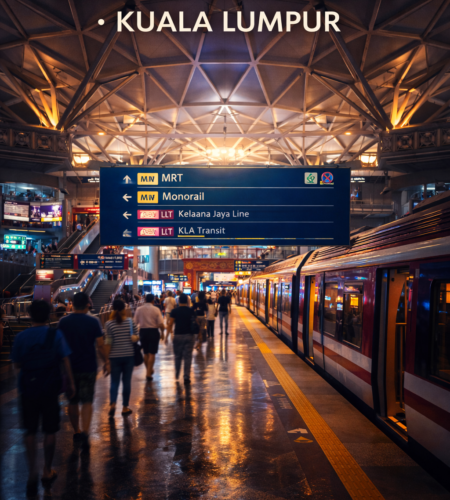
If you’re planning Kuala Lumpur by rail, the good news is simple: most journeys start (or connect) at KL Sentral, and from there you can reach the airport, other Malaysian states, and nearly every major tourist area using MRT/LRT/Monorail + KTM trains.
The 3 stations you must know (tourist-proof)
1) KL Sentral — the #1 rail hub in Kuala Lumpur
KL Sentral Station is the city’s major transit hub. From here you can take:
- KLIA Ekspres / KLIA Transit (airport trains)
- KTM Komuter (commuter rail)
- KTM ETS + Intercity (long-distance trains)
- Urban rail connections: LRT Kelana Jaya Line, MRT Kajang Line, and the Monorail (via walking links)
When to use KL Sentral: airport transfers, intercity travel (Penang/Ipoh/north), or “I just want the easiest connections.”
2) Bandar Tasik Selatan (BTS) / TBS area — best interchange (rail + airport + bus hub)
Bandar Tasik Selatan is a powerful interchange station: it connects KTM Komuter, LRT Sri Petaling Line, and the ERL airport trains (KLIA Transit / Ekspres)—plus it’s integrated with the Terminal Bersepadu Selatan (TBS) bus hub.
When to use BTS: if you’re mixing intercity bus travel with rail, or you want a flexible transfer point south of the city center.
3) Kuala Lumpur Railway Station (historic) — beautiful + useful for KTM Komuter
The classic Kuala Lumpur railway station is a landmark, but today it’s mainly a KTM Komuter stop (long-distance services were diverted to KL Sentral years ago).
When to use it: quick Komuter rides + heritage photos near the old station area.
Airport trains: KLIA → City (fastest, simplest)
KLIA Ekspres (non-stop)
- Runs every 20 minutes all day (typical schedule)
- Travel time: 28 minutes between KL Sentral ↔ KLIA T1, plus 3 minutes between KLIA T1 ↔ KLIA T2
KLIA Transit (stops)
KLIA Transit stops at 3 intermediate stations: Bandar Tasik Selatan, Putrajaya & Cyberjaya, and Salak Tinggi.
Best quick rule:
- Want the fastest airport ride → Ekspres
- Want a stop that helps you transfer (e.g., BTS/TBS or Putrajaya) → Transit
Intercity trains: going beyond Kuala Lumpur (other states)
KTM ETS (Electric Train Service)
ETS is Malaysia’s intercity electric train service, and KL Sentral is a key ETS station and a main starting point for many longer trips.
KTM Intercity
Long-distance KTM services are also referenced as available from KL Sentral as part of the hub’s national connections.
Tip: For intercity trips, plan to arrive early—platforms, gates, and ticket validation can take time during peak travel days.
Commuter rail: KTM Komuter (practical for suburbs + a few tourist routes)
KTM Komuter is the commuter rail network (dozens of stations, multiple lines) used daily by locals for Greater KL travel.
When Komuter helps tourists:
- If your accommodation is near Komuter stations
- If you’re linking KL Sentral to areas outside the city core
- If you prefer fewer transfers than MRT/LRT in certain directions
Urban rail inside KL: MRT, LRT, Monorail (the tourist workhorses)
MRT (Kajang Line highlights)
The MRT Kajang Line includes key stations like Muzium Negara (KL Sentral area), Pasar Seni, Merdeka, and Bukit Bintang—excellent for museum/Chinatown/shopping access.
LRT (Rapid KL)
Rapid KL operates major LRT lines including Kelana Jaya Line and Ampang/Sri Petaling Lines—useful for KLCC and many city districts.
Monorail (Golden Triangle)
The KL Monorail is specifically positioned to link key inner-city destinations and the “Golden Triangle” areas, and it’s part of Rapid KL’s rail system.
Which station should you choose? (fast scenarios)
- Arriving from KLIA / KLIA2 → KL Sentral (then connect anywhere)
- Going to another state by train (ETS / Intercity) → KL Sentral
- Mixing rail + intercity bus → Bandar Tasik Selatan (BTS/TBS)
- Want a heritage station photo + Komuter ride → Kuala Lumpur Railway Station
- Chinatown / Central Market area → Pasar Seni (MRT/LRT)
- Bukit Bintang shopping + Jalan Alor → Bukit Bintang (MRT) or Monorail
Practical tips (saves time + stress)
- Use KL Sentral as your “base hub”: even if your hotel is elsewhere, it simplifies airport + intercity planning.
- Avoid peak commuter time on urban rail if possible (weekday rush hours = packed trains).
- Leave buffer time for transfers at big hubs (KL Sentral and BTS can be large and multi-level).
- For airport trains, check the latest first/last train on the official operator page before late-night travel.
FAQ
Is KL Sentral the same as the old Kuala Lumpur Railway Station?
No. The historic station is a separate landmark, while most long-distance and hub connections operate via KL Sentral.
What’s the fastest way from KLIA to the city?
KLIA Ekspres: non-stop, 28 minutes to KL Sentral (T1), plus 3 minutes between T1 and T2.
Which station is best if I’m taking buses to other cities?
Bandar Tasik Selatan (BTS/TBS) is built as an intermodal hub connecting rail + airport trains + the TBS bus terminal.
Conclusion
For Kuala Lumpur, the “winning setup” is simple: KL Sentral for airport + intercity, MRT/LRT/Monorail for city sightseeing, and BTS/TBS when you mix rail + buses. Once you understand those hubs, KL becomes one of the easiest big cities in Southeast Asia to navigate by rail.
Comments