
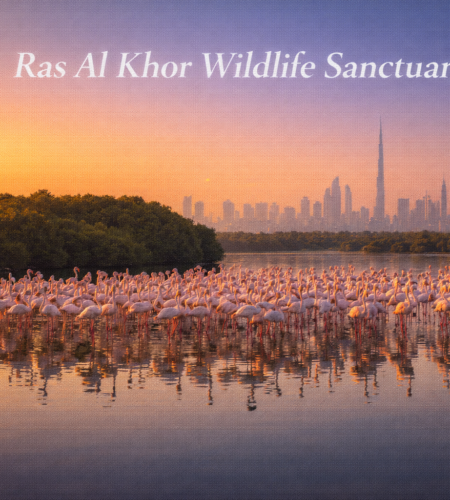
Ras Al Khor Wildlife Sanctuary is one of the rare places in Dubai where you can watch wild flamingos and migratory waterbirds with a skyline in the background. This urban wetland was established in 1985 and was officially declared a protected area on 1 March 1998.
It’s also internationally recognized: the UAE became a Ramsar Convention party in December 2007, and Ras Al Khor Wildlife Sanctuary was designated the UAE’s first Ramsar Site (site 1,715) at that time.
Below is a practical, no-fluff visitor guide: what you can actually see, which hides to use, the official-ish working hours by season, and the easiest way to get there.
What makes Ras Al Khor special (and what you can see) 📍🦩
Ras Al Khor is a 6.2 km² wetland landscape of salt flats, mangroves, mudflats and lagoons, connected to Dubai Creek. It’s recognized as a globally important bird area and a Ramsar-designated wetland.
Wildlife highlights (realistic expectations) ✅
- Greater flamingos are the headline attraction (especially in the cooler season).
- You may also spot herons, egrets, cormorants, stilts, plovers, sandpipers, spoonbills, ospreys and more (species vary by season/tide).
- In winter, the wetland can become dramatically busy: one government source notes 20,000+ waterbirds from 67 species congregating during winter season.
The bird hides (how visiting works) 🔭🚶
You don’t walk into the wetland itself. The visitor experience is built around bird hides positioned on the perimeter—quiet, controlled viewing points designed to avoid disturbing wildlife.
A UAE government page specifically mentions:
- Flamingo Hide (best for flamingo viewing)
- Mangrove Hide (good for different species in mangrove habitat)
…and notes the hides are maintained and equipped with stationary telescopes, stools, and water coolers.
Important update to check before you go ⚠️
Dubai Municipality’s “Book a visit” page (as shown in the official snippet) indicates Mangrove Hide is “temporarily closed.”
Because hide availability can change, always check the latest status before heading out.
Best time to visit (when you’ll actually see birds) 🌡️🦩
Season
The recommended visit season is October to March.
That aligns with peak migratory activity and better weather for long viewing sessions.
Time of day (simple strategy) ✅
- Early morning: cooler air + calmer hides
- Late afternoon: softer light + good photography conditions
- If your goal is flamingos: plan enough time to sit quietly—this is a “watch and wait” place, not a fast attraction.
How to get there 🚇🚌🚕🚗
Ras Al Khor is close to central Dubai, but it’s not a “walk from a big tourist mall” kind of spot. The easiest approaches are:
By taxi / ride-hailing 🚕 (most reliable)
If you want the least friction (and the best chance of arriving with energy), taxi/ride-hailing is usually the smoothest option—especially in summer heat.
By Metro + taxi / water transport 🚇➡️🚕🚤
A credible travel source (Emirates’ Dubai experience guide) suggests:
- Take the Metro to Creek Metro Station, then take a water bus or taxi onward to the sanctuary area.
This is a good “public transport + short last mile” strategy.
By bus 🚌 (possible, but check live routes)
Bus routing can change; if you want a bus-heavy plan, use a live journey planner on the day (RTA journey planner or similar). Community transit directories list multiple bus options in the broader area, but treat those as directional rather than official route guarantees.
By car 🚗
Driving is straightforward for most visitors; the main “gotcha” is arriving at the correct hide access point, then respecting on-site rules (quiet, no disturbance, no off-trail wandering).
Opening hours and working days ⏱️
Hours are seasonal and include a special Friday schedule during summer, per a UAE government page:
| Season | Days | Hours |
|---|---|---|
| Summer | Sat–Thu | 6:00 AM – 6:00 PM |
| Summer | Fri | 2:00 PM – 5:30 PM |
| Winter | Sat–Fri | 7:30 AM – 5:30 PM |
⚠️ Always re-check before you go, because hide availability (and sometimes access procedures) can change.
Tickets / prices 💳
Good news: there’s no entrance fee listed on the UAE government ecotourism page.
In practice, your main costs are transport + any snacks/coffee you bring (and any nearby stops you add to the day).
Practical tips (and common mistakes) ✅⚠️
Do this ✅
- Bring binoculars if you have them (even though telescopes may be available at hides).
- Arrive early in warm months to avoid heat fatigue.
- Stay quiet and patient—wildlife viewing improves when people stop moving and talking.
Avoid this ⚠️
- Showing up without checking hide status (Mangrove Hide has been marked temporarily closed on the official booking snippet).
- Treating it like a zoo: it’s a protected wetland, and the whole point is minimal disturbance.
- Expecting “guaranteed flamingo poses” in peak heat—wildlife activity varies.
FAQ ❓
Is Ras Al Khor Wildlife Sanctuary free?
Yes—one UAE government page lists no entry fee, and Emirates’ guide calls it a free activity.
What’s the best season to see the most birds?
October to March is the recommended season.
Why is it internationally important?
It’s a Ramsar Site, and sources note it was the UAE’s first Ramsar designation (in the context of the UAE joining Ramsar in 2007).
How big is the sanctuary?
Protected Planet lists a reported area of 5.89 km², and other references commonly cite ~6.2 km² for the wetland landscape.
Are there multiple bird hides?
Yes—official info highlights hides like Flamingo Hide and Mangrove Hide, with equipment such as stationary telescopes. Also note: Mangrove Hide has been shown as temporarily closed on the Dubai Municipality booking snippet, so check status.
Conclusion
Ras Al Khor Wildlife Sanctuary is one of Dubai’s best “unexpected” experiences: a Ramsar-recognized urban wetland where you can watch flamingos and migratory birds just minutes from the city. Plan it like a nature visit (quiet, patient, early timing), pick the right hide, and check the latest hide availability before you go.
Comments