
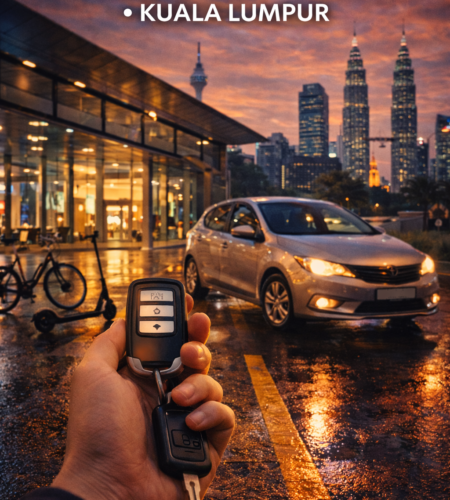
Kuala Lumpur is one of those cities where you usually don’t need a private car—the rail network covers most tourist zones, and ride-hailing is everywhere. But rentals and shared mobility can still be the best choice for day trips, late-night flexibility, or traveling with family/luggage. This guide breaks down the smartest options: airport car rentals, car-sharing (hourly), micromobility, and tourist travel passes.
Best option by travel style
🚆 Staying in central KL (KLCC, Bukit Bintang, Chinatown)
- Use rail + walking.
- Add GoKL City Bus for short hops between tourist districts (it’s marketed as a free city bus with many stops near attractions).
- Consider Rapid Kembara Pass (tourist unlimited rides) if you’ll do many trips in 1–3 days.
🏞️ Day trips (Batu Caves + beyond) / family road trips
- Rent a car (classic daily rental) or
- Car-sharing (hourly/daily) like SOCAR for flexibility without full-day rental paperwork.
🧳 Airport arrival with luggage
- Car rental directly at KLIA / KLIA2 is straightforward, with official rental-service listings and counters.
Car rental in Kuala Lumpur
Where to rent at the airport (KLIA & KLIA2)
KLIA (Terminal 1): Malaysia Airports lists rental services and counters (example shown: Hertz in the Arrival Hall, plus other providers).
KLIA2 (Terminal 2): Malaysia Airports also lists providers (e.g., Hertz, Europcar, Mayflower, PRAC).
At KLIA2, car rental is tied to the Transportation Hub (Level 1) area in the gateway@klia2 complex.
Documents & requirements (what usually gets checked)
Most rental companies require you to show a valid driving licence (often in English) or an International Driving Permit (IDP), depending on your licence language/format. Hertz Malaysia’s FAQ explicitly notes licence/IDP requirements for pickup.
Practical driving notes (so you don’t get surprised)
- Tolls & payment: In Peninsular Malaysia, toll roads commonly use the Touch ’n Go ecosystem; the Touch ’n Go card is described as usable for tolls and public transport.
- Insurance & deposits: Always check the included coverage and the deposit/hold policy before confirming.
Car-sharing (hourly/daily): SOCAR
If you want “rent a car only when you need it,” SOCAR is one of the best-known car-sharing options in Malaysia, with bookings handled inside the app. SOCAR advertises rentals hourly/daily/weekly/monthly and pricing “from RM6/hour” (promotions can change).
When SOCAR is perfect
- Quick shopping/errand trips
- Short out-of-the-city drives
- You don’t want to deal with a full-day rental counter
Bikes, e-scooters & micromobility (what’s realistic in KL)
Micromobility can be great in parks and controlled zones, but you must follow local restrictions.
Important rule: e-scooters & public roads
Malaysia’s Road Transport Department (JPJ), reported by local news, has emphasized that micromobility vehicles (including e-scooters) are not permitted on public roads—only in designated areas such as recreational parks, dedicated lanes, or private premises.
Shared e-scooter operators
Services like Beam exist in Malaysia; always follow the operator’s in-app rules, geofencing, and parking instructions.
In practice: treat e-scooters as “last-mile inside allowed zones”, not as a substitute for citywide transport.
Tourist-friendly “shared mobility” that actually works: Rapid KL passes
If your “shared mobility” goal is cheap, unlimited movement (without driving), KL has strong public-transport pass options:
Rapid Kembara Pass (tourists)
This is a tourist-oriented unlimited ride pass for Rapid KL rail + buses. The official product page lists RM25 (1 day) and RM55 (3 days) and explains where to buy it (Rapid KL customer service counters and selected hubs).
Rapid Bulanan Pass (30-day unlimited)
If you’re staying longer, Rapid KL’s Rapid Bulanan Pass offers 30 days unlimited rides and is listed at RM150.
Tips (save money + avoid headaches)
- Don’t rent a car if your plan is mostly KLCC ↔ Bukit Bintang ↔ Chinatown. Parking + traffic can cost more than transit.
- Rent a car if you’re doing multiple stops outside central KL or traveling as a group.
- Use car-sharing for 2–6 hour “burst” trips.
- Use micromobility only where it’s clearly allowed (parks/controlled areas) and never assume roads are okay.
FAQ
Is renting a car at KLIA/KLIA2 easy?
Yes—Malaysia Airports publishes rental-service listings for both terminals, and KLIA2 has car rental access through the Transportation Hub area.
Do I need an International Driving Permit (IDP)?
It depends on your licence language/format and rental policy. Some companies state you need an IDP or an English licence at pickup.
Can I ride an e-scooter anywhere in the city?
No—JPJ guidance reported in local media indicates micromobility (including e-scooters) is not allowed on public roads, only in designated areas.
Best “unlimited transport” option for tourists?
Rapid Kembara is designed for tourists and includes unlimited rides for 1 or 3 days.
Conclusion
For most visitors, Kuala Lumpur is easiest with public transport + walking, plus occasional ride-hailing. Use car rentals (especially from KLIA/KLIA2) when you’re heading beyond the core, and consider SOCAR for flexible hourly driving. Treat e-scooters as a park/zone tool only—Malaysia enforcement guidance warns against using them on public roads.
Comments