
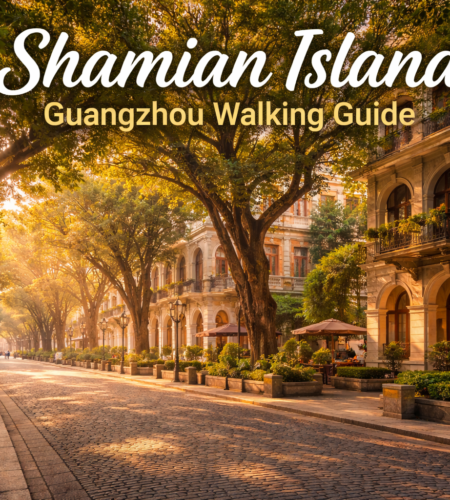
If you want a calm, “old-world” stroll in the middle of a megacity, Shamian Island Guangzhou is the classic pick: shaded streets, European-style facades, river air, cafés, and a totally different pace from the rest of Guangzhou. Historically, Shamian became an Anglo–French concession in the 19th century—one reason the architecture feels so unlike typical South China streetscapes.
Shamian Island Guangzhou at a glance 📍⏱️✅
| What you need | Practical answer |
|---|---|
| Best for | Easy walking, architecture photos, quiet breaks, cafés ✅ |
| Time needed | 1–2 hours (fast) or 2–3 hours (slow photo walk) |
| When to go | Early morning or before sunset for softer light + fewer crowds 📷 |
| “Open hours” | It’s a public island/neighborhood—walkable any time (individual sites may have hours) |
Why Shamian feels “different” (the quick history) 🗺️
After the Opium War era, Shamian was set aside as an Anglo–French concession (often described from 1859 onward in major references). That history shaped the streets, churches, consular buildings, and the overall European architectural character you see today.
What to do on Shamian Island Guangzhou ✅📸
1) Walk the tree-lined avenues (the main attraction) 🌳
The most photogenic experience is simply walking the shaded streets and shooting details: balconies, shutters, arches, stone steps, ironwork, and the canopy light.
2) Architecture “hunt” (make it fun) 🏛️
Create a mini checklist:
- 10 best façades (pick your own winners)
- 5 doorways
- 3 rooflines
- 1 “perfect symmetry” shot down a street
3) Café break + people-watching ☕
Shamian’s vibe is made for a slow stop—especially if you’ve been doing big-ticket sights like Canton Tower or busy shopping streets.
How to get there 🚇🚌🚕🚶
By metro (easiest) 🚇✅
Go to Huangsha Station (黄沙站) — it’s an interchange station on Guangzhou Metro Line 1 and Line 6, and it’s specifically noted as being near Shamian Island.
From there, it’s a short walk toward the bridges.
Practical tip: save “黄沙站” (Huangsha) and “沙面” (Shamian) in your phone for maps.
By taxi / ride-hailing 🚕
Best if you’re short on time. Pin “Shamian Island / 沙面” and you’ll be dropped near one of the bridge entrances.
On foot 🚶
If you’re already exploring Liwan, walking in can be part of a bigger loop (Shamian → riverfront → local food streets).
Hours / operating times ⏱️
Shamian is essentially a public district/island, so it’s typically listed as open all day (but individual attractions—museums, churches, galleries—can have their own operating hours).
Tickets / prices 💳
Walking around Shamian is free. Costs only apply if you enter specific attractions (museums, paid exhibits) or spend at cafés/restaurants.
Tips & common mistakes ✅⚠️
✅ Go for golden hour
Morning and late afternoon light makes the streets look cinematic and reduces harsh shadows.
✅ Use a “slow lens” mindset
Shamian rewards details. Don’t rush—stop often, shoot close-ups, look up.
⚠️ Don’t plan it as a “full-day” sight
Unless you’re writing/sketching/photographing heavily, most people are happiest with 1–3 hours here.
⚠️ Don’t rely on random “opening hours” for the whole island
The island is open; specific buildings might not be.
FAQ ❓
Is Shamian Island Guangzhou worth it if I only have one day?
Yes, if you want a calm contrast to the city’s modern skyline and big malls.
What’s the closest metro station?
Huangsha (黄沙) on Lines 1 & 6 is commonly used for Shamian access.
Do I need tickets?
No for the island walk—only for any paid attractions you choose to enter.
Is it good for photos?
Yes—tree tunnels, façades, and street symmetry are the main draw.
Conclusion
Shamian Island Guangzhou is one of the easiest “high reward, low effort” stops in the city: free, walkable, photogenic, and relaxing. Pair it with a busy attraction the same day (like a tower, museum, or shopping district), and it becomes the perfect reset.
Comments