
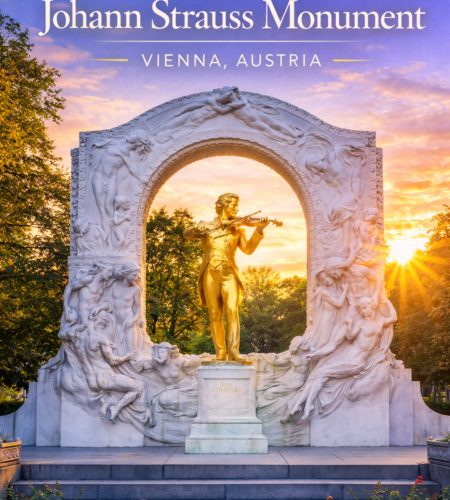
Stadtpark and Johann Strauss Monument is one of the most “Vienna-in-one-stop” experiences you can do: a central green park with ponds, lawns, and the city’s most photographed statue—the golden Johann Strauss monument. It’s perfect for a quick break between museums, a sunset walk, or a “Vienna music vibe” photo session without buying a ticket.
Why Stadtpark and Johann Strauss Monument is worth it ✅
Vienna’s first public park—right in the center
Vienna’s Tourist Board notes the Stadtpark opened in 1862 during the Ringstraße era and is considered the oldest publicly accessible park in Vienna.
The City of Vienna adds that the park on the left bank of the Wien River opened on 20 August 1862, and the “children’s park” on the right bank followed in 1863.
The city’s most iconic “music statue”
The Vienna Tourist Board calls Edmund Hellmer’s golden Johann Strauss monument the most popular photo subject in Vienna and confirms it was erected in 1921.
It also explains the statue’s “gold” look is gold-plated bronze (bronze core, gold-plated on the outside).
It’s a true “micro-itinerary” spot
Stadtpark has lawns, flowerbeds, exotic trees, a large pond, and lots of benches—easy to enjoy even if you only have 30 minutes.
What to see in Stadtpark 📍
1) Johann Strauss Monument (your #1 stop) 🎻✨
The monument shows Strauss as the “waltz king” playing violin, framed by a decorative marble arch—basically the postcard of Vienna.
If you want deeper context: the Tourist Board notes the unveiling happened on June 21, 1921, and the Vienna Philharmonic played “On the Beautiful Blue Danube” at the ceremony.
2) The pond + wildlife moments 🦆
The Stadtpark pond is a surprisingly good “slow down” zone: the Tourist Board mentions ducks, even herons, squirrels, and sometimes hedgehogs at dusk.
3) Kursalon Hübner (concert vibes) 🏛️🎶
The Tourist Board points out the Kursalon on the southern edge of the park, historically used for concerts and dance events—and it’s still a key “Vienna waltz” visual.
4) Otto Wagner Stadtpark station + Wien River portal (Art Nouveau detail) 🚇
The Tourist Board highlights the impressive Art Nouveau Wien River portal and notes the nearby Stadtpark subway station is a preserved Otto Wagner building.
Best visit plans ✅
| Time you have | What to do | Best for |
|---|---|---|
| 20–40 minutes | Strauss statue → pond loop → quick Kursalon view | Quick photos + “Vienna moment” |
| 60–90 minutes | Full park loop + monuments + river portal | Relaxed walk + variety |
| 2–3 hours | Park + café break + concert/nearby museum corridor | Slow travel day |
How to get there 🚇 🚋 🚌
Stadtpark stretches between the Ringstraße side (Parkring/Innere Stadt) and the Heumarkt side (Landstraße), acting as a link between the city center and the 3rd district.
Easiest public transport options
- 🚇 U4: Stadtpark station (direct access to the park area; the station is on the U4 line).
- 🚇 U3: Stubentor (good for the Ringstraße edge / Parkring side).
- 🚆 Wien Mitte–Landstraße (S-Bahn + U3/U4 hub; short walk to the park).
- 🚋 Tram 2 to stops near Parkring/Stubentor-area edges (handy if you’re already on the Ring).
Navigation tip: If your goal is the statue first, type “Johann Strauss Monument Stadtpark” in maps—it saves time because Stadtpark is long and has multiple entrances.
Hours / operating times ⏱️
Stadtpark (the park)
Stadtpark is a public municipal park (not a ticketed venue). The City of Vienna and Vienna Tourist Board present it as an open city green space; you can enter freely and wander at your own pace.
Facilities inside the park
Restaurants/cafés and concert venues have their own schedules. For example, the Vienna Tourist Board lists separate opening times for venues like Meierei in Stadtpark and Steirereck-related outlets.
If you’re planning a meal or concert, always check the venue’s official site the same day.
Tickets / prices / cards 💳
- ✅ Stadtpark entry: free (no ticket needed).
- 🎶 Concerts at/near Kursalon: ticketed (prices vary by program and organizer).
- 📸 Johann Strauss Monument: free to visit (it’s inside the public park).
Tips / common mistakes ✅ ⚠️
Best photo strategy for the Strauss statue 📸
- ✅ Go early morning for fewer people in the frame.
- ✅ Go late afternoon / blue hour for dramatic light and the “gold pop” effect.
- ✅ Step back to include the marble arch behind Strauss (it makes the composition feel complete).
Don’t miss the “second layer” of Stadtpark
Many people only do the statue and leave. The Tourist Board points out the park is full of other monuments (Schubert, Bruckner, Lehár, Stolz, and more) and has multiple “moods” depending on which side you enter from.
Dog rule (important) ⚠️
The City of Vienna notes dogs are not allowed in Stadtpark; it points dog owners to a dog zone along the Wien River promenade.
FAQ ❓
Is Stadtpark and Johann Strauss Monument free?
Yes—Stadtpark is a public municipal park, and the Strauss monument is inside it, so visiting is free.
When was Stadtpark opened?
The Vienna Tourist Board says Stadtpark opened in 1862; the City of Vienna gives the opening date of the left-bank park as 20 August 1862.
When was the Johann Strauss Monument erected?
The Vienna Tourist Board states the statue was erected in 1921 and describes it as gold-plated bronze.
What’s the easiest metro stop for Stadtpark?
U4 Stadtpark station is the most direct, and it’s also a notable Otto Wagner-era station next to the park.
Are dogs allowed in Stadtpark?
No—dogs are forbidden in Stadtpark according to the City of Vienna.
Conclusion
Stadtpark and Johann Strauss Monument is one of the best “zero-stress” stops in Vienna: a historic park opened in 1862, a wildlife-and-pond calm zone, and the city’s signature golden Strauss monument (1921) that captures Vienna’s music identity in one photo. Do it smartly: arrive early or at blue hour, walk beyond the statue for a fuller park vibe, and pair it with nearby Ringstraße sights for an effortless half-day.
Comments