
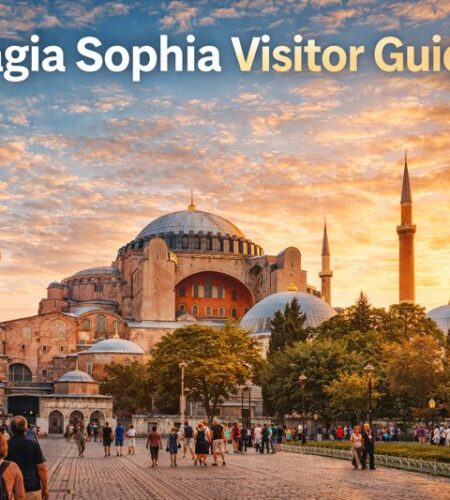
Visiting Hagia Sophia is one of those “this is why I came to Istanbul” moments—whether you’re here for architecture, history, or simply the feeling of standing inside a 1,500-year-old masterpiece. Today, it functions as a mosque with a dedicated visitor route (primarily to the upper galleries) and specific entry rules for foreign visitors.
Below is a practical, no-fluff guide to plan your visit: exactly where to enter, what you can see, when to go, what to wear, how to arrive by tram/metro, and the common mistakes that waste time.
✅ Hagia Sophia at a glance (quick planning table)
| Topic | What you need to know |
|---|---|
| 📍 Location | Historic center of Istanbul, on the European side, in the old city area |
| 🕘 Visiting hours (visitor area) | Daily 09:00–19:30 (noted for 2025). |
| 🕌 Prayer-time restrictions | Visitor area closed 12:30–14:30 on Fridays due to Friday prayers. |
| 🎟️ Ticket price (visitor area) | €25 for the visiting area; exchange rate applied at the ticket booth. Free for children under 8 with valid ID. |
| 🚪 Where foreign visitors enter | New visitor gate across Sultan Ahmed III Fountain; ticket booth is there too. |
| 👗 Dress code | Modest clothing; women need head covering. Covers may be available for a small fee at the ticket booth. |
| ⏱️ Time needed | 60–90 minutes for a comfortable visit (more if you linger in the galleries) |
| 🚇 Best transport | Tram T1 to Sultanahmet stop (fastest + easiest for tourists). |
Why Hagia Sophia matters (30-second context, no lecture)
Hagia Sophia is part of Historic Areas of Istanbul on the World Heritage List of UNESCO. It’s famous not only for its scale and dome, but for being a rare place where you can feel layers of Byzantine and Ottoman history in one space.
Hagia Sophia tickets and entrance rules (what people get wrong)
1) “Is it free?”
It depends on which area you’re visiting.
- Visitor route / visiting area (upper galleries and designated tour path): ticketed for foreign visitors, listed at €25.
- The building is a place of worship, so worshippers are not charged for entering to pray.
2) Where do foreign tourists enter?
Foreign visitors are directed to a visitor management entry introduced from Jan 15, 2024, using a gate located across Sultan Ahmed III Fountain (with the ticket booth nearby).
The visitor route typically brings you up to the galleries via a ramp, with views down into the sanctuary floor and access to mosaics along the upper-level path (subject to restoration/management decisions).
3) Are museum passes accepted?
Don’t assume a museum pass will work here. The official visitor info notes no museum passes available for visiting the Hagia Sophia visiting area.
Hagia Sophia opening hours and prayer-time closures
Visiting hours (plan your day around this)
The visitor information lists: open daily 09:00–19:30 (2025).
Friday reality check (important)
The visiting area is closed to visitors between 12:30–14:30 on Fridays due to Friday prayers.
Morning access note
The same visitor guidance notes the praying area can be closed for daily cleaning/maintenance until 10:00, and advises checking local prayer times.
Best time to arrive: ✅ weekdays, right at opening (09:00) or later afternoon (after peak tour rush).
Worst time to arrive: ⚠️ midday Friday.
How to get to Hagia Sophia (tram/metro/ferry/taxi)
🚋 By tram (easiest): T1 to Sultanahmet
Take the Metro Istanbul T1 Kabataş–Bağcılar tram and get off at Sultanahmet station.
- T1 operating hours are listed as 06:00–00:00.
- From Sultanahmet stop, it’s a short walk through the historic square to Hagia Sophia.
Good T1 stops for tourists nearby:
- Sultanahmet (closest)
- Gülhane (nice walk through Gülhane Park)
- Beyazıt–Kapalıçarşı (if you combine with Grand Bazaar)
🚇 By metro + tram (from Taksim / modern center)
If you’re staying around Taksim/Şişli:
- Take M2 metro (listed operational hours 06:00–00:00) toward the old city side, then connect to T1 where convenient (for example via walking connections around central stops or using the tram corridor).
⛴️ By ferry (scenic option)
If you’re coming from the Asian side, ferries bring you to the European waterfront around Eminönü, where you can hop on the T1 tram toward Sultanahmet. (T1 explicitly notes sea-operation connections at waterfront stops like Eminönü and others.)
🚖 By taxi / ride-hail
Taxi is convenient but traffic in the historic peninsula can be slow. If you’re arriving close to prayer times or on a busy weekend, tram often wins.
✈️ Airport Connections (IST & SAW → Hagia Sophia)
From Istanbul Airport (IST)
A straightforward public option is Havaist airport buses. The airport transportation page lists a route to Sultanahmet (HVL-11) with a posted fare (example shown: TRY 315).
Simple route: IST → (Havaist HVL-11) → Sultanahmet → walk to Hagia Sophia.
Tip: Airport bus times vary with traffic—build buffer time if you’re trying to catch a timed entry or another attraction.
From Sabiha Gökçen International Airport (SAW)
The airport’s official info highlights HAVABUS shuttles connecting SAW with major hubs Kadıköy and Taksim.
Simple route (two common ways):
- SAW → HAVABUS → Taksim → M2 + connect toward T1 → Sultanahmet → walk
- SAW → HAVABUS → Kadıköy → ferry to European side → T1 to Sultanahmet → walk
What you’ll actually see inside (and how to enjoy it)
🏛️ The visitor route experience
The visitor system describes a route that brings visitors to the gallery level, where you can:
- Look down into the sanctuary floor
- Pass key internal points (like the Marble Door / “Heaven and Hell gate”)
- View mosaics along the upper level (where accessible)
🎧 AR / audio guidance
Visitor info mentions an AR/QR-code experience in multiple languages and recommends using headphones so you don’t disturb worshippers.
Dress code & etiquette (don’t get turned away)
✅ What to wear
- Modest clothing that covers shoulders and knees is the safe baseline.
- Women should have a head covering available; the visitor info notes headscarves/body covers may be available at the ticket booth for a small fee.
📸 Photography etiquette
It’s a working place of worship—avoid photographing people praying up close, and keep your voice low. The visitor guidance explicitly asks visitors not to disturb worshippers.
Accessibility notes (important if you have mobility needs)
The visitor guidance warns that the visiting area ramps/stairs may not be suitable for people with walking difficulties and suggests alternative entry arrangements for those cases.
Tips & common mistakes (save time, avoid frustration)
✅ Go early (09:00) to beat the tour groups.
✅ Use the correct gate: foreign visitor entrance is not always where people line up first—follow the visitor-entry signage near Sultan Ahmed III Fountain.
✅ Bring a scarf (or be ready to buy/borrow a cover).
⚠️ Don’t show up during Friday closure (12:30–14:30 visitor area).
⚠️ Don’t plan it like a “normal museum.” It’s a mosque first; access can shift with worship, management rules, and conservation needs.
✅ Pair it smartly: combine in one walking loop with Topkapi Palace and Gülhane Park for a full historic-day itinerary.
FAQ (fast answers)
Is Hagia Sophia open every day?
The visitor info lists it as open every day, with visiting hours shown for 2025.
What is the ticket price?
Visitor area is listed at €25, with exchange rate applied at the ticket booth; children under 8 can be free with valid ID.
Is it closed on Fridays?
Not all day, but the visitor area is listed as closed to visitors 12:30–14:30 due to Friday prayers.
What’s the easiest public transport stop?
Tram T1 Sultanahmet stop is the classic choice.
Do I need an Istanbul public transport card?
For frequent rides, a transit card is useful; Istanbulkart is the official stored-value option.
Conclusion
Hagia Sophia is absolutely worth it—but it’s not a “walk in anytime like a museum” experience anymore. If you plan around visitor hours, avoid the Friday closure window, enter through the correct visitor gate, and arrive by T1 tram to Sultanahmet, you’ll get a smooth, memorable visit without losing half your day in the wrong line.
Comments