
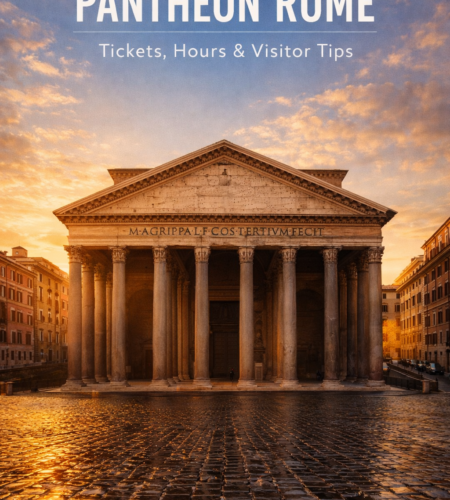
If you’re planning to visit Pantheon Rome, the key things to get right are timing (crowds + liturgy windows), tickets (official channels + time slots), and expectations (it’s a functioning basilica with a dress code). This guide covers what to see, when to go, how entry works, and the mistakes that waste time in one of Rome’s most iconic interiors.
Overview (what it is, why it matters, who it’s for) 📍
The Pantheon—officially the Pantheon–Basilica of Santa Maria ad Martyres—is among the best-preserved monuments of classical antiquity, in part because it was converted into a church in 609.
The site’s current form dates to the early reign of Hadrian (c. 118–125), while the earlier temple is associated with Marcus Agrippa (27–25 BC).
This visit is for:
- First-timers who want a “must-see” Rome interior ✅
- Architecture lovers chasing the 43.30 m dome span (diameter)
- Travelers who need practical rules: hours, tickets, dress code, and accessibility ♿️
Why go / Why it’s worth it ✅
- The dome experience is unmatched. The scale (43.30 m) is easier to feel than to explain—stand under the center and look up.
- It’s a rare “alive” monument. Unlike many ancient sites, the Pantheon is still a basilica open to worship, which changes the atmosphere and the rules.
- It fits almost any itinerary. Even if you have only 2–3 hours in central Rome, Pantheon Rome is a high-impact stop.
What to expect (step-by-step experience) 👀
- Arrive early (or late) to avoid peak queues—capacity and time slots can bottleneck fast.
- Security + entry control: entry is regulated with official ticketing and selected time slots.
- Inside flow is simple: most visitors do a slow loop around the perimeter niches + altar area, then spend time under the dome.
- Liturgical moments matter: during services, access is reserved to worshippers; ticket sales can pause ahead of liturgy.
Best time to visit (season, time of day, crowd strategy) ⏱️
- Best crowd windows: right at opening (9:00) or later afternoon (but keep last entry in mind).
- Best “quiet interior” strategy: avoid the hour before scheduled liturgy, because ticket sales may be suspended and movement inside changes.
- Best seasonal comfort: spring/fall mornings—Rome summers in the historic center can be intense.
✅ Pro tactic: If you only care about photos and atmosphere, go early and stay 15–25 minutes. If you care about details, budget 45–75 minutes inside.
How to get there (metro / bus / tram / train / taxi / walk) 🚇 🚌 🚋 🚆 🚖
Pantheon Rome address: Piazza della Rotonda (historic center).
Metro + walk (most reliable) 🚇
There is no metro stop directly at the Pantheon, so the common strategy is: metro + a pleasant walk through the center.
- Metro Line A: get off at Barberini–Fontana di Trevi or Spagna, then walk ~10–20 minutes depending on route and pace.
- From Roma Termini, Metro A is the easiest starting point (then walk from Barberini/Spagna).
Taxi / ride-hail 🚖
Convenient if you’re short on time or mobility is limited. Note: cars can’t always stop right in front due to central-area access patterns; you may still walk a few minutes.
Walking (recommended if you’re central) 🚶
If you’re staying around Piazza Navona / Trevi / Campo de’ Fiori / the Jewish Ghetto, walking can be fastest—and it’s the best way to “feel” central Rome.
✈️ From airports (simple official route):
- Fiumicino (FCO): take Trenitalia’s Leonardo Express (non-stop) to Roma Termini, then Metro A + walk.
- Ciampino (CIA): Ciampino Airlink (train + bus service) connects the airport with the Rome Termini network, then Metro A + walk.
Hours / Operating times ⏰
Pantheon Rome is generally open daily 9:00–19:00, with last entry at 18:30 for individual tickets; the ticket office has an earlier cutoff.
Hours may change during religious celebrations, and ticket sales can be suspended one hour before liturgical activity.
Closures: the official museum authority notes closures on December 25 and January 1 (unless special openings are announced).
✅ Always confirm the day-of schedule if you’re visiting on a major holiday week.
Tickets / prices / passes 💳
Pantheon Rome requires an official ticket for tourist visits. The Ministry of Culture and the national museum authority list a standard price of €5 full, €2 reduced (EU citizens 18–25), and free for under 18 (with other exemptions).
Official ticket types (simple table)
| Ticket | Who it’s for | Price |
|---|---|---|
| Full | Standard visitor | €5.00 |
| Reduced | EU citizens 18–25 | €2.00 |
| Free | Under 18 (and other categories) | €0 |
Where to buy (official channels only) ✅
Official guidance is clear: purchase via the Musei Italiani portal/app or on-site ticket offices/automatic machines.
Time slots should be respected, and “skip-the-line” entry is not available as a special option.
Important rules you should know ⚠️
- Tickets are released monthly, typically in the middle of the previous month—so popular dates can sell out.
- Pantheon Rome is not included in the Roma Pass or Omnia Card circuits (so don’t assume your pass covers it).
- Nominative tickets + ID: official rules state your ticket name must match your identity document.
- Free entry for worship: during Holy Mass times, entrance can be free for worshippers (not for tourist visiting).
Accessibility, safety, and rules ♿️ ⚠️
Pantheon Rome provides an accessible entry option: visitors with reduced mobility can enter via the external ramp on the Via della Minerva side.
There is no cloakroom, so plan to carry what you bring.
Because it’s a basilica, rules are stricter than at many museums:
- Dress code: shoulders covered; no very short shorts/skirts; avoid overly revealing or transparent clothing.
- Behavior: keep a respectful, quiet attitude; silence devices; no eating/drinking/smoking inside.
Common mistakes (and how to avoid them) ⚠️
- Assuming it’s free “like before.” Tourist entry is ticketed; check official info and book if needed.
- Showing up in beachwear. Dress code is enforced because it’s a place of worship.
- Trying to “skip the line.” Official policy states there’s no special skip-the-line option—plan with timing instead.
- Arriving right before Mass. Ticket sales may pause ahead of liturgy; plan around service windows.
- Rushing the interior. Give yourself time to stand still under the dome—this is the “wow” moment.
Tips / pro tactics ✅
- ✅ Go early, then do nearby highlights (Trevi area, Piazza Navona, Campo de’ Fiori) afterward.
- ✅ Use the dome as your anchor: step to the center, look up, then walk the perimeter slowly—your brain will “map” the space better.
- ✅ If you’re sensitive to crowds: choose a weekday morning and avoid the first Sunday of the month (free days can mean heavier queues).
- ✅ Mobility tip: use the Via della Minerva ramp approach if you need the most accessible entry.
Nearby spots to pair with this visit (1–5 ideas) 🗺️
- Piazza Navona — classic baroque square within an easy walk.
- Trevi Fountain area — pairs naturally if you use Metro A (Barberini/Spagna).
- Largo di Torre Argentina — ruins + cats + a great “Rome layers” vibe.
- Campo de’ Fiori — lively streetscape for a snack break after the visit.
FAQ
Is Pantheon Rome a church or a museum?
Both: it’s officially the Pantheon–Basilica of Santa Maria ad Martyres and is open to worship, with visitor rules reflecting that.
What are Pantheon Rome opening hours?
Official information lists daily opening around 9:00–19:00, with last entry 18:30 for individual tickets (and earlier cutoffs for ticket office).
Do I need to book a time slot?
Yes—official guidance asks visitors to respect the time slot chosen at purchase, and tickets are released on a monthly calendar.
How much do Pantheon Rome tickets cost?
Official prices list €5 full, €2 reduced (EU 18–25), and free for under 18 (plus other categories).
Is Pantheon Rome included in Roma Pass?
No—official notes say it’s not included in the Roma Pass / Omnia card circuit.
Is there a dress code?
Yes: shoulders covered and modest clothing required; the site is a basilica.
What’s the easiest metro route?
Use Metro Line A (e.g., Barberini or Spagna) and walk into the historic center.
Is Pantheon Rome accessible for wheelchair users?
Yes—access is possible via an external ramp on the Via della Minerva side.
Conclusion
Pantheon Rome is one of the highest “wow per minute” stops in the city—if you plan it smartly. Book through official channels, respect time slots, dress appropriately, and avoid the liturgy pinch points. Do that, and you’ll get a calm, unforgettable dome experience in the heart of Rome.
Comments