
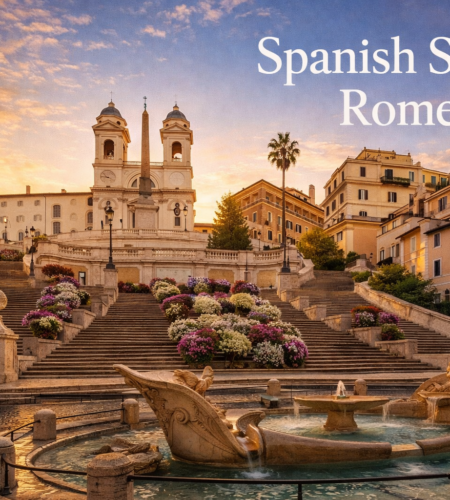
The Spanish Steps Rome (Scalinata di Trinità dei Monti) are one of the city’s most photographed landmarks—an 18th-century travertine staircase linking Piazza di Spagna at the bottom with Trinità dei Monti and the Pincio area above. Built 1723–1726 to create a “scenographic” connection between two historic districts, the steps are free to visit, best enjoyed early, and (important!) not a picnic bench anymore.
Spanish Steps Rome at a glance ✅
| Detail | What to know |
|---|---|
| Location 📍 | Piazza di Spagna ↔ Trinità dei Monti |
| Built 🏛️ | 1723–1726 (Francesco De Sanctis) |
| Steps 🔢 | Commonly cited as 135 steps |
| Cost 💳 | Free (public monument / open space) |
| Nearest metro 🚇 | Spagna (Line A) |
| Best season 🌸 | Mid-April → mid-May: Capitoline azaleas display |
A quick history of the Spanish Steps Rome (and why they’re “Spanish”) 🏛️
Despite the French church at the top (Trinità dei Monti), the landmark is called “Spanish” because Piazza di Spagna historically relates to the Spanish presence in the area (including the Spanish Embassy nearby). The project to overcome the steep slope had been discussed for centuries, but the steps were ultimately built 1723–1726, designed by Francesco De Sanctis, and finished under Pope Benedict XIII.
Architecturally, it’s classic Roman urban theatre: ramps, landings, changing angles, and viewpoints that pull your eye upward—while still functioning as a real pedestrian route. Turismo Roma describes the staircase as 11 ramps with resting points and balustrades that interrupt the climb.
What to see around Spanish Steps Rome 👀
1) Fontana della Barcaccia (at the bottom) ⛲
Right at the base sits the Barcaccia Fountain, created 1626–1629 by Pietro Bernini (with possible involvement by his son Gian Lorenzo). It’s one of those details people skip—don’t. It frames the entire view upward and is a landmark in its own right.
2) Trinità dei Monti (at the top) ⛪
At the top landing you reach the church area and viewpoints toward the city. Even if you don’t go inside, the façade + skyline combo is one of the most “Rome” visuals you’ll get in central Rome.
3) The “Piazza di Spagna” zone 🛍️
This is prime strolling territory: Via dei Condotti luxury shopping, classic Roman streets, and quick walking access toward Trevi Fountain / Via del Corso.
Best time to visit Spanish Steps Rome ⏱️
For photos 📸:
- Sunrise → 9:00: quietest, cleanest light, fewer crowds.
- Golden hour: beautiful, but crowded.
For the famous flowers 🌸:
Turismo Roma notes the traditional Capitoline azaleas display runs approximately mid-April to mid-May (around 450 plants), and it’s been a seasonal tradition since the 1950s.
Avoid:
- Midday in peak season (crowds + harsh light).
- Big event moments (access may be managed by staff/police).
How to get to Spanish Steps Rome 🚇🚌🚕🚶
Metro (fastest) 🚇
- Take Metro Line A to Spagna station.
- Accessibility note ♿: ATAC states that Line A stations including Spagna do not have lifts/stair lifts connecting with the platforms. However, ATAC also lists a lift/stair-lift connection at Spagna (Vicolo del Bottino ↔ Trinità dei Monti area). In practice: if you need step-free access, plan carefully and check ATAC accessibility status before you go.
Bus 🚌
Buses serve the surrounding central streets, but routes change. Use ATAC’s journey planner / service updates when planning same-day.
Taxi / ride apps 🚕
Best if you’re short on time or have mobility constraints—ask for Piazza di Spagna or Trinità dei Monti depending on whether you want the bottom or top view first.
Walk (best for sightseeing) 🚶
The Spanish Steps are an easy add-on from:
- Trevi Fountain area
- Via del Corso
- Piazza del Popolo / Villa Borghese edge
Hours / operating times ⏰
The Spanish Steps are an outdoor public monument and are generally accessible any time (no ticketed gate). Still, events, maintenance, or crowd-control rules may affect movement on specific days. (Turismo Roma provides location + official references for the site.)
Tickets / prices 💳
Visiting the Spanish Steps
- Free (no entry ticket).
Public transport tickets (useful for getting here) 🚇
ATAC’s official info (common options):
| Ticket | What it’s for | Price |
|---|---|---|
| BIT (100-minute) | Single/short travel windows | €1.50 |
| ROMA 24H | Unlimited within 24h | €8.50 |
| ROMA 48H | Unlimited within 48h | €15.00 |
| ROMA 72H | Unlimited within 72h | €22.00 |
| CIS (weekly) | 7-day integrated card | €29.00 |
Rules, etiquette, and common mistakes (read this) ⚠️
Don’t sit / sprawl / snack on the steps 🧍♂️🚫🍕
Rome tightened enforcement to protect the monument. Italian news agency ANSA reported that sitting/lying on the steps can trigger a €250 fine, rising up to €400 for more serious behavior (e.g., dirtying/damaging the monument). Reuters also reported fines in the €160–€400 range tied to enforcement.
Avoid “damage by accident” 🧳
Dragging hard luggage, forcing strollers, or treating the steps like a playground is a fast way to annoy everyone (and potentially attract enforcement). Use surrounding streets if you have wheels.
Pickpocket basics 🕵️
Busy tourist sites = distracted visitors. Keep phones/wallets secure, especially during crowd surges.
Tips for an actually good visit ✅
- Do it twice: bottom → top for the “grand staircase” feeling, then top → bottom for the view down into Piazza di Spagna.
- Use the Barcaccia as your photo anchor: it’s the classic composition.
- Azaleas season: go early morning for clean shots and fewer people.
- Coffee strategy ☕: step off the staircase zone, grab a takeaway nearby, then enjoy it away from the monument.
FAQ ❓
How many steps are there at Spanish Steps Rome?
Most standard references cite 135 steps (counts vary slightly depending on what you include, but 135 is the common figure).
Are the Spanish Steps free?
Yes—no ticket required.
Can you sit on the Spanish Steps?
It’s strongly discouraged and actively enforced; reported fines include €250 (up to €400 for serious cases).
What metro stop is closest?
Spagna (Metro Line A) is the closest.
Is Spagna metro station wheelchair accessible?
ATAC states Spagna lacks lifts/stair lifts connecting to the platforms (Line A). Check ATAC accessibility status and consider surface transport if you need step-free routing.
When are the famous azaleas on the steps?
Approximately mid-April to mid-May.
Conclusion
The Spanish Steps Rome are iconic for a reason: they’re Roman urban design as theatre—views, symmetry, motion, and a perfect “gateway” between neighborhoods. Visit early, treat it like a protected monument (not a lounge), and you’ll get the best version of the experience—especially during azaleas season.
Comments