
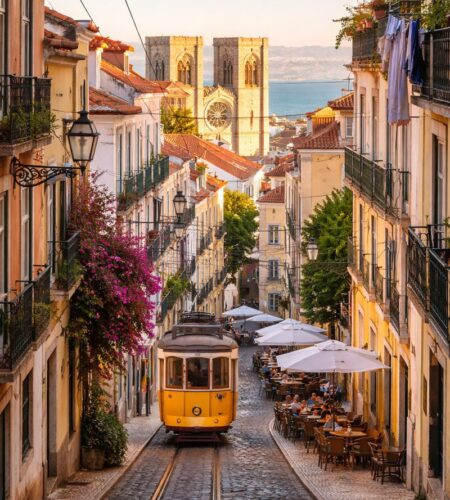
The Alfama District Lisbon is the city’s oldest, most traditional neighborhood—famous for its maze of cobbled lanes, steep stairways, riverside viewpoints, and the unmistakable sound of fado drifting from tiny taverns after dark. Lisbon’s official tourism board describes Alfama as a place to be discovered slowly, on foot, with frequent stops to enjoy the atmosphere and the views over the Tagus River.
If you want “real Lisbon” in one walk—old streets, miradouros, tiled façades, laundry lines, hidden courtyards—Alfama is it.
Quick facts (for your place card)
- Place: Alfama District (Lisbon)
- Address (area): Alfama, Santa Maria Maior, Lisbon, Portugal (historic center hillside above the Tagus)
- Official tourism page: Visit Lisboa — Alfama
- Best-known viewpoints: Miradouro de Santa Luzia / Portas do Sol (easy stops on classic routes through Alfama)
- Nearest metro stations:
- Santa Apolónia (Blue Line) — great for eastern Alfama
- Terreiro do Paço (Blue Line) — great for lower Alfama by the river
- Baixa-Chiado (Blue + Green Lines) — good starting point if you combine Baixa + Alfama
- Iconic transport: Tram 28E passes key Alfama stops (Portas do Sol, Santa Luzia, Sé/Cathedral)
What is Alfama—and why it feels different from the rest of Lisbon
Alfama is the kind of neighborhood that doesn’t “open up” all at once. It’s built for wandering: narrow alleys, small staircases, sudden little squares, and viewpoint terraces that appear out of nowhere.
Visit Lisboa highlights Alfama’s cobbled lanes, alleys, and steep climbs, recommending that you discover it “little by little.” It also points visitors toward major landmarks woven into an Alfama walk—like Lisbon Cathedral (Sé) and Miradouro de Santa Luzia, with classic Tagus views.
Top things to do in Alfama
1) Get lost (on purpose)
Alfama is best experienced without a strict route. Pick a start point (metro or tram stop), set a “must-see” viewpoint, and let the streets guide you.
Tip: Wear shoes with good grip. Alfama’s slopes and stone pavements can be slippery.
2) Visit Lisbon Cathedral (Sé)
Visit Lisboa specifically calls out the Sé (cathedral) as a key stop in Alfama and notes its historic significance.
Even if you don’t go deep inside, the exterior and surrounding lanes are peak “old Lisbon.”
3) Chase the best viewpoints (miradouros)
Two of the most photogenic stops—also appearing on the Tram 28E path—are:
- Lg. Portas do Sol
- Miradouro Sta. Luzia
These spots are perfect in late afternoon for warm light and wide river panoramas.
4) Do a classic Tram 28E ride (or just use it strategically)
The famous Carris 28E route is not just a tourist attraction—it’s a practical way to connect hills and viewpoints without burning your legs immediately.
On Carris’ official route page, the 28E path includes Alfama-related stops like Lg. Portas Sol, Miradouro Sta. Luzia, and Sé (Cathedral).
You can ride a short segment (instead of end-to-end) and then continue on foot.
5) Experience fado where it belongs
Alfama is one of Lisbon’s neighborhoods most associated with fado culture. UNESCO lists Fado, urban popular song of Portugal on the Representative List of the Intangible Cultural Heritage of Humanity (inscribed in 2011) and describes it as widely practiced in Lisbon—performed in small “fado houses” and community associations, especially in older neighborhoods.
How to do it right (simple rules):
- Book a small venue (intimate rooms feel more authentic than big shows).
- Aim for a later start (fado nights often peak after dinner).
- Choose “fado + dinner” only if you want convenience; otherwise eat first and go just for the performance.
The best walking route in Alfama (2–3 hours)
This route is built around official landmarks and easy transport:
- Start: Santa Apolónia (Blue Line) — enter Alfama from the east
- Walk uphill into the lanes (slowly, with photo stops)
- Sé Cathedral
- Miradouro Sta. Luzia
- Lg. Portas do Sol
- Optional: continue toward São Jorge Castle area (close by; great views)
If you prefer a flatter start, begin from the river at Terreiro do Paço (Blue Line) and climb into Alfama from below.
How to get to Alfama (metro, tram, walking)
By metro (most useful stations)
Because Alfama is a hillside district, the “best” station depends on where you want to start:
- Santa Apolónia (Blue Line)
Official metro info confirms Santa Apolónia belongs to the Blue Line. - Terreiro do Paço (Blue Line)
Official metro info confirms Terreiro do Paço belongs to the Blue Line. - Baixa-Chiado (Blue + Green Lines)
Official metro info confirms Baixa-Chiado is an interchange between Blue and Green lines.
By tram (the iconic way)
The official Carris page for Tram 28E shows it serving key Alfama stops including Portas do Sol, Santa Luzia, and Sé.
When to visit Alfama
- Morning: quieter streets, softer light, easier photos
- Late afternoon: best viewpoints + golden hour
- Night: fado atmosphere (book ahead)
Practical tips (so you enjoy it more)
- Go slow: Alfama rewards wandering—rushing makes it feel like “just hills.”
- Plan your climbs: do viewpoints first, then descend to dinner, not the other way around.
- Use tram/metro smart: ride 28E for one segment, then walk.
- Pick a “home base” square: if you’re meeting friends, choose a specific miradouro or metro station—Alfama’s lanes can be confusing.
Official site and key references
- Visit Lisboa (official tourism): Alfama overview and highlights
- Carris (official transit): Tram 28E route and stops (includes Alfama landmarks)
- UNESCO (official): Fado inscription and description
- Lisbon Metro (official): station pages for Santa Apolónia, Terreiro do Paço, Baixa-Chiado
FAQ: Alfama District Lisbon
Is Alfama worth visiting?
Yes—Alfama is Lisbon’s most historic “walkable maze,” full of viewpoints and old streets. Visit Lisboa calls it the oldest and most traditional neighborhood, best discovered on foot.
What’s the best metro station for Alfama?
Santa Apolónia (Blue Line) is excellent for eastern Alfama; Terreiro do Paço (Blue Line) is great for lower Alfama near the river.
Does Tram 28E go through Alfama?
Yes—Carris’ official route includes stops like Portas do Sol, Santa Luzia, and Sé.
What is fado and why is it linked to Alfama?
UNESCO describes fado as a Lisbon-based performance tradition (music + poetry), practiced widely and performed in small “fado houses,” especially in older neighborhoods.
Conclusion
If you want a Lisbon neighborhood that feels timeless, Alfama District Lisbon should be at the top of your list. It’s built for walking, viewpoint-hopping, and discovering the city’s older soul—especially when you pair a tram segment with a slow wander and end the night with fado.
Comments