
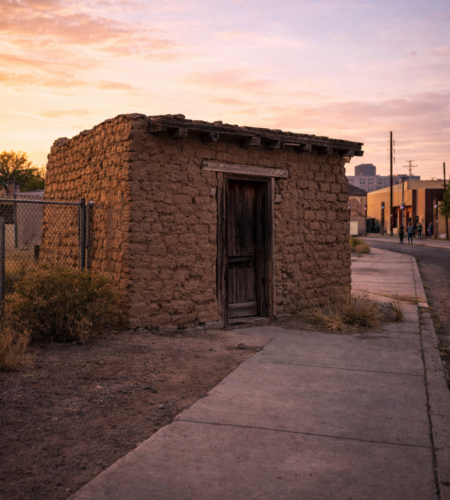
The Duppa-Montgomery Adobe (often called the Duppa Homestead) is one of the most “blink-and-you’ll-miss-it” historic places in Phoenix: a small adobe structure surviving in the warehouse area just south of downtown. It’s officially listed on the City of Phoenix Historic Property Register (listed November 2005) with a recorded construction date of ca. 1895.
This is not a staffed museum with interior touring hours. It’s best approached as a quick historic-photo stop you pair with a downtown walking/transit day (Capitol Museum, Heritage Square, Roosevelt Row, etc.).
What is the Duppa-Montgomery Adobe and why does it matter? 🏜️🏛️
The Duppa-Montgomery Adobe sits on the site associated with “Lord” Phillip Darrell Duppa, an early Phoenix-era figure often credited in local history with influencing the city’s name, and later ownership by John Montgomery. Recent reporting describes the larger homestead story and notes that accounts differ on what the surviving structure originally functioned as (home vs. outbuilding), but agrees it’s a rare physical survivor from early Phoenix.
The date confusion (and the most reliable way to state it)
You’ll see older claims that it dates to the 1870s—but the City of Phoenix’s official register entry lists the structure as ca. 1895.
The clean, defensible way to explain this to readers is:
- The homestead site is tied to earlier settlement-era Phoenix history (often described as early 1870s in secondary sources).
- The surviving adobe structure at the address is documented by the City as ca. 1895.
What you can do when you visit ✅
Treat it like a 10–20 minute stop:
| Do | Skip |
|---|---|
| 📸 Photograph the exterior from public areas | ❌ Don’t trespass or try to enter fenced/gated areas |
| 🧭 Use it as a “history waypoint” on a downtown itinerary | ❌ Don’t expect interior access or docents |
| 🌇 Visit in daylight/golden hour for better photos | ❌ Don’t come late at night (warehouse area, limited foot traffic) |
Location 📍
Official address listing (City of Phoenix):
715 S. Second Ave / 116 W. Sherman St, Phoenix
Recent local reporting places it on Sherman Street between 1st and 2nd avenues, just south of downtown.
Finding it on foot (simple approach):
- Navigate to 116 W Sherman St.
- You’re looking for a small, low adobe building in a more industrial/warehouse setting (not a landscaped “historic campus”).
How to get there 🚇🚌🚕🚗
By light rail (most convenient “no car” plan) 🚇✅
If you’re already using Valley Metro in downtown Phoenix, the simplest transit anchor is the B Line station Buckeye/Central Ave (listed as a B Line stop by Valley Metro).
From there, you can walk west toward 2nd Ave and then south to Sherman (use Valley Metro Trip Planner for the exact best walking route from your starting point).
By bus 🚌
A common bus corridor nearby is Buckeye Rd, where Valley Metro lists Route 13 serving major points including Central Ave & Buckeye Rd.
Again: confirm your exact routing with Valley Metro Trip Planner (service patterns can change).
By rideshare 🚕
If you want the lowest-friction visit (especially in summer heat), rideshare is ideal:
- Destination: 116 W Sherman St, Phoenix
By car 🚗
There isn’t a “visitor lot” experience here. If you drive:
- Expect to park legally on nearby streets or public lots (follow posted signs).
- Don’t block industrial driveways or private lots.
Hours and best time to visit ⏱️🌇
Because the Duppa-Montgomery Adobe is not a staffed museum, the practical rule is:
- Visit during daylight for safety and for better photos.
- Golden hour (late afternoon) usually gives the best texture on adobe and the most “historic” look.
If you’re building a downtown itinerary, this stop works well as:
- Late morning → early afternoon in cooler months, or
- Late afternoon paired with a sunset downtown walk.
Tickets / prices 💳
- There’s no ticket booth or standard admission model associated with the Duppa-Montgomery Adobe as a visitor attraction.
- Cost is essentially free (you’re viewing a historic structure from public space).
Preservation status: why you should expect “view-only” right now 🧱⚠️
The city has acknowledged the building’s fragility and the need for preservation work. Reporting in 2024 described the City of Phoenix planning a preservation effort (including funding and public-facing signage) to protect the structure.
That context matters for visitors because it explains why you may see:
- fencing,
- limited access,
- an “artifact in place” feel rather than a curated visitor site.
Tips and common mistakes ✅⚠️
Tips that make it better
- 📍 Pin the exact address (116 W Sherman St) instead of searching “Duppa Homestead” in random map layers.
- 🌇 Bring a wide lens (or use your phone’s 0.5x) because the structure is small and the surroundings are tight.
- 🧊 In hot months, do this stop early or late and keep it short—then head to an indoor attraction (Capitol Museum, Heard Museum, etc.).
Mistakes to avoid
- Expecting museum access. Plan for exterior viewing only.
- Going late at night. The area is not a nightlife district; it’s quieter and more industrial.
- Over-planning the stop. The “win” is pairing it with a larger downtown route.
FAQ
Where is the Duppa-Montgomery Adobe?
It’s listed at 715 S. Second Ave / 116 W. Sherman St, Phoenix on the City of Phoenix Historic Property Register.
How old is it?
The City of Phoenix lists the Duppa-Montgomery Adobe with a construction date ca. 1895 (and a register listing date of November 2005).
Is it the oldest building in Phoenix?
Some sources call it the oldest or one of the oldest, but accounts vary; even preservation advocates note debate about its original purpose and exact “oldest” status.
What’s the easiest transit approach?
Use Valley Metro Rail (B Line) to Buckeye/Central Ave and walk from there; confirm the best route with Valley Metro Trip Planner.
Conclusion
The Duppa-Montgomery Adobe is a rare kind of Phoenix landmark: small, quiet, and historically loaded—more like a surviving “artifact” than a polished attraction. If you treat it as a short exterior stop on a downtown transit day, it’s absolutely worth it—especially when you connect the place-name history and preservation story to what you’re seeing in front of you.
Comments