
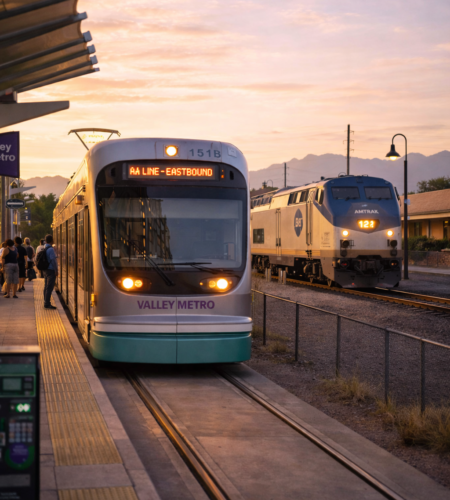
If you’re planning car-free sightseeing (or arriving by intercity train/bus), knowing the Phoenix rail and train stations that actually matter will save you time, money, and confusion. Phoenix’s “rail” experience is mostly Valley Metro light rail (A Line + B Line) plus the PHX Sky Train at the airport; meanwhile, Amtrak’s intercity trains do not currently stop in downtown Phoenix, and the closest rail stop for Amtrak trains is Maricopa, AZ (MRC) with Thruway bus connections into the metro.
This guide breaks it down clearly: the best light rail stations for visitors, how the Downtown Hub works, where to connect at Sky Harbor, and how to handle “train station” logistics for Amtrak.
Rail vs train in Phoenix (the 60-second explanation) 🚈✅
In Phoenix, “rail stations” usually mean Valley Metro light rail stations. Valley Metro operates a two-line light rail system:
- A Line (east–west: Phoenix–Tempe–Mesa)
- B Line (north–south: Phoenix only)
with transfers at the Downtown Phoenix Hub.
“Train stations” (intercity rail) usually means Amtrak, and today Amtrak’s closest station serving the Phoenix metro is Maricopa, AZ (MRC)—not downtown Phoenix.
The most important Phoenix rail stations for visitors 🗺️🚇
These are the stations that function like “tourist gateways”—easy transfers, easy downtown walks, and good connections.
1) Downtown Phoenix Hub (transfer point between A Line & B Line) 🔁
This is the most important station cluster because it’s the main transfer point between lines in downtown. Valley Metro introduced the two-line system (A + B) with the Downtown Hub as the connection point.
When it matters:
If you plan to ride north/south (B Line) and then head east to Tempe/Mesa (A Line), you’ll use the Hub.
2) Roosevelt/Central Ave (Arts District gateway) 🎨
This is the classic “start here” station for murals, cafés, and Roosevelt Row vibes. It’s prominently marked on the official Valley Metro rail system map and sits right where downtown exploration feels the most walkable.
3) 3rd St/Jefferson + 3rd St/Washington (event corridor) 🏟️
For big downtown venues (arenas, stadium area, convention corridor), these are the “best stops” Valley Metro itself calls out for major event destinations.
4) 44th St/Washington (light rail ↔ airport connection) ✈️
This is the rail stop you want if you’re doing airport-to-downtown without a car. You connect here to the PHX Sky Train (airport people-mover) to reach terminals. Valley Metro’s system map explicitly includes the PHX Sky Train connection.
Valley Metro Rail stations: a practical “pick your base” table ✅
Here’s a simple way to choose which station is “best” depending on your day:
| Your plan | Best station(s) | Why it works |
|---|---|---|
| Murals + cafés + walkable downtown | Roosevelt/Central Ave | Arts district gateway, easy walking loop |
| Hop between downtown districts + transfers | Downtown Phoenix Hub | Core transfer between A & B lines |
| Games, concerts, convention corridor | 3rd St/Jefferson or 3rd St/Washington | Valley Metro’s recommended event-access stops |
| Airport → downtown (no car) | 44th St/Washington (then Sky Train) | Designed connection to PHX Sky Train + terminals |
| Tempe waterfront day | Tempe Beach Park/Rio Salado Pkwy (A Line) | Direct to Town Lake / waterfront area |
| Downtown Mesa culture day | Center/Main St (A Line) | Drops you into downtown Mesa core |
Fares: how to pay for Phoenix rail without overpaying 💳✅
Valley Metro’s posted fare structure makes day exploring simple:
- $2 Local 1-Ride
- $4 Local Daily Maximum (Smart Fare cap)
with additional weekly/monthly caps listed on the official pricing page.
Pro tip: If you’re doing multiple hops, Smart Fare is your friend—your cost caps at the daily max as long as you’re using eligible payment methods (like app/card) and you still validate each ride.
PHX Sky Train “stations” (airport rail-like stops) ✈️🚆
The PHX Sky Train isn’t light rail, but for travelers it behaves like a rail line with stations: it connects terminals, parking, rental cars, and the light rail connection point. Valley Metro lists Sky Train as its own route with the key airport stops.
Why it matters for a “rail & stations” guide:
It’s the cleanest way to go Airport → 44th St Station → Light Rail → Downtown with no car and no rideshare.
Intercity “train stations” for Phoenix: what you need to know about Amtrak 🚆⚠️
The closest Amtrak station serving Phoenix metro: Maricopa, AZ (MRC)
Amtrak’s official station page for Maricopa (MRC) lists the station address as:
44605 West Mercado Street, Maricopa, AZ 85138.
This is the station most Phoenix-bound rail travelers use for long-distance trains (like Sunset Limited / Texas Eagle).
The “Phoenix connection”: Amtrak Thruway bus into the metro 🚌➡️🚆
Amtrak publishes timetables showing Thruway connecting service that links:
- Maricopa (MRC)
- Tempe (TEM)
- Phoenix – Sky Harbor Airport (PHA)
- Phoenix – Phoenix North Station (PXN)
That means you can book a trip that includes a bus connection into Phoenix rather than trying to arrange your own ride from Maricopa.
Phoenix Union Station: historic station, not an active passenger hub 🏛️
Phoenix still has an iconic historic station building: Phoenix Union Station. But passenger rail service to downtown Phoenix was discontinued in the 1990s, and the intercity “train station” function moved out to Maricopa. A detailed Amtrak-affiliated station profile explains that in 1996, passenger rail service to Phoenix Union Station was discontinued and Maricopa became the closest station to the Phoenix capital area.
How to use this in a modern itinerary:
Treat Union Station as a photo/architecture stop, not a transportation station.
How to plan a “rail day” using stations (3 ready-made routes) 🗺️✅
1) Downtown Core Rail Day (best for first-time visitors) 🚇
- Start: Roosevelt/Central Ave (murals + coffee)
- Transfer: Downtown Phoenix Hub if needed
- Event corridor: hop toward 3rd St/Jefferson or 3rd St/Washington
- End: back to Roosevelt Row for sunset/night vibe
2) Airport → Downtown (no car) ✈️➡️🚇
- Fly in → PHX Sky Train → connect at 44th St/Washington
- Ride light rail to downtown stations (Roosevelt/Central or Hub depending on hotel)
3) Tempe Waterfront Day (easy + scenic) 🌊
- Ride the A Line to Tempe Beach Park/Rio Salado Pkwy
- Walk the lake paths + bridges, then rail back
Tips and common mistakes ⚠️✅
✅ Do this
- Use the Downtown Phoenix Hub as your mental anchor for transfers between A and B lines.
- Use 44th St/Washington for the airport connection instead of guessing which terminal road to use.
- If taking Amtrak, plan around Maricopa + Thruway connections (TEM/PHA/PXN).
⚠️ Avoid this
- Don’t assume there’s an active “Phoenix Amtrak station” downtown. Your Amtrak rail boarding point is Maricopa (MRC).
- Don’t plan transfers without checking whether you’re on A Line vs B Line—the two-line system matters.
FAQ: Phoenix Rail and Train Stations
What is the main transfer station for Phoenix light rail?
The Downtown Phoenix Hub is the key transfer point between the A Line and B Line.
What’s the best station for Roosevelt Row murals?
Roosevelt/Central Ave is the main arts district gateway station.
Where do I connect from Sky Harbor to light rail?
Use the PHX Sky Train connection and then light rail at 44th St/Washington (shown on the official system map).
Does Amtrak stop in downtown Phoenix?
No—Amtrak’s current Phoenix-metro rail boarding point is Maricopa, AZ (MRC), with Thruway bus connections into Phoenix/Tempe/Sky Harbor.
What are the main Amtrak Thruway stops for Phoenix?
Amtrak timetables list Maricopa (MRC), Tempe (TEM), Phoenix–Sky Harbor Airport (PHA), and Phoenix North Station (PXN).
Conclusion
The easiest way to navigate Phoenix rail and train stations is to separate them into two categories: Valley Metro light rail stations (your day-to-day city exploring tool) and Amtrak’s intercity station + Thruway connections (Maricopa → Phoenix/Tempe/Sky Harbor). Use Roosevelt/Central for arts, the Downtown Phoenix Hub for transfers, 44th St/Washington for airport connections, and Maricopa (MRC) for Amtrak rail travel.
Comments