
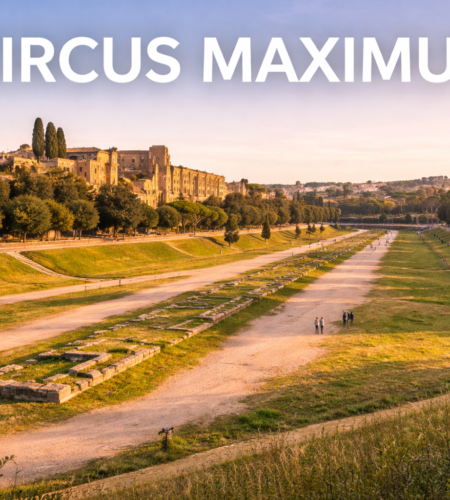
The Circus Maximus is the biggest entertainment venue of ancient Rome—and one of the largest ever built—stretching about 600 m long and 140 m wide in the valley between the Palatine and Aventine hills.
Today it looks like a long green “park,” but once it hosted roaring chariot races, ceremonies, and public events that shaped Roman life.
Why the Circus Maximus is special ✅
- Scale you can still feel: even without the original seating tiers, the sheer footprint is mind-blowing (especially when you walk the length).
- Deep time layers: from early uses in the Murcia Valley to major rebuilding under Trajan, and later reuse as farmland and industrial space, the site tells Rome’s “recycling history” in one place.
- It’s easy + flexible: you can do it as a free scenic stop—or go deeper with the archaeological area and the Circo Maximo Experience (AR/VR).
What you’re actually looking at today 📍
The “valley stadium” layout
The Circus Maximus sat in the Valle Murcia (Murcia Valley) between Palatine and Aventine; it evolved into a true masonry circus under Julius Caesar, was repeatedly damaged by fire, and was largely rebuilt under Trajan (many visible remains relate to that phase).
A headline detail many visitors miss: the obelisk story
Tourism Rome notes that a gigantic obelisk was erected here in 357 AD by Constantius II and is now at the Lateran.
Three ways to experience the Circus Maximus (pick your style) ✅
| Option | Time | Cost | Best for |
|---|---|---|---|
| Free lawn walk | 20–45 min | Free | Quick stop, sunrise/sunset stroll |
| Archaeological Area + Torre della Moletta | 45–90 min | Ticketed | Seeing real structures + understanding the site |
| Circo Maximo Experience (AR/VR) | ~40 min | Ticketed | “Bring it back to life” reconstruction, immersive storytelling |
The Torre della Moletta is a medieval tower inside the archaeological complex; Turismo Roma notes it’s associated with a mill (“moletta”) and was owned by the Frangipane family from at least 1145.
Tickets / prices 💳
1) Archaeological Area (excluding Circo Maximo Experience)
Official listing (Sovrintendenza Capitolina) shows:
- Full (non-residents): €7.00
- Reduced (non-residents): €4.00
- Free for Rome + metropolitan area residents (with proof) and MIC card holders
2) Circo Maximo Experience (AR/VR)
Official listing shows:
- Full: €12.00
- Reduced: €10.00
- Family: €22.00 (2 adults + children under 18)
Hours / operating times ⏱️
Archaeological Area + Torre della Moletta (official)
Open Tue–Sun with seasonal hours (last entry matters):
- Last Sunday of Oct → last Saturday of Mar: 09:30–16:00 (last entry 15:00)
- Last Sunday of Mar → last Saturday of Oct: 09:30–19:00 (last entry 18:00)
Closed Mon, 25 Dec, 1 May
Circo Maximo Experience
The official page advises checking the dedicated info site and “Avvisi” (notices) before planning.
Circo Maximo Experience: what it is (and who it’s for) 🎧🕶️
If you’ve ever stood in a ruin and thought “I wish I could see it,” this is for you.
- It’s a ~40-minute walking itinerary using AR/VR headsets and audio.
- The experience is structured in stops that reconstruct different phases and features (including chariot-race moments).
- It’s offered in multiple languages, and the site notes accessibility features such as simplified subtitles for deaf visitors (Italian/English).
Best fit: first-time visitors who want context fast, families/teens, and anyone who finds “a grassy field” underwhelming without interpretation.
How to get there 🚇🚌🚶
Metro (fastest) 🚇
Take Rome Metro Line B to Circo Massimo station (it’s on the official Line B/B1 map).
Walking (best if you’re already central) 🚶
Circus Maximus sits between major sightseeing zones (Palatine/Colosseum area and Aventine/Testaccio side), so it’s an easy link in a day route.
Bus / taxi 🚕
Buses and traffic patterns change often with events; if you’re going for a timed entry (archaeological area or AR/VR), give yourself buffer.
Tips + common mistakes ✅⚠️
Do this ✅
- Choose your goal before you arrive: scenic stop vs. “I want to understand the monument.” That determines whether you need tickets/time slots.
- Respect last entry times for the archaeological area—Rome sites are strict about “ultimo ingresso.”
- Do the AR/VR if you’re not used to “reading ruins.” It’s designed exactly for that.
Avoid this ⚠️
- Showing up Monday expecting the archaeological area to be open.
- Thinking it’s only a park: the Circus Maximus remained active until the early 6th century, and the site’s visible phase is tied strongly to Trajan’s rebuilding—there’s real history under your feet.
Practical mini-itineraries 🧭
30–45 minutes (free + satisfying)
- Walk the length of the valley
- Pause for a “scale moment” (look back and imagine the seating)
- Leave
90 minutes (best value for understanding)
- Archaeological Area + Torre della Moletta
- Add Circo Maximo Experience if you want the “reconstruction layer”
FAQ ❓
Is Circus Maximus free?
The large open area is essentially a public green space; the archaeological area is ticketed with scheduled access.
What are the official archaeological area hours?
Tue–Sun with seasonal hours (09:30–16:00 winter; 09:30–19:00 summer), closed Mon, 25 Dec, 1 May.
How do I get to Circus Maximus by metro?
Use Line B and exit at Circo Massimo.
Is Circo Maximo Experience worth it?
If you want to see the ancient stadium reconstructed and don’t want to rely on imagination alone, yes—the official site describes a ~40-minute AR/VR walk designed to restore the monument’s “lost” layers.
Conclusion
The Circus Maximus is one of Rome’s best “high-impact, low-stress” stops: you can visit in 20 minutes for pure atmosphere—or go deep with the archaeological area and the Circo Maximo Experience to understand what once stood here. Either way, it’s a place where Rome’s scale becomes real.
Comments