
Thessaloniki rewards the traveller who leaves room between sights. A market lane becomes a lunch stop; a church courtyard gives way to busy streets; the sea appears at the end of the square. Use the metro to reach a neighbourhood, then spend your time above ground.
This flexible itinerary gives you a first day of markets and waterfront, followed by a second day of Roman monuments and either hilltop views or museums. The stations are useful starting points, rather than promises of the nearest entrance. Check the onward walk against your accommodation, energy and the weather.
Three stations to keep in mind
- Venizelou: start here for Kapani, Modiano and the streets leading down to Aristotelous Square. The Roman Forum lies in the other direction, uphill from the market district.
- Agias Sofias: useful for Agia Sofia church and central streets between Egnatia and the waterfront.
- Sintrivani: begin the Roman quarter walk here, then continue towards the White Tower or the museum district when your plans take you east.
For the transport side of your visit, read our Thessaloniki metro and airport transport guide. Allow separately for the train journey, street crossings and the walk from the station.
Day one, morning: Venizelou and the markets
Start at Venizelou with a reminder that modern Thessaloniki sits over earlier streets. Excavations during metro construction uncovered substantial remains in the historic centre. Take time for any accessible archaeological displays and interpretation, following the current station signs. The Thessaloniki Tourism account of the metro antiquities explains their wider context.
Above ground, head into Kapani, then towards Modiano. Make this a morning outing when food shopping fits naturally into the walk. Browse the lanes, choose something to eat and let the market set your pace. Keep a little space in your day for an unplanned coffee or a bakery stop.
These two markets work well as a pair: Kapani gives you a network of trading streets, while Modiano brings the food-market experience indoors. Visit with curiosity and leave room for people doing their everyday shopping. There is no need to turn lunch into a checklist.
Day one, afternoon: the square opens onto the sea
Continue towards Aristotelous Square and walk down its broad axis to the waterfront. This is a good moment to stop navigating and look around: the open space changes the scale of the city after the market lanes.
Turn east along the seafront towards the White Tower. If you want one museum visit today, its exhibition provides an introduction to the city’s history inside a landmark you have already been walking towards. Check current admission and opening information before deciding to go inside; the White Tower Museum visitor page describes the exhibition and rooftop outlook.
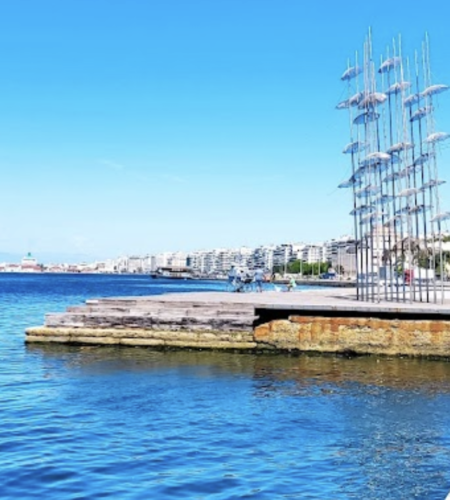
With energy left, continue along the New Waterfront to the Umbrellas sculpture. Otherwise, finish near the tower and leave the longer promenade for another day. The waterfront is a shared space, so watch for cyclists when stepping aside for photographs.
For dinner, Ladadika is an option back towards the port. Treat that as a separate evening outing from your hotel if the return walk feels too much. With only one day available, this markets-to-sea route gives you a varied introduction without trying to fit every monument into the afternoon.
Day two, morning: Roman streets from Sintrivani
Begin at Sintrivani and walk to the Rotunda. Its Roman origins, later religious uses and surviving mosaics offer a concentrated introduction to the city’s overlapping histories. The official tourism guide to the Rotunda is useful background before an interior visit.
Continue to Kamara, the Arch of Galerius, then south towards the palace remains around Navarinou Square. Pause to connect the monuments in your mind: these stops make more sense together than as isolated pins. Modern cafés and apartment buildings remain part of the scene throughout.
Turn west towards Agia Sofia church to finish this part of the walk. It is a place of worship, so follow posted visiting guidance and give services priority. Agias Sofias station gives you a useful point at which to end the morning, return to your hotel or choose the afternoon’s direction.
Day two, afternoon: choose the hills or the museums
For views and smaller streets, head to Ano Poli, the Upper Town. The municipality’s Ano Poli guide introduces the walls, Trigonion Tower and Vlatadon Monastery. This is an uphill outing beyond the central metro stops. Consider an onward bus or taxi to a high starting point, then walk down at a comfortable pace.
A rewarding sequence begins around Trigonion, follows the walls towards Vlatadon and continues through the upper neighbourhood towards Agios Dimitrios and the Roman Forum. Expect slopes, uneven surfaces and possible steps; choose the actual streets using a walking map. You can shorten the route after any stop.
For a museum afternoon, choose the Archaeological Museum of Thessaloniki or the Museum of Byzantine Culture instead. Both lie east of the White Tower area. Give one collection proper attention, check its current visitor information and keep the waterfront as an easy change of scene afterwards.
Choose a base that suits your walks
The booking links and experience widget below are partner recommendations. WAY4I may earn a commission. Compare room details, cancellation terms and the total price for your dates.
- Electra Palace Thessaloniki: on Aristotelous Square, a natural base for the central waterfront. Check prices for your dates.
- COLORS Urban Hotel Thessaloniki: on Tsimiski Street, handy for a markets-and-port itinerary. Check prices for your dates.
- Daios Luxury Living: on Nikis Avenue, for a stay focused on the seafront. Check prices for your dates.
- Orestias Kastorias: near the Roman Forum and Agios Dimitrios, useful for exploring the historic centre. Check prices for your dates.
Keep comfortable shoes, water and a little flexibility in your plans. Pick the stops that interest you, check opening arrangements before setting off and save space for the city between them.
Prefer to explore with a guide?
A guided walk or a day trip can add context to a free afternoon. Browse tours and check prices for your dates. Confirm the meeting point and what is included before booking.
Comments