
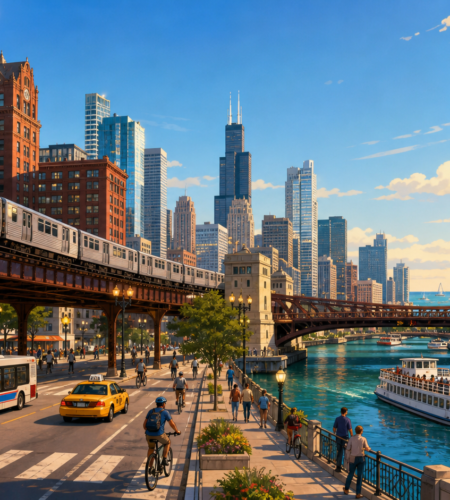
Chicago is easy to admire and surprisingly easy to misplan. The skyline, Lake Michigan, the Chicago River and the elevated trains make the city look compact in photographs, but its best experiences stretch across distinct neighborhoods. A visitor can spend an hour crossing town because a museum day, a baseball game and dinner were booked in three different directions. The solution is not a longer checklist. It is a smarter geographic plan.
This Chicago travel guide is designed around that reality. It explains which airport is better for your trip, how to use the CTA, where to stay without a car, what the major attractions cost, which local foods are worth seeking out, and how to arrange one to five days without wasting half the visit in transit. It also covers hotel taxes, tipping, safety, accessibility, mobile data, insurance and realistic daily budgets.
Prices, operating details and transport information were checked on August 13, 2026. Hotel rates, airfares, attraction prices, event schedules and dynamic tickets can change. Always treat the final price and conditions shown by the provider at checkout as definitive.
Affiliate disclosure: This guide contains affiliate links and booking widgets. We may receive a commission or referral reward from an eligible purchase, at no additional cost to you. Inclusion does not mean that a provider is the best choice for every traveler. Compare the final price, cancellation terms, insurance coverage and eligibility before paying.
Chicago at a Glance
| Essential | What to know |
|---|---|
| Main airports | O'Hare International Airport (ORD) and Midway International Airport (MDW) |
| Best airport for international choice | ORD, with extensive long-haul and domestic networks |
| Easiest airport transfer | CTA Blue Line from ORD or Orange Line from MDW |
| Suggested stay | 3 full days for first-time essentials; 4-5 days for neighborhoods, museums and a slower pace |
| Best first-time base | The Loop, River North or Streeterville |
| Best local-feeling base | Wicker Park, Logan Square, Lincoln Park or Lakeview |
| Currency | United States dollar (USD / $) |
| Time zone | Central Time: UTC-6 in winter and UTC-5 during daylight saving time |
| Transit | CTA trains and buses; Metra for suburbs; Divvy bikes; seasonal water taxis |
| CTA fares | Train $2.50, bus $2.25, one-day pass $5, three-day pass $15, seven-day pass $20 |
| Hotel tax warning | Many Chicago hotel bills carry about 17.4% tax; qualifying large hotels may also pass through a 1.5% CTID charge, bringing the load close to 18.9% before other property fees |
| Restaurant tax | Usually 10.75%, or 11.75% in the central MPEA area and at the airports |
| Tipping | About 20% of the pre-tax bill for standard table service; inspect the bill for an included service charge |
| Power | 120 V, 60 Hz; Type A and B plugs |
| Emergency | 911 for police, fire or ambulance; 311 for non-emergency city services |
Plan a Chicago Trip in the Right Order
The following sequence prevents the most common expensive mistakes:
- Confirm entry documents. International visitors should verify whether they need an ESTA, visitor visa or other authorization before buying non-refundable travel.
- Check the citywide calendar. Major conventions, festivals, sports weekends and the Chicago Marathon can sharply increase hotel prices.
- Choose a neighborhood before choosing a hotel. A lower room rate near O'Hare can disappear once daily airport-to-city travel is included.
- Group each day geographically. Keep the Loop and river together, Museum Campus together, the North Side together, and Hyde Park with other South Side stops.
- Book timed attractions. Architecture cruises, observation decks, Shedd Aquarium and popular restaurants can sell out at useful times.
- Decide whether an attraction pass actually saves money. Add the specific attractions you will use rather than relying on an advertised maximum saving.
- Add mobile data and medical coverage. U.S. health care can be very expensive for uninsured visitors.
- Recheck CTA alerts and weather 24 hours before arrival. Construction, elevator outages, severe heat, thunderstorms or winter weather can change the best route.
Entry Requirements for the United States
Most foreign nationals visiting the United States for tourism need either a B-2 or B1/B2 visitor visa or eligibility under the Visa Waiver Program. The U.S. Department of State provides the official tourism and visitor visa overview.
Eligible Visa Waiver Program travelers need an approved ESTA before travel. The official application fee was $40.27 when this guide was checked. An ESTA is generally valid for multiple trips for two years or until the passport expires, whichever comes first, and Visa Waiver visits are limited to 90 days or less. Approval authorizes travel to a U.S. port of entry; it does not guarantee admission. Apply only through the official CBP ESTA website and avoid lookalike commercial application pages.
Entry rules depend on nationality, passport history, previous travel and individual circumstances. Travelers arriving from Canada by land should also check current ESTA and I-94 rules. Carry the passport used for the authorization, the address of the first accommodation, onward or return travel details, and evidence supporting the purpose of the visit if requested.
Best Time to Visit Chicago
Chicago is a four-season city beside a very large lake. Lake Michigan moderates some temperatures but also creates sharp local differences, strong wind and quickly changing conditions. National Weather Service 1991-2020 normals for O'Hare are a useful planning baseline, not a forecast.
| Period | Normal daytime range | Best for | Main trade-off |
|---|---|---|---|
| January-February | Highs about 32-36 F / 0-2 C; lows about 19-22 F / -7 to -6 C | Museums, theatre, lower-demand weekends | Snow, ice, wind chill and disrupted travel |
| March-April | Highs rise from about 47 to 59 F / 8 to 15 C | Architecture, indoor-outdoor city breaks | Highly variable weather and cold lake wind |
| May-June | Highs about 71-80 F / 22-27 C | Walking, lakefront, patios, festivals | Rain, conventions and rising hotel rates |
| July-August | Highs about 83-85 F / 28-29 C | Beaches, baseball, outdoor music and long evenings | Humidity, thunderstorms, crowds and peak pricing |
| September-October | Highs fall from about 76 to 63 F / 24 to 17 C | Comfortable walking, architecture and food | Event weekends and fast-changing late-season weather |
| November-December | Highs about 48-37 F / 9-3 C | Holiday events, theatre and indoor culture | Short daylight, cold rain, snow and wind |
For a first visit, late May through June and September through early October usually offer the best balance of outdoor comfort and full attraction schedules. July and August are excellent for the lakefront but can be hot, humid and expensive. Winter is worthwhile for museums, food and theatre when the itinerary has indoor alternatives and enough buffer for travel delays.
The lakefront can feel substantially colder than inland neighborhoods in spring. Pack a wind-resistant layer even when the forecast looks mild. In summer, carry water, sunscreen and a light rain shell. In winter, bring insulated waterproof footwear with traction, gloves, a hat and a coat that blocks wind rather than relying on fashion layers alone.
Check the National Weather Service Chicago forecast before each travel day. During severe weather, follow official warnings rather than trying to preserve a fixed outdoor itinerary.
How Many Days Do You Need in Chicago?
One day is enough only for a concentrated downtown introduction: Millennium Park, the Chicago Cultural Center, the Riverwalk and an architecture cruise or the Art Institute.
Two days adds one major museum zone or a North Side neighborhood, but it still requires choosing rather than collecting attractions.
Three full days is the minimum comfortable first visit. It allows one Loop and river day, one Museum Campus or Hyde Park day, and one neighborhood day.
Four to five days is ideal for first-time travelers who want architecture, major museums, local food, the lakefront and at least two neighborhoods without rushing.
A week works for sports, theatre, multiple museums, South and West Side culture, and a day trip to Oak Park, Evanston, Indiana Dunes or Milwaukee.
Arrival and departure days should be treated as partial days. O'Hare is far enough from downtown that a 5 p.m. landing rarely becomes a useful sightseeing evening after immigration, baggage and transit.
Where to Stay in Chicago
Chicago has 77 official community areas and many more named neighborhoods. For visitors, the important decision is not simply downtown versus outside downtown. It is how often the planned sights require crossing the river or traveling north and south.
| Area | Best for | Strengths | Trade-off |
|---|---|---|---|
| The Loop | First visits, architecture, museums and business | Walkable to Millennium Park, Art Institute, theatres and multiple train lines | Some blocks become quiet after business hours; dining is less neighborhood-oriented |
| River North | Nightlife, river access and restaurants | Close to architecture cruises, galleries, bars and the Magnificent Mile | Busy, noisy and usually expensive |
| Streeterville | Families, Navy Pier and lake access | Near the lake, Northwestern medical campus, 360 Chicago and major hotels | Tourist-heavy; not as directly connected to every train line |
| South Loop | Museum Campus, Grant Park and quieter nights | Walkable or short transit to Field, Shedd and Adler; good lakefront access | Fewer late-night options than River North or West Loop |
| West Loop / Fulton Market | Serious dining and nightlife | One of the city's strongest restaurant districts; Green and Pink Line access | Hotel rates can be high; fewer classic first-time sights at the door |
| Lincoln Park | Families, parks and a residential atmosphere | Free zoo, lakefront, cafes and attractive streets | Longer ride to Hyde Park and some downtown attractions |
| Lakeview / Wrigleyville | Cubs games, LGBTQ+ nightlife and North Side energy | Red Line access, Wrigley Field and busy evening scene | Loud around games and weekend nightlife |
| Wicker Park / Bucktown | Repeat visitors, shopping and a local base | Blue Line directly to O'Hare and downtown; independent shops and restaurants | Nightlife noise near the North/Damen/Milwaukee intersection |
| Logan Square | Food, bars and neighborhood character | Blue Line, boulevards, restaurants and music | Farther from lakefront sights |
| Hyde Park | University of Chicago, Griffin MSI and South Side culture | Intellectual, historic, lakeside and distinct from downtown | Not on the CTA L; use Metra Electric or buses for many trips |
Best Area for a First Visit
Choose the Loop for maximum sightseeing efficiency, especially if the Art Institute and architecture are priorities. Choose River North when restaurants and nightlife matter as much as museums. Choose South Loop for a family trip centered on Museum Campus. Streeterville is convenient for the lake and Navy Pier but can require more bus travel.
Best Area Without a Car
The Loop, River North, Wicker Park and Lakeview all work well without a car when the hotel is close to a useful train station. Wicker Park is especially practical for travelers using O'Hare because the Blue Line goes directly to Damen or Division.
Where Not to Stay for a City Vacation
An airport hotel makes sense for a layover, a canceled flight or a very early departure. It is rarely good value for a sightseeing trip. A daily round trip between O'Hare and downtown can consume 90 minutes or more. A suburban room also may require Metra schedules, station parking or costly rideshares at night.
Chicago Hotels Worth Comparing
Hotel rates are dynamic and can double around major events. The examples below are useful for their location and trip style, not because one property is always the cheapest.
| Property | Address | Best fit | Check before booking |
|---|---|---|---|
| Chicago Athletic Association | 12 S Michigan Avenue | Design-focused Loop stay opposite Millennium Park | Destination fee, room size, breakfast and parking |
| HI Chicago Hostel | 24 E Ida B. Wells Drive | Budget travelers and solo visitors in the Loop | Dorm type, private bath, membership terms and cancellation |
| LondonHouse Chicago | 85 E Wacker Drive | River views and central architecture access | View category, rooftop noise, destination fee and valet cost |
| The Robey | 2018 W North Avenue | Wicker Park nightlife and Blue Line access | Street noise, room size and parking; self-parking was listed at $49/day when checked |
| Hotel Zachary | 3630 N Clark Street | Cubs games and Lakeview | Game-day noise, rates and transport after late events |
| SOPHY Hyde Park | 1411 E 53rd Street | Hyde Park, university and South Side itinerary | Downtown travel time, parking and event pricing |
Chicago's hotel taxes require attention. The established composite hotel tax is about 17.39%. From May 1, 2026, hotels with at least 100 rooms in specified Chicago zip codes fall within a Tourism Improvement District with a 1.5% transaction charge that a hotel may pass to guests if disclosed separately. At an affected property, the effective load can approach 18.9% before destination fees, parking or incidental deposits. Compare the final total, not the nightly headline.
The Expedia search below can compare Chicago hotels and flights. Open the rate details and verify all taxes, mandatory property fees, payment timing and cancellation rules.
Chicago Airports: ORD or MDW?
Chicago is served by two airports connected directly to the CTA rail network.
| Airport | Best for | Train to downtown | Typical official estimate | Key issue |
|---|---|---|---|---|
| O'Hare (ORD) | International flights, United and American networks, widest route choice | Blue Line, 24 hours | 40-45 minutes; $5 from O'Hare | Large airport; terminal and security walks can be long |
| Midway (MDW) | Many domestic trips, especially Southwest schedules | Orange Line; N62 bus overnight | 20-25 minutes; $2.50 | Orange Line does not run all night |
O'Hare International Airport
O'Hare is at 10000 W O'Hare Avenue, Chicago, IL 60666. It handles the broadest selection of domestic and international flights. As of the airport's published 2025 network summary, it offered service to more than 180 U.S. cities and dozens of international destinations; the exact route map changes seasonally.
The CTA Blue Line station is inside the airport complex. From Terminals 1, 2 and 3, follow signs for CTA Trains or Trains to City. From Terminal 5, take the free Airport Transit System (ATS) to the domestic terminal area for the Blue Line. The ATS also serves the Multi-Modal Facility for rental cars, Economy Lot F, Pace buses and Metra.
Blue Line trains run 24 hours. Downtown travel normally takes 40-45 minutes, but construction or overnight work can add time. The fare charged when entering at O'Hare is $5; an unlimited CTA/Pace pass can also be used without an additional airport surcharge.
CTA's current comparison estimates a taxi at around $40 and rideshare at approximately $35-$50, with severe surge pricing possible. Traffic can stretch a 25-minute clear-road ride toward 90 minutes. These figures do not include gratuity and should be treated as planning estimates.
O'Hare rental companies are centered at the Multi-Modal Facility, 10255 W Zemke Boulevard. Use the free ATS rather than looking for a rental shuttle at each terminal.
Midway International Airport
Midway is at 5700 S Cicero Avenue, Chicago, IL 60638. It is smaller and often faster to navigate. The airport reported about 250 daily direct flights to 83 U.S. cities and a smaller international network in July 2026.
The accessible CTA Midway station is east of the terminal via an enclosed walkway. Follow the orange line painted on the floor and signs for Trains to City. Orange Line trains take roughly 20-25 minutes to the Loop and cost the regular rail fare of $2.50. The line does not operate through the full overnight period; the N62 Archer bus provides alternate overnight service.
CTA's comparison estimates a taxi near $25 and rideshare around $25-$40, again with traffic and surge pricing able to increase the total.
Which Airport Should You Choose?
Choose the better door-to-door itinerary, not the smaller airport automatically. Midway is usually more convenient for the Loop, South Loop and some South Side stays. O'Hare can be extremely convenient for Wicker Park or Logan Square because of the direct Blue Line. A nonstop ORD flight is often better than a cheaper MDW itinerary with a connection.
Transferring Between ORD and MDW
There is no direct airport express. The all-transit route is Blue Line from O'Hare to Clark/Lake, then Orange Line to Midway. Allow at least 90-120 minutes for the station-to-station trip in normal conditions, plus terminal walking, waiting and a substantial disruption buffer. For separate tickets, an overnight connection or checked baggage, a same-day airport change is risky unless the layover is generous.
Arriving by Train or Intercity Bus
Chicago Union Station
Amtrak's principal station is Chicago Union Station, 225 S Canal Street. It connects Chicago with Milwaukee, St. Louis, Detroit, Indianapolis, the East Coast, the Pacific Northwest, California and other regional or long-distance destinations. The station is staffed, has paid bag storage, and is accessible, but it does not have its own station parking.
Amtrak recommends arriving at least 30 minutes before departure when no ticketing, baggage or assistance is needed and at least 60 minutes when checking baggage or requesting services. Boarding gates close five minutes before departure.
Union Station is west of the Loop. Many downtown hotels are a walk or short bus ride away, but travelers with luggage should check the route before assuming an easy train connection. Clinton Blue Line station is nearby but involves several blocks and is not the most comfortable transfer in bad weather.
Greyhound and FlixBus
Chicago has multiple coach stops, and the correct location is printed on the ticket. Current Greyhound/FlixBus listings include:
- Chicago Bus Station, 630 W Harrison Street
- Chicago Train Station stop, approximately 537-517 W Jackson Boulevard, temporarily located in the red bus lane near Union Station because of construction
- Cumberland CTA station, 5800 N Cumberland Avenue for selected services
- 95th/Dan Ryan, 15 W 95th Street for selected routes
Do not navigate to a remembered "Chicago bus terminal" without checking the current ticket. Operators can change the assigned curb or station during construction. Arrive early enough to identify the exact bus bay, especially for a late-night departure.
Getting Around Chicago Without a Car
Most visitors do not need a car. CTA rail and buses cover the principal districts, walking works well within each neighborhood, and rideshare can fill an occasional gap. A car becomes useful for multiple suburban destinations, regional day trips or travelers whose mobility needs are better served by a private vehicle.
CTA Fares and Passes
The official CTA fare page still listed the following prices when checked on August 13, 2026:
| Fare product | Price | Notes |
|---|---|---|
L train |
$2.50 | O'Hare entry is $5 |
| Bus with Ventra/contactless | $2.25 | Same payment method required for transfers |
| Transfer | Free | Up to two additional CTA rides within two hours |
| Cash bus fare | $2.50 | Exact cash; no transfer |
| Single-ride Ventra ticket | $3 | Useful only in limited cases |
| 1-day CTA/Pace pass | $5 | Valid for 24 hours from first use |
| 3-day CTA/Pace pass | $15 | Valid for 72 hours from first use |
| 7-day CTA/Pace pass | $20 | Usually excellent value for a longer city stay |
| 30-day CTA/Pace pass | $75 | Designed mainly for longer stays |
Pay with a Ventra Card, a contactless bank card, Apple Pay or Google Pay. Use the same card or device throughout a transfer. A new physical Ventra Card costs $5; that purchase fee can be returned as transit value when the card is registered within 90 days. Chicago does not automatically convert ordinary contactless taps into the cheapest unlimited pass, so buy a pass intentionally when it saves money.
The Blue Line and Red Line operate 24 hours. Other lines and many buses have different schedules. The elevated State/Lake station is closed for full reconstruction from January 2026 into 2029; use nearby Clark/Lake or Washington/Wabash where appropriate and confirm current service alerts.
CTA Strategy by Neighborhood
- Blue Line: O'Hare, Wicker Park, Logan Square, West Loop edge and downtown.
- Red Line: Chinatown, downtown, Lincoln Park, Lakeview/Wrigleyville, Uptown and the North Side.
- Brown Line: a scenic elevated ride through Lincoln Park and North Side neighborhoods into the Loop.
- Green Line: West Loop, Garfield Park Conservatory, Bronzeville and parts of the South and West Sides.
- Orange Line: Midway and the Loop.
- Pink Line: Pilsen-adjacent stations, West Side neighborhoods and the Loop.
CTA buses often provide the most direct lakefront and east-west routes. The 146 is useful between downtown and Museum Campus; the 151 follows parts of Michigan Avenue and the lakefront; route choices can change with construction and events.
Accessibility
CTA states that all buses and railcars have accessible features, but not every rail station has step-free access. Elevators can also be temporarily unavailable. Use CTA's accessible trip option and check the live elevator status page immediately before travel. All bus routes use accessible vehicles with ramps or lifts available on request.
Metra
Metra is Chicago's commuter rail network. It is useful for Hyde Park via Metra Electric, suburbs such as Evanston or Oak Park-area alternatives, and regional outings. It is not interchangeable with the CTA fare system unless using a qualifying regional product. Buy Metra tickets or passes in the Ventra app and confirm which downtown terminal the chosen line uses: Union Station, Ogilvie Transportation Center, LaSalle Street Station or Millennium Station.
Divvy Bikes
Divvy offers classic bikes, e-bikes and scooters. Current visitor pricing lists a $19.90 day pass with unlimited classic-bike rides of up to three hours each during a 24-hour period. E-bikes cost extra by the minute. A single classic ride starts with a $1 unlock plus per-minute charges.
The lakefront is one of the city's best rides, but wind, crowding and dock availability matter. Confirm that a ride has ended correctly in the app. A lost or unsecured bike can lead to a large charge.
Chicago Water Taxi
Chicago Water Taxi operates seasonally, generally from March through December, with stops at Chinatown/Ping Tom Park, Michigan Avenue and the Union/Ogilvie area. A one-way ticket was $10 when checked. It is transport with a skyline view, not a substitute for the narrated architecture cruise. Schedules vary by day and season, and the service does not currently stop at Navy Pier.
Renting a Car and Parking
A rental car is unnecessary for a conventional downtown visit and often becomes an expensive parked object. Rent one for Indiana Dunes, multiple suburban sites, regional road trips or an itinerary built around places poorly linked by transit.
Compare the full cost: airport concession fees, tax, fuel, toll program, parking, additional drivers, one-way charges, insurance and the deposit. Chicago hotels commonly charge significant overnight parking fees.
Compare rental cars: Check the exact pickup facility, mileage, deposit, toll policy, fuel terms and cancellation rules before paying.
Chicago street meters currently use three general tiers: $7 per hour in the Loop, $4.75 in the central business district, and $2.50 in many neighborhoods. Posted signs and the six-digit ParkChicago zone always control. Residential permit restrictions, street cleaning, snow rules, event closures and tow zones can override a payment session.
Illinois Tollway roads are cashless. A rental company may offer an electronic toll program with daily or administrative fees. Another option is Illinois Tollway Pay By Plate, which can be set up before travel or within 14 days after using eligible Illinois Tollway roads. It does not cover every separately operated toll road, including the Chicago Skyway. Photograph the rental plate and read the agency's toll terms before leaving the desk.
Best Things to Do in Chicago: Addresses, Hours and Prices
Chicago's principal attractions are large enough that quality falls when too many are forced into one day. Prices below are standard starting or general rates checked on August 13, 2026; dynamic pricing, special exhibitions and taxes may change the total.
| Attraction | Address | Current planning information | Adult price |
|---|---|---|---|
| Millennium Park and Cloud Gate | 201 E Randolph Street | Outdoor public space; security or event restrictions can affect access | Free |
| Chicago Cultural Center | 78 E Washington Street | Usually daily 10 a.m.-5 p.m.; exhibitions, architecture and the Tiffany dome | Free |
| Art Institute of Chicago | 111 S Michigan Avenue | Mon/Wed 11-5, Thu 11-8, Fri-Sun 11-5, closed Tue | $32 nonresident general admission |
| CAC River Cruise | Meet at 112 E Wacker Drive | 90 minutes; arrive 30 minutes early; weather-dependent | From $57 |
| Skydeck Chicago | 233 S Wacker Drive, Jackson Boulevard entrance | Timed entry to Willis Tower's 103rd floor and The Ledge | From $32 |
| 360 Chicago | 875 N Michigan Avenue, 94th floor | Daily 9 a.m.-11 p.m., last entry 10 p.m.; TILT costs extra | From $30 |
| Field Museum | 1400 S DuSable Lake Shore Drive | Daily 9 a.m.-5 p.m., last entry 4 p.m. | From $30 |
| Shedd Aquarium | 1200 S DuSable Lake Shore Drive | Timed tickets strongly recommended; hours and nonresident prices vary | Dynamic plan-ahead pricing |
| Adler Planetarium | 1300 S DuSable Lake Shore Drive | Advance online ticket required for most admission; shows cost extra | $25 entry; $32 with one sky show |
| Griffin Museum of Science and Industry | 5700 S DuSable Lake Shore Drive | Most regular days 9:30 a.m.-4 p.m.; timed experiences cost extra | $25.95 |
| Chicago History Museum | 1601 N Clark Street | Tue-Sat 9:30-4:30, Sun 12-5, usually closed Mon | $19 |
| Lincoln Park Zoo | 2400 N Cannon Drive | Open 365 days; building and seasonal hours vary | Free |
| Garfield Park Conservatory | 300 N Central Park Avenue | Closed Mon-Tue; Wed 10-8, Thu-Sun 10-5; reserve ahead | $10 nonresident adult; Chicago residents free with proof |
| Navy Pier | 600 E Grand Avenue | Pier admission free; wheel, cruises, theatre and rides cost extra | Free entry |
What Is Actually Worth Prioritizing?
The architecture cruise is the best single paid introduction for many first-time visitors. It explains why the skyline looks the way it does while turning the river into a route rather than a backdrop. Book a daylight departure for detail or a late-afternoon departure for warmer light. In cold or wet weather, bring a real outer layer; the river can feel much colder than the street.
The Art Institute deserves at least two to three hours. It is nearly one million square feet, so use the museum map and choose a few collection priorities. Children under 14 receive free general admission; special ticketed exhibitions can cost extra.
Museum Campus is not one attraction. The Field Museum, Shedd Aquarium and Adler Planetarium can each fill several hours. Choose one as the day's anchor and add the lakefront or a shorter second stop. Trying to complete all three produces queues, fatigue and very little time with the collections.
Choose one observation deck unless skyline photography is a central interest. Skydeck has the famous glass Ledge and a west/south city perspective. 360 Chicago has broad lake views, later hours and the optional TILT experience. Weather determines value, so avoid a non-changeable ticket when low cloud obscures the towers.
Navy Pier is free to enter and useful for lake views, cruises, family activities and seasonal fireworks. It is not a mandatory full-day attraction. Combine it with Streeterville, Ohio Street Beach or a lake cruise.
Lincoln Park Zoo is one of the city's best free attractions. Pair it with the Lincoln Park Conservatory, lakefront and neighborhood dining. Parking can cost more than the zoo visit, which is another reason to arrive by bus, bike or rideshare.
Free Chicago That Is Genuinely Worth Your Time
- Cloud Gate, Crown Fountain and the Lurie Garden in Millennium Park
- Chicago Cultural Center interiors and rotating exhibitions
- Chicago Riverwalk from the lake west toward Lake Street
- Lincoln Park Zoo and the nearby lakefront
- Chicago beaches during the official season
- National Museum of Mexican Art in Pilsen
- Garfield Park Conservatory for Chicago residents; modest paid admission for visitors
- Public art including Picasso's sculpture at Daley Plaza and Calder's Flamingo in Federal Plaza
- Free concerts and films at Millennium Park when scheduled
Chicago Park District beaches are free. During the 2026 beach season, lifeguards were on duty daily from 11 a.m. to 7 p.m. through Labor Day. Swimming outside designated beaches or outside guarded hours is prohibited and dangerous. Check the daily flag and water-quality status before entering Lake Michigan.
Chicago Architecture Without Turning It Into Homework
Chicago's architecture is not only a collection of famous towers. It is the story of fire, engineering, land value, rail, labor, immigration and changing ideas about public space.
Start with the Chicago Architecture Center cruise or a docent walking tour. On foot in the Loop, look for the Rookery Building, Monadnock Building, Marquette Building, Chicago Board of Trade, Federal Center, Aqua, Marina City and the river bridges. Enter lobbies only where public access is permitted and respect security instructions.
For Frank Lloyd Wright, travel to Oak Park rather than trying to understand his work through one downtown facade. The Home and Studio and the surrounding historic district form a strong half-day trip. Reserve interior tours in advance.
Open House Chicago, usually held in October, offers access to buildings that are normally closed or restricted. It is a superb event but changes crowd patterns and requires a strategy; do not expect to cross the whole city visiting every headline site.
Chicago Neighborhoods Worth Leaving Downtown For
Pilsen
Go for Mexican American culture, murals, bakeries, taquerias and the free National Museum of Mexican Art. The neighborhood is lived-in, not a themed district, so photograph murals respectfully and spend with local businesses. Pair 18th Street with a meal rather than treating it as a quick photo stop.
Chinatown
Use the Red Line to Cermak-Chinatown or the seasonal water taxi to Ping Tom Memorial Park. Explore Chinatown Square, Wentworth Avenue and the park. It works well after Museum Campus because the areas are close, though not always directly connected by the most obvious walking route.
Wicker Park and Bucktown
The intersection of Milwaukee, North and Damen is the center of shopping, music, bars and restaurants. Walk part of The 606 elevated trail, browse Milwaukee Avenue and use the Blue Line. This is one of the easiest neighborhoods to make a hotel base for an O'Hare trip.
Logan Square
Come for boulevards, independent restaurants, cocktails, coffee and music rather than a single landmark. Logan Square is best experienced as an evening or slow weekend morning. Stay near the Blue Line if downtown travel matters.
Hyde Park
Hyde Park combines the University of Chicago, Griffin MSI, Robie House, bookstores, parks and important Black cultural history. Use Metra Electric from Millennium Station for the fastest downtown connection in many cases, or CTA buses for direct routes. Give the neighborhood most of a day instead of appending it to a packed downtown schedule.
Bronzeville
Bronzeville is central to Chicago's Black history, music, art and the Great Migration. Visit with context through a guided tour, local cultural institution or researched self-guided route. The neighborhood's significance is larger than a single monument.
Andersonville and Uptown
Andersonville is strong for independent shops, cafes and a relaxed neighborhood afternoon. Uptown adds historic music venues, Asia on Argyle and the lakefront. The Green Mill, at 4802 N Broadway, is a landmark jazz venue, but schedules, cover charges and payment rules should be checked before arrival.
What to Eat in Chicago
Chicago's food identity is much broader than deep-dish pizza. The city has been shaped by Black Southern, Mexican, Polish, Italian, Chinese, Puerto Rican, Greek, Jewish, South Asian, Eastern European and many other communities. Build meals around neighborhoods rather than eating every dinner near the hotel.
| Chicago food | A useful place to start | Address | Ordering note |
|---|---|---|---|
| Pan pizza with caramelized edge | Pequod's Pizza | 2207 N Clybourn Avenue | Reserve or expect a wait; this is pan pizza, not the only definition of Chicago pizza |
| Classic deep dish | Lou Malnati's or another established local specialist | Multiple locations | A whole pie can take 30-45 minutes; order soon after sitting |
| Tavern-style thin crust | Vito & Nick's | 8433 S Pulaski Road | Far from downtown; square-cut thin crust is closer to many locals' everyday pizza |
| Italian beef | Al's Italian Beef | 1079 W Taylor Street | Choose sweet or hot peppers and dry, wet or dipped |
| Chicago-style hot dog | Portillo's | 100 W Ontario Street | Traditional toppings include mustard, relish, onion, tomato, pickle, sport peppers and celery salt |
| Maxwell Street Polish | Jim's Original | 1250 S Union Avenue | Sausage with grilled onions, mustard and peppers; casual counter service |
| Jewish deli | Manny's Cafeteria and Delicatessen | 1141 S Jefferson Street | Cafeteria line; known for substantial corned beef and classic comfort food |
| Southern cooking | Virtue | 1462 E 53rd Street | Hyde Park destination; reserve well ahead |
| Dim sum and Cantonese dishes | MingHin Cuisine | 2168 S Archer Avenue | Useful Chinatown group meal; menu and wait vary by time |
| Jibarito | Jibaritos y Mas | 1500 W Fullerton Avenue | Chicago-born Puerto Rican sandwich using fried plantain instead of bread |
Do not let the ketchup debate turn into etiquette theatre. The classic Chicago hot dog is balanced without it, but the purpose of lunch is to eat what you enjoy.
Restaurant Costs, Tax and Tipping
Prepared-food tax is typically 10.75% outside the central MPEA area and 11.75% within it, which includes much of downtown and both airports. A restaurant may also add a service charge, hospitality fee or automatic gratuity. Read the bill before adding another 20%.
For ordinary table service, local visitor guidance describes 20% of the pre-tax amount as the standard gratuity. Tip bartenders about $1 per simple drink or around 20% for a full bar tab. Tip hotel bell staff around $2 per bag and housekeeping roughly $2-$5 per day, preferably daily because staff can change.
Reservations are valuable for destination restaurants, Friday and Saturday nights, and pre-theatre dinner. Leave more time than the map suggests when crossing downtown at rush hour.
Music, Comedy, Theatre and Sports
Chicago is one of the rare cities where an evening performance should be treated as a core attraction rather than an optional add-on.
- Blues: Buddy Guy's Legends, 700 S Wabash Avenue, and Kingston Mines, 2548 N Halsted Street. Check age rules, set times and cover charges.
- Jazz: Green Mill, 4802 N Broadway, plus clubs in River North and the South Side. Arrive early for good seating.
- Comedy: The Second City, 1616 N Wells Street, has multiple stages and show formats. Confirm the exact theatre and whether food service is available.
- Classical music: Chicago Symphony Center, 220 S Michigan Avenue, is exceptionally convenient for a Loop day.
- Theatre: The downtown theatre district includes touring Broadway productions and local companies; neighborhood storefront theatre is a separate Chicago tradition worth exploring.
For sports, Wrigley Field is at 1060 W Addison Street, Rate Field at 333 W 35th Street, United Center at 1901 W Madison Street, and Soldier Field at 1410 Special Olympics Drive. Public transport is usually easier than parking. Event tickets are dynamic, and resale rules vary; buy through the team, venue or an authorized platform.
Chicago Itineraries That Respect Geography
One Day: The Essential First Look
Begin at Millennium Park before the largest crowds, then cross to the Chicago Cultural Center. Walk south to the Art Institute for a focused two- to three-hour visit. After lunch, follow Michigan Avenue north to the river and take a late-afternoon architecture cruise. Finish on the Riverwalk or with one observation deck near sunset.
Do not add Museum Campus. It looks close on a map, but a serious museum visit will hollow out the rest of the day.
Two Days: Downtown Plus One Major Museum
Follow the Loop and river plan on day one. On day two, choose the Field Museum, Shedd Aquarium or Adler Planetarium as the anchor. Walk the Museum Campus lakefront, continue through Grant Park and have dinner in Chinatown or the South Loop.
Families can spend most of day two at Shedd or Field without apology. Museum fatigue is more expensive than a missed attraction because it makes every ticket feel wasted.
Three Days: Add the North Side
Use days one and two above. On day three, start at Lincoln Park Zoo and the lakefront. Continue to the Chicago History Museum or browse Lincoln Park. In the afternoon, choose Lakeview/Wrigleyville, Andersonville or Uptown. End with comedy, jazz, a Cubs game or neighborhood dinner.
Four Days: Add the West Side and Local Food
On day four, take the Blue Line to Wicker Park. Walk Milwaukee Avenue and part of The 606, then continue to Logan Square for lunch or coffee. Move to West Loop/Fulton Market for a reserved dinner. Garfield Park Conservatory can replace Logan Square for travelers who prefer horticulture; use the Green Line and reserve entry.
Five Days: Hyde Park and the South Side
Use Metra Electric or a direct bus to Hyde Park. Choose Griffin MSI or a Robie House tour, walk through the University of Chicago campus, visit local bookstores and reserve dinner at a neighborhood restaurant. With careful timing, add Bronzeville or the DuSable Black History Museum, but do not force both around a full science-museum visit.
Rain Plan
Keep the Art Institute, Chicago Cultural Center, Field Museum, Griffin MSI, Chicago History Museum, theatre and conservatories as strong weather alternatives. An architecture cruise in ordinary rain can still operate, but severe weather, lightning, high wind or very low cloud can reduce comfort and visibility.
Day Trips from Chicago
Oak Park
Best for architecture. Take the CTA Green Line or Metra, then visit the Frank Lloyd Wright Home and Studio and surrounding historic district. Reserve an interior tour. This is the easiest meaningful half-day trip from downtown.
Evanston
Best for a relaxed lakefront and university town. Use the Purple Line or Metra. Combine Northwestern University's campus, lakefront paths and downtown restaurants.
Indiana Dunes National Park
Best for beaches, dunes and hiking. Driving provides the most flexibility, though South Shore Line rail can reach selected access points with additional walking or local transport. National park entrance fees apply, and swimming conditions on Lake Michigan can be dangerous even on clear days.
Milwaukee
Amtrak Hiawatha and Borealis services make Milwaukee feasible without a car, often in about 90 minutes each way depending on the train. Choose a day with an early departure and a late-enough return. A rushed trip is less rewarding than adding another Chicago neighborhood.
Realistic Chicago Travel Budget
The ranges below are planning estimates for one adult in 2026, not quoted prices. Major events, summer weekends and premium views can move costs far above them.
Accommodation per Night Before Tax
| Style | Typical planning range | What it often means |
|---|---|---|
| Hostel dorm | $40-$90 | Shared room, central or transit-accessible location |
| Budget hotel | $140-$230 | Smaller room, limited service or less central address |
| Mid-range hotel | $220-$380 | Central location and conventional full-service room |
| Upscale/luxury | $400+ | Premium location, larger room, views or extensive facilities |
Add roughly 17.4%-18.9% at many hotels, then inspect destination fees and parking. A $250 room can become approximately $294-$297 before a separate property fee.
Food and Daily Spending
| Item | Typical range |
|---|---|
| Coffee and bakery breakfast | $8-$18 |
| Casual lunch | $15-$30 |
| Table-service dinner | $35-$75+ before tax and tip |
| Cocktail or craft beer | $9-$18 before tax and tip |
| Major museum | $25-$40 before upgrades |
| Architecture cruise | From $57 |
| CTA day pass | $5 |
Budget traveler: approximately $70-$120 per day excluding accommodation, using free sights, CTA, grocery or counter-service meals and one paid attraction spread across the trip.
Mid-range traveler: approximately $150-$275 per day excluding accommodation, including a major attraction, table-service dinner, drinks and occasional rideshare.
Comfort-focused traveler: $300+ per day excluding accommodation, with premium tickets, frequent rideshare, cocktails and destination dining.
The strongest savings usually come from geography, not deprivation: stay near the planned transit line, buy the correct CTA pass, choose one observation deck, mix paid museums with excellent free sites, and avoid daily hotel parking.
Tours and Tickets
A guided architecture, food, history or neighborhood tour can add context that a generic attraction list cannot. Compare group size, duration, start point, mobility requirements, cancellation terms and what admission is included. A "skip-the-line" label does not always bypass security screening or timed-entry procedures.
Browse Chicago tours: Compare architecture cruises, walking tours, food experiences and day trips, then verify the operator, meeting point and cancellation policy.
For additional travel inventory, travelers can also compare available travel options through TRGO. Check the supplier name and final terms before purchase.
Mobile Data, Wi-Fi and Useful Apps
Free Wi-Fi is common in hotels, museums, airports and cafes, but mobile data is valuable for CTA alerts, rideshare pickup, reservations and navigation. International roaming can be expensive.
Install an eSIM before departure while reliable Wi-Fi is available. Confirm that the phone is carrier-unlocked, supports eSIM and accepts the selected United States network. Keep the home SIM active only when necessary for banking codes, and disable expensive data roaming on that line.
Need data in Chicago? Compare the plan size, validity period, hotspot policy and supported networks before activating.
Useful apps and mobile sites include:
- Ventra for CTA and Metra trip planning, balances and passes
- Transit, Google Maps or Apple Maps for live route planning
- ParkChicago for metered parking
- Divvy/Lyft for bike share
- Airline and airport apps for gate changes
- Hotel and attraction apps for timed tickets
Download an offline map around the hotel and save the accommodation address in plain text. Underground platforms can interrupt data just when a transfer is needed.
Travel Insurance and Medical Care
Visitors should not assume that a home-country public health plan covers U.S. treatment. Review emergency medical limits, deductible, pre-existing-condition rules, trip cancellation, delay, baggage and any sports or alcohol-related exclusions. Coverage must normally be purchased before a known event becomes foreseeable.
For a life-threatening emergency, call 911. For non-emergency city information, call 311. Bring prescriptions in original labeled packaging and carry enough medication for the trip plus a reasonable delay buffer.
Money, Cards and Tipping
Cards and mobile wallets are widely accepted, and many venues are cashless. Carry a small backup amount of cash plus a second card stored separately. When an ATM or terminal offers to charge in your home currency, declining dynamic currency conversion and paying in USD usually lets your own bank handle the exchange rate; confirm your card's fee structure.
Manage travel money: Compare exchange rates, card availability and fees for your country of residence.
Remember that menu prices usually exclude tax and tip. A downtown restaurant bill can add 11.75% tax, then a customary 20% tip calculated on the pre-tax amount. A disclosed service charge may or may not function as a gratuity; ask the restaurant when the wording is unclear.
Safety in Chicago
Chicago is a major city with large differences by location and time of day. Most visitor trips are straightforward when travelers use normal urban awareness without treating neighborhoods as stereotypes.
- Plan the route before leaving a venue, especially late at night.
- Wait in well-lit, populated parts of stations and move cars if a situation feels uncomfortable.
- Keep phones and wallets away from train doors and crowded boarding areas.
- Do not leave luggage visible in a parked car, even briefly.
- Verify the license plate and driver in the rideshare app before entering.
- Avoid walking along the river edge, lake revetments or breakwaters during high waves, ice or severe weather.
- Use official beach swim zones only when lifeguards are on duty.
- Call 911 for an immediate threat or medical emergency; use 311 for non-emergency city assistance.
At night, the shortest route is not always the best route. A busy commercial street, bus or brief rideshare can be preferable to an isolated walk. Ask hotel staff or venue staff about the current route rather than relying on a years-old forum post.
Accessibility and Family Travel
Chicago's major museums and public attractions generally publish detailed accessibility information. Request accommodations directly and early for guided tours, sensory needs, wheelchairs or assisted listening.
CTA buses are accessible, and railcars have accessible spaces, but some historic L stations lack elevators. Check live elevator status for every required station. A route that is step-free in theory can stop being so during an outage.
For families, choose one major museum per day, include a park or lakefront break, and avoid stacking timed tickets too tightly. Strong family combinations include:
- Field Museum plus the Museum Campus lakefront
- Shedd Aquarium plus Grant Park or Chinatown dinner
- Lincoln Park Zoo plus the conservatory and neighborhood lunch
- Griffin MSI as a nearly full-day destination
- Millennium Park plus Maggie Daley Park and an early architecture cruise
Strollers are manageable in most central areas, but older rail stations, crowded platforms and winter slush can complicate transfers. A bus may be easier than an elevated station with multiple stairs.
Common Chicago Planning Mistakes
- Booking an airport hotel for a downtown vacation. The commute usually costs more time than the room saves money.
- Treating all of Museum Campus as one attraction. Each institution deserves its own priority decision.
- Driving downtown every day. Parking and traffic overwhelm the convenience for most visitors.
- Buying two observation decks automatically. Choose the view and weather window that fit the trip.
- Ignoring hotel tax and destination fees. Compare the final total before committing.
- Scheduling dinner across town immediately after a timed attraction. Chicago distances and event traffic are real.
- Using the wrong Greyhound or FlixBus stop. The ticket address is the source of truth.
- Assuming every CTA station has an elevator. Check the accessible route and live outage list.
- Eating only in River North. Some of Chicago's strongest food experiences are in neighborhoods.
- Underpacking for the lakefront. Wind can make a mild forecast feel much colder.
Chicago Travel Guide FAQ
Is three days enough for Chicago?
Three full days are enough for a strong first visit: one Loop and river day, one major museum day, and one North Side or neighborhood day. Four or five days provide a much better balance.
Do I need a car in Chicago?
No. Most first-time visitors are better served by CTA, walking and occasional rideshare. Rent a car for regional day trips or a specialized suburban itinerary.
Is O'Hare or Midway better?
Midway is smaller and closer to the Loop, while O'Hare has far more international and connecting options. O'Hare can be especially convenient for Wicker Park and Logan Square because of the direct Blue Line.
How much is the train from O'Hare to downtown?
The current CTA fare charged when entering at O'Hare is $5. The Blue Line normally takes 40-45 minutes to downtown and operates 24 hours.
Can I tap a credit card on CTA?
Yes. CTA accepts qualifying contactless cards and mobile wallets. Use the same card or device for transfers. Unlimited passes should be purchased deliberately because ordinary taps do not automatically create the cheapest pass.
What is the best neighborhood for a first visit?
The Loop is best for maximum sightseeing efficiency. River North is better for nightlife and restaurants. South Loop is convenient for Museum Campus, while Wicker Park offers a more local feel with direct O'Hare access.
Is Navy Pier free?
Entry to Navy Pier is free. The Centennial Wheel, rides, theatre, cruises and many special activities charge separately.
Is the Chicago architecture cruise worth it?
For most first-time visitors, yes. It combines skyline views with the history and engineering context that makes Chicago distinct. Reserve ahead in good-weather months.
Can I visit Field Museum, Shedd and Adler in one day?
Technically yes, but it is poor value for most travelers. Choose one as the anchor and perhaps add a short second visit only if interests and opening hours align.
When is the best month to visit Chicago?
June and September are strong all-around choices. May and early October can also be excellent, while July and August are best for beaches and outdoor events but bring heat, crowds and higher prices.
Is Chicago good in winter?
Yes for museums, restaurants, music and theatre, provided the itinerary has weather flexibility. Bring proper windproof and insulated clothing and allow extra airport time.
How much should I tip in Chicago?
About 20% of the pre-tax amount is customary for standard table service. Inspect the bill first because some restaurants include a service charge or automatic gratuity.
Are Chicago beaches free?
Yes. Swim only at designated beaches during official guarded hours and check daily lake conditions. Lake Michigan can have dangerous currents and waves.
Is a Chicago attraction pass worth buying?
It can be, but only when the included attractions match the actual itinerary and reservation requirements. Add the live prices of the exact three to five places you will visit, then compare the pass total and flexibility.
Final Planning Checklist
- Verify passport, visa or ESTA requirements on an official U.S. government site.
- Compare ORD and MDW by total journey, not airfare alone.
- Check the convention, sports and festival calendar before choosing hotel dates.
- Select the neighborhood before selecting the property.
- Compare the hotel total with tax, CTID charge, destination fee and parking.
- Reserve the architecture cruise, Shedd, observation deck and high-demand restaurants.
- Buy the CTA pass that matches the actual number of days.
- Download Ventra, offline maps and all timed tickets.
- Install and test an eSIM before departure if needed.
- Confirm travel medical insurance and exclusions.
- Check CTA service, elevator alerts and weather the day before arrival.
- Reconfirm the exact Amtrak, Greyhound or FlixBus departure point.
- Leave room in the schedule for one neighborhood meal and one unplanned walk.
Official Sources and Update Notes
This guide prioritizes official and primary sources. Key references include:
- Choose Chicago: where to stay by neighborhood
- Choose Chicago: getting around
- Choose Chicago: international visitor information
- CTA fare information
- CTA airport trains
- CTA accessible services
- CTA elevator status
- Chicago O'Hare ground transport
- O'Hare rental car facility
- Midway nonstop service
- Amtrak Chicago Union Station
- Greyhound Chicago stops
- Metra fares and rider information
- Divvy visitor pricing
- Chicago Water Taxi FAQ
- ParkChicago rates
- Illinois Tollway Pay By Plate
- National Weather Service Chicago climate normals
- U.S. Department of State tourism and visitor visas
- Official ESTA application
- Art Institute visitor information
- Chicago Architecture Center river cruise
- Field Museum tickets and visiting information
- Shedd Aquarium visitor information
- Adler Planetarium tickets
- Griffin Museum of Science and Industry pricing
- Chicago History Museum visitor information
- Lincoln Park Zoo visitor information
- Garfield Park Conservatory visitor information
- Navy Pier hours and admission
- Chicago Park District beaches
- 360 Chicago hours and pricing
- Skydeck Chicago visitor guide
- Illinois Department of Revenue MPEA food and beverage tax
- Chicago Tourism Improvement District information
Recheck dynamic fares, attraction calendars and temporary service alerts close to travel. The article's research date is displayed near the beginning so readers can judge which details require a live confirmation.
Comments