
Last Update: June 9, 2026
Vancouver is one of Canada’s easiest cities to love: ocean, mountains, beaches, forests, glass towers, sushi counters, bike paths, ski slopes, coffee shops and cruise ships all packed into a compact West Coast setting. It is also a city where planning details matter. Rain gear is not optional outside summer. Downtown parking is expensive. The airport train is excellent, but YVR trips have an airport AddFare. Hotel prices can jump during cruise season, summer, long weekends, conferences and FIFA World Cup 2026 activity.
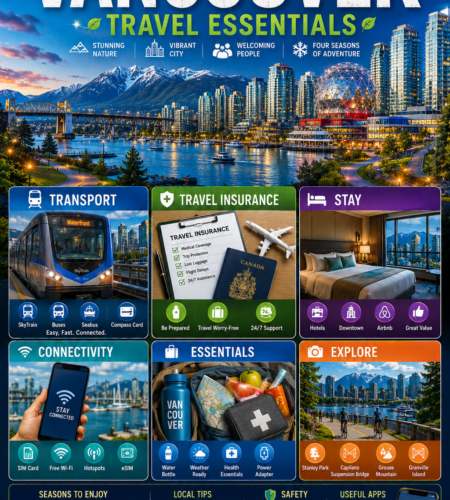
This Vancouver travel essentials guide gives visitors a practical foundation before arrival: Canada entry rules, eTA and visa basics, YVR airport transfers, TransLink fares, where to stay, money, taxes, safety, health, tap water, mobile data, weather, what to pack, day trips, car rental and the key phone numbers to save.
All prices are in Canadian dollars (CAD). Fares, taxes, airport rules, service schedules, road conditions, health advice, weather alerts and entry requirements can change. Always confirm final details with official Government of Canada, CBSA, YVR, TransLink, City of Vancouver, Destination Vancouver, HealthLink BC, DriveBC and your airline before travelling.
Table of Contents
- Quick Answer: Vancouver Essentials
- Vancouver at a Glance
- Entry Rules, eTA and Visa Basics
- Arrival Airport: YVR
- Best Time to Visit Vancouver
- Where to Stay: Best Areas
- Getting Around Vancouver
- TransLink, Compass and Transit Fares
- Money, Cards, Taxes and Tipping
- Internet, SIM Cards and eSIM
- Safety and Street Smarts
- Health, Tap Water and Travel Insurance
- Food, Coffee and Local Eating Habits
- What to Pack
- Useful Apps
- Day Trips and Tours
- Car Rental, Driving and Parking
- Accessibility and Comfort
- Vancouver for Different Travellers
- Essential Contacts
- Travel Planning Tools
- FAQ
- Final Word
- Sources Checked
Quick Answer: Vancouver Essentials
For most visitors, the best airport-to-downtown route is the Canada Line from Vancouver International Airport (YVR). YVR states that the Canada Line connects the airport with downtown Vancouver in under 30 minutes. It is fast, reliable and cheaper than a taxi.
For travellers with heavy luggage, late-night arrivals, cruise departures or hotels far from stations, taxis and rideshare can be easier. YVR has taxi stands on International Arrivals Level 2 and Domestic Arrivals Level 2. Lyft and Uber are authorized ride-app providers at YVR with pickup areas at International Arrivals Level 2, Domestic Arrivals Level 2 and South Terminal.
For public transport, TransLink runs buses, SkyTrain, SeaBus and West Coast Express. A single fare is valid for 90 minutes on bus, SkyTrain, SeaBus and HandyDART. All bus trips are one-zone fares at all times. Children 12 and under ride free on the main TransLink system.
For entry to Canada, U.S. citizens are exempt from the eTA requirement and should carry proper identification such as a valid U.S. passport. Many visa-exempt travellers flying to Canada need an eTA and a valid passport. Visa-required travellers need a visitor visa unless a specific exception applies.
For first-time accommodation, Downtown, Coal Harbour, West End, Yaletown and Kitsilano are the easiest bases. Richmond is practical for airport stays. North Vancouver is excellent for mountains and nature, but it is less central for nightlife.
For packing, bring layers and rain protection. Vancouver is mild year-round, but autumn and winter are wet. Summer is warm and comfortable rather than extremely hot.
Vancouver at a Glance
| Essential | Practical Detail |
|---|---|
| City | Vancouver, British Columbia |
| Country | Canada |
| Main airport | Vancouver International Airport (YVR) |
| Main airport train | Canada Line |
| Main transit agency | TransLink |
| Main city visitor office | Destination Vancouver |
| Currency | Canadian dollar (CAD) |
| Sales taxes | GST 5% plus BC PST generally 7% on many taxable purchases |
| Emergency | 911 |
| Non-emergency police | 604-717-3321 |
| City services | 3-1-1 or 604-873-7000 |
| Health advice | 8-1-1 HealthLink BC |
| Poison control | 1-800-567-8911 |
| Tap water | Safe to drink according to City of Vancouver monitoring information |
| Best transit card | Compass Card or contactless payment |
| Airport transit fee | YVR Airport AddFare when leaving YVR/Sea Island stations toward the city |
| Best city months | May-September for drier outdoor travel; spring and autumn for lighter crowds |
Vancouver is best for:
- City and nature in one trip
- Cruise passengers
- Food travellers
- Outdoor travellers
- Families
- Coffee and craft beer
- Cycling and walking
- Ski plus city trips in winter
- Day trips to Whistler, Victoria, Richmond, North Shore and islands
- Travellers who prefer transit over renting a car
Vancouver is less ideal for:
- Travellers who dislike rain
- Visitors who expect cheap hotels in summer
- Drivers who want easy downtown parking
- Itineraries that underestimate mountain weather
- Visitors who book tight airport-cruise or ferry connections
Entry Rules, eTA and Visa Basics
Canada’s entry rules depend on citizenship, travel document, residency status and how you enter the country. Always use official Government of Canada and CBSA tools before travel.
Basic Entry Documents
CBSA says travellers should carry proper identification for themselves and any children or minors travelling with them. International travellers generally need a passport as the most reliable and universally accepted travel document.
Depending on your situation, you may also need:
- Electronic Travel Authorization (eTA)
- Visitor visa
- Proof of permanent resident status
- Supporting documents for children
- Airline-required documents
- Proof of onward/return travel if requested
- Accommodation details
U.S. Citizens
Government of Canada information states that U.S. citizens are exempt from the eTA requirement and must carry proper identification, such as a valid U.S. passport. CBSA recommends U.S. citizens travel with a valid passport to prove identity and citizenship.
Practical advice:
- Use a valid passport for air travel.
- Carry hotel and return flight details.
- Check airline document requirements.
- If travelling with minors, carry supporting documents.
U.S. Permanent Residents
Government of Canada information states that lawful permanent residents of the United States are exempt from the eTA requirement as of April 26, 2022, but must show required documents for all methods of travel to Canada. CBSA notes that U.S. permanent residents arriving by air must carry proof of citizenship and proof of status in the United States, such as a valid U.S. permanent resident card.
eTA Travellers
Many visa-exempt foreign nationals need an eTA when flying to Canada. Government of Canada says travellers from eTA-required countries need an eTA and a valid passport to board a flight to Canada.
Important:
- You need either an eTA or a visitor visa, not both.
- In most cases, eTA-required travellers arriving by land or sea do not need an eTA, but still need a valid passport.
- Apply through the official Government of Canada website.
- Be careful with fake eTA websites and third-party fee traps.
- Apply early because some applications can take several days.
Visitor Visa Travellers
Visa-required travellers need a visitor visa. If you are from a select visa-required country, you may be eligible for an eTA instead of a visitor visa only when travelling to Canada by air, but you still need a visitor visa when arriving by car, bus, train or boat.
Typical Visitor Stay
Canada commonly allows many visitors to stay up to six months, but the final decision is made by the border services officer. Your passport may be stamped or you may receive specific instructions. If you need to extend your stay, use official IRCC visitor record guidance before your status expires.
Children and Minors
CBSA advises adults travelling with a minor to carry acceptable identification for the child, copies of custody documents if applicable and a consent letter if travelling without the other parent/legal guardian or if not the parent/legal guardian.
Practical advice:
- Bring a birth certificate copy where relevant.
- Bring a notarized consent letter when appropriate.
- Carry custody documents if applicable.
- Keep children’s documents accessible at the border.
Entry Checklist
Before flying to Vancouver:
- Valid passport
- eTA or visitor visa if required
- Proof of U.S. permanent resident status if applicable
- Return or onward ticket
- Hotel address
- Travel insurance
- Proof of funds if asked
- Child consent documents if applicable
- Airline app and boarding documents
- Mobile data plan or eSIM ready
Arrival Airport: YVR
Vancouver International Airport (YVR) is in Richmond, south of Vancouver. It is connected to downtown by the Canada Line and has taxis, rideshare, car rental, hotel shuttles and long-distance transport options.
YVR to Downtown by Canada Line
YVR states that the Canada Line connects YVR to downtown Vancouver in under 30 minutes and to downtown Richmond in 18 minutes. The YVR Airport station is located between the International and Domestic terminals.
Why it works:
- Fast
- Traffic-free
- Direct to downtown stations
- Good for Waterfront, Vancouver City Centre, Yaletown and Richmond
- Easy for solo travellers and light luggage
Important fare point:
- Trips leaving YVR Airport, Sea Island Centre or Templeton stations toward Bridgeport and beyond include the YVR Airport AddFare.
- As of June 9, 2026, the AddFare is $5.
- TransLink states that on July 1, 2026, the YVR Airport AddFare will increase to $6.50.
- There is no YVR AddFare for journeys to the airport.
Good downtown arrival stations:
- Vancouver City Centre: best for central downtown, shopping and many hotels
- Waterfront: best for Canada Place, cruise terminal, Coal Harbour, Gastown, SeaBus and SkyTrain connections
- Yaletown-Roundhouse: best for Yaletown and False Creek
YVR to Downtown by Taxi
Taxis are simple and useful for:
- Heavy luggage
- Late arrivals
- Families
- Cruise passengers
- Hotels not near Canada Line
- Travellers who prefer door-to-door service
YVR taxi facts:
- Taxi stands are on International Arrivals Level 2 and Domestic Arrivals Level 2.
- South Terminal taxi stand is outside the terminal.
- YVR uses zone fares for trips departing the airport to specific zones.
- Meter rates apply for trips outside the zone map.
- Trips to YVR are metered, except the flat fare from Canada Place Cruise Ship Terminal to YVR.
- Cash, credit card and debit card are accepted.
- Rates do not include gratuities.
- Luggage charges are not permitted.
YVR by Rideshare
Lyft and Uber are authorized ride-app providers at YVR.
Pickup areas:
- International Arrivals, Level 2
- Domestic Arrivals, Level 2
- South Terminal
Drop-off:
- Ride-app drivers may use permitted unloading areas on Departures Level 3.
YVR advice:
- Collect luggage before requesting a ride.
- Follow Ride App signs.
- Check the app for current pricing and vehicle type.
- Expect higher prices during peak times, cruise days, major events and bad weather.
YVR Car Rentals
YVR car rental facilities are steps from the terminal on the ground floor of the parkade.
On-site rental brands listed by YVR include:
- Avis
- Alamo
- Budget
- Dollar
- Enterprise
- Hertz
- National
- Thrifty
Off-airport rental companies use courtesy shuttle zones. YVR also notes wheelchair-accessible car rentals are available with 48 hours’ advance notice through the rental company.
YVR Hotel Shuttles
Courtesy shuttle buses serve many local airport hotels, selected off-airport car rentals, Airport South, YVR JetSet Parking and YVR Value Long Term. Hotel shuttle request phones are located on Departures Level 3 of both International and Domestic terminals.
YVR Night Transport
YVR states that when the Canada Line is closed, the N10 NightBus supports late-night and early-morning public transit access between YVR, downtown and Richmond.
Best YVR Transfer by Traveller Type
| Traveller | Best Choice |
|---|---|
| Solo with light luggage | Canada Line |
| Family with bags | Taxi or rideshare |
| Cruise passenger | Taxi/rideshare or Canada Line to Waterfront if luggage is manageable |
| Airport hotel stay | Hotel shuttle or taxi |
| Downtown hotel near station | Canada Line |
| Late night | Taxi/rideshare or N10 NightBus if transit fits |
| Road trip starting immediately | YVR car rental |
Best Time to Visit Vancouver
Destination Vancouver describes Vancouver as mild year-round, with early spring blooms, warm comfortable summers, colourful autumn and relatively temperate winters.
Spring
Spring is excellent for:
- Cherry blossoms
- Gardens
- Early hiking
- Lower crowds than summer
- Mild city walks
Pack:
- Light rain jacket
- Layers
- Comfortable waterproof shoes
- Sweater
Summer
Summer is the most popular visitor season.
Best for:
- Stanley Park
- Beaches
- Seawall cycling
- Outdoor dining
- Festivals
- Whale watching
- Cruise departures
- Mountain day trips
Destination Vancouver says summer has warm, mild conditions with average temperatures around 15 C to 25 C, and occasional rain at the edges of the season.
Watch for:
- Higher hotel prices
- Cruise crowds
- Wildfire smoke risk in some years
- Busy attractions
- FIFA World Cup 2026 activity
Autumn
Autumn is beautiful and moodier.
Best for:
- Fall colours
- Food trips
- Markets
- Museums
- Fewer crowds
- Cozy coastal atmosphere
Watch for:
- Rain increases
- Shorter daylight
- Waterproof footwear becomes useful
Winter
Winter in Vancouver is mild compared with much of Canada, but wet in the city and snowy in the mountains.
Best for:
- Skiing and snowboarding nearby
- Christmas lights
- Cafes and breweries
- Museums and indoor culture
- Lower city crowds outside holidays
Watch for:
- Rain in the city
- Snow/ice in mountain areas
- Winter tire requirements on many BC highways
- Ferry/weather disruptions
Month-by-Month Logic
| Period | Travel Style |
|---|---|
| January-March | Ski plus city, rain gear, museums, winter lights |
| April-June | Cherry blossoms, gardens, milder hikes, lighter crowds |
| July-August | Peak summer, beaches, cruises, festivals, highest demand |
| September-October | Great shoulder season, mild weather, food and nature |
| November-December | Rain, lights, markets, cozy city, mountain snow begins |
Where to Stay: Best Areas
Vancouver neighbourhood choice affects your trip. The city is compact, but bridges, water, rain and transit station proximity matter.
Downtown Vancouver
Best for:
- First-time visitors
- Business travellers
- Short stays
- Transit access
- Shopping
- Cruise departures
- Restaurants and attractions
Downtown is the most practical base if you want easy access to SkyTrain, Canada Line, waterfront, Gastown, Yaletown, Stanley Park and Canada Place.
Coal Harbour
Best for:
- Waterfront hotels
- Cruise passengers
- Quiet downtown feel
- Stanley Park access
- Harbour views
Coal Harbour is polished, scenic and convenient for Canada Place. It is excellent for couples, cruise passengers and travellers who want calm evenings.
West End
Best for:
- Stanley Park
- English Bay
- Beaches
- Walkable local restaurants
- Good-value downtown stays
The West End is one of Vancouver’s best visitor bases if you like walking, parks and a more residential downtown mood.
Yaletown
Best for:
- Restaurants
- Nightlife
- False Creek
- Canada Line access
- Polished city stay
Yaletown is stylish and convenient. It works well for couples and travellers who want dining and nightlife without being far from transit.
Gastown
Best for:
- Historic atmosphere
- Restaurants and bars
- Photography
- Waterfront Station access
Gastown is atmospheric but choose your exact location carefully. Some nearby streets can feel rougher, especially late at night. Stay aware and use taxis/rideshare after dark if needed.
Kitsilano
Best for:
- Beaches
- Cafes
- Local lifestyle
- Families
- Longer stays
- Summer trips
Kitsilano is excellent if you want a neighbourhood feel and beach access. It is less convenient for rapid transit, so check bus routes and taxi times.
Mount Pleasant
Best for:
- Breweries
- Cafes
- Local restaurants
- Younger creative energy
- Longer stays
Mount Pleasant is good for travellers who want a less touristy, food-and-drink-focused base.
Commercial Drive
Best for:
- Independent restaurants
- Cafes
- Music and local culture
- More relaxed stays
Commercial Drive has strong neighbourhood character and good transit access via Commercial-Broadway, but it is not as central as downtown.
Richmond / Airport Area
Best for:
- Early flights
- Late arrivals
- Asian food
- Airport hotels
- YVR access
Richmond is practical for YVR and excellent for food, but not the best base if your main goal is downtown sightseeing.
North Vancouver
Best for:
- Mountains
- Capilano/Grouse-style trips
- SeaBus access
- Quieter stays
North Vancouver is strong for nature travellers. Stay near the SeaBus if you want easy downtown access.
Best Area by Traveller Type
| Traveller | Best Base |
|---|---|
| First-time visitor | Downtown, Coal Harbour, West End |
| Cruise passenger | Coal Harbour, Downtown near Canada Place |
| Food/nightlife | Yaletown, Gastown, Mount Pleasant |
| Beach stay | Kitsilano or West End |
| Family | West End, Coal Harbour, Kitsilano |
| Airport stopover | Richmond/YVR hotels |
| Outdoor traveller | North Vancouver or West End |
| Budget-conscious | Check Mount Pleasant, Commercial Drive, Richmond |
Getting Around Vancouver
Vancouver is easy without a car if you stay in the right place.
Walking
Downtown, Coal Harbour, West End, Yaletown, Gastown and the waterfront are very walkable.
Best walks:
- Stanley Park Seawall
- Coal Harbour to Canada Place
- Yaletown to False Creek
- English Bay to Stanley Park
- Olympic Village to Granville Island area
- Gastown to Waterfront Station by day
SkyTrain
SkyTrain is Vancouver’s rapid transit system. It is useful for:
- YVR via Canada Line
- Downtown
- Richmond
- Burnaby
- New Westminster
- Surrey
- Coquitlam
- Major event movement
Visitors use Canada Line most often, but Expo Line and Millennium Line are important for wider Metro Vancouver.
SeaBus
SeaBus connects Waterfront Station with Lonsdale Quay in North Vancouver. It is practical and scenic.
Good for:
- North Vancouver
- Lonsdale Quay
- Shipyards District
- Mountain connection by bus
- A cheap harbour crossing with views
Buses
Buses fill the gaps between rapid transit lines. They are especially useful for:
- Kitsilano
- UBC
- Granville Island area
- Stanley Park edges
- North Shore transfers
- Mount Pleasant and Commercial Drive
Bikes and Mobi
Vancouver is one of Canada’s best cycling cities. The City of Vancouver highlights cycling routes and Mobi bike share. The Seawall is divided into marked sections: outer path for walkers/joggers and inside path for cyclists/inline skaters.
Good bike rides:
- Stanley Park Seawall
- False Creek
- Kitsilano to Spanish Banks
- Coal Harbour waterfront
- Arbutus Greenway
Aquabus and Granville Island Ferries
Small ferries on False Creek are useful for:
- Granville Island
- Yaletown
- Olympic Village
- Science World
- Sunset water views
They are not part of standard TransLink fares, so check operator pricing.
Taxis and Rideshare
Use taxis or rideshare for:
- Late nights
- Heavy rain
- Luggage
- North Shore trailheads
- Restaurants far from transit
- Airport transfers with family bags
TransLink, Compass and Transit Fares
TransLink is the main transit agency for Metro Vancouver.
Transit Modes
TransLink includes:
- Bus
- SkyTrain
- SeaBus
- West Coast Express
- HandyDART
Fare Zones
TransLink has three fare zones across Metro Vancouver.
Key rules:
- All bus and HandyDART trips are one-zone fares at all times.
- SkyTrain requires one, two or three zones depending on boundaries crossed, time and day.
- SeaBus requires one or two zones depending on time/day.
- All trips starting after 6:30 p.m. Monday-Friday are one-zone fares.
- All weekend and provincial statutory holiday trips are one-zone fares.
- A single fare is valid for 90 minutes on bus, SkyTrain, SeaBus and HandyDART.
Current Adult Cash and Contactless Fares
Verified June 9, 2026:
| Zone | Current Fare | July 1, 2026 Fare |
|---|---|---|
| 1 Zone | $3.35 | $3.50 |
| 2 Zones | $4.85 | $5.10 |
| 3 Zones | $6.60 | $6.70 |
Stored Value Compass Card Fares
| Zone | Current Adult Stored Value | July 1, 2026 |
|---|---|---|
| 1 Zone | $2.70 | $2.85 |
| 2 Zones | $4.00 | $4.20 |
| 3 Zones | $5.10 | $5.40 |
DayPass
| Product | Current Fare | July 1, 2026 Fare |
|---|---|---|
| Adult DayPass | $11.95 | $12.55 |
| Concession DayPass | $9.40 | $9.75 |
A DayPass gives unlimited travel on buses, SkyTrain, SeaBus and HandyDART for one service day until 4 a.m. the next day. It is not valid on West Coast Express.
YVR Airport AddFare
Current:
- $5 YVR Airport AddFare for some trips starting at YVR Airport, Sea Island Centre or Templeton and ending from Bridgeport onward.
Scheduled:
- $6.50 from July 1, 2026.
Important:
- No YVR AddFare for trips to the airport.
- AddFare applies to many fare types including single-use tickets, DayPasses bought at Sea Island stations, Compass Stored Value and Tap to Pay.
Contactless Payment
TransLink accepts contactless Interac Debit, American Express, Mastercard, Visa, Apple Pay, Google Pay and Samsung Pay for single adult fares.
Important:
- Use the same physical card or device throughout the journey.
- Remove the card from your wallet to avoid card clash.
- Contactless payment charges cash fare, not discounted Compass Stored Value.
- For discounted fares, use a Compass Card.
Kids 12 and Under
TransLink says children 12 and under ride free on bus, SkyTrain, SeaBus and West Coast Express. Children may need assistance at fare gates when travelling on gated systems.
Best Fare Choice by Traveller Type
| Traveller | Best Fare Option |
|---|---|
| One or two simple rides | Contactless card/device |
| Several rides in one day | DayPass |
| Longer stay | Compass Card with Stored Value |
| Family with young children | Adults pay; kids 12 and under ride free |
| YVR to downtown only | Canada Line with AddFare or taxi/rideshare if luggage-heavy |
| Evening/weekend travel | One-zone fare across the system, except special cases |
Money, Cards, Taxes and Tipping
Currency
Canada uses the Canadian dollar (CAD). Prices are usually shown with $, and unless otherwise stated in Vancouver, that means CAD.
Cards
Credit and debit cards are widely accepted in Vancouver. Contactless payment is common.
Use cards for:
- Hotels
- Restaurants
- Transit tap payments
- Shops
- Attractions
- Taxis/rideshare
- Tours
Carry some cash for:
- Tips
- Small markets
- Backup
- Laundromats
- Some food trucks or small vendors
Sales Tax
In British Columbia, travellers commonly see:
- Federal GST: 5% on many taxable supplies
- BC PST: generally 7% on many taxable goods and services, with exceptions
Combined tax on many retail purchases can therefore be 12%, but some items are exempt or taxed differently. Accommodation, alcohol, car rentals and special categories can have additional or different taxes/fees. Do not assume shelf prices are the final total.
Tipping
Common visitor tipping norms:
- Restaurants: 15-20% for good service
- Coffee/counter service: optional, often small amount
- Taxi/rideshare: 10-15% or round up
- Hotel porter: small per-bag tip
- Tour guides: tip for good service
- Spa/salon services: 15-20%
Tipping is not usually included unless your bill says so.
Budget Notes
Vancouver can be expensive, especially for accommodation.
Expect higher costs during:
- Summer
- Cruise season
- Long weekends
- Major concerts/events
- FIFA World Cup 2026
- Large conferences
- Ski weekends in winter
Save money by:
- Staying near transit
- Using Canada Line from YVR
- Buying a DayPass on heavy transit days
- Eating in Richmond, Commercial Drive or neighbourhood cafes
- Booking hotels early
- Using free parks, beaches and Seawall walks
Internet, SIM Cards and eSIM
Mobile data is very useful in Vancouver. You will use it for transit, maps, rideshare, restaurant reservations, ferry updates, hiking weather and emergency alerts.
Free Public Wi-Fi
Destination Vancouver says there are more than 500 free public Wi-Fi hotspots around the city. Look for #VanWiFi at libraries, city buildings, neighbourhood hangouts and popular public spaces.
City of Vancouver also describes #VanWiFi as free public Wi-Fi at libraries, city and Park Board buildings and other locations.
Local SIM and Roaming
Canadian mobile plans can be expensive for visitors. Options:
- International roaming from your home provider
- Canadian prepaid SIM
- eSIM
- Free Wi-Fi plus offline maps
eSIM
An eSIM is useful for:
- Airport arrival
- Canada Line navigation
- Rideshare pickup
- Restaurant bookings
- Google/Apple Maps
- Ferry and weather updates
- Hiking safety
- Translation
Partner option:
Set up mobile data for Canada with Yesim
Safety and Street Smarts
Vancouver is generally manageable for visitors, but it is still a major city. Use practical street awareness.
Emergency and Non-Emergency
Call 911 for police, fire or medical emergencies that need immediate action.
For non-emergency police in Vancouver, use:
- 604-717-3321
For city services:
- 3-1-1
- 604-873-7000
Common Visitor Safety Tips
- Keep phones secure near busy sidewalks.
- Do not leave bags visible in rental cars.
- Use hotel safes for passports.
- Lock bikes properly.
- Avoid isolated parks/trails at night.
- Use taxis/rideshare late at night if unsure.
- Be cautious around intoxicated nightlife areas.
- Stay alert around major stations and busy tourist zones.
Downtown Eastside and Nearby Areas
Some streets near Gastown, Chinatown and the Downtown Eastside can feel challenging for visitors because of visible homelessness, drug use and social distress. This does not mean all nearby neighbourhoods are unsafe, but first-time visitors should choose accommodation carefully and avoid wandering unfamiliar blocks late at night.
Practical approach:
- Use main streets.
- Stay aware.
- Avoid displaying valuables.
- Use transit, taxi or rideshare at night if uncertain.
- Ask hotel staff about the best walking route.
Outdoor Safety
Vancouver’s nature is close, but mountains and water can be serious.
Before hikes or mountain trips:
- Check weather.
- Check trail status.
- Tell someone your plan.
- Carry water, layers and power bank.
- Do not rely only on city weather for mountain conditions.
- Avoid snow/ice routes without proper gear.
Wildfire Smoke and Weather Alerts
Summer and early autumn can bring wildfire smoke in some years. Winter storms can affect roads, ferries, flights and mountain access. Use official alerts and local news.
Health, Tap Water and Travel Insurance
Tap Water
City of Vancouver says drinking water is regularly monitored by City staff, Vancouver Coastal Health and Metro Vancouver, meets water quality standards and is safe to drink.
Bring a reusable bottle. Vancouver is a good city for refilling.
Health Advice
HealthLink BC provides health advice through 8-1-1. It connects callers with a navigator and can connect them with health professionals. Translation services are available in over 130 languages.
HealthLink BC notes:
- 8-1-1 health service navigators: 24/7
- Registered nurses: 24/7
- Pharmacists: 5 p.m. to 9 a.m., 7 days a week
- Physicians: 9 a.m. to 11 p.m., 7 days a week by referral
For emergencies, call 911.
For poison exposure:
- 1-800-567-8911
Travel Insurance
Canada medical care can be expensive for visitors without provincial coverage. Travel insurance is strongly recommended.
Insurance is useful for:
- Emergency care
- Hospital visits
- Trip interruption
- Flight delays
- Lost baggage
- Cruise disruptions
- Ski or outdoor activity issues
- Medical evacuation
Partner option:
Check SafetyWing travel insurance for Canada
SafetyWing widget:
Food, Coffee and Local Eating Habits
Vancouver is one of North America’s best food cities for Asian cuisine, seafood, coffee, casual dining and international neighbourhood eats.
Try:
- Sushi
- Ramen
- Chinese food in Richmond
- Dim sum
- Seafood
- Salmon
- Spot prawns in season
- Japadog-style street food
- Craft beer
- Coffee roasters
- Indigenous-owned restaurants where available
- Food trucks
- Granville Island Public Market
Neighbourhood food ideas:
- Richmond: Chinese, Taiwanese, Hong Kong-style cafes
- Commercial Drive: Italian roots, cafes, casual global food
- Mount Pleasant: breweries, coffee, modern casual dining
- Yaletown: polished dining and bars
- Gastown: cocktail bars and restaurants
- Kitsilano: brunch, beach cafes, casual dinners
- West End: ramen, Korean, Japanese and neighbourhood dining
Reservations are useful for popular restaurants, especially Friday/Saturday, summer, cruise season and major event weeks.
What to Pack
Year-Round Essentials
- Passport and entry documents
- Travel insurance
- Phone with eSIM/SIM plan
- Power bank
- Waterproof jacket
- Comfortable walking shoes
- Layers
- Reusable water bottle
- Credit/debit card
- Small cash
- Sunglasses
- Daypack
- Transit-ready payment card
Rain Gear
For autumn, winter and spring:
- Proper rain jacket
- Waterproof shoes or boots
- Quick-dry layers
- Compact umbrella if you like one
- Backpack rain cover
Summer Gear
- Light layers
- Swimsuit
- Sunscreen
- Hat
- Comfortable sandals plus walking shoes
- Light sweater for evenings
Outdoor Gear
For hikes/day trips:
- Trail shoes
- Extra layer
- Water
- Snacks
- Offline map
- Battery pack
- Weather check
- Emergency contact plan
Winter Mountain Gear
If going to Whistler, Grouse, Cypress or Seymour:
- Warm waterproof outer layer
- Gloves
- Hat
- Proper footwear
- Ski/snow gear if needed
- Confirm winter tires if driving
Useful Apps
Useful Vancouver apps and tools:
- Google Maps
- Apple Maps
- Transit app
- TransLink trip planner
- Uber
- Lyft
- Mobi bike share
- Van311
- Alertable
- YVR airport app/site
- HealthLink BC
- DriveBC
- BC Ferries
- Airline app
- Currency converter
- Weather app
- AllTrails or hiking map app
Day Trips and Tours
Vancouver is a strong base for day trips.
Easy City and Near-City Trips
- Stanley Park
- Granville Island
- Capilano area
- Grouse Mountain
- Lynn Canyon
- Queen Elizabeth Park
- Museum of Anthropology at UBC
- Kitsilano and Spanish Banks
- Lonsdale Quay and North Vancouver Shipyards
Regional Day Trips
- Whistler
- Sea to Sky Highway
- Squamish
- Victoria
- Bowen Island
- Steveston
- Richmond food trip
- Deep Cove
- Fort Langley
- Fraser Valley wineries
When a Tour Is Worth It
Use a tour if:
- You do not want to rent a car.
- You want Whistler without driving.
- You are visiting Victoria and Butchart Gardens in one day.
- You want a guided food or brewery experience.
- You have a cruise stop and limited time.
- You want a structured North Shore day.
Partner option:
Browse Vancouver tours and day trips on Viator
Car Rental, Driving and Parking
You do not need a car for central Vancouver if your hotel is near transit.
Rent a car for:
- Sea to Sky Highway
- Whistler
- Squamish
- Fraser Valley
- Vancouver Island road trip
- Multi-day BC itinerary
- Family nature trips
Avoid renting a car for:
- Downtown-only sightseeing
- Cruise pre-night
- Stanley Park and Granville Island only
- Trips where parking will cost more than transit/taxis
Driving Licence
BC official information says visitors can drive in BC for up to six months if they hold a valid foreign or out-of-province licence, and licence restrictions still apply. If your licence is not in English or French, an International Driving Permit can be useful as a translation.
Winter Tires
BC has designated routes where winter tires and chains are required between October 1 and March 31, and some routes may extend to April 30. If driving to Whistler or mountain areas in winter, confirm your rental vehicle is properly equipped.
Parking
Downtown parking can be expensive and limited. Check:
- Hotel parking rates
- Overnight rules
- Street signs carefully
- Event restrictions
- Park parking fees
Road Conditions
Use DriveBC for road conditions, closures, webcams and delays.
Partner option:
Compare Vancouver car rental on DiscoverCars
Accessibility and Comfort
Vancouver is generally accessible for many travellers, but terrain and weather matter.
Consider:
- Rainy sidewalks
- Hills in some areas
- Long waterfront walks
- Older buildings in historic districts
- Crowded transit during events
- Mountain attractions with different accessibility levels
Transit:
- Canada Line is accessible by elevator at YVR.
- YVR has Guest Experience staff and Green Coat volunteers.
- TransLink includes accessible transit resources.
Comfort tips:
- Stay near a SkyTrain or Canada Line station.
- Use taxi/rideshare for rainy late nights.
- Break up long walking days with cafes.
- Choose waterproof shoes.
- Confirm attraction accessibility before booking.
Vancouver for Different Travellers
First-Time Visitors
Stay Downtown, Coal Harbour or West End. Use Canada Line from YVR if luggage is manageable. Spend time in Stanley Park, Granville Island, Gastown by day, Yaletown, English Bay and the North Shore.
Cruise Passengers
Stay near Canada Place, Coal Harbour or Downtown. For YVR to cruise terminal, Canada Line to Waterfront can work if you can manage luggage; taxi/rideshare is easier with bags.
Families
Choose West End, Coal Harbour, Kitsilano or a family-friendly downtown hotel. Use parks, beaches, Science World, aquarium, Granville Island and gentle transit days.
Outdoor Travellers
Stay West End, North Vancouver or Downtown. Plan Stanley Park, North Shore, Sea to Sky and Whistler. Check weather and trail conditions.
Food Travellers
Stay Yaletown, Mount Pleasant, Commercial Drive, Richmond or Downtown. Include Richmond, sushi, food trucks, Granville Island and breweries.
Digital Nomads
Choose Mount Pleasant, Kitsilano, West End, Yaletown or Commercial Drive. Prioritize Wi-Fi, cafes, transit and laundry access. Use eSIM or local mobile data.
Budget Travellers
Stay near transit rather than deep downtown if hotel prices are high. Use Compass/DayPass, free parks, free Wi-Fi and neighbourhood food areas.
Essential Contacts
Emergency and Health
| Service | Contact |
|---|---|
| Emergency police, fire, ambulance | 911 |
| Vancouver Police non-emergency | 604-717-3321 |
| HealthLink BC | 8-1-1 |
| Deaf/hard of hearing health line | 7-1-1 |
| Poison Control Centre | 1-800-567-8911 |
| Canada Suicide Crisis Helpline | 9-8-8 |
City and Visitor Help
| Service | Contact |
|---|---|
| City of Vancouver services | 3-1-1 |
| City of Vancouver outside 311 | 604-873-7000 |
| Destination Vancouver visitor services | 604-683-2000 |
| Destination Vancouver website | https://www.destinationvancouver.com/ |
| City of Vancouver website | https://vancouver.ca/ |
Transport
| Service | Contact |
|---|---|
| TransLink | https://www.translink.ca/ |
| YVR Airport | https://www.yvr.ca/ |
| DriveBC | https://www.drivebc.ca/ |
| BC Ferries | https://www.bcferries.com/ |
Official Entry and Government
| Service | Contact |
|---|---|
| CBSA travel documents | https://www.cbsa-asfc.gc.ca/travel-voyage/td-dv-eng.html |
| Canada eTA | https://www.canada.ca/en/immigration-refugees-citizenship/services/visit-canada/eta.html |
| Visitor visa | https://www.canada.ca/en/immigration-refugees-citizenship/services/visit-canada/visitor-visa.html |
Travel Planning Tools
These partner tools can support a Vancouver trip. Use them alongside official sources for entry, transport, safety and weather.
Mobile Data: Yesim
Vancouver is easy with live data: transit, rideshare, maps, weather, ferry alerts, restaurant reservations and emergency notices.
Useful for:
- YVR arrival
- Canada Line navigation
- Transit app
- Uber/Lyft
- DriveBC and BC Ferries
- Hiking maps
- Hotel communication
Link:
Get mobile data for Canada with Yesim
Hotels: Expedia
Accommodation choice matters in Vancouver. A hotel near Canada Line, Waterfront, Burrard, Granville, Yaletown or a strong bus route can save time and money.
Good searches:
- Downtown Vancouver hotels
- Coal Harbour hotels
- West End hotels
- Yaletown hotels
- Vancouver cruise terminal hotels
- YVR airport hotels
- Kitsilano stays
- North Vancouver hotels
Link:
Search Vancouver hotels on Expedia
Tours: Viator
Tours can be useful for Whistler, Victoria, North Shore, food walks, whale watching and cruise-friendly itineraries.
Good tour ideas:
- Whistler and Sea to Sky day trip
- Victoria and Butchart Gardens
- Vancouver food tour
- North Shore nature tour
- Whale watching
- Bike tour
- City highlights for cruise passengers
Link:
Browse Vancouver tours on Viator
Car Rental: DiscoverCars
Car rental is best for wider British Columbia travel rather than downtown sightseeing.
Best use cases:
- Whistler
- Squamish
- Fraser Valley
- Vancouver Island road trip
- Multi-day BC itinerary
Link:
Compare Vancouver car rental on DiscoverCars
Travel Insurance: SafetyWing
Travel insurance is useful in Canada because medical care can be expensive for visitors.
Link:
Check SafetyWing travel insurance
SafetyWing widget:
Support the Project: Patreon
If this guide helped you plan a smoother trip, you can support future independent travel guides here:
Support HEDONISM.cloud on Patreon
FAQ
Is Vancouver worth visiting?
Yes. Vancouver is one of Canada’s strongest city-and-nature destinations, with mountains, ocean, beaches, parks, food, transit and day trips close together.
How many days do I need in Vancouver?
Three days is a good minimum. Five to seven days lets you add North Shore, Richmond, Whistler, Victoria or a slower food/outdoor itinerary.
What is the best way from YVR to downtown Vancouver?
The Canada Line is best for most visitors. It connects YVR to downtown in under 30 minutes and avoids traffic.
Is there an airport surcharge on the Canada Line?
Yes. Trips starting at YVR Airport, Sea Island Centre or Templeton and travelling eastbound beyond Sea Island include the YVR Airport AddFare. It is $5 as of June 9, 2026 and scheduled to rise to $6.50 on July 1, 2026.
Is there an AddFare when travelling to YVR?
No. TransLink states there is no YVR Airport AddFare for journeys to the airport.
Can I pay for Vancouver transit with a credit card?
Yes. TransLink accepts contactless debit/credit cards and mobile wallets for adult single fares. Use the same card or device throughout your trip.
Is a Compass Card worth it?
For a short trip with a few rides, contactless is easiest. For a longer stay or many rides, Compass Stored Value gives discounted fares over cash/contactless adult fares.
Do kids ride free on Vancouver transit?
Yes. TransLink says children 12 and under ride free on bus, SkyTrain, SeaBus and West Coast Express.
Do I need a car in Vancouver?
Not for the city. Rent a car for Whistler, Squamish, Fraser Valley, Vancouver Island road trips or multi-day BC travel.
Is Vancouver expensive?
Yes, especially accommodation. Costs rise in summer, cruise season, major events, long weekends and high-demand periods.
What taxes should visitors expect?
Many taxable purchases in BC include 5% GST plus generally 7% PST, with exceptions. Accommodation and certain categories can have additional or different taxes/fees.
Do U.S. citizens need an eTA for Canada?
No. Government of Canada says U.S. citizens are exempt from the eTA requirement and should carry proper identification such as a valid U.S. passport.
Who needs an eTA for Canada?
Many visa-exempt foreign nationals need an eTA when flying to Canada. They usually do not need an eTA when arriving by land or sea, but still need proper documents.
How long can visitors stay in Canada?
Many visitors are allowed up to six months, but the final decision is made at the border. Check official IRCC guidance for your status and extensions.
Is Vancouver safe?
Vancouver is generally safe for visitors, but use big-city precautions. Protect your phone, do not leave bags in cars, stay aware late at night and choose accommodation carefully around Gastown/Chinatown edges.
Can I drink tap water in Vancouver?
Yes. City of Vancouver says its drinking water is regularly monitored, meets water quality standards and is safe to drink.
What is the emergency number in Vancouver?
Call 911 for police, fire or medical emergencies.
What is the non-emergency police number?
Vancouver Police non-emergency is 604-717-3321.
What is HealthLink BC?
HealthLink BC is the 8-1-1 health advice service. It can connect callers with navigators and health professionals, with translation services available in many languages.
What is the best area to stay in Vancouver for first-time visitors?
Downtown, Coal Harbour and the West End are the strongest first-time choices because they are central, walkable and transit-friendly.
Is Richmond a good place to stay?
Richmond is excellent for airport access and food, especially Asian cuisine, but it is less convenient than downtown for first-time sightseeing.
Is North Vancouver a good base?
Yes for nature and mountains. Stay near the SeaBus if you want easy downtown access.
What should I pack for Vancouver?
Bring layers, a waterproof jacket, comfortable walking shoes and a refillable bottle. In autumn and winter, waterproof shoes matter.
What is Vancouver weather like?
Mild but rainy outside summer. Summers are warm and comfortable; autumn and winter bring more precipitation; nearby mountains can have very different conditions from downtown.
Can I visit Whistler without a car?
Yes. Use a bus, shuttle or guided tour. A car gives flexibility, but winter driving requires more caution and proper tires on designated routes.
Is Vancouver good for cycling?
Yes. The Seawall, bike lanes and Mobi bike share make cycling one of the best ways to explore the city.
What is the best free thing to do in Vancouver?
Walk or cycle the Stanley Park Seawall. The City of Vancouver describes it as the world’s longest uninterrupted waterfront path, extending from the Vancouver Convention Centre to Spanish Banks Park.
Final Word
Vancouver is easiest when you plan around water, weather and transit. Stay near the places you will actually use, take the Canada Line from YVR when luggage is manageable, keep a rain layer handy, use TransLink for daily movement, and save your car rental for the mountains and wider British Columbia.
The city rewards travellers who leave space in the itinerary. A perfect Vancouver day might be a coffee, a seawall walk, a SkyTrain ride, sushi, a beach, a ferry view, rain on glass, and mountains appearing when the clouds lift. Handle the essentials first, then let the city breathe.
Sources Checked
- CBSA travel and identification documents: https://www.cbsa-asfc.gc.ca/travel-voyage/td-dv-eng.html
- Government of Canada eTA eligibility: https://www.canada.ca/en/immigration-refugees-citizenship/services/visit-canada/eta/eligibility.html
- Government of Canada eTA: https://www.canada.ca/en/immigration-refugees-citizenship/services/visit-canada/eta.html
- Government of Canada visitor visa: https://www.canada.ca/en/immigration-refugees-citizenship/services/visit-canada/visitor-visa.html
- YVR public transportation: https://www.yvr.ca/en/passengers/transportation/public-transportation
- YVR taxis: https://www.yvr.ca/en/passengers/transportation/taxis
- YVR rideshare: https://www.yvr.ca/en/passengers/transportation/rideshare
- YVR car rentals: https://www.yvr.ca/en/passengers/transportation/car-rentals
- YVR courtesy shuttles: https://www.yvr.ca/en/passengers/transportation/courtesy-shuttles
- TransLink pricing and fare zones: https://www.translink.ca/transit-fares/pricing-and-fare-zones
- TransLink transferring and AddFare: https://www.translink.ca/transit-fares/transferring-and-addfare
- TransLink Compass Card: https://www.translink.ca/transit-fares/compass-card
- Destination Vancouver getting around: https://www.destinationvancouver.com/plan-your-trip/getting-around
- Destination Vancouver visitor services: https://www.destinationvancouver.com/plan-your-trip/visitor-services
- Destination Vancouver free public Wi-Fi: https://www.destinationvancouver.com/plan-your-trip/free-public-wifi
- Destination Vancouver climate and weather: https://www.destinationvancouver.com/vancouver/climate-and-weather
- Destination Vancouver best time to visit: https://www.destinationvancouver.com/plan-your-trip/best-time-to-visit
- Destination Vancouver neighbourhoods: https://www.destinationvancouver.com/neighbourhoods
- Destination Vancouver day trips: https://www.destinationvancouver.com/plan-your-trip/day-trips
- City of Vancouver visiting guide: https://vancouver.ca/guides/visiting-vancouver.aspx
- City of Vancouver emergency information: https://vancouver.ca/home-property-development/emergency-information.aspx
- City of Vancouver drinking water: https://vancouver.ca/home-property-development/drinking-water-monitoring-and-results.aspx
- Vancouver Police report crime/contact: https://vpd.ca/report-a-crime/
- HealthLink BC: https://www.healthlinkbc.ca/
- BC PST: https://www2.gov.bc.ca/gov/content/taxes/sales-taxes/pst
- Canada GST/HST charging rates: https://www.canada.ca/en/revenue-agency/services/tax/businesses/topics/gst-hst-businesses/charge-collect-which-rate.html
- BC driving without a valid driver’s licence / visitor rules: https://www2.gov.bc.ca/gov/content/transportation/driving-and-cycling/roadsafetybc/high-risk/without-valid-dl
- BC winter tire and chain routes: https://www2.gov.bc.ca/gov/content/transportation/driving-and-cycling/traveller-information/seasonal/winter-driving/winter-tire-and-chain-up-routes
- DriveBC: https://www.drivebc.ca/
Comments