
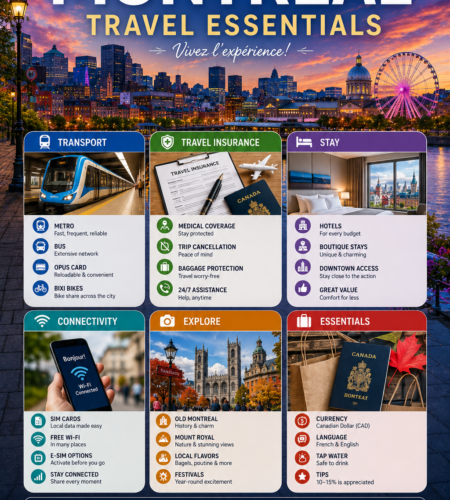
Last Update: June 9, 2026
Montreal is one of North America’s most rewarding city breaks: French street signs, summer festivals, old stone lanes, bagels from wood-fired ovens, late-night restaurants, leafy staircases, murals, markets, winter sparkle and a metro system that makes the core easy to explore without a car.
It is also a city where a little preparation pays off. Quebec uses French as its official language. Sales tax is higher than many visitors expect. The airport is not connected to the metro by train yet, so most travellers use the 747 airport bus, taxi or rideshare. Winter can be beautiful, but serious. Summer can be hot, crowded and expensive during major festivals and Grand Prix periods.
This guide gives you the practical foundation before arrival: Canada entry rules, eTA and visa basics, YUL airport transfers, STM fares, where to stay, money, taxes, tipping, safety, health, drinking water, mobile data, weather, packing, day trips, driving rules and essential contacts.
All prices are in Canadian dollars (CAD). Fares, taxes, airport rules, health advice, road conditions, service hours and entry requirements can change. Always confirm final details with official Government of Canada, CBSA, YUL, STM, ARTM, Ville de Montreal, Tourisme Montreal, Gouvernement du Quebec, Revenu Quebec, SAAQ and your airline before travelling.
Quick Answer: Montreal Essentials
Montreal is best explored by metro, walking, bus, BIXI bike and occasional taxi or rideshare. Most visitors do not need a rental car inside the city.
The main airport is YUL Montreal-Trudeau International Airport in Dorval, west of downtown Montreal.
The best-value airport transfer is usually STM line 747. As checked on June 9, 2026, STM lists the 747 fare at $11.25 per person, and that fare gives a 24-hour pass for bus, metro, exo train and REM in Zone A.
The simplest airport transfer with luggage is a taxi or rideshare. YUL’s official taxi guidance lists fixed downtown taxi fares of $49.45 from 5:00 a.m. to 11:00 p.m. and $56.70 from 11:00 p.m. to 5:00 a.m., as checked from the airport’s help page updated May 14, 2026.
Canada entry documents depend on nationality, travel document, departure country and mode of travel. Many visa-exempt air travellers need an eTA. Some visitors need a visa. U.S. citizens do not need an eTA for air travel, but still need acceptable ID and must satisfy border requirements.
Quebec taxes are important for budgeting. The federal GST is 5% and the Quebec QST is 9.975%. Tourist lodging in Quebec usually has an additional lodging tax of 3.5% on the price of an overnight stay.
French is the official language of Quebec. English is widely usable in hotels, restaurants, attractions and central visitor areas, but learning a few basic French phrases makes the trip smoother.
Emergency number: 911.
Non-urgent health advice in Quebec: 811.
City services in Montreal: 311 or 514-872-0311 from outside Montreal.
Best areas for first-time visitors: Downtown, Old Montreal, Quartier des Spectacles and the Plateau/Mile End depending on budget and trip style.
Best seasons: late May to October for the easiest sightseeing; December to March for winter atmosphere if you pack properly.
Montreal at a Glance
City: Montreal
Province: Quebec
Country: Canada
Airport: YUL Montreal-Trudeau International Airport
Main transit operator: STM for metro and city buses
Regional fare authority: ARTM
Currency: Canadian dollar (CAD)
Language: French is the official language of Quebec; English is common in visitor-facing areas.
Electricity: 120V, Type A/B plugs, same as the United States and most of Canada.
Emergency: 911
Health advice: 811
City services: 311
Tap water: Generally drinkable, but always follow local boil-water advisories or building-specific notices.
Travel style: Food, festivals, design, old city charm, nightlife, museums, cycling, winter activities and day trips.
Entry Rules, eTA and Visa Basics
What documents do visitors need for Canada?
The Canada Border Services Agency says international travellers must carry acceptable identification when entering Canada, and a passport is the only reliable and universally accepted travel and identification document when travelling abroad.
In addition to a passport, visitors may need:
- An Electronic Travel Authorization (eTA)
- A visitor visa
- Another valid travel authorization, depending on status
- Supporting documents for the border officer
What you need depends on:
- Your citizenship
- Your travel document
- Where you are travelling from
- Whether you arrive by air, land or sea
- Whether you are transiting or entering Canada
eTA basics
The Government of Canada states that the official eTA application costs CAN$7. It is used for many visa-exempt foreign nationals travelling to or transiting through Canada by air.
Practical advice:
- Apply only on the official Government of Canada eTA website.
- Beware of lookalike websites that charge extra service fees.
- Apply before booking non-refundable travel when possible.
- Most approvals are fast, but some applications take longer.
- Use the same passport for the eTA and the flight.
Visitor visa basics
Some nationalities need a visitor visa instead of an eTA. If you need a visa, apply through the official Government of Canada process and allow enough time for biometrics, document checks and processing.
U.S. travellers
U.S. citizens usually do not need an eTA or visitor visa for short visits to Canada, but they still need acceptable proof of citizenship and identity. U.S. permanent residents and dual citizens should check their specific requirements before travelling.
Border control tips
Have these ready:
- Passport
- Visa or eTA confirmation if applicable
- Return or onward ticket
- Hotel address
- Proof of funds if asked
- Travel insurance details
- Invitation letter if staying with someone
- Documents for minors if travelling with children
Border officers decide admission at the port of entry. Be clear, calm and truthful about your purpose of travel, length of stay and accommodation.
Arrival Airport: YUL Montreal-Trudeau
YUL Montreal-Trudeau International Airport is in Dorval, west of central Montreal. It is the main airport for the city and the normal arrival point for international visitors.
YUL to downtown Montreal: best options
| Option | Best for | Notes |
|---|---|---|
| STM 747 bus | Budget travellers, solo travellers, light luggage | $11.25 as checked; includes 24-hour Zone A travel |
| Taxi | Simple hotel transfer, luggage, families | Official fixed downtown fare listed by YUL |
| Rideshare | App users, direct transfer | Pickup process may use app/PIN system at airport |
| Rental car | Road trips outside Montreal | Usually unnecessary inside the city |
| Hotel shuttle | Airport-area hotels | Check with your hotel before arrival |
STM 747 airport bus
The 747 is the key public transport link between YUL and central Montreal.
As checked on June 9, 2026:
- The STM 747 fare is $11.25 per person.
- It gives a 24-hour pass for bus, metro, exo train and REM in Zone A.
- Departures are generally every 10 to 20 minutes, all day, in both directions.
- The YUL stop is at door 28.
- The route serves Lionel-Groulx metro station and Berri-UQAM.
- STM notes that, starting January 26, 2026, the 747-1 Centre-Ville departure point and terminus moved to Stop 52905 on Boulevard Rene-Levesque and Rue Berri due to Berri project work.
Why the 747 is useful:
- It is cheaper than taxi or rideshare.
- The fare doubles as a 24-hour city transit pass.
- It connects to major metro lines.
- It works well for travellers staying near downtown, Berri-UQAM, Quartier Latin, Quartier des Spectacles or the metro network.
When the 747 may not be ideal:
- You have large luggage and a tight schedule.
- You arrive very tired after a long-haul flight.
- Your hotel is far from a stop.
- You are travelling as a group and taxi cost becomes competitive.
- You need door-to-door access late at night.
Buying the 747 fare
STM lists several purchase options:
- Exact change on the bus
- Chrono mobile app
- Fare vending machines at YUL
- STM information counter at the airport
- Metro station machines before travelling to the airport
- Some parking pay stations near 747 stops
Important practical detail: if buying on board, STM says cash must be exact change and no paper bills are accepted.
Taxi from YUL
YUL’s official taxi information says taxis are available at door 23 on the arrivals level, with a dispatcher assisting passengers.
As checked on June 9, 2026, YUL’s help page lists downtown fixed fares:
- 5:00 a.m. to 11:00 p.m.: $49.45
- 11:00 p.m. to 5:00 a.m.: $56.70
For other destinations, fares are metered and depend on distance and time of day.
Taxi is the best choice if:
- You are arriving late.
- You have heavy luggage.
- You are staying in Old Montreal on a narrow street.
- You are travelling with children.
- You want a direct ride after a long flight.
Rideshare from YUL
YUL states that app-based rideshare services are available. Airport help guidance says Uber pickup is at door 28 on the arrivals level, where passengers book in the pickup area and receive a PIN code in the app.
Rideshare can be convenient, but compare live prices with the fixed taxi fare before confirming.
Car rental at YUL
YUL lists car rental counters in the P4 parking lot, generally open daily. Airport guidance says passengers from the terminal can head to the Leigh-Capreol drop-off area accessible from door 28, where a free shuttle takes them to P4.
Rent a car if:
- You plan to visit the Laurentians, Eastern Townships, Quebec City or rural areas.
- You are staying outside the city.
- You need flexibility for day trips.
Skip the car if:
- Your trip is mostly downtown, Old Montreal, Plateau, Mile End and museums.
- You dislike parking fees.
- You are visiting in winter and are not comfortable driving on snow or ice.
YUL Wi-Fi and airport tips
YUL airport help says passengers can connect to the .YUL Wi-Fi network. A session provides up to 60 minutes of free browsing, and travellers can start a new session for more time.
YULExpress is a free security appointment system available for eligible flights, generally bookable up to 72 hours before departure. Check official YUL guidance before relying on it.
Airport tip: Montreal airport roadwork and terminal access changes can affect pickup, drop-off and bus stops. Check YUL’s official roadwork page and your airline alerts before departure.
Best Time to Visit Montreal
Montreal changes personality by season. Choosing the best time depends on whether you want festivals, patio life, autumn colour or winter atmosphere.
Late May to June
This is one of the best windows for first-time visitors.
Expect:
- Comfortable walking weather
- Greener parks
- Outdoor terraces
- Festival build-up
- Fewer peak-summer crowds than July
Good for:
- Couples
- Food trips
- First-time visitors
- Photography
- Long walking days
July and August
Summer is lively, hot and event-heavy. Montreal shines in summer, but prices can rise sharply around festivals, holidays and major events.
Expect:
- Warm to hot weather
- Busy patios
- Outdoor concerts
- Crowded Old Montreal
- Higher hotel prices
Pack:
- Sunglasses
- Sunscreen
- Breathable clothes
- Comfortable walking shoes
- A light layer for air-conditioned interiors
September to October
Fall is excellent for food, walking, parks and day trips.
Expect:
- Cooler temperatures
- Beautiful tree colour
- Less humid weather
- Good restaurant energy
- Strong photography conditions
This is one of the easiest seasons for travellers who want Montreal without the hottest summer days.
November
November is quieter and less predictable. It can feel grey, cold and damp before winter activities fully begin.
Good for:
- Lower hotel rates
- Museums
- Food weekends
- Budget travel
Less ideal for:
- First-time sightseeing
- Outdoor-heavy itineraries
December to March
Winter Montreal can be magical if you dress properly.
Expect:
- Snow
- Ice
- Cold wind
- Short days
- Indoor festivals and winter events
- Beautiful Old Montreal streets after snowfall
Pack seriously:
- Insulated coat
- Gloves
- Hat
- Scarf
- Thermal base layers
- Waterproof winter boots with traction
- Lip balm and moisturizer
Winter tip: do not underestimate icy sidewalks. Shoes matter.
April to early May
Spring can be muddy, wet and uneven. Some days feel like winter; others feel like patio season.
Good for:
- Lower rates
- Museums
- Food
- Fewer crowds
Pack:
- Waterproof shoes
- Layers
- Light rain jacket
Where to Stay: Best Areas
Montreal is a neighbourhood city. Where you stay shapes the trip.
Downtown
Best for:
- First-time visitors
- Shopping
- Museums
- Transit convenience
- Business trips
- Access to the Underground City
Downtown is practical. You get hotels, metro access, shopping, restaurants, museums and easy connections to the airport bus.
Choose downtown if you want convenience over charm.
Old Montreal and Old Port
Best for:
- Couples
- First-time visitors
- Historic atmosphere
- Photography
- Weekend trips
- Boutique hotels
Old Montreal is the most atmospheric area: stone buildings, narrow streets, galleries, restaurants, riverfront walks and easy access to major sights.
Trade-offs:
- Hotels can be expensive.
- Streets can be busy in high season.
- Some cobblestone areas are awkward with rolling luggage.
- Nightlife is more polished than local.
Quartier des Spectacles
Best for:
- Festivals
- Entertainment
- Nightlife
- Concerts
- Visitors who want central energy
This is Montreal’s performance and festival district. It is a strong base for summer events, winter light installations, concerts and central transit.
Plateau Mont-Royal
Best for:
- Local cafes
- Murals
- Restaurants
- Walkable streets
- Colourful staircases
- Longer stays
The Plateau is a classic Montreal neighbourhood: expressive, residential, creative and full of cafes, bars and casual restaurants.
Choose it if you prefer neighbourhood texture over hotel-district convenience.
Mile End
Best for:
- Bagels
- Coffee
- Independent shops
- Creative atmosphere
- Food-focused travellers
Mile End is compact, stylish and delicious. It is great for slow mornings, bakeries, bookstores, bars and people-watching.
Griffintown and Little Burgundy
Best for:
- Modern apartments
- Restaurants
- Canal walks
- Younger travellers
- Access to Atwater Market
This area has changed quickly and works well for visitors who want restaurants, condos, canalside walks and access to downtown without sleeping in the most touristy zone.
Near YUL airport
Best for:
- Early flights
- Overnight layovers
- Car rental pickup
- Business travel near Dorval
Do not stay near the airport if your goal is to experience Montreal nightlife, Old Montreal or neighbourhood dining.
Short-term rental note
Quebec and Montreal regulate short-term tourist accommodation. The City of Montreal says that, in most boroughs, using a main residence for tourist rentals is allowed only from June 10 to September 10 each year, with a host permit and criteria. CITQ and Quebec rules require tourist accommodation registration for short stays.
Visitor advice:
- Prefer legal hotels, licensed aparthotels and verified accommodation.
- Check for a valid registration number on short-term rental listings.
- Avoid listings that look too cheap, hide the address or avoid questions about legality.
- Book early for summer, Grand Prix, major festivals and conference periods.
Natural hotel partner placement
For hotel research, compare areas carefully before booking. A practical route is to check downtown, Old Montreal and Plateau/Mile End options side by side on Expedia, then confirm the hotel location on a map before paying.
Getting Around Montreal
Montreal is not a car-first city for visitors. The best travel mix is usually:
- Metro for longer city hops
- Walking for neighbourhoods
- Bus for gaps between metro lines
- 747 bus for airport transfer
- BIXI bike in warmer months
- Taxi or rideshare late at night or with luggage
- Rental car only for out-of-city trips
Metro
Montreal’s metro is fast, frequent and easy to use.
Useful stations for visitors:
- Berri-UQAM for transfers and Quartier Latin
- Place-d’Armes for Old Montreal
- Champ-de-Mars for Old Montreal and City Hall
- Peel and McGill for downtown shopping
- Place-des-Arts for Quartier des Spectacles
- Mont-Royal for the Plateau
- Jean-Talon for Little Italy and Jean-Talon Market
- Lionel-Groulx for airport bus connections
Walking
Montreal rewards walkers, but distances can be deceptive. A day can easily include 20,000 steps if you combine Old Montreal, downtown, Mount Royal and the Plateau.
Walking tips:
- Wear real walking shoes.
- In winter, use boots with grip.
- In summer, carry water.
- Expect hills near Mount Royal and the Plateau.
- Be careful crossing bike lanes.
Buses
Buses fill the gaps between metro lines and are useful for:
- Mount Royal access
- Residential neighbourhoods
- Late-night transit
- Airport transfer via 747
- Areas not directly on the metro
Use the Transit app, Chrono, Google Maps or official STM tools to check live times.
BIXI bike share
BIXI is Montreal’s bike-share system and one of the best ways to experience the city in warm months.
Official BIXI information for 2026 shows service from April 15 to November 15 for seasonal membership and a network of more than 13,000 bikes and over 1,000 stations across Montreal and nearby cities.
For visitors, BIXI’s one-way pass page lists:
- Unlocking fee: $1.50
- Regular BIXI: $0.20 per minute
- Electric BIXI: $0.35 per minute
- Prices before taxes
Bike tips:
- Use protected bike lanes where possible.
- Do not ride on sidewalks.
- Watch for car doors.
- Dock the bike properly.
- Check the brakes before starting.
- Use a helmet if you can, especially for e-bikes.
Underground City
Montreal’s Underground City is useful in winter and rain. It connects malls, metro stations, offices, hotels and food courts in central areas.
It is not one single simple tunnel. Think of it as a network of indoor passages. Use it for comfort, not as a replacement for navigation.
STM, OPUS, Chrono and Transit Fares
Montreal transit fares are coordinated regionally through ARTM and used by STM, exo and REM depending on fare type and zone.
Zone A basics
For most visitor trips on the island of Montreal, you use Zone A.
ARTM says All Modes fares allow travel by bus, train, metro and REM. A Zone A fare covers travel within the agglomeration of Montreal.
Important: trips to Laval or Longueuil metro stations require an All Modes AB fare, not just an All Modes A fare.
Current fare examples checked June 9, 2026
STM’s Zone A regular fare page showed these regular examples when checked:
| Fare | Price shown | Visitor use |
|---|---|---|
| 1-trip, All Modes A | $3.75 | Single metro/bus trip |
| 2-trip, All Modes A | $7.00 | Two rides for one person |
| 10-trip, All Modes A | $34.25 | Longer stays |
| Unlimited evening | $6.50 | Night plans |
| 24-hr, All Modes A | $11.25 | One full day |
| Unlimited Weekend | $16.75 | Friday 4 p.m. to Monday 5 a.m. |
| 3-day, All Modes A | $21.75 | Weekend or short city break |
| YUL airport 747 | $11.25 | Airport bus plus 24-hour Zone A travel |
STM also notes new fare schedules can take effect, including July 1 changes. Always verify before travel.
OPUS card
OPUS is the reloadable smart card used in the Montreal region. It can be useful for longer stays, regular transit users or multi-ticket loading.
For short visits, a disposable fare card or mobile/digital fare may be easier.
Chrono app
Chrono is useful for:
- Digital airport fare
- Loading certain fares
- Transit planning
- Service alerts
STM notes that a digital 747 fare must be activated before boarding and requires Wi-Fi or data to activate.
Which fare should tourists buy?
For one airport arrival plus transit: the 747 fare is often a good deal because it includes 24 hours of Zone A transit.
For a heavy sightseeing day: consider 24-hour All Modes A.
For a weekend: compare Unlimited Weekend with single fares.
For three consecutive days: compare 3-day All Modes A with your expected rides.
For very light use: single fares may be enough.
Money, Cards, Taxes and Tipping
Currency
Montreal uses the Canadian dollar (CAD).
Cards are widely accepted. Contactless payment is common in restaurants, shops, hotels and cafes.
Carry some cash for:
- Small bakeries
- Tips
- Laundry
- Older parking meters or machines
- Markets
- Bus cash situations if needed
Taxes in Quebec
Quebec uses two main sales taxes:
- GST: 5%
- QST: 9.975%
Canada Revenue Agency lists Quebec GST at 5% and provincial sales tax at 9.975%. Revenu Quebec lists QST at 9.975% from January 1, 2013 to present.
Combined, many taxable purchases show about 14.975% in sales tax before any tip.
Lodging tax
Revenu Quebec states the tax on lodging is usually 3.5% of the price of an overnight stay. GST and QST can apply on the total including lodging tax depending on the billing situation.
Budget tip: the advertised hotel price may not include GST, QST, lodging tax, resort-style fees, parking or breakfast.
Tipping
Quebec tourism guidance says tipping is customary in restaurants, bars and taxis, generally 10% to 15% of the total bill before taxes. In practice, many Montreal card terminals may suggest 15%, 18% or 20%.
Practical tipping guide:
| Situation | Typical visitor tip |
|---|---|
| Full-service restaurant | 15% to 20% for good service |
| Bar drink | $1 to $2 per drink or 15% |
| Taxi/rideshare | 10% to 15% |
| Food delivery | 10% to 15% |
| Hotel porter | $2 to $3 per bag |
| Housekeeping | $2 to $5 per day |
| Tour guide | Depends on tour length and quality |
Tip culture can feel aggressive on payment screens. It is okay to choose a reasonable amount based on service.
ATMs and currency exchange
Use bank ATMs when possible. Avoid expensive airport currency exchange unless necessary.
If your card asks whether to charge in CAD or your home currency, CAD is usually the better choice because your bank or card network typically gives a better exchange rate than dynamic currency conversion.
Internet, Wi-Fi, SIM Cards and eSIM
Free Wi-Fi
Montreal has helpful free Wi-Fi options:
- YUL airport Wi-Fi via .YUL
- MTLWiFi in selected libraries, parks, borough offices, tourist sites and commercial streets
- Many cafes
- Hotels
- Shopping centres
- Some museums and public buildings
The City of Montreal describes MTLWiFi as free Wi-Fi at several public locations, including libraries, parks, borough offices, tourist sites and commercial streets.
Why an eSIM is still useful
Free Wi-Fi is helpful, but it is not enough for a smooth trip if you need:
- Live transit alerts
- Rideshare pickup
- Map navigation
- Restaurant reservations
- Translation
- Emergency calls via apps
- Airport fare activation
- Day trips outside central Montreal
For mobile data, a travel eSIM can be easier than buying a local SIM. You can compare Canada data plans through Yesim before arrival so maps, Chrono, Uber and translation apps work as soon as you land.
Safety and Street Smarts
Montreal is generally comfortable for visitors, especially in central tourist areas, but it is still a major city.
Common visitor risks
The most common issues are:
- Pickpocketing in crowded areas
- Phone theft from tables
- Bike theft
- Car break-ins
- Drunk nightlife incidents
- Winter slips and falls
- Overpriced or illegal accommodation
- Parking tickets
- Misreading French road or parking signs
Areas and situations to watch
Use normal city awareness around:
- Busy metro stations
- Late-night entertainment streets
- Empty parks after dark
- Crowded festival zones
- Tourist-heavy Old Montreal streets
- Cars parked with visible luggage
This does not mean avoid those places. It means keep your phone, wallet and bags under control.
Nightlife safety
Montreal nightlife is one of the city’s strengths. Use it wisely.
Tips:
- Travel in pairs late at night when possible.
- Use licensed taxis or app-based rides.
- Keep your drink in sight.
- Save your hotel address offline.
- Do not leave coats, phones or bags unattended.
- Check closing metro times before relying on transit.
Winter safety
Winter danger is less dramatic than crime but more common.
Watch for:
- Black ice
- Slushy curbs
- Snowbanks at crossings
- Wet stairs in metro stations
- Frostbite risk during extreme cold
- Snow-removal parking restrictions
Pack proper boots. Montreal is not the place for smooth fashion soles in January.
Cannabis, alcohol and smoking
Quebec’s cannabis rules are stricter than many visitors expect. Tourisme Montreal and Quebec guidance note that the legal age for cannabis is 21.
The legal drinking age in Quebec is 18.
Always follow local rules for smoking, vaping, cannabis possession and public consumption. Do not bring cannabis across the Canadian border.
Health, Tap Water and Travel Insurance
Emergency and non-emergency care
For emergencies, call 911.
For non-urgent health advice in Quebec, call 811 and choose the appropriate option. The Quebec government says Info-Sante 811 option 1 connects callers with a nurse for non-urgent health issues and is available 24 hours a day, 365 days a year.
For poison emergencies or advice, Tourisme Montreal lists the Quebec Poison Control Centre at 1-800-463-5060.
Hospitals and clinics
Visitors should understand that Canadian public health care is not free for most foreign tourists. Travel insurance matters.
Bring:
- Travel insurance policy number
- Emergency assistance phone number
- Medication list
- Prescription copies
- Allergy information
- Doctor letter for controlled medication if relevant
Tap water
Montreal tap water is generally safe to drink, and the City of Montreal provides drinking water monitoring and public advisories. However, boil-water advisories can happen by borough, street or building.
Always follow:
- Hotel notices
- City alerts
- Building management notices
- Local boil-water advisories
If unsure, ask your accommodation or use bottled water temporarily.
Travel insurance partner placement
For long trips, remote work, multi-country travel or visitors without Canadian health coverage, compare travel medical insurance before departure. One flexible option to review is SafetyWing.
Food, Coffee and Local Eating Habits
Montreal is one of Canada’s best food cities. Come hungry.
What to try
Classic and local favourites:
- Montreal-style bagels
- Smoked meat
- Poutine
- Portuguese chicken
- Quebec cheeses
- Maple desserts
- French pastries
- Jewish deli classics
- Market produce
- Natural wine bars
- BYOW restaurants
- Late-night diners
Food neighbourhoods
Good areas for eating:
- Mile End for bagels, cafes and casual restaurants
- Little Italy for Jean-Talon Market and Italian food
- Plateau for local restaurants and bars
- Old Montreal for polished dining
- Little Burgundy for restaurants and nightlife
- Downtown for convenience
- Chinatown for quick meals
- Jean-Talon Market and Atwater Market for browsing and snacks
Reservations
Book ahead for:
- Popular restaurants
- Friday and Saturday nights
- Summer patios
- Grand Prix period
- Festival weekends
- Groups
Breakfast and coffee
Montreal is strong for coffee and bakeries. A good local morning can be as simple as coffee, pastry, a walk and a market visit.
Budget food tips
- Eat at markets for casual meals.
- Use bakeries for breakfast.
- Try lunch specials.
- Mix one restaurant dinner with cheaper casual meals.
- Check whether menu prices include taxes or not. Usually they do not.
What to Pack
Year-round essentials
- Passport and entry documents
- Travel insurance
- Credit card and backup card
- Some CAD cash
- Comfortable walking shoes
- Phone charger
- Power adapter if needed
- Reusable water bottle
- Day bag
- Medication and prescriptions
- Offline maps
Summer packing
- Breathable clothes
- Sunglasses
- Sunscreen
- Hat
- Light rain jacket
- Comfortable sandals or sneakers
- Layer for cool evenings
Fall packing
- Light jacket
- Sweater
- Walking shoes
- Umbrella or rain jacket
- Layers for changing temperatures
Winter packing
- Insulated coat
- Winter boots with grip
- Gloves
- Hat
- Scarf or neck warmer
- Thermal base layer
- Thick socks
- Moisturizer
- Lip balm
Spring packing
- Waterproof shoes
- Rain jacket
- Layers
- Warm sweater
- Small umbrella
Useful Apps
Useful apps for Montreal:
- Chrono for transit fares and planning
- Transit app for live transit
- Google Maps or Apple Maps
- BIXI for bike share
- Uber or local taxi apps
- Airline app
- Mobile banking app
- Translation app
- WeatherCAN or other weather app
- 311 Montreal app for city alerts and reports
Offline preparation:
- Save hotel address.
- Download offline map.
- Screenshot airport transfer instructions.
- Save eTA or visa confirmation.
- Save insurance details.
- Save emergency contacts.
Day Trips and Tours
Montreal works well as a base for day trips if you have enough time.
Easy day trip ideas
| Day trip | Best for | Notes |
|---|---|---|
| Quebec City | History, architecture, old streets | Long day by train, bus or car |
| Ottawa | Museums, Parliament area, capital city | Possible by train or car |
| Laurentians | Nature, lakes, small towns | Easier with car or tour |
| Mont-Tremblant | Mountains, resort village | Better with car or guided trip |
| Eastern Townships | Wineries, villages, countryside | Best with car |
| Mont-Saint-Hilaire | Hiking and nature | Check trail access and transport |
| Jean-Drapeau Park | Easy city escape | Metro accessible |
Guided tours
Tours can be useful for:
- Food walks
- Old Montreal history
- Bike tours
- Day trips without renting a car
- Quebec City excursions
- Winter activities
- Photography routes
You can compare Montreal tours and day trips on Viator, especially if you want a guide for Old Montreal, food culture or a no-car day trip.
Car Rental, Driving and Parking
Do you need a car in Montreal?
Usually no.
A car is useful for:
- Laurentians
- Mont-Tremblant
- Eastern Townships
- Rural Quebec
- Multi-city road trips
- Families staying outside the core
A car is inconvenient for:
- Downtown hotels
- Old Montreal
- Plateau
- Festival weekends
- Winter parking
- Short city breaks
Foreign driver’s licence in Quebec
SAAQ says non-residents travelling in Quebec may drive for six consecutive months with a licence issued outside Quebec, provided the licence is valid and authorizes the type of vehicle being driven.
If your licence is not in French or English, SAAQ recommends getting an international driving permit before coming to Quebec.
Winter tires
Quebec’s official winter tire guidance says vehicles registered in Quebec, including rental vehicles, must be winter-ready from December 1 to March 15. The requirement does not apply to vehicles registered outside Quebec, but winter tires are still strongly recommended for safety.
If renting a car in Quebec during winter, confirm winter tires before driving away.
Parking
Parking can be stressful because signs may include:
- Resident-only rules
- Street cleaning
- Snow removal
- Time limits
- Paid meter periods
- Loading zones
- Permit zones
Use official parking apps where available and read the whole sign, not just the first line.
Car rental partner placement
For road trips beyond Montreal, compare airport and city rental prices through DiscoverCars. For a city-only stay, spend that money on transit, food and a better hotel location instead.
Accessibility and Comfort
Montreal is rewarding but not always effortless for mobility needs.
What helps
- Metro elevators at selected stations
- Buses with ramps on many routes
- 747 route accessibility information from STM
- Taxis and adapted taxis at YUL
- Underground City for weather protection downtown
- Central hotels near metro stations
What can be difficult
- Old Montreal cobblestones
- Winter snowbanks
- Icy sidewalks
- Metro stations without elevators
- Narrow restaurant entrances
- Hills near Mount Royal
- Outdoor staircases in residential areas
Accessibility planning tips:
- Check hotel entrance and elevator details before booking.
- Choose a hotel near an accessible metro station if transit matters.
- Use taxi/rideshare when sidewalks are icy.
- Avoid cobblestone-heavy stays if rolling luggage or mobility devices are difficult.
- Confirm accessibility directly with venues.
Montreal for Different Travellers
First-time visitors
Stay downtown, Old Montreal or Quartier des Spectacles. Use the 747 bus or taxi from YUL. Spend one day on Old Montreal and the Old Port, one day around Mount Royal and Plateau/Mile End, and one day for markets, museums or a food tour.
Couples
Consider Old Montreal, Plateau or a boutique downtown hotel. Book one strong dinner, one market morning, one Mount Royal walk and one evening in a wine bar or jazz venue.
Families
Choose a hotel near the metro. Use taxis when children are tired. Add science museums, parks, markets, the Biodome/Olympic area and short food stops instead of overloading the itinerary.
Solo travellers
Montreal is good for solo travel. Stay central, use transit, join a food walk or bike tour, and choose restaurants with bar seating.
Digital nomads
Plan reliable mobile data, not only cafe Wi-Fi. Pick Plateau, Mile End, downtown or Griffintown depending on budget. Winter stays require serious clothing and a good apartment heating setup.
Budget travellers
Use the 747 airport bus, buy transit passes strategically, stay near metro, eat bakeries and markets, and book outside peak festival dates.
Luxury travellers
Look at Old Montreal boutique hotels, downtown luxury properties, fine dining, private tours, spa time and chauffeured day trips.
Essential Contacts
| Need | Contact |
|---|---|
| Emergency police, fire, ambulance | 911 |
| Non-urgent health advice in Quebec | 811 |
| Quebec Poison Control Centre | 1-800-463-5060 |
| City of Montreal services | 311 |
| City of Montreal from outside Montreal | 514-872-0311 |
| Tourisme Montreal | 514-844-5400 |
| Tourisme Montreal toll-free Canada/U.S. | 1-800-230-0001 |
| Montreal Tourist Information Office | 174 Notre-Dame Street East, Metro Champ-de-Mars |
| YUL airport general information | 514-633-3333 |
| YUL airport toll-free | 1-800-465-1213 |
| SPVM emergency | 911 |
| Anonymous crime information | Info-Crime Montreal 514-393-1133 |
| SAAQ general information | 1-800-361-7620 |
Travel Planning Tools
These partner links are included because they match real travel decisions visitors make before or during a Montreal trip.
Mobile data
For maps, airport pickup, transit apps and translation, compare Canada eSIM options on Yesim.
Hotels
For hotels in Downtown, Old Montreal, Quartier des Spectacles, Plateau or near YUL, compare options on Expedia.
Tours
For Old Montreal walks, food tours, bike tours and day trips, browse Viator.
Car rental
For Quebec road trips, compare rental cars on DiscoverCars.
Travel insurance
For travel medical coverage and longer trips, review SafetyWing.
Support the project
If this guide helped you plan better, you can support future independent travel research through Patreon.
FAQ
Is Montreal easy to visit without a car?
Yes. Most visitors should avoid renting a car for a city-only trip. Metro, bus, walking, BIXI, taxi and rideshare cover most needs.
What is the cheapest way from YUL airport to downtown Montreal?
The STM 747 airport bus is usually the best-value option. As checked on June 9, 2026, the fare is $11.25 and includes 24 hours of Zone A transit.
Where does the 747 bus stop at YUL?
STM lists the YUL 747 stop at door 28.
How much is a taxi from YUL to downtown Montreal?
YUL’s taxi help page lists fixed downtown fares of $49.45 from 5:00 a.m. to 11:00 p.m. and $56.70 from 11:00 p.m. to 5:00 a.m., as checked on June 9, 2026. Confirm at the airport before riding.
Do I need an eTA for Montreal?
It depends on your citizenship, travel document and how you enter Canada. Many visa-exempt foreign nationals need an eTA when travelling to or transiting through Canada by air. Check the official Government of Canada tool before booking.
Is English spoken in Montreal?
Yes, English is widely used in hotels, restaurants, attractions and central visitor areas. French is the official language of Quebec, so basic French greetings are appreciated.
What taxes should tourists expect in Montreal?
Quebec has GST at 5% and QST at 9.975%. Many taxable purchases therefore add about 14.975% before tip. Hotels can also include a lodging tax, usually 3.5% of the overnight stay price.
How much should I tip in Montreal?
For full-service restaurants, 15% to 20% for good service is common. Quebec tourism guidance describes tipping as customary in restaurants, bars and taxis, generally 10% to 15% before taxes.
Is tap water safe in Montreal?
Generally yes, but always follow local boil-water advisories, hotel notices and City of Montreal alerts.
Is Montreal safe for tourists?
Montreal is generally safe for visitors, but use normal city awareness. Watch belongings in crowds, avoid leaving luggage in cars, use licensed rides at night and take winter sidewalk conditions seriously.
What is the best area to stay in Montreal for first-timers?
Downtown is the most practical. Old Montreal is the most atmospheric. Quartier des Spectacles is best for events. Plateau/Mile End is best for neighbourhood restaurants and local character.
Is BIXI good for tourists?
Yes, especially from spring to fall. It is useful for short rides on protected lanes, but check pricing, dock the bike correctly and avoid riding if you are not comfortable in city traffic.
Can foreign visitors drive in Quebec?
SAAQ says non-resident visitors may drive in Quebec for six consecutive months with a valid licence issued outside Quebec, if the licence authorizes the type of vehicle driven. If the licence is not in French or English, an international driving permit is recommended.
Are winter tires required in Quebec?
Quebec requires vehicles registered in Quebec, including rental vehicles, to have winter tires from December 1 to March 15. Vehicles registered outside Quebec are exempt, but winter tires are strongly recommended for safety.
Is Montreal expensive?
It can be moderate to expensive depending on season. Hotels rise during summer, festivals, Grand Prix and major events. Food can be reasonable if you mix restaurants with bakeries, markets and casual meals.
What should I book before arriving?
Book accommodation, major restaurants, popular tours, airport transfer plan, travel insurance and eSIM/mobile data. In summer, book earlier than you think.
Suggested Internal Links
Use these internal links when publishing on Hedonism Cloud:
- Montreal Transport Hub
- Toronto Travel Essentials
- Toronto Transport Hub
- Vancouver Travel Essentials
- Vancouver Transport Hub
- Tax Free in Canada
- Busan Travel Essentials
- Dubai Transport Hub
Suggested anchor text:
- “how to use Montreal public transport”
- “Canada tax-free shopping rules”
- “Toronto travel essentials”
- “Vancouver travel essentials”
- “airport transfer guides for Canada”
FAQ Schema JSON-LD
<script type="application/ld+json"> { "@context": "https://schema.org", "@type": "FAQPage", "mainEntity": [ { "@type": "Question", "name": "What is the cheapest way from YUL airport to downtown Montreal?", "acceptedAnswer": { "@type": "Answer", "text": "The STM 747 airport bus is usually the best-value option. As checked on June 9, 2026, STM lists the 747 fare at CAD 11.25, including 24 hours of travel on bus, metro, exo train and REM in Zone A." } }, { "@type": "Question", "name": "Do I need an eTA to visit Montreal?", "acceptedAnswer": { "@type": "Answer", "text": "It depends on your citizenship, travel document and how you enter Canada. Many visa-exempt foreign nationals need an eTA when travelling to or transiting through Canada by air. Some visitors need a visitor visa instead." } }, { "@type": "Question", "name": "Is Montreal easy to visit without a car?", "acceptedAnswer": { "@type": "Answer", "text": "Yes. Most city visitors can use the metro, buses, walking, BIXI bikes, taxis and rideshare. A rental car is usually useful only for trips outside Montreal." } }, { "@type": "Question", "name": "What taxes do tourists pay in Montreal?", "acceptedAnswer": { "@type": "Answer", "text": "Quebec has GST at 5% and QST at 9.975%, so many taxable purchases add about 14.975% before tip. Tourist lodging usually has an additional lodging tax of 3.5% of the overnight stay price." } } ] } </script>
Final Word
Montreal is easiest when you plan the practical details first: know your Canada entry requirement, decide how you will leave YUL, choose a hotel near the kind of trip you want, learn the basic transit fare logic, budget for Quebec taxes and pack for the season honestly.
Once those basics are handled, the city becomes wonderfully simple: ride the metro, walk until you find a cafe, eat better than expected, climb toward Mount Royal, explore Old Montreal early before crowds, try a market lunch and leave room for the kind of small discoveries that make Montreal feel different from every other Canadian city.
Sources Checked
Official and high-reliability sources checked on June 9, 2026:
- CBSA – Travel and identification documents for entering Canada: https://www.cbsa-asfc.gc.ca/travel-voyage/td-dv-eng.html
- Government of Canada – Electronic Travel Authorization: https://www.canada.ca/en/immigration-refugees-citizenship/services/visit-canada/eta.html
- Government of Canada – eTA eligibility: https://www.canada.ca/en/immigration-refugees-citizenship/services/visit-canada/eta/eligibility.html
- Government of Canada – Visitor visa: https://www.canada.ca/en/immigration-refugees-citizenship/services/visit-canada/visitor-visa.html
- YUL – Buses and airport transport: https://www.admtl.com/en-CA/parking-and-transport/transport-services/buses
- STM – 747 YUL airport bus route, schedule and fare purchase: https://www.stm.info/en/info/networks/bus-network-and-schedules-enlightened/747-yul-montreal-trudeau-airport-downtown
- STM – 747 YUL airport fare: https://www.stm.info/en/info/fares/transit-fares/yul-aeroport-centre-ville-747
- STM – Transit fares: https://www.stm.info/en/info/fares/transit-fares
- STM – Regular fare Zone A: https://www.stm.info/en/node/212
- ARTM – All Modes fares: https://www.artm.quebec/en/fares/all-modes/
- YUL – Taxi fares: https://yulsatisfaction.admtl.com/hc/en-ca/articles/29089144643357-What-is-the-fare-for-a-taxi-ride
- YUL – Taxis and accessible taxis: https://www.admtl.com/en-CA/parking-and-transport/transport-services/taxis-limousines
- YUL – Rideshare: https://www.admtl.com/en-CA/parking-and-transport/transport-services/rideshare
- YUL – Uber pickup guidance: https://yulsatisfaction.admtl.com/hc/en-ca/articles/360000846597-How-do-I-book-a-ride-with-Uber-from-YUL
- YUL – Car rentals: https://www.admtl.com/en-CA/parking-and-transport/transport-services/car-rental
- YUL – Vehicle rental counters: https://yulsatisfaction.admtl.com/hc/en-ca/articles/360000839397-Where-are-the-vehicle-rental-service-counters
- YUL – Wi-Fi: https://yulsatisfaction.admtl.com/hc/en-ca/articles/360000868938-How-can-I-access-the-Internet
- YUL – Contact: https://yulsatisfaction.admtl.com/hc/en-ca/articles/360001218197-Contact-us
- Tourisme Montreal – Practical information: https://www.mtl.org/en/city/visitor-information/practical-information
- Tourisme Montreal – Contact: https://www.mtl.org/en/contact-us
- Tourisme Montreal – Resources for visiting the city: https://www.mtl.org/en/city/visitor-information/resources-visiting-city
- Tourisme Montreal – Neighbourhoods: https://www.mtl.org/en/city/about-montreal/neighbourhoods
- Tourisme Montreal – Seasons and climate: https://www.mtl.org/en/city/about-montreal/seasons
- Tourisme Montreal – Practical city guide: https://www.mtl.org/en/experience/practical-guide
- Tourisme Montreal – Wi-Fi in Montreal: https://www.mtl.org/en/experience/where-to-find-wi-fi-when-travelling-montreal
- Ville de Montreal – Contact us / 311: https://montreal.ca/en/contact-us
- Ville de Montreal – MTLWiFi: https://montreal.ca/en/services/mtlwifi-internet-access-free-charge
- Ville de Montreal – Drinking water: https://montreal.ca/en/topics/drinking-water
- Ville de Montreal – Short-term tourist accommodation: https://montreal.ca/en/topics/short-term-tourist-accommodation
- SPVM – Contact: https://spvm.qc.ca/en/contact
- SPVM – 911: https://spvm.qc.ca/en/Fiches/Details/911
- SPVM – Online police report: https://spvm.qc.ca/en/Fiches/Details/Online-police-report
- Gouvernement du Quebec – Info-Sante 811: https://www.quebec.ca/en/health/finding-a-resource/info-sante-811
- Gouvernement du Quebec – Cannabis Regulation Act: https://www.quebec.ca/en/health/advice-and-prevention/alcohol-drugs-gambling/recognizing-drugs-and-their-effects/cannabis/regulating-cannabis-in-quebec/cannabis-regulation-act
- Government of Canada – GST/HST calculator and rates: https://www.canada.ca/en/revenue-agency/services/tax/businesses/topics/gst-hst-businesses/charge-collect-which-rate/calculator.html
- Revenu Quebec – GST and QST rates: https://www.revenuquebec.ca/en/businesses/consumption-taxes/gsthst-and-qst/basic-rules-for-applying-the-gsthst-and-qst/tables-of-gst-and-qst-rates/
- Revenu Quebec – Tax on lodging: https://www.revenuquebec.ca/en/citizens/consumption-taxes/taxable-zero-rated-or-tax-exempt-goods-and-services/tax-on-lodging/
- Bonjour Quebec – Good to know before you leave: https://www.bonjourquebec.com/en-us/plan-your-trip/useful-information/good-to-know-before-leave
- Quebec.ca – French language modernization: https://www.quebec.ca/en/government/policies-orientations/french-language/modernization-charter-french-language
- SAAQ – Non-resident visitor driving in Quebec: https://saaq.gouv.qc.ca/en/drivers-licences/drivers-licence-issued-outside-quebec/non-resident-visitor-tourist-or-other-1
- Quebec.ca – Winter tire requirements: https://www.quebec.ca/en/transports/traffic-road-safety/winter-road-safety/requirements-for-winter-tires
- BIXI – Visit Montreal: https://bixi.com/en/visit-montreal/
- BIXI – Seasonal membership: https://bixi.com/en/seasonal-membership/
- Environment Canada – Montreal forecast: https://weather.gc.ca/en/location/index.html?coords=45.529%2C-73.562
- CITQ – Tourist accommodation registration: https://citq.qc.ca/en/
Comments