
Last Update: June 9, 2026
Buenos Aires is one of the great city-break destinations of the Americas: elegant, loud, late, literary, football-obsessed, cafe-rich and full of neighbourhoods that feel like separate small worlds. It can also confuse first-time visitors because Argentina has its own rhythm: dinner is late, inflation changes prices quickly, transport uses the SUBE card, airport transfers need attention, and even the simple “$” symbol usually means Argentine pesos, not US dollars.
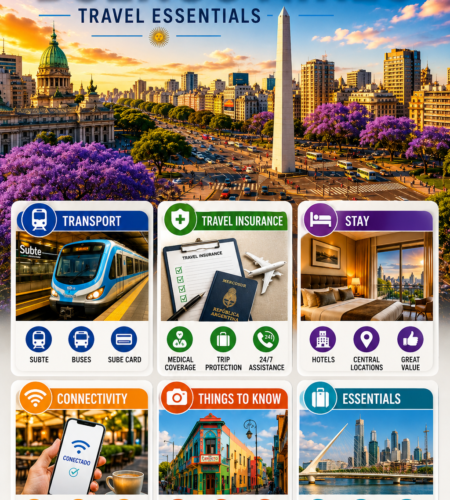
This Buenos Aires travel essentials guide gives you the practical foundation before you land: entry rules, passports, airports, transport, money, safety, health, weather, SIM and eSIM options, where to stay, what to pack, how to move around, how to tip, and what contacts to save.
It is written for travellers who want a confident first trip, a smoother return visit, or a clean planning page for a bigger Argentina itinerary.
All prices are in Argentine pesos (ARS) or US dollars (USD), depending on context. Argentina changes fast. Airport transfer prices, public transport fares, card exchange rates, hotel taxes, museum fees and app rules can shift. Always confirm final details with official sources, your airline, your hotel, your bank, Transport/SUBE channels and Buenos Aires City tourism before travel.
Table of Contents
- Quick Answer: Buenos Aires Essentials
- Buenos Aires at a Glance
- Entry Rules, Passport and Visa Basics
- Arrival Airports: EZE and AEP
- Best Time to Visit Buenos Aires
- Where to Stay: Best Neighbourhoods
- Getting Around the City
- SUBE Card, Buses, Subte and Train Fares
- Money, Cards, Cash and Exchange
- Internet, SIM Cards and eSIM
- Safety and Scams
- Health, Water and Travel Insurance
- Food, Meal Times and Tipping
- What to Pack
- Useful Apps
- Day Trips and Tours
- Car Rental and Driving
- Accessibility and Travel Comfort
- Buenos Aires for Different Travellers
- Essential Contacts
- Travel Planning Tools
- FAQ
- Final Word
- Sources Checked
Quick Answer: Buenos Aires Essentials
If you only read one section before travelling, read this:
- Main international airport: Ezeiza International Airport (EZE)
- Main domestic/regional airport: Aeroparque Jorge Newbery (AEP)
- Currency: Argentine peso (ARS)
- Time zone: UTC/GMT-3 year-round
- Public transport card: SUBE
- Emergency: 911
- Medical emergency ambulance in Buenos Aires: 107
- Police: 101
- Fire: 100
- Tourist Police: +54 9 11 5050 3293 / 9260
- Country code: +54
- Buenos Aires city code: 11
- Tap water: drinkable in the city according to official Buenos Aires tourism
- Power: 220-380 volts, plug types with 2 or 3 flat angled pins
- Best first neighbourhoods: Palermo, Recoleta, San Telmo, Puerto Madero, Microcentro/Monserrat depending on travel style
- Best months for weather: spring and autumn are often the easiest, but the city is visitable year-round
- Late dinner culture: dinner commonly starts around 8 p.m. to 11 p.m.
- Airport transfer advice: use official taxis/remis, pre-booked transfers or trusted apps; avoid unsolicited drivers
Buenos Aires at a Glance
| Essential | Practical Detail |
|---|---|
| City | Buenos Aires |
| Region | Autonomous City of Buenos Aires, Argentina |
| Local name for residents | Portenos |
| Language | Spanish |
| Currency | Argentine peso (ARS) |
| Time zone | UTC/GMT-3, no daylight saving time |
| Climate | Temperate, average around 18 C / 64 F according to city tourism |
| Main airports | EZE and AEP |
| Public transport | Subte, buses, trains, taxis, rideshare, bikes |
| Payment | Cards common in hotels/large businesses; cash useful for small places |
| Transport card | SUBE |
| Emergency number | 911 |
| Ambulance | 107 |
Buenos Aires works well for:
- Food lovers
- Tango and nightlife
- Architecture
- Football culture
- Bookshops and cafes
- Long urban walks
- Museums and galleries
- Digital nomads
- South America first-timers
- Travellers using Argentina as a gateway to Patagonia, Iguazu, Mendoza, Salta or Antarctica cruises
Buenos Aires is less ideal for:
- Travellers who expect early dinners
- Visitors who dislike big-city traffic
- Anyone who wants fixed prices months in advance
- Drivers who want easy downtown parking
- Travellers who plan too many far-apart neighbourhoods in one day
Entry Rules, Passport and Visa Basics
Argentina’s entry rules depend on your nationality, passport type and purpose of travel. Always check official immigration or consular information before booking non-refundable travel.
Tourist Stay Length
Argentina’s official Migraciones page defines a tourist as a foreigner entering for rest or recreation, with an authorized stay of up to three months, extendable for a similar period through the immigration authority.
Practical meaning:
- Many tourists are admitted for up to 90 days.
- Extensions must be handled through Migraciones before the relevant deadline.
- Overstays require an exit authorization process and fees.
- Your passport or accepted travel document must be valid/current.
U.S. Passport Holders
The U.S. Department of State states that private U.S. citizens need a valid passport to enter Argentina and do not need a tourist or business visa for stays of 90 days or less.
Important:
- Diplomatic or official passport rules can differ.
- Damaged or expired passports may lead to denied entry.
- Entry decisions are made by Argentine authorities.
Other Nationalities
Rules vary. Some nationalities are visa-exempt; others need a consular visa or may qualify for an electronic travel authorization (AVE) under specific conditions.
Before travel, check:
- Argentina Migraciones
- The Argentine consulate responsible for your country
- Your airline’s document checker
- Official government travel advice from your passport country
Children and Family Travel
Argentina has specific documentation rules for minors in some cases, especially children travelling alone, with one parent, or under unusual custody arrangements.
Practical advice:
- Carry birth certificates where relevant.
- Carry notarized authorization if a child travels without both parents/guardians.
- Check airline and Argentine immigration requirements before departure.
- Do not rely only on forum advice for minors’ documentation.
Entry Checklist
Before flying:
- Passport valid and undamaged
- Visa/AVE if required for your nationality
- Return or onward ticket if asked
- Accommodation address
- Travel insurance details
- Copies of passport and cards
- Emergency contact details
- Hotel phone number
- eSIM or roaming plan ready
Arrival Airports: EZE and AEP
Buenos Aires has two airports travellers commonly use.
Ezeiza International Airport (EZE)
EZE, formally Ministro Pistarini International Airport, is the main long-haul international airport. It is outside the city and usually requires more transfer time than Aeroparque.
Best for:
- Long-haul international arrivals
- North America, Europe and many intercontinental routes
- Some regional flights
- Transfers to/from AEP for domestic connections
Main transfer options:
- Official taxi
- Remis/private car
- Tienda Leon bus or transfer products
- Pre-booked transfer
- Rideshare/app car where available
- Public bus for experienced, light-luggage travellers
Airport arrival advice:
- Avoid unsolicited drivers in arrivals halls.
- Use official taxi/remis counters, recognized transfer desks or pre-booked services.
- Confirm whether the quoted price is in ARS or USD.
- Keep your hotel address ready.
- Allow extra time during rain, rush hour or protests.
Aeroparque Jorge Newbery (AEP)
AEP is the city airport, located near the river and much closer to many central neighbourhoods. It is used heavily for domestic flights and regional routes.
Best for:
- Domestic Argentina flights
- Regional South America flights
- Shorter taxi rides to Palermo, Recoleta, Retiro and Microcentro
- Easier city access than EZE
Transfer options:
- Taxi
- Remis
- App cars
- Tienda Leon and other transfer products
- Public buses for travellers with SUBE
EZE to AEP Transfers
If you connect between an international flight at EZE and a domestic flight at AEP, plan conservatively.
Why:
- Immigration can take time.
- Baggage can take time.
- Airport-to-airport road transfer can be affected by traffic.
- Airlines may not protect self-booked separate tickets.
- Argentina domestic flights can depart from AEP, EZE or other terminals depending on airline and route.
Aeropuertos Argentina’s online store listed EZE-AEP and AEP-EZE Tienda Leon transfer products when this guide was checked. Prices and schedules can change, so verify before booking.
Airport Transfer Rule of Thumb
| Situation | Best Choice |
|---|---|
| First time in Buenos Aires, arriving at EZE | Official taxi/remis or pre-booked transfer |
| Solo traveller on a budget | Tienda Leon transfer if route fits |
| Staying in Palermo or Recoleta from AEP | Taxi or app car |
| Connecting EZE-AEP | Pre-book transfer or official airport transfer service |
| Arriving very late | Official taxi/remis or pre-booked transfer |
| Light luggage and Spanish confidence | Public bus can work, but not ideal for first arrival |
Best Time to Visit Buenos Aires
Buenos Aires is visitable year-round, but each season feels different.
Official Buenos Aires tourism describes the city as temperate and sunny, with average temperatures around 18 C / 64 F.
Spring: September to December
Best for:
- Pleasant temperatures
- Jacaranda blooms
- Outdoor cafes
- Parks and walking
- First-time trips
Watch for:
- Rain in spring
- Higher demand around holidays and events
Summer: December to March
Best for:
- Long evenings
- Nightlife
- Outdoor dining
- Travellers combining Buenos Aires with Patagonia or beach/coast plans
Watch for:
- Heat and humidity, especially January and February
- Warm nights
- Some locals leaving the city for holidays
- Air-conditioning becoming important in accommodation
Autumn: March to June
Best for:
- Comfortable weather
- Food and wine mood
- Long walks
- Cultural trips
- Softer light and fewer heat issues
Watch for:
- Rain
- Cooler evenings from May into June
Winter: June to September
Best for:
- Museums
- Theatre
- Cafes
- Tango
- Lower heat
- Travellers who dislike humidity
Watch for:
- Cool nights
- Need for layers
- Shorter days
Month-by-Month Packing Logic
| Period | Pack |
|---|---|
| December-February | Light clothing, sunscreen, hat, breathable shoes, refillable water bottle |
| March-May | Layers, light jacket, umbrella, comfortable walking shoes |
| June-August | Warmer layers, jacket, scarf for evenings |
| September-November | Light layers, umbrella, comfortable shoes, camera-ready spring clothes |
Where to Stay: Best Neighbourhoods
Buenos Aires has 48 neighbourhoods. For first-time visitors, your base matters more than chasing the cheapest hotel.
Palermo
Best for:
- Restaurants
- Nightlife
- Cafes
- Boutiques
- Parks
- Longer stays
- Digital nomads
Palermo is large and often divided into Palermo Soho, Palermo Hollywood, Palermo Chico and park-side areas. It is lively, fashionable and full of food options.
Good for travellers who:
- Want nightlife and restaurants nearby
- Prefer a modern, social base
- Do not mind being slightly away from the historic centre
- Plan to use taxis/app cars at night
Recoleta
Best for:
- Elegant streets
- Museums
- Classic hotels
- Walkable comfort
- First-time visitors
- Couples
- Families
Official tourism describes Recoleta as refined, European-style and home to many luxury hotels, tree-lined avenues, cafes, boutiques and Recoleta Cemetery.
Good for travellers who:
- Want a polished central base
- Prefer calmer evenings than Palermo
- Like museums and classic architecture
- Want good access to city sights
San Telmo
Best for:
- Tango atmosphere
- History
- Antiques
- Sunday market
- Bohemian mood
- Photogenic streets
San Telmo is one of the oldest neighbourhoods and has a strong tango and arts identity. It is atmospheric, but choose accommodation carefully and be more street-aware late at night.
Good for travellers who:
- Love historic streets
- Want cafes, markets and tango
- Prefer character over polish
- Are comfortable in older urban areas
Puerto Madero
Best for:
- Modern hotels
- Waterfront walking
- Business travel
- Safer-feeling evening walks
- Upscale restaurants
- Families wanting calm
Puerto Madero is the city’s modern docklands district. It is clean, spacious and comfortable, but can feel less local and more expensive.
Good for travellers who:
- Want modern infrastructure
- Prefer quiet after dark
- Like waterfront paths
- Are comfortable taking taxis to nightlife
Microcentro / San Nicolas / Monserrat
Best for:
- Obelisco
- Teatro Colon
- Plaza de Mayo
- Short stays
- Classic downtown sightseeing
- Lower-cost hotels
This area is convenient in the day and central for sightseeing, but it can feel quiet or less polished at night on some streets.
Good for travellers who:
- Want central landmarks
- Have a short itinerary
- Prefer historic downtown
- Are comfortable choosing streets carefully
La Boca
Visit La Boca by day for Caminito and football culture, but most first-time visitors should not stay there. Official Buenos Aires tourism notes that tourist areas are safe for visitors by day, but it is not recommended to walk La Boca streets at night.
Best Area by Traveller Type
| Traveller | Best Base |
|---|---|
| First-time visitor | Recoleta or Palermo |
| Food/nightlife | Palermo |
| Classic elegance | Recoleta |
| History/tango | San Telmo |
| Business/modern comfort | Puerto Madero |
| Short sightseeing stop | Microcentro/Monserrat |
| Families | Recoleta, Palermo or Puerto Madero |
| Digital nomads | Palermo, Villa Crespo, Recoleta |
Getting Around the City
Buenos Aires has a large transport network: Subte, buses, trains, taxis, app cars, bikes and walking routes.
Subte
The Subte is the Buenos Aires underground metro. It is usually the fastest way to cross central corridors during the day.
Good for:
- Microcentro
- Palermo
- Recoleta edges
- San Telmo/Plaza de Mayo area
- Avenida Corrientes
- Daytime movement
Watch for:
- Crowds at rush hour
- Limited late-night service
- Need for SUBE or accepted payment method
- Station stairs/escalators depending on stop
Buses / Colectivos
Buses go almost everywhere. They are cheap and useful, but they require route confidence.
Good for:
- Local trips
- Areas not served by Subte
- AEP airport access
- Late-ish journeys where routes operate
- Neighbourhood-to-neighbourhood trips
Watch for:
- You usually need SUBE.
- Tell the driver your destination or fare zone if needed.
- Stops can be informal-feeling to newcomers.
- Traffic affects timing.
Trains
Urban and suburban trains are useful for:
- Tigre day trip
- Retiro connections
- Some suburban routes
- Budget regional movement inside AMBA
For most central tourist days, Subte, bus, taxi and walking are simpler.
Taxis
Buenos Aires has many licensed taxis. Official city tourism describes a large network of licensed taxis.
Taxi tips:
- Use licensed black-and-yellow taxis.
- Use radio taxi or app-based options when possible.
- Keep the destination written down.
- Pay attention to belongings.
- Avoid unlicensed offers at airports.
App Cars
Uber, Cabify and similar services may be available depending on current regulations and app coverage. They are popular with many visitors for predictable pricing and door-to-door routes.
Good for:
- Night returns
- Palermo-Recoleta-San Telmo cross-city trips
- Airport-to-hotel routes if pickup works
- Travellers who do not speak much Spanish
Walking
Buenos Aires is a walking city, but distances can be bigger than expected.
Best walks:
- Recoleta to Retiro
- Palermo parks
- San Telmo to Plaza de Mayo
- Puerto Madero waterfront
- Avenida Corrientes theatre corridor
- Palermo Soho shopping/cafe streets
Walking safety:
- Use extra care with phones.
- Avoid empty streets late at night.
- Take taxis/app cars after dark in unfamiliar areas.
- In La Boca, stay in the tourist area by day.
SUBE Card, Buses, Subte and Train Fares
The SUBE card is the key public transport card for Buenos Aires and much of Argentina.
Official Buenos Aires tourism states that to travel by bus or Subte in Buenos Aires, you need a rechargeable SUBE travel card and credit loaded onto it.
Where to Get SUBE
According to Buenos Aires tourism, SUBE cards are available at:
- Subte stations
- Tourist Assistance Centers
- Many kioskos
- Other SUBE vendor points shown on the SUBE map
You can recharge at:
- Subte stations
- National lottery outlets
- Some kioskos with automated terminals
- Official digital/top-up options where available
Public Transport Fares Checked
Argentina.gob.ar lists AMBA public transport fares from June. These fares can change frequently, so treat them as a verified snapshot, not a permanent price list.
CABA Bus Fares
| Distance | Registered SUBE | Social Fare | Unregistered SUBE |
|---|---|---|---|
| 0-3 km | ARS 788.28 | ARS 354.72 | ARS 1,253.37 |
| 3-6 km | ARS 875.90 | ARS 394.15 | ARS 1,392.68 |
| 6-12 km | ARS 943.37 | ARS 424.51 | ARS 1,499.96 |
| 12-27 km | ARS 1,010.90 | ARS 454.90 | ARS 1,607.33 |
Train Fares
| Section | Registered SUBE | Social Fare | Unregistered SUBE | Cash |
|---|---|---|---|---|
| 1 | ARS 350.00 | ARS 157.50 | ARS 700.00 | ARS 1,100.00 |
| 2 | ARS 470.00 | ARS 211.50 | ARS 940.00 | ARS 1,100.00 |
| 3 | ARS 590.00 | ARS 265.50 | ARS 1,040.00 | ARS 1,100.00 |
Subte Fares
| Monthly Trips | Registered SUBE | Unregistered SUBE |
|---|---|---|
| 1-20 | ARS 1,558.00 | ARS 2,477.22 |
| 21-30 | ARS 1,246.40 | ARS 1,981.78 |
| 31-40 | ARS 1,090.60 | ARS 1,734.05 |
| 41+ | ARS 934.80 | ARS 1,486.33 |
Tourist Advice for SUBE
If you are in Buenos Aires for only a few days:
- Get a SUBE if you plan to ride buses or Subte often.
- Ask your hotel or a kiosk where to buy/recharge one nearby.
- Keep enough balance for your return trip.
- Use official fare pages before publishing exact prices.
- Consider taxis/app cars late at night or with luggage.
Money, Cards, Cash and Exchange
Money in Argentina deserves attention. The peso can change value quickly, and the exchange system can be confusing for visitors.
Currency
The national currency is the Argentine peso (ARS). Buenos Aires tourism warns that the “$” symbol normally refers to Argentine pesos unless otherwise stated; US dollars are usually shown as U$S.
Cards
Buenos Aires tourism states that most hotels and many large shops/businesses accept payment by card, while smaller businesses may accept only cash.
Cards are useful for:
- Hotels
- Restaurants
- Larger stores
- Tours
- Some museums
- Rideshare/app services
Cash is useful for:
- Small cafes
- Tips
- Markets
- Kiosks
- Small taxis
- Street fairs
- Emergencies
ATMs and Exchange
Official city tourism says local currency can be obtained at casas de cambio, banks and ATMs, and that ID is needed when changing money. It also warns visitors to avoid illegal street money changers, even when they advertise better exchange rates.
Practical advice:
- Use legal, regulated institutions.
- Change small amounts at a time.
- Keep exchange receipts.
- Carry smaller bills when possible.
- Check your card’s foreign transaction fees.
- Keep cards in sight when paying.
BCRA Exchange Rates
The Central Bank of Argentina publishes official exchange rate information. Use it as a reference, but understand that card exchange rates, tourist rates, cash exchange and market rates can differ.
Money Safety
Use common sense:
- Avoid counting cash in public.
- Do not flash large bills.
- Use ATMs inside banks or malls when possible.
- Keep backup cards separate.
- Use a money belt or internal pocket for backup cash/passport copies.
Internet, SIM Cards and eSIM
Buenos Aires is app-friendly. You will use data for maps, taxis, restaurant reservations, WhatsApp, translation, bank alerts, SUBE tools and flight updates.
Local SIM Cards
Official Buenos Aires tourism says local SIM cards/chips can be bought from mobile phone stores and many kiosks. Leading networks include Personal, Movistar and Claro.
Local SIM is useful if:
- You stay several weeks
- You need a local number
- You will travel around Argentina
- You are comfortable registering/buying in Spanish
eSIM
An eSIM can be easier for short stays because it can be installed before arrival.
Good for:
- Airport arrival maps
- Taxi/app pickup
- WhatsApp with hotel
- Translation
- Checking exchange rates
- Museum/tour tickets
- Emergency calls via apps when cellular voice is not needed
Partner option:
Set up mobile data for Argentina with Yesim
Free Wi-Fi
Buenos Aires tourism notes that the city has many free Wi-Fi hotspots, including on Subte and Metrobus networks, and many cafes/restaurants offer Wi-Fi for customers.
Do not rely only on public Wi-Fi for arrival day. Have at least one mobile-data option ready.
Safety and Scams
Buenos Aires is a major metropolis. It is rewarding and generally manageable for visitors, but petty theft exists.
Official Buenos Aires tourism advises visitors to keep belongings with them, take licensed taxis, keep bags closed, stick to well-lit streets in the evening and keep flashy jewellery to a minimum.
Common Risk Areas
Use extra awareness:
- Crowded Subte trains
- Bus stops
- San Telmo market crowds
- La Boca outside tourist zone
- Florida Street/currency exchange area
- Nightlife exits
- Outdoor cafe tables
- Phone use near the street
- Airport arrival halls
Phone Theft
Phone snatching can happen in many large cities, including Buenos Aires.
Reduce risk:
- Do not hold your phone loosely near the curb.
- Step inside a doorway to check maps.
- Use a crossbody bag.
- Do not leave phones on restaurant tables.
- Keep backup 2FA access for banks and email.
Taxis and Transfers
Use:
- Official taxi ranks
- Licensed taxis
- Hotel-called taxis
- App cars
- Official airport counters
- Pre-booked transfers
Avoid:
- Drivers approaching you inside airport halls
- Unclear fares
- Random cash-only offers
- Sharing your phone/passport with strangers
La Boca Safety
Official Buenos Aires tourism says the tourist areas in La Boca are safe by day, but it is not recommended to walk La Boca streets at night.
Practical plan:
- Visit Caminito by day.
- Use taxi/app car to and from the area.
- Stay near the tourist streets.
- Avoid wandering side streets late.
Travel Advisory Balance
The U.S. travel advisory for Argentina was Level 1, Exercise Normal Precautions, as of May 20, 2026. Canada advises normal precautions for Argentina overall but higher caution in Greater Metropolitan Buenos Aires due to crime, including petty crime and muggings. Australia advises normal safety precautions and highlights emergency contacts. Use these advisories as context, not panic.
Health, Water and Travel Insurance
Tap Water
Buenos Aires official tourism states that tap water is drinkable in the city.
If you have a sensitive stomach:
- Use bottled water for the first day if preferred.
- Carry a refillable bottle.
- Ask your accommodation if the building has old internal pipes.
Public Hospitals
Official Buenos Aires tourism states that public hospitals are open 24 hours and attend patients free of charge. For ambulance service in Buenos Aires, call 107.
This does not replace travel insurance. Private clinics, medication, evacuation, missed flights and trip disruptions can still be expensive.
Vaccinations and Health
Buenos Aires tourism states no vaccinations are required for entry into Argentina and that tropical outbreaks such as zika in other parts of South America have not affected temperate Buenos Aires. However, your personal health needs may differ.
Before travel:
- Check your government’s health guidance.
- Bring prescriptions in original packaging.
- Carry travel insurance details.
- Keep a copy of prescriptions.
- Use sunscreen and hydration in summer.
Travel Insurance
Travel insurance is especially useful for:
- Medical issues
- Theft
- Flight delays
- Missed domestic connections
- Lost baggage
- Trip interruption
- Evacuation
- Longer South America itineraries
Partner option:
Check SafetyWing travel insurance for Argentina
SafetyWing widget:
Food, Meal Times and Tipping
Buenos Aires is a city of late meals, cafes, steak, pizza, empanadas, gelato, vermouth, wine and long conversations.
Meal Times
Official Buenos Aires tourism gives general meal times:
- Breakfast: 7 a.m. to 10 a.m.
- Lunch: 12:30 p.m. to 3 p.m.
- Dinner: 8 p.m. to 11 p.m.
Many restaurants will feel quiet before 8:30 p.m. Dinner at 10 p.m. is not unusual.
What to Eat
Start with:
- Empanadas
- Parrilla steak
- Milanesa
- Choripan
- Pizza portena
- Helado
- Medialunas
- Alfajores
- Provoleta
- Malbec
- Fernet and cola
Tipping
Tipping expectations can vary, but a common visitor habit is:
- Restaurants: around 10 percent when service is good
- Cafes: round up or leave small cash
- Hotel porter: small cash tip
- Taxi/app car: rounding up is appreciated but not always expected
- Tour guides: tip for good service
Some restaurants may prefer cash tips. Carry small bills.
Reservations
Book ahead for:
- Popular parrillas
- Fine dining
- Tango shows
- Weekend brunch
- Palermo restaurants
- Special dates
What to Pack
Essentials
- Passport
- Copies of passport
- Travel insurance
- Cards plus backup card
- Some cash
- Phone with eSIM/SIM plan
- Power adapter
- Comfortable walking shoes
- Crossbody bag
- Light rain layer
- Medication
- Refillable water bottle
Electrical Adapter
Argentina uses AC 220-380 volts according to Buenos Aires tourism, with plug configurations using 2 or 3 flat pins with the top two pins diagonally angled. Bring adapters and check whether your devices are dual voltage.
Shoes
Bring shoes for:
- Long sidewalks
- Cobblestones in San Telmo
- Museum days
- Dinner
- Rainy streets
Clothes by Season
Summer:
- Light clothing
- Sunscreen
- Sunglasses
- Breathable fabrics
- One smart-casual outfit
Autumn/spring:
- Layers
- Light jacket
- Umbrella
Winter:
- Warm jacket
- Sweater
- Scarf
- Comfortable closed shoes
Useful Apps
Useful apps for Buenos Aires:
- Google Maps
- Uber
- Cabify
- BA Taxi or local taxi tools where available
- SUBE tools
- BA WiFi / Buenos Aires city apps where available
- Translation app
- Airline app
- Bank/card app
- Maps.me or offline map
- Currency converter
Use WhatsApp for:
- Hotels
- Tours
- Restaurants
- Drivers
- Local contacts
Day Trips and Tours
Buenos Aires is strong as a city destination, but tours can make some experiences smoother.
Best City Experiences
- Recoleta Cemetery
- Teatro Colon
- San Telmo market
- La Boca and Caminito by day
- Palermo parks
- MALBA
- Museo Nacional de Bellas Artes
- Plaza de Mayo
- Cafe Tortoni-style historic cafes
- Tango show or milonga
- Football match with a reputable operator
Best Day Trips
- Tigre and Parana Delta
- Estancia day trip
- Uruguay ferry to Colonia or Montevideo
- San Antonio de Areco
- Temaiken or family attractions
- Food and wine experiences
When a Tour Is Worth It
Use a guided tour when:
- You want local context
- You have limited time
- You are visiting La Boca/football areas
- You want a tango or food experience
- You need transport outside the city
- You want a safer structured evening
Partner option:
Browse Buenos Aires tours and day trips on Viator
Car Rental and Driving
You do not need a car for Buenos Aires city. Traffic, parking, one-way streets and local driving style make taxis and public transport easier.
Rent a car if:
- You are leaving Buenos Aires for a road trip
- You plan rural Buenos Aires Province
- You are comfortable driving in Argentina
- You need flexibility outside the city
Do not rent a car if:
- You only visit Buenos Aires
- Your hotel lacks parking
- You plan nightlife
- You are uncomfortable with city traffic
Partner option:
Compare Buenos Aires car rental on DiscoverCars
Driving Documents
Check rental company rules before arrival. You may need:
- Valid driver’s license
- Passport
- Credit card
- International Driving Permit depending on license country and rental policy
- Insurance confirmation
Accessibility and Travel Comfort
Buenos Aires has accessible tourism resources, but the city can be uneven.
Consider:
- Older sidewalks
- Uneven curbs
- Subte station stairs
- Crowded buses
- Heat in summer
- Cobblestones in historic areas
- Long airport transfers from EZE
Comfort planning:
- Choose accommodation near your main interests.
- Use taxis/app cars for long cross-city moves.
- Ask hotels about elevators and room access.
- Avoid overpacking daily itineraries.
- Build rest stops around cafes.
Buenos Aires for Different Travellers
First-Time Visitors
Stay in Recoleta or Palermo. Plan San Telmo, Plaza de Mayo, Teatro Colon, Recoleta Cemetery, Palermo parks and one tango night. Use taxis/app cars at night until you understand the city.
Food Travellers
Base in Palermo or Recoleta. Book parrillas ahead. Add San Telmo Market, classic cafes, pizza on Corrientes, helado and a food tour.
Digital Nomads
Palermo, Villa Crespo and Recoleta are practical. Prioritize Wi-Fi, cafes, coworking access, eSIM/local SIM, card-friendly businesses and safe late-night routes.
Families
Recoleta, Palermo and Puerto Madero are easiest. Use taxis for longer routes. Add parks, museums, river walks, ice cream, easy lunch stops and lighter evening schedules.
Couples
Recoleta, Palermo Soho and Puerto Madero work well. Plan a tango night, a wine dinner, a long cafe afternoon, parks and one day trip to Tigre or Colonia.
Solo Travellers
Palermo and Recoleta are practical bases. Join walking tours, food tours or tango classes for social structure. Use extra care with phones and nightlife exits.
Essential Contacts
Save these before arrival.
Emergency and Safety
| Service | Contact |
|---|---|
| Emergencies | 911 |
| Medical emergency / SAME ambulance | 107 |
| Fire | 100 |
| Police | 101 |
| Civil defence | 103 |
| Domestic/gender-based violence | 144 |
| People trafficking | 145 |
| Children’s services | 102 |
| Tourist Police | +54 9 11 5050 3293 / 9260 |
Tourist Support
| Service | Contact |
|---|---|
| Tourist Ombudsman / Defensoria del Turista | +54 11 4302-7816 |
| Tourist Ombudsman email | turista@defensoria.org.ar |
| Tourist Police email | serv.turista@gmail.com |
| Buenos Aires tourism | https://turismo.buenosaires.gob.ar/en |
Airports
| Airport | Website |
|---|---|
| Ezeiza International Airport | https://www.aeropuertosargentina.com/es/EZE |
| Aeroparque Jorge Newbery | https://www.aeropuertosargentina.com/es/AEP |
| Aeropuertos Argentina | https://www.aeropuertosargentina.com/ |
Immigration and Official Travel
| Service | Website |
|---|---|
| Argentina Migraciones – tourists | https://www.argentina.gob.ar/migraciones/turistas |
| Argentina AVE | https://www.migraciones.gob.ar/ave/ |
| U.S. travel information for Argentina | https://travel.state.gov/content/travel/en/international-travel/International-Travel-Country-Information-Pages/Argentina.html |
Travel Planning Tools
These partner tools can support a Buenos Aires trip when used naturally and thoughtfully. Always verify official transport, entry and safety information separately.
Mobile Data: Yesim
Mobile data is one of the best arrival-day investments in Buenos Aires. It helps with maps, taxi apps, WhatsApp, translation, airport pickup and checking live information.
Useful for:
- Airport arrival
- Taxi/app rides
- Hotel communication
- SUBE and map checks
- Restaurant reservations
- Translation
- Day-trip logistics
Link:
Get mobile data for Argentina with Yesim
Hotels: Expedia
Your Buenos Aires hotel area shapes the whole trip. Recoleta and Palermo are strong first-time bases; Puerto Madero is modern and calm; San Telmo is historic and atmospheric; Microcentro is central for landmarks.
Good searches:
- Recoleta hotels
- Palermo Soho hotels
- Palermo Hollywood hotels
- Puerto Madero hotels
- San Telmo boutique hotels
- EZE airport hotels for early flights
Link:
Search Buenos Aires hotels on Expedia
Tours: Viator
Tours are useful for tango, football, food, Tigre, estancia days and first-time orientation.
Good tour ideas:
- Tango show
- Food tour
- Recoleta Cemetery tour
- La Boca and San Telmo guided walk
- Football match experience
- Tigre Delta day trip
- Estancia day trip
Link:
Browse Buenos Aires tours on Viator
Car Rental: DiscoverCars
Car rental is not needed for the city, but it can be useful if Buenos Aires is the start of a wider Argentina road trip.
Best use cases:
- Province road trip
- Estancia route
- Multi-city itinerary
- Flexible rural travel
Link:
Compare Buenos Aires car rental on DiscoverCars
Travel Insurance: SafetyWing
Travel insurance is useful for medical needs, theft, flight disruption, lost baggage, longer South America routes and digital nomad stays.
Link:
Check SafetyWing travel insurance
SafetyWing widget:
Support the Project: Patreon
If this guide helped you plan a smoother trip, you can support future independent travel guides here:
Support HEDONISM.cloud on Patreon
FAQ
Is Buenos Aires worth visiting?
Yes. Buenos Aires is one of South America’s great cultural capitals, with architecture, tango, football, food, cafes, bookshops, museums, nightlife and strong neighbourhood character.
How many days do I need in Buenos Aires?
Three full days is a good minimum. Five to seven days is better if you want neighbourhoods, museums, nightlife, a tango evening and a day trip.
What is the best area to stay in Buenos Aires for first-time visitors?
Recoleta and Palermo are the safest all-round choices for many first-time visitors. Recoleta is elegant and central; Palermo is better for restaurants, cafes and nightlife.
Is Buenos Aires safe for tourists?
Buenos Aires is manageable for tourists, but petty theft exists. Use big-city precautions: protect your phone, keep bags closed, use licensed taxis, avoid empty streets late at night and be careful in crowded areas.
Can I drink tap water in Buenos Aires?
Yes. Official Buenos Aires tourism says tap water is drinkable in the city.
Do U.S. citizens need a visa for Argentina?
Private U.S. citizens do not need a visa for tourism or business visits of 90 days or less, according to the U.S. Department of State. Always check before travel because rules can change.
How long can tourists stay in Argentina?
Argentina Migraciones describes tourist stays as authorized for up to three months, extendable for a similar period through the immigration authority.
Which airport should I fly into for Buenos Aires?
EZE is the main international airport. AEP is closer to the city and is common for domestic and regional flights.
How do I get from EZE to Buenos Aires?
Use an official taxi/remis, pre-booked transfer, Tienda Leon transfer or trusted app option. Public buses are possible but not ideal for most first-time arrivals with luggage.
Is AEP better than EZE?
For city access, yes. AEP is much closer to central Buenos Aires. For long-haul international flights, EZE is usually the main airport.
Do I need a SUBE card?
Yes, if you plan to use buses or the Subte regularly. Official tourism says travellers need a rechargeable SUBE card for bus and Subte travel.
Can I use cash on Buenos Aires buses?
Visitors should not rely on cash for buses. Use SUBE and check current transport rules.
Is Buenos Aires expensive?
It depends on exchange rates and travel style. Hotels, restaurants and tours can change quickly in price because of inflation and currency movement. Budget with flexibility.
Should I bring cash?
Bring some backup cash, but use regulated exchange channels. Cards are accepted in many hotels and larger businesses; smaller places may need cash.
Is the “$” symbol in Buenos Aires US dollars?
Usually no. In Argentina, “$” generally means Argentine pesos unless the price clearly says USD or U$S.
Should I exchange money on Calle Florida?
Official city tourism warns that unofficial street money changers are illegal and recommends changing money only at legal regulated institutions.
What is the best month to visit Buenos Aires?
Spring and autumn are often the easiest for weather. Official tourism says Buenos Aires is visitable year-round, with January-February warmer and more humid, and July the coldest month.
What time is dinner in Buenos Aires?
Dinner is late. Official tourism gives dinner generally between 8 p.m. and 11 p.m.
Do I need travel insurance for Buenos Aires?
It is strongly recommended. Public hospitals handle emergencies, but insurance helps with private care, theft, trip disruption, evacuation and flight problems.
Is English widely spoken?
In hotels, tours and tourist-facing businesses, often yes. In taxis, kiosks, smaller restaurants and public transport, Spanish is useful.
Can I visit La Boca at night?
Official Buenos Aires tourism says tourist areas in La Boca are safe by day, but it is not recommended to walk La Boca streets at night.
Is Palermo better than Recoleta?
Palermo is better for nightlife, restaurants and a younger social feel. Recoleta is better for classic elegance, museums, calm streets and first-time comfort.
Should I rent a car in Buenos Aires?
Not for the city. Rent only for road trips outside Buenos Aires.
What number do I call for an ambulance?
Call 107 in Buenos Aires for SAME medical emergency ambulance service. For general emergencies, call 911.
What is the Tourist Police number?
Buenos Aires tourism lists Tourist Police at +54 9 11 5050 3293 / 9260 and email serv.turista@gmail.com.
Final Word
Buenos Aires is best when you give it room. Do not over-plan every hour. Choose the right neighbourhood, arrive with mobile data, use official airport transfers, get a SUBE card if you will use public transport, keep some small cash, protect your phone, and let the city stretch into cafes, late dinners, parks, bookshops, tango and long evening walks.
The essentials are not complicated once they are organized: passport and entry rules, EZE or AEP, SUBE, pesos, licensed transport, 911/107, weather layers and a realistic neighbourhood base. With those handled, Buenos Aires becomes what it should be: grand, warm, theatrical, delicious and wonderfully alive.
Sources Checked
- Argentina Migraciones – Tourists: https://www.argentina.gob.ar/migraciones/turistas
- Argentina AVE: https://www.migraciones.gob.ar/ave/
- U.S. Department of State Argentina information: https://travel.state.gov/content/travel/en/international-travel/International-Travel-Country-Information-Pages/Argentina.html
- U.S. Department of State Argentina advisory: https://travel.state.gov/content/travel/en/traveladvisories/traveladvisories/argentina-travel-advisory.html
- Government of Canada Argentina travel advice: https://travel.gc.ca/destinations/argentina
- GOV.UK Argentina travel advice: https://www.gov.uk/foreign-travel-advice/argentina
- Smartraveller Argentina advice: https://www.smartraveller.gov.au/destinations/americas/argentina
- Official Buenos Aires tourism – Useful information: https://turismo.buenosaires.gob.ar/en/agrupador-noticias/useful-information
- Official Buenos Aires tourism – Getting around: https://turismo.buenosaires.gob.ar/en/article/getting-around
- Official Buenos Aires tourism – Health and security: https://turismo.buenosaires.gob.ar/en/article/health-and-security
- Official Buenos Aires tourism – Money: https://turismo.buenosaires.gob.ar/en/article/money
- Official Buenos Aires tourism – Telecommunications: https://turismo.buenosaires.gob.ar/en/article/telecommunications
- Official Buenos Aires tourism – Climate: https://turismo.buenosaires.gob.ar/en/article/climate
- Official Buenos Aires tourism – Opening hours and electricity: https://turismo.buenosaires.gob.ar/en/article/opening-hours-sizes-and-electricity
- Official Buenos Aires tourism – Neighbourhoods: https://turismo.buenosaires.gob.ar/en/article/neighbourhoods
- Argentina.gob.ar AMBA public transport fares from June: https://www.argentina.gob.ar/redsube/tarifas-de-transporte-publico-amba
- Argentina.gob.ar SUBE: https://www.argentina.gob.ar/SUBE
- Aeropuertos Argentina – EZE access: https://www.aeropuertosargentina.com/es/EZE/servicios/como-llego
- Aeropuertos Argentina – AEP access: https://www.aeropuertosargentina.com/es/AEP/servicios/como-llego
- Aeropuertos Argentina online transfers – EZE: https://tienda.aeropuertosargentina.com/ezeiza/categoria-producto/traslados/
- Aeropuertos Argentina online transfers – AEP: https://tienda.aeropuertosargentina.com/aeroparque/categoria-producto/traslados/
- Central Bank of Argentina exchange rates: https://www.bcra.gob.ar/en/exchange-rates/
Comments