
Last Update: June 9, 2026
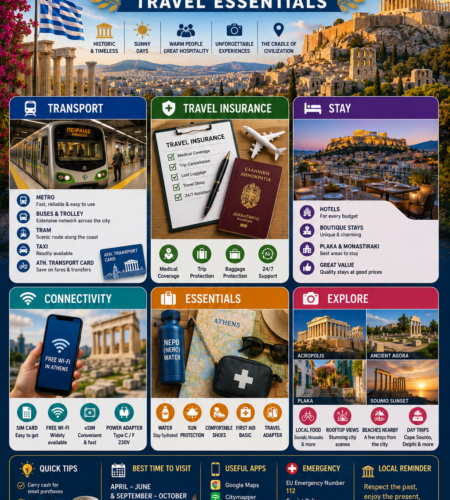
Athens is one of the world’s great city gateways: ancient, noisy, sunny, layered, affordable by Western European standards in some areas, expensive in others, and packed with more history than a first-time visitor can absorb in one trip. The Acropolis dominates the skyline, but the real Athens is also Metro platforms, rooftop bars, street markets, bakeries, late dinners, ferry plans, neighbourhood walks, summer heat, taxis, strikes, archaeological sites, and the constant question: “Should I stay one more night before the islands?”
It is a rewarding city when planned well. Athens International Airport connects directly with the centre and Piraeus by Metro Line 3. Public transport is inexpensive. Many historic areas are walkable. Food can be excellent without being formal. But the practical details matter: Schengen entry rules, EES border processing, airport ticket fares, taxi flat rates, hotel climate fees, VAT refund steps, pickpocketing hotspots, summer wildfire alerts, heat planning, and ferry timing can all affect a trip.
This Athens travel essentials guide gives visitors a complete pre-arrival foundation: Greece entry rules, Schengen visa basics, EES and ETIAS, Athens Airport, airport transfers, Metro, buses, taxis, where to stay, money, accommodation fees, VAT refunds, safety, emergency numbers, health, tap water, weather, packing, day trips, car rental and useful contacts.
All prices are in euros (EUR). Rules, fares, visa policies, airport procedures, museum prices, ferry schedules, hotel fees, wildfire alerts, health guidance and travel advisories can change. Always confirm final details with the Hellenic Ministry of Foreign Affairs, Visit Greece, the EU Travel Europe portal, Athens International Airport, OASA, STASY, Hellenic Train, AADE, Hellenic Police, your airline, your ferry company, your hotel and your own government’s travel advisory before travelling.
Current Travel Advisory Note
As of June 9, 2026, Greece is generally treated by major Western advisories as a normal travel destination, but Athens content should still be safety-aware.
The U.S. Department of State travel advisories list Greece as Level 1: Exercise Normal Precautions. The UK FCDO highlights practical risks including wildfires, earthquakes, extreme heat, flash floods, road safety and the need to allow for emergency alerts. Government of Canada travel advice notes petty crime, pickpocketing, luggage theft, ATM/card fraud, demonstrations, terrorism risk in Europe, and the availability of tourist police assistance.
Before departure:
- Check your own government’s Greece travel advisory.
- Allow extra time for Schengen border processing because EES is being implemented.
- Keep your phone enabled for emergency alerts while in Greece.
- Follow official 112 Greece instructions during fires, heat events, floods or earthquakes.
- Keep valuables close in crowded Metro stations, tourist streets and restaurants.
- Confirm flight, ferry and transport timing during strikes, severe weather or summer disruption.
- If travelling after late 2026, check the official EU ETIAS page before booking.
Quick Answer: Athens Travel Essentials
For most first-time visitors, Athens is easiest when planned around these practical basics:
| Topic | Best Practical Answer |
|---|---|
| Main airport | Athens International Airport “Eleftherios Venizelos” (ATH) |
| Best airport transfer | Metro Line 3 to Syntagma, Monastiraki or Piraeus |
| Late-night airport option | 24-hour airport express buses such as X95 and X96 |
| Airport Metro fare | EUR 9 full fare, EUR 16 return according to OASA/This is Athens |
| Airport express bus fare | EUR 5.50 full fare |
| Standard city transport fare | EUR 1.20 for a 90-minute urban ticket |
| Currency | Euro (EUR) |
| Cards | Widely accepted, but keep some cash |
| Emergency number | 112 |
| Police | 100 |
| Ambulance | 166 |
| Fire | 199 |
| Tourist police / visitor help | 1571 |
| Tap water | Athens tap water is monitored by EYDAP and generally safe |
| Best season | April-June and September-October |
| Hottest months | July and August |
| Car needed? | No for Athens; maybe for mainland road trips |
| Key risk | Heat, pickpockets, traffic, strikes, wildfire alerts, ferry timing |
If you only remember one thing: stay near a Metro station, visit the Acropolis early or late, budget for the accommodation climate fee, keep valuables close on public transport, and give yourself more transfer time than the map suggests.
Athens at a Glance
Athens is the capital of Greece and the main arrival hub for mainland Greece, the Saronic islands, the Cyclades and many wider Aegean itineraries. It is a city where ancient landmarks sit directly beside apartment blocks, cafes, graffiti, rooftop restaurants and everyday neighbourhood life.
Why Athens Works for Visitors
- The airport has direct public transport to the city centre and Piraeus.
- The historic core is walkable.
- Public transport is affordable.
- Many key sights are clustered around the Acropolis.
- English is widely used in tourism areas.
- Food can be excellent at many price points.
- Athens is a strong base for Delphi, Cape Sounion, Hydra, Aegina and other day trips.
- It works as a pre-island or post-island stop.
What Makes Athens Tricky
- Summer heat can be intense.
- Pavements can be uneven.
- Drivers may not always stop at pedestrian crossings.
- Pickpocketing occurs in busy tourist and transport areas.
- Strikes can affect transport, ferries and museums.
- Taxi misunderstandings happen if fares are not clear.
- Piraeus port is large and ferry gates matter.
- The city can feel chaotic on arrival after a long flight.
Ideal Length of Stay
| Trip Length | Best For |
|---|---|
| 1 day | Acropolis, Plaka, Monastiraki, Syntagma |
| 2 days | Classic ancient Athens plus food and museum time |
| 3 days | Strong first visit with neighbourhoods and slower evenings |
| 4-5 days | Athens plus Cape Sounion, Delphi or island day trip |
| 1 week | Athens, mainland day trips, beaches, museums, food and ferry buffer |
If you are going to the islands, do not cut Athens too tightly. One buffer night before a ferry or international flight can save the whole trip when weather or strikes interfere.
Entry Rules, Schengen Visa, EES and ETIAS
Greece is part of the European Union and the Schengen Area. Entry rules depend on your nationality, passport, residence status, travel purpose and length of stay.
Schengen Short-Stay Rule
The Schengen rule for many visitors is:
- Up to 90 days in any 180-day period.
- The limit is shared across the Schengen Area.
- Visits to other Schengen countries count toward the same 90-day total.
- Working, studying, residence and long stays require different permissions.
The European Commission explains that Schengen countries apply common visa rules for short visits up to 90 days in any 180-day period. Greece’s Ministry of Foreign Affairs also defines a Schengen visa as authorisation for stays up to 90 days in any 180-day period.
Who May Need a Visa
You may need a Schengen visa if your passport nationality is visa-required. Greece’s Ministry of Foreign Affairs says travellers may apply for a short-term Schengen visa or a long-term national visa depending on the duration and purpose of the journey.
Common Schengen visa documents can include:
- Valid passport.
- Completed application.
- Passport photos.
- Travel medical insurance.
- Accommodation proof.
- Return or onward travel.
- Proof of financial means.
- Purpose-of-visit documents.
- Biometrics where required.
Always apply through the official Greek consular or visa application route for your country.
Visa-Free Travellers
Many passport holders can visit Greece visa-free for tourism or short business, but you may still need to show:
- Valid passport.
- Return or onward ticket.
- Accommodation details.
- Proof of funds.
- Travel insurance.
- Purpose of stay.
- Evidence that you will leave before your allowed stay ends.
GOV.UK notes that visa-free travel to Greece and the Schengen Area is generally up to 90 days in any 180-day period for tourism, family visits, business meetings, cultural or sports events, and short-term studies or training.
Passport Validity
For many non-EU visitors, Schengen passport rules generally require:
- Passport valid for at least three months after intended departure from the Schengen Area.
- Passport issued within the previous 10 years.
Greece’s MFA page for U.S. passport holders states that the passport should be valid for at least three months after the intended departure date from the EU country visited and issued within the previous 10 years.
Practical advice: travel with at least six months’ validity where possible, especially if your itinerary includes multiple countries, cruises, non-Schengen connections or onward travel with airline-specific rules.
EES: Entry/Exit System
The EU Entry/Exit System (EES) affects non-EU and non-Schengen travellers entering participating European countries for short stays. GOV.UK explains that EES may require biometric registration such as fingerprints and a photo, with no cost, and that first-time registration can add extra border time.
For Athens travellers:
- Allow extra time at Athens Airport on arrival and departure.
- Follow instructions from airport and border staff.
- If connecting through another Schengen country, EES may happen at your first Schengen entry point.
- Keep passport and itinerary details easy to access.
- Do not plan tight international-to-domestic self-transfers.
ETIAS: Planned Travel Authorisation
ETIAS is the planned EU travel authorisation for visa-exempt travellers. The official EU Travel Europe page states that ETIAS will start operations in the last quarter of 2026.
As of June 9, 2026:
- ETIAS is not something travellers should buy from unofficial websites.
- No action is required until the EU opens the official process.
- Travellers should monitor the official EU ETIAS page for late-2026 and 2027 trips.
Passport, Border Checks and Arrival Documents
Prepare a simple travel folder before departure.
Keep These Ready
- Passport.
- Visa or residence permit, if applicable.
- Return or onward ticket.
- Hotel booking or host address.
- Ferry tickets if continuing to islands.
- Travel insurance policy.
- Proof of funds if relevant.
- Copies of prescriptions.
- Emergency contact details.
- Copies of passport and key documents.
Arrival Tips at ATH
- Keep your passport in your hand luggage, not checked baggage.
- Keep your hotel address available offline.
- If you have a ferry connection, allow enough time between landing and port departure.
- If arriving during high season, assume queues can take longer.
- If asked border questions, answer simply and consistently.
Cruises and Ferries
If Athens is part of a cruise or island itinerary, confirm:
- Whether you enter Greece through airport, cruise port or land border.
- Whether your itinerary includes non-Schengen countries.
- Whether you need to pass passport control before joining a ferry or flight.
- Whether your ferry leaves from Piraeus, Rafina or Lavrio.
“Athens ferry port” is not a single place. Check the exact port and gate.
Athens International Airport (ATH)
Athens International Airport “Eleftherios Venizelos” is located southeast of central Athens. The Official Athens Guide states that it is 33 km southeast of Athens and that driving from downtown can take 30-45 minutes depending on traffic.
Why ATH Is Practical
- Direct Metro Line 3 to central Athens and Piraeus.
- 24-hour airport express buses.
- Suburban railway connections.
- Taxis and private transfers.
- Regional buses to Rafina and Lavrio port connections.
- Car rental at the airport.
- Customs and VAT refund facilities.
Main Airport Transport Options
| Option | Best For | Notes |
|---|---|---|
| Metro Line 3 | Syntagma, Monastiraki, Piraeus, central hotels | Direct, avoids traffic |
| Airport express bus X95 | Syntagma, late-night arrivals | 24-hour route |
| Airport express bus X96 | Piraeus port | Useful for ferries, especially late |
| Suburban railway | Piraeus, Athens Station, rail links | Check schedule carefully |
| Taxi | Families, heavy bags, late arrivals | Fixed airport-centre fare zone applies |
| Private transfer | Cruise/ferry timing, groups, accessibility | More expensive, easier logistics |
Athens Airport Contacts
Useful official airport-linked numbers:
- Airport information and transport support: check Athens International Airport website.
- Airport Traffic Police contact listed by Athens Airport: +30 210 3536899.
- OASA public transport information: 11185.
- Hellenic Train information: 14511.
Airport to City Centre
Best Option for Most Visitors: Metro Line 3
Athens Airport states that Metro Line 3 (Blue Line) connects the airport with Athens city centre and Piraeus-Dimotiko Theatro. This is usually the simplest option for visitors staying near Syntagma, Monastiraki, Evangelismos, Megaro Moussikis or Piraeus.
The Official Athens Guide states:
- Metro Line 3 connects the airport to Syntagma.
- Journey time is approximately 40 minutes to the city centre.
- Trains run every 30 minutes from around 6:30 to 23:30.
- One-way ticket is EUR 9 full fare.
- Return ticket is EUR 16.
Airport Express Buses
Athens Airport and OASA list four airport express routes:
| Route | Connects Airport With | Best For |
|---|---|---|
| X93 | Kifissos and Liosion intercity bus stations | Mainland bus connections |
| X95 | Syntagma Square | Central Athens, 24-hour budget option |
| X96 | Piraeus port | Ferries and cruise access |
| X97 | Elliniko Metro Station | South Athens/coast connections |
OASA lists the airport express bus fare at EUR 5.50 full fare and EUR 2.70 discounted.
Airport to Piraeus
Athens Airport gives these Piraeus options:
- Metro Line 3 from Athens Airport to Piraeus, estimated travel time around 60 minutes.
- Suburban railway to Piraeus, estimated travel time around 65 minutes.
- X96 bus, estimated travel time around 90 minutes.
Always check your ferry gate. Piraeus is large, and some gates require a long walk or short port transfer.
Taxi from Airport
Athens taxis use official airport flat fares to the city-centre inner ring. The Athens Transport Hub article in this project uses the current practical benchmark:
- EUR 40 daytime.
- EUR 55 nighttime.
Confirm the fare before departure and ensure the destination is within the official fixed-fare zone. For hotels outside the centre, ports, coastal suburbs or long routes, pricing can differ.
Private Transfers
Private transfers are useful for:
- Late-night arrivals.
- Families with children.
- Cruise or ferry transfers.
- Travellers with mobility needs.
- Groups with heavy luggage.
- First-time arrivals who want a driver waiting.
Compare the total price with an official taxi and Metro before booking.
Best Time to Visit Athens
Athens has a Mediterranean climate with hot, dry summers and milder winters. The best months for most travellers are spring and autumn.
Best Overall Months
April, May, early June, September and October are usually the best months for sightseeing. Temperatures are more comfortable, daylight is good and archaeological sites are easier to enjoy.
Seasonal Breakdown
| Season | What to Expect | Best For |
|---|---|---|
| March-April | Mild, variable, spring flowers | Museums, walking, fewer crowds |
| May-June | Warm, bright, very good sightseeing | Best all-round city break |
| July-August | Very hot, busy, dry | Islands, nightlife, early/late sightseeing |
| September-October | Warm, calmer, excellent light | Best mix of weather and comfort |
| November-February | Cooler, more rain, fewer crowds | Museums, food, lower hotel rates |
Summer Heat
July and August can be harsh in Athens. Plan outdoor sights early in the morning or late afternoon. The Acropolis has little shade. Carry water, wear a hat, use sunscreen and do not underestimate the climb.
Weather Sources
Use official forecasts from:
- Hellenic National Meteorological Service (HNMS/EMY).
- Meteo.gr / National Observatory of Athens for detailed local weather.
- 112 Greece emergency alerts for serious events.
Where to Stay in Athens
The best Athens neighbourhood depends on whether your trip is a classic first visit, a nightlife stay, a port connection, a family trip or a slow food/design itinerary.
Best Areas for First-Time Visitors
| Area | Best For | Notes |
|---|---|---|
| Plaka | Classic first visit | Pretty, central, touristy, close to Acropolis |
| Syntagma | Transport, shopping, airport bus | Very practical, central |
| Monastiraki | Metro, markets, rooftop views | Busy, convenient, can be noisy |
| Psiri | Food, bars, nightlife | Fun, energetic, choose hotel carefully |
| Koukaki | Acropolis access, calmer local feel | Excellent first-visit base |
| Kolonaki | Upscale, cafes, museums | More polished, hilly |
| Pangrati | Local restaurants, longer stays | Good if you like neighbourhood life |
| Piraeus | Early ferries | Useful for port, not ideal for classic Athens sightseeing |
| Glyfada / coast | Beaches, coastal stay | Less convenient for ancient Athens |
Hotel Booking Tips
- Stay near a Metro station if you plan to use public transport.
- Check whether the hotel climate fee is included or paid locally.
- Ask about air conditioning if travelling May-October.
- Rooftop views are common, but rooms below rooftop bars can be noisy.
- If arriving late, confirm reception hours.
- If taking an early ferry, consider Piraeus for the night before.
- If you have mobility issues, check lifts, stairs and street slope carefully.
Partner Tip: Hotels
For hotel research, compare Athens neighbourhoods by Metro access and cancellation policy before paying.
You can browse Athens stays through our partner link:
This is most useful for refundable city-centre hotels, airport hotels, Piraeus pre-ferry stays and longer apartment-style stays.
Getting Around Athens
Athens is easiest with a mix of walking, Metro, taxis and occasional buses.
Best Transport Mix
- Walk inside Plaka, Monastiraki, Psiri, Syntagma and Koukaki.
- Use Metro for airport, Piraeus, Syntagma, Monastiraki and Acropolis areas.
- Use buses or trolleybuses for neighbourhoods not directly on Metro.
- Use tram for coastal access when timing works.
- Use taxi for late nights, luggage, heat or awkward cross-town routes.
- Avoid renting a car for central Athens.
Public Transport Basics
Athens public transport includes:
- Metro.
- Buses.
- Trolleybuses.
- Tram.
- Suburban railway within relevant fare zones.
OASA is the main urban transport authority. STASY operates Metro and tram. Hellenic Train handles suburban and national rail.
Metro, Buses, Tram and Airport Tickets
Standard Urban Ticket
The Official Athens Guide lists:
- Standard public transport ticket: EUR 1.20.
- Valid for 90 minutes on all modes except airport services.
- Children up to age 6 travel free.
- Ages 7-18, students and seniors over 65 may have reduced fares with proof.
OASA Contactless Payment
OASA notes a contactless payment option for full-fare products, including:
- 90-minute urban ticket.
- 24-hour ticket.
- Airport express bus.
- Metro airport ticket.
This can be helpful for visitors who do not want to pre-purchase a ticket, but always confirm current eligibility and tap rules before relying on it.
Airport Tickets
OASA lists:
| Ticket | Full Fare |
|---|---|
| Airport express bus | EUR 5.50 |
| Metro airport ticket | EUR 9 |
| Metro airport return | EUR 16 |
| 3-day tourist ticket | EUR 20 |
The 3-day tourist ticket includes 3 x 24 hours on many OASA modes and includes a two-way airport journey by Metro or airport express bus, according to OASA.
Ticket Mistakes to Avoid
- Using a standard EUR 1.20 ticket for the airport.
- Forgetting to validate a paper/card ticket.
- Assuming all passes include airport services.
- Losing the ticket before inspection.
- Confusing Piraeus Metro station with your exact ferry gate.
- Boarding an airport bus without confirming direction.
Taxis, Uber and Private Transfers
Taxis are useful in Athens but should be used with basic fare awareness.
When Taxi Makes Sense
- Late-night arrival.
- Very hot weather.
- Heavy luggage.
- Hotel far from Metro.
- Family travel.
- Early ferry.
- Mobility needs.
- Cross-town trips with awkward public transport.
Taxi Tips
- Use official taxis or reputable apps.
- Confirm fixed airport fare if going into the central zone.
- Ask whether tolls and luggage are included when relevant.
- Make sure the meter is used for non-fixed routes.
- Keep small cash as backup.
- Get the receipt if there is a dispute.
- Avoid drivers who aggressively solicit inside transport hubs.
Uber in Athens
Uber-style apps in Athens generally connect travellers with licensed taxis rather than private rides in the same way as some other countries. App booking can still be useful because it gives route visibility and payment record.
Money, Cards, VAT and Tipping
Currency
Greece uses the euro (EUR).
Cards and Cash
Cards are widely accepted in Athens, especially in hotels, restaurants, museums, larger shops and tourist areas. Still, keep some cash for:
- Small bakeries.
- Kiosks.
- Taxis.
- Tips.
- Small family restaurants.
- Markets.
- Short taxi rides.
- Accommodation fees collected locally.
ATMs
Use bank ATMs where possible. Avoid dynamic currency conversion if the machine offers to charge you in your home currency. Choose EUR and let your bank handle conversion.
VAT
Greece’s standard VAT rate is 24%, with reduced rates for some categories. VAT is usually included in retail prices.
Tipping
Tipping is appreciated but not as rigid as in the United States.
Typical patterns:
- Cafe: round up or leave small coins.
- Casual restaurant: round up or 5-10% for good service.
- Taxis: round up.
- Tour guide: tip if the guide is good.
- Hotel porter/housekeeping: small cash tips are appreciated.
Budget Expectations
| Style | Daily Pattern |
|---|---|
| Budget | Hostel/simple room, bakeries, Metro, free walks |
| Mid-range | Central hotel, casual restaurants, paid sites, occasional taxi |
| Comfort | Boutique hotel, tours, rooftop meals, taxis in heat |
| Luxury | 5-star hotel, private transfers, guided tours, fine dining |
Greece Hotel Climate Fee
Greece applies a Climate Crisis Resilience Fee on many tourist accommodations. Travellers often call it tourist tax, hotel tax, climate tax or accommodation tax.
AADE’s official FAQ states that the climate resilience fee replaces the accommodation tax and is imposed per daily use and per room or apartment. AADE guidance also states that it is paid to the Tax Administration through monthly declarations by liable parties.
Official Fee Logic
The fee is:
- Charged per room, apartment or rental unit.
- Not per person.
- Based on accommodation type/category.
- Higher from April to October.
- Lower from November to March.
- Usually collected by the accommodation with a special receipt.
2026 Practical Rates Based on Current AADE Decision
AADE Decision A.1202/2024, effective from January 1, 2025, lists these rates:
| Accommodation Type | April-October | November-March |
|---|---|---|
| 1-2 star hotel | EUR 2.00 | EUR 0.50 |
| 3-star hotel | EUR 5.00 | EUR 1.50 |
| 4-star hotel | EUR 10.00 | EUR 3.00 |
| 5-star hotel | EUR 15.00 | EUR 4.00 |
| Furnished rooms/apartments | EUR 2.00 | EUR 0.50 |
| Short-term rental | EUR 8.00 | EUR 2.00 |
| Detached short-term rental house over 80 sq m | EUR 15.00 | EUR 4.00 |
| Furnished tourist villa | EUR 15.00 | EUR 4.00 |
| Furnished tourist residence under 80 sq m | EUR 8.00 | EUR 2.00 |
| Furnished tourist residence 80 sq m and above | EUR 15.00 | EUR 4.00 |
Budget Example
If two travellers stay in one 4-star Athens hotel room for 4 nights in May:
- EUR 10 x 4 nights = EUR 40 total climate fee.
If four travellers share one short-term rental for 5 nights in November:
- EUR 2 x 5 nights = EUR 10 total climate fee.
Important Booking Tip
This fee may not be included in the headline booking price. Check your booking confirmation for wording such as:
- Climate Crisis Resilience Fee.
- Tourist tax.
- Hotel tax.
- Local tax payable on arrival.
- Accommodation tax.
Ask for a receipt when you pay it.
VAT Refund for Tourists
Eligible non-EU residents may be able to claim a VAT refund on qualifying goods purchased in Greece and exported outside the EU.
Basic VAT Refund Rules
Planet’s Greece tax-free guidance lists:
- Standard VAT rate: 24%.
- Minimum spend: EUR 50.
- Eligible shoppers: permanent residents in a non-EU country.
- Goods should be unused and available for inspection.
- Tax Free forms need customs validation.
Always confirm with the shop because not every store participates in a VAT refund scheme.
Athens Airport VAT Refund
Athens International Airport states that eligible passengers need to proceed with the purchased items to the Customs office opposite Check-in Counter No. 61 before check-in and baggage drop-off so the Tax Refund form can be stamped by Customs.
The airport also states:
- This is accepted only after check-in counters for your flight open.
- Global Blue and Planet refund services are available at ONExchange currency exchange units after security in Schengen and non-Schengen departures and in the satellite terminal.
- If your final destination outside the EU is reached via another EU country, the customs stamp can be obtained only in the last EU country before leaving the EU.
- Customs Tax Refund Office: +30 210 3532216, 24-hour operation.
VAT Refund Mistakes
- Checking in goods before customs inspection.
- Using items before export.
- Forgetting passport and travel documents.
- Trying to refund VAT on meals, hotels or services consumed in Greece.
- Leaving the EU from another country but trying to stamp too early in Athens.
- Arriving at the airport without enough time.
Internet, Wi-Fi, SIM Cards and eSIM
Athens is easy for connected travellers, but mobile data is very useful for navigation, tickets, taxi apps, restaurant maps, translation, ferry updates, emergency alerts and last-minute changes.
Best Connectivity Plan
- Use your home roaming plan if affordable.
- Use an eSIM if your phone supports it.
- Keep hotel Wi-Fi as backup.
- Download offline maps before arrival.
- Screenshot hotel and ferry details.
- Keep a power bank in summer because navigation drains battery.
Partner Tip: eSIM
For quick mobile data in Athens and across Greece, an eSIM can be easier than buying a physical SIM after landing.
You can check Greece and Europe data plans through our partner:
Get a Greece/Europe eSIM with Yesim
Install before departure, but activate according to the provider’s instructions so your data validity starts at the right time.
Safety and Common Scams
Athens is generally safe for visitors, but petty theft and tourist-targeted tricks happen.
Main Visitor Risks
- Pickpocketing on Metro and buses.
- Bag theft in restaurants and cafes.
- Phone theft in nightlife areas.
- Taxi misunderstandings.
- ATM/card fraud.
- Unofficial tour or ticket sellers.
- Overpriced tourist restaurants with unclear pricing.
- Heat exhaustion.
- Traffic and pedestrian crossing risks.
- Demonstrations or strike disruption.
Government of Canada warns that petty crime such as pickpocketing, purse snatching and luggage theft occurs, and tourists are frequently targeted. It also warns about ATM and credit card fraud.
Higher-Awareness Areas
Be careful around:
- Metro Line 3 airport route.
- Monastiraki.
- Omonia.
- Syntagma.
- Piraeus port.
- Crowded buses.
- Outdoor restaurant strips.
- Flea markets.
- Airport arrival halls.
- Train and bus stations.
Practical Safety Tips
- Keep your bag zipped and in front on transport.
- Do not put your phone on cafe tables near the street.
- Do not hang bags on chair backs.
- Use bank ATMs.
- Watch for distraction techniques.
- Confirm taxi fare logic before departure.
- Avoid poorly lit streets late at night.
- Do not carry passport and all cards together.
- Keep a backup card separate.
- Save 112 and 1571.
Tourist Police
Hellenic Police lists 1571 as a service available in Greek, English, French and German for Greek and foreign tourists to solve problems they may encounter. Visit Greece also refers to Tourist Police at 1571, operating 24/7 for consumer/tourism issues.
For emergencies, use 112 or 100 instead.
Demonstrations, Strikes and Disruption
Athens has frequent demonstrations and strikes compared with some European capitals. They are part of public life, but they can disrupt travel.
What Can Be Affected
- Metro.
- Buses.
- Taxis.
- Ferries.
- Flights.
- Museums and archaeological sites.
- Roads around Syntagma.
- University and government areas.
How to Plan Around Disruption
- Check local news before airport/ferry days.
- Ask your hotel the day before a major transfer.
- Keep a taxi budget as backup.
- Avoid tight same-day flight-to-ferry plans.
- Do not walk through demonstrations.
- Follow police instructions.
- Keep your passport and tickets handy.
Wildfires, Heat, Floods and Earthquakes
GOV.UK warns that Greece can experience extreme natural phenomena such as earthquakes, wildfires, extreme heat and flash floods. It advises enabling emergency alerts on your phone and following official instructions.
Wildfire season is especially important from April to October. Do not light fires, discard glass, leave cigarettes burning or use barbecues in risky areas. Causing a wildfire can be a criminal offence in Greece even if unintentional.
Local Laws, Etiquette and Culture
Athens is relaxed in many everyday ways, but visitors should still follow local expectations.
Basic Etiquette
- Dress respectfully at churches and monasteries.
- Do not touch archaeological remains.
- Do not climb restricted ruins for photos.
- Keep noise down late at night in residential streets.
- Ask before photographing people closely.
- Let passengers exit Metro before boarding.
- Do not block narrow pavements with luggage.
- Be patient with slower restaurant service.
Archaeological Sites
At major sites:
- Follow marked paths.
- Do not remove stones or fragments.
- Do not use drones without permission.
- Do not bring large bags if prohibited.
- Wear shoes with grip because marble can be slippery.
Smoking
Smoking is common in Greece, though indoor smoking restrictions exist. If sensitive to smoke, check restaurant seating, room policies and balcony arrangements.
Alcohol
Enjoy the nightlife, but keep common sense:
- Watch your drink.
- Avoid accepting drinks from strangers if unsure.
- Use official taxis or apps late at night.
- Do not leave friends alone if intoxicated.
Health, Pharmacies and Travel Insurance
Athens has good medical services, but tourists should travel with insurance.
Emergency Numbers
Gov.gr lists the national emergency numbers:
- 112: European emergency service line.
- 100: Hellenic Police.
- 199: Hellenic Fire Service.
- 166: Medical Emergency Service (EKAB).
- 108: Hellenic Coast Guard.
Pharmacies and Medicines
GOV.UK notes that pharmacies in Greece stock a good supply of medicines, but there are strict rules around dispensing certain medicines, including antibiotics. Bring prescription medicines with you and carry a doctor’s letter stating the quantity required during your stay. Keep medicines in original containers with prescription labels, and ensure the prescription name matches your passport.
Travel Insurance
Travel insurance should cover:
- Medical care.
- Emergency treatment.
- Trip interruption.
- Ferry/flight disruption.
- Lost luggage.
- Heat-related illness.
- Hiking or adventure activities if relevant.
- Rental car excess if driving.
Partner option:
SafetyWing price widget:
Always read the policy wording carefully, especially for pre-existing conditions, official travel advisory exclusions, scooter/motorbike use, hiking, alcohol-related incidents and rental vehicles.
Tap Water and Summer Heat
Is Athens Tap Water Safe?
Athens water is supplied and monitored by EYDAP. EYDAP states that daily quality control tests of raw and drinking water are designed to ensure and certify the excellent quality of water supplied to Athens residents, and that results meet legislative requirements for water intended for human consumption.
For Athens city stays, tap water is generally safe to drink. On some Greek islands, bottled water may be recommended, so do not assume the same advice applies everywhere in Greece.
Heat Planning
Athens heat can affect sightseeing quickly.
Smart habits:
- Visit Acropolis early or late.
- Carry water.
- Wear a hat and sunscreen.
- Take breaks in shade.
- Use Metro or taxi during peak afternoon heat.
- Avoid heavy meals before uphill walks.
- Watch children and older travellers carefully.
- Do not hike alone in high heat.
Signs to Watch
Slow down if you feel:
- Dizziness.
- Nausea.
- Headache.
- Heavy sweating or sudden lack of sweating.
- Confusion.
- Muscle cramps.
- Weakness.
Seek medical help if symptoms are severe.
Food, Coffee and Restaurant Tips
Athens is one of the easiest Mediterranean capitals to eat well without planning every meal months ahead. The best meals are often simple: grilled fish, meze, souvlaki, salads, pies, bakeries, coffee and neighbourhood tavernas.
What to Try
- Souvlaki.
- Gyros.
- Greek salad.
- Dakos.
- Spanakopita.
- Tiropita.
- Moussaka.
- Grilled octopus.
- Fried calamari.
- Fava.
- Tzatziki.
- Loukoumades.
- Greek coffee.
- Freddo espresso.
- Freddo cappuccino.
Restaurant Tips
- Dinner is often later than in Northern Europe.
- Ask about fish pricing by weight before ordering.
- Check whether bread and water are charged.
- Avoid restaurants where menus are pushed aggressively.
- Book rooftop restaurants in advance during high season.
- In tourist zones, check reviews and menu prices before sitting.
- Explore Koukaki, Pangrati, Exarchia, Mets, Petralona and Psiri for varied dining.
Budget Food Ideas
- Bakeries for breakfast.
- Souvlaki shops for quick meals.
- Markets for snacks and fruit.
- Meze shared by the table.
- Lunch specials.
- Tap water in Athens where appropriate.
What to Pack
Athens packing depends strongly on season.
Year-Round Essentials
- Comfortable walking shoes with grip.
- Light day bag with zipper.
- Reusable water bottle.
- Sunscreen.
- Sunglasses.
- Power adapter.
- Power bank.
- Copies of passport and insurance.
- Prescription medicines in original containers.
- Light layer for evenings.
- Offline maps.
Summer Packing
- Breathable clothing.
- Hat.
- Sunscreen.
- Electrolytes.
- Swimwear if visiting coast or islands.
- Sandals plus proper walking shoes.
- Light scarf or cover-up for churches.
Winter Packing
- Light jacket or coat.
- Umbrella or rain jacket.
- Layers.
- Shoes for wet pavements.
- Warmer evening clothing.
Acropolis Packing
- Shoes with grip.
- Water.
- Hat.
- Sunglasses.
- Small bag.
- Ticket screenshot.
- No heavy luggage.
Marble paths can be slippery, especially after rain.
Useful Apps
Install before arrival:
| App / Tool | Best For |
|---|---|
| Google Maps / Apple Maps | Walking, restaurants, orientation |
| OASA Telematics | Athens buses and transport info |
| Ath.ena Card / OASA tools | Tickets and fare information |
| Hellenic Train | Rail and suburban railway |
| Ferry company app/site | Island schedules and tickets |
| Airline app | Flight updates and check-in |
| Taxi app | Licensed taxi booking |
| HNMS / weather app | Weather and heat planning |
| 112 alerts enabled | Emergency warnings |
| Translation app | Menus, pharmacy, signs |
| Mobile banking app | Card freeze and spending alerts |
Important: if your ticket is digital or app-based, keep your phone charged.
Acropolis, Museums and Tickets
The Acropolis is the headline sight, but Athens has enough museums and sites to fill several days.
Acropolis Ticket
The Greek Ministry of Culture’s Odysseus page for the Acropolis lists:
- Full ticket: EUR 30.
- Reduced ticket: EUR 15.
- Tickets available on site and online.
Check the official Hellenic Heritage e-ticket platform before visiting because timed entry, seasonal hours, free days and crowd rules can change.
Acropolis Museum
The Acropolis Museum official page lists:
- General admission: EUR 20.
- Reduced admission: EUR 10.
The museum pairs well with the Acropolis, but do not rush both in brutal midday heat. Many visitors prefer Acropolis early and museum later with air conditioning.
Best Acropolis Timing
- Arrive early morning or late afternoon.
- Avoid midday in summer.
- Wear serious walking shoes.
- Carry water.
- Check closure alerts during heatwaves or strikes.
- Buy official tickets in advance when possible.
Other Key Sights
- Ancient Agora.
- Roman Agora.
- Hadrian’s Library.
- Temple of Olympian Zeus.
- National Archaeological Museum.
- Benaki Museum.
- Museum of Cycladic Art.
- Panathenaic Stadium.
- Lycabettus Hill.
- Stavros Niarchos Foundation Cultural Center.
Partner Tip: Tours
For guided Acropolis walks, food tours, Cape Sounion trips, Delphi day trips or island day tours, compare the meeting point, cancellation rules and whether entry tickets are included.
You can browse Athens experiences through our partner:
Explore Athens tours and day trips on Viator
This is most useful for travellers who want historical context, food walks, skip-the-planning day trips or transport included.
Day Trips, Islands and Experiences
Athens is a strong base for day trips.
Best Day Trips from Athens
| Destination | Best For | Notes |
|---|---|---|
| Cape Sounion | Temple of Poseidon, sunset | Easy guided tour or car |
| Delphi | Ancient site, mountains | Long day, best with tour or car |
| Aegina | Easy island day | Ferry from Piraeus |
| Hydra | Car-free island atmosphere | Longer ferry day |
| Corinth | Canal and ancient site | Good with car or tour |
| Meteora | Monasteries, landscapes | Better as overnight, possible long tour |
| Vouliagmeni / Athens Riviera | Beach, lake, coast | Tram/taxi/car depending on exact spot |
Ferry Planning
For island trips:
- Confirm port: Piraeus, Rafina or Lavrio.
- Confirm gate.
- Arrive early.
- Watch weather and strike news.
- Keep paper or offline ticket copies.
- Do not book tight ferry-to-flight connections.
Car Rental and Driving
You do not need a car for central Athens. A car can be stressful because of traffic, parking, narrow streets and unfamiliar driving behaviour.
When Renting Makes Sense
- Mainland road trips.
- Delphi, Peloponnese or rural routes.
- Family travel outside Athens.
- Photography itineraries.
- Multiple non-rail stops.
- Accommodation outside public transport reach.
When Not to Rent
- City-only Athens trip.
- First-time visit focused on Acropolis and museums.
- Hotel in Plaka, Monastiraki, Syntagma or Koukaki.
- Airport-to-city transfer only.
- Ferry connection to islands.
Driving Warnings
GOV.UK notes that traffic can be busy, fast and chaotic in larger Greek cities, and that drivers do not always stop at pedestrian crossings. Drink-driving is a serious offence.
Partner Tip: Car Rental
If your trip continues beyond Athens, compare prices, insurance, deposit, fuel policy and one-way fees carefully.
Compare Athens car rental on DiscoverCars
Before driving to islands by ferry, confirm whether the rental company allows ferry transport.
Accessibility and Comfort
Athens can be challenging for travellers with mobility needs because of hills, marble, old pavements, heat, crowds and uneven surfaces.
Accessibility Tips
- Choose hotels with confirmed lift access.
- Ask about step-free access from street to room.
- Stay near Metro but confirm station lifts are operating.
- Avoid steep neighbourhoods if walking is difficult.
- Use taxis during heat.
- Check museum and archaeological accessibility before booking.
- Visit outdoor sites early.
Acropolis Accessibility
The Acropolis has accessibility provisions, but terrain remains uneven and lift availability can vary. Contact the official site or museum before visiting if accessibility is central to your trip.
Athens for Different Travellers
First-Time Visitors
Stay in Plaka, Koukaki, Syntagma, Monastiraki or near a Metro station. Visit the Acropolis early, spend time in the Acropolis Museum, walk Plaka and Anafiotika, eat in a neighbourhood taverna, and keep one evening for a rooftop view.
Couples
Choose Koukaki, Plaka, Kolonaki or boutique hotels with Acropolis views. Prioritise sunset, wine bars, museums, food tours and slower neighbourhood walks.
Families
Stay near Syntagma, Koukaki or a calm Metro-connected area. Avoid too many outdoor ruins in one day during summer. Use taxis when children are tired and keep water/snacks ready.
Solo Travellers
Athens works well solo. Stay central, keep nightlife common sense, use guided tours for context and social time, and avoid deserted streets late at night.
Digital Nomads
Athens can be good for longer stays, especially in Pangrati, Koukaki, Exarchia, Neos Kosmos or Petralona. Check air conditioning, desk setup, Wi-Fi and noise before booking.
Island Travellers
Use Athens as a buffer. If your international flight leaves from Athens, return from islands at least one night before departure unless the connection is protected and low-risk.
Cruise Passengers
Know whether you dock at Piraeus and how much time you have. Athens sightseeing from cruise terminals is possible, but traffic and site queues matter. A guided transfer can be worth it on short port calls.
Essential Contacts
Save these before arrival.
| Need | Contact |
|---|---|
| European emergency number | 112 |
| Police | 100 |
| Ambulance / EKAB | 166 |
| Fire service | 199 |
| Coast Guard | 108 |
| Tourist police / visitor assistance | 1571 |
| OASA transport information | 11185 |
| Hellenic Train information | 14511 |
| Athens Airport Traffic Police | +30 210 3536899 |
| Athens Airport customs tax refund office | +30 210 3532216 |
| Athens Airport | aia.gr |
| Visit Greece | visitgreece.gr |
| Official Athens Guide | thisisathens.org |
| Hellenic Police | astynomia.gr |
| AADE tax authority | aade.gr |
| EYDAP water utility | eydap.gr |
| EU EES / ETIAS portal | travel-europe.europa.eu |
Consular Help
If you lose your passport, are arrested, face serious medical trouble or need emergency assistance, contact your embassy or consulate. Save your consulate’s emergency number before travelling.
Travel Planning Tools
Use these partner tools only where they genuinely help your trip.
Mobile Data
Yesim eSIM for Greece and Europe
Best for maps, tickets, ferry updates, taxi apps and multi-country Europe trips.
Hotels
Best for comparing refundable stays, airport hotels, Piraeus pre-ferry hotels and city-centre locations.
Tours and Day Trips
Best for Acropolis tours, food walks, Cape Sounion, Delphi, Meteora and island day trips.
Car Rental
Best for mainland Greece road trips beyond the city.
Travel Medical Insurance
SafetyWing travel medical insurance
Best for travellers who need medical cover, longer trips or flexible international insurance.
Support the Project
If this guide helped you plan better, you can support independent travel research here:
Support HEDONISM cloud on Patreon
Athens Travel Essentials Checklist
Before booking:
- Check Greece entry rules for your passport.
- Confirm Schengen visa status.
- Check EES and ETIAS updates.
- Choose hotel area based on Metro, heat and noise.
- Check travel insurance.
- Decide whether Athens comes before or after islands.
One week before travel:
- Download offline maps.
- Save emergency contacts.
- Confirm airport transfer.
- Book Acropolis tickets if needed.
- Check ferry and strike news.
- Check weather and heat warnings.
- Prepare medicine documents.
Arrival day:
- Keep passport accessible.
- Use Metro Line 3 or correct airport bus.
- Watch bags on transport.
- Confirm hotel climate fee at check-in.
- Drink water.
- Avoid rushing into a packed sightseeing schedule after a long flight.
Before departure:
- Allow extra airport time.
- Validate VAT refund forms before check-in if eligible.
- Keep purchased goods available for customs.
- Check flight/ferry status.
- Keep your phone charged.
FAQ
Is Athens expensive?
Athens can be moderate compared with Northern and Western European capitals, but hotels, rooftop restaurants, taxis, Acropolis-area dining and summer stays can become expensive. Public transport, bakeries, souvlaki shops and neighbourhood restaurants help control costs.
What currency does Athens use?
Athens uses the euro (EUR).
Can I use credit cards in Athens?
Yes. Cards are widely accepted in hotels, restaurants, museums and larger shops, but keep some cash for small purchases, taxis, kiosks and local fees.
Do I need a visa for Athens?
It depends on your nationality and residence status. Greece is in the Schengen Area. Many travellers can visit visa-free for up to 90 days in any 180-day period, while others need a Schengen visa.
Is ETIAS required for Athens in June 2026?
As of June 9, 2026, the official EU ETIAS page says ETIAS will start operations in the last quarter of 2026. No action is required before the EU opens the official process.
What is EES and will it affect Athens Airport?
EES is the EU Entry/Exit System for non-EU and non-Schengen short-stay travellers. It can add biometric processing at borders, so allow extra time at Athens Airport and other Schengen entry points.
What is the best way from Athens Airport to the city centre?
Metro Line 3 is the best option for most visitors staying near Syntagma, Monastiraki or central Metro stations. The X95 bus is useful late at night and runs to Syntagma.
How much is the Athens airport Metro?
OASA lists the Metro airport ticket at EUR 9 full fare and EUR 16 for a return ticket.
Is there a 24-hour bus from Athens Airport?
Yes. Airport express buses operate 24 hours. X95 goes to Syntagma, X96 goes to Piraeus, X93 goes to intercity bus stations and X97 goes toward Elliniko.
Is Athens safe for tourists?
Athens is generally safe, but pickpocketing and bag theft occur in tourist and transport areas. Keep valuables close, be careful on Metro and watch for taxi or restaurant misunderstandings.
What emergency number should I call in Athens?
Call 112 for emergencies. You can also call 100 for police, 166 for ambulance, 199 for fire and 1571 for tourist police/visitor assistance.
Is Athens tap water safe?
Athens tap water is monitored by EYDAP and generally safe to drink. On some islands, bottled water may be recommended, so check locally when leaving Athens.
What is the Greece hotel climate fee?
It is the Climate Crisis Resilience Fee, charged per room or apartment per night, not per person. Rates depend on accommodation type and season, and may be paid locally at check-in or check-out.
Can tourists get a VAT refund in Greece?
Eligible non-EU residents may claim VAT refunds on qualifying goods, with a minimum spend often listed at EUR 50 by tax-free operators. Goods must be exported and tax-free forms need customs validation.
Do I need a car in Athens?
No for central Athens. Public transport, walking and taxis are easier. Rent a car only for mainland road trips or places not easily reached by rail, bus or tour.
What is the best time to visit Athens?
April-June and September-October are usually best. July and August can be very hot and crowded.
How many days do I need in Athens?
Two full days is enough for the main ancient sights and neighbourhoods. Three days is better for a first visit. Add more time for day trips, beaches or a ferry buffer.
FAQ Schema JSON-LD
{ "@context": "https://schema.org", "@type": "FAQPage", "mainEntity": [ { "@type": "Question", "name": "Do I need a visa for Athens?", "acceptedAnswer": { "@type": "Answer", "text": "It depends on your nationality and residence status. Greece is in the Schengen Area. Many travellers can visit visa-free for up to 90 days in any 180-day period, while others need a Schengen visa." } }, { "@type": "Question", "name": "What is the best way from Athens Airport to the city centre?", "acceptedAnswer": { "@type": "Answer", "text": "Metro Line 3 is the best option for most visitors staying near Syntagma, Monastiraki or central Metro stations. The X95 airport express bus is useful late at night and runs to Syntagma." } }, { "@type": "Question", "name": "How much is the Athens airport Metro?", "acceptedAnswer": { "@type": "Answer", "text": "OASA lists the Metro airport ticket at EUR 9 full fare and EUR 16 for a return ticket." } }, { "@type": "Question", "name": "Is Athens safe for tourists?", "acceptedAnswer": { "@type": "Answer", "text": "Athens is generally safe, but pickpocketing and bag theft occur in tourist and transport areas. Keep valuables close on Metro, buses, markets, restaurants and around major sights." } }, { "@type": "Question", "name": "What is the Greece hotel climate fee?", "acceptedAnswer": { "@type": "Answer", "text": "The Climate Crisis Resilience Fee is charged per room or apartment per night, not per person. Rates depend on accommodation type and season and may be paid locally at check-in or check-out." } }, { "@type": "Question", "name": "Can tourists get a VAT refund in Greece?", "acceptedAnswer": { "@type": "Answer", "text": "Eligible non-EU residents may claim VAT refunds on qualifying goods exported outside the EU. Forms must be validated by customs, and at Athens Airport eligible passengers should go to customs before check-in and baggage drop-off." } } ] }
Suggested Internal Links
Use these internal links to strengthen topical authority:
- Athens Transport Hub
- Athens Airport to City Centre
- Athens Metro and Ticket Guide
- Athens to Piraeus Port
- Tax Free in Greece
- Athens Neighbourhood Guide
- Best Day Trips from Athens
- Greece Travel Essentials
- Athens Food Guide
- Athens to Greek Islands Ferry Guide
Final Word
Athens is best when you stop treating it only as a gateway and give it enough room to breathe. Yes, the islands are waiting. Yes, the Acropolis is the headline. But the city itself has a rhythm worth learning: coffee in the morning, ruins before the heat, a slow lunch, a museum when the sun is sharp, a rooftop at dusk, and a dinner that starts later than you planned.
The essentials are simple: check Schengen rules, allow time for EES border processing, use Metro Line 3 from the airport when it fits, budget for the climate fee, keep valuables close, respect heat and wildfire alerts, and never schedule a ferry or flight transfer so tightly that one delay ruins the trip.
With the logistics handled, Athens becomes much easier to enjoy: ancient stone, bright light, loud streets, good food, and that slightly wild feeling that the past is not behind glass here. It is under your feet.
Sources Checked
Official and primary sources checked on June 9, 2026:
- Visit Greece – Passports and visas: https://visitgreece.gr/before-travelling-to-greece/passports-visas/
- Hellenic Ministry of Foreign Affairs – Visas: https://www.mfa.gr/usa/en/services/visas/
- Hellenic Ministry of Foreign Affairs – Countries requiring or not requiring a visa: https://www.mfa.gr/en/services/visas-for-foreigners-traveling-to-greece/countries-requiring-or-not-requiring-a-visa/
- European Commission – Visa policy: https://home-affairs.ec.europa.eu/policies/schengen/visa-policy_en
- EU Travel Europe – Entry/Exit System: https://travel-europe.europa.eu/en/ees
- EU Travel Europe – ETIAS: https://travel-europe.europa.eu/en/etias
- GOV.UK – Greece entry requirements: https://www.gov.uk/foreign-travel-advice/greece/entry-requirements
- GOV.UK – Greece safety and security: https://www.gov.uk/foreign-travel-advice/greece/safety-and-security
- GOV.UK – Greece health: https://www.gov.uk/foreign-travel-advice/greece/health
- U.S. Department of State – Travel advisories: https://travel.state.gov/content/travel/en/traveladvisories/traveladvisories..html
- Government of Canada – Greece travel advice: https://travel.gc.ca/destinations/greece
- Athens International Airport – Public transportation: https://www.aia.gr/en/traveller/transportation-airport/public-transportation-airport
- Athens International Airport – Customs and tax refund: https://www.aia.gr/en/traveller/procedures/customs-tax-refund
- OASA – Prices of products: https://www.oasa.gr/en/tickets/prices-of-products/
- The Official Athens Guide – Coming from the airport: https://www.thisisathens.org/getting-around/airport-transportation-metro-bus-taxi
- The Official Athens Guide – Public transport: https://www.thisisathens.org/getting-around/public-transportation-metro-bus-tram
- AADE – Climate Crisis Resilience Fee service: https://www.aade.gr/en/climate-crisis-resilience-fee-issuance-statement
- AADE – Climate Resilience Fee FAQ, January 2026: https://www.aade.gr/sites/default/files/2026-02/FAQs_en_telos_anthektikotitas_stin_klimatiki_krisi_02_02_2026.pdf
- AADE Decision A.1202/2024: https://www.aade.gr/sites/default/files/2025-01/a_1202_2024.pdf
- Gov.gr – National emergency numbers: https://www.gov.gr/en/sdg/healthcare/national-emergency-numbers
- Hellenic Police – Direct lines: https://www.astynomia.gr/citizens-guide/direct-lines/?lang=en
- Visit Greece – Travel tips and Tourist Police: https://www.visitgreece.gr/before-travelling-to-greece/travel-tips/
- EYDAP – Raw and drinking water quality control: https://www.eydap.gr/en/TheCompany/Water/QualityCheck/
- EYDAP – Water supply: https://www.eydap.gr/en/thecompany/water/
- Hellenic National Meteorological Service: https://emy.gr/en
- Meteo.gr – National Observatory of Athens weather: https://www.meteo.gr/index-en.cfm
- Ministry of Culture – Acropolis of Athens: https://odysseus.culture.gr/h/3/eh355.jsp?obj_id=2384
- Hellenic Heritage e-ticket platform: https://hhticket.gr/
- Acropolis Museum – Plan your visit: https://www.theacropolismuseum.gr/en/plan-your-visit
Comments