
Last Update: June 9, 2026
Las Vegas is one of the easiest cities in the United States to arrive in and one of the easiest to underestimate. The airport is close to the Strip, hotels look walkable on a map, taxis are everywhere, restaurants run late, and the whole city appears designed for spontaneous decisions. Then the practical details arrive: resort fees, hotel taxes, summer heat, long casino walks, taxi zones, event traffic, show tickets, nightlife rules, legal age limits, cannabis restrictions, parking fees, tipping expectations and the fact that a “next door” hotel can still mean a 25-minute walk through casino floors and pedestrian bridges.
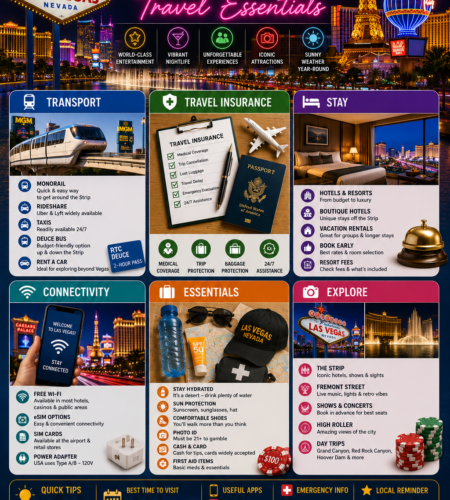
This Las Vegas travel essentials guide gives visitors a complete planning foundation: U.S. entry basics, ESTA and visitor visas, REAL ID for domestic flyers, Harry Reid International Airport, airport transfers, Strip transport, RTC buses, taxis, rideshare, resort fees, hotel taxes, sales tax, no VAT refund, money, safety, heat, local laws, gambling, alcohol, cannabis, health, tap water, packing, day trips, car rental and essential contacts.
All prices are in U.S. dollars (USD). Rules, fares, fees, hotel taxes, airport procedures, security rules, event traffic patterns, public transport passes, taxi flat rates and travel advisories can change. Always confirm final details with Harry Reid International Airport, RTC Southern Nevada, Nevada Taxicab Authority, TSA, CBP, Travel.State.Gov, Las Vegas Metropolitan Police Department, National Weather Service, Southern Nevada Health District, your airline, your hotel and your own government’s travel advisory before travelling.
Current Travel Advisory Note
As of June 9, 2026, Las Vegas is open and operating as a major U.S. tourism destination, but practical safety context matters.
GOV.UK’s USA travel advice checked on June 9, 2026 notes that violent crime and gun crime rarely affect tourists but advises taking care in unfamiliar areas and avoiding quieter areas alone at night. Government of Canada warns that petty crime, including pickpocketing and purse snatching, can occur in U.S. urban centres and tourist locations, and advises not leaving valuables in vehicles. Australia’s Smartraveller lists the United States as “Exercise normal safety precautions” but notes that violent crime rates vary and that unsafe areas can exist even in cities with relatively low overall risk.
For Las Vegas specifically:
- Use 911 for emergencies.
- Use 311 or 702-828-3111 for LVMPD non-emergency police response.
- Avoid isolated walks away from bright tourist corridors late at night.
- Do not leave bags, passports, electronics or luggage in parked cars.
- Plan around extreme heat from late spring through early autumn.
- Confirm airport, show, event and road timing during major conventions, Formula 1 setup, festivals and sports weekends.
- Keep your phone charged for maps, rideshare, hotel reservations and emergency alerts.
Quick Answer: Las Vegas Travel Essentials
For most first-time visitors, Las Vegas is easiest when planned around these essentials:
| Topic | Best Practical Answer |
|---|---|
| Main airport | Harry Reid International Airport (LAS) |
| Best airport transfer to Strip | Taxi or rideshare for most visitors |
| Cheapest airport option | RTC bus routes 108, 109 or Centennial Express (CX), depending on terminal and destination |
| Main Strip bus | Deuce on the Strip |
| Main rail-like Strip option | Las Vegas Monorail on the east side of the Strip |
| Currency | U.S. dollar (USD) |
| Cards | Widely accepted, but cash is useful for tips and gambling |
| Sales tax | Clark County sales/use tax listed by Nevada Department of Taxation as 8.375% |
| VAT refund | No U.S.-style tourist VAT refund in Nevada |
| Hotel fees | Resort fees and lodging taxes can add significantly to hotel cost |
| Emergency | 911 |
| Non-emergency police | 311 or 702-828-3111 |
| Legal gambling age | 21 in Nevada |
| Alcohol age | 21 |
| Cannabis | 21+, but public consumption is prohibited |
| Tap water | Safe by official water standards, though taste may be mineral/chlorine-heavy |
| Biggest weather risk | Extreme heat, especially June-September |
| Car needed? | No for Strip/Downtown; yes for national parks and desert day trips |
If you only remember one thing: compare the real hotel total, not just the nightly rate. In Las Vegas, the room rate, resort fee, hotel tax, parking, show tickets, tips, rideshare surges and heat-related taxi use can change the trip budget quickly.
Las Vegas at a Glance
Las Vegas is the largest city in Nevada’s main tourism corridor and the central visitor hub of Clark County. Most travellers spend time in three major areas:
- The Strip, technically much of it in unincorporated Clark County, where the major resort casinos are located.
- Downtown Las Vegas, especially Fremont Street and the Arts District.
- Off-Strip and suburban areas, including Chinatown, Summerlin, Henderson, Red Rock, Enterprise and local casino corridors.
Why Las Vegas Works for Visitors
- The airport is close to the Strip.
- Hotels, casinos, shows and restaurants are concentrated.
- Taxis, rideshare and buses are easy to find.
- The city runs late.
- English is the main language, but international tourism is common.
- Restaurants cover every budget level.
- The city works for entertainment, conferences, sports, nightlife, shopping, weddings and desert day trips.
Why Las Vegas Surprises Visitors
- Hotels are massive and distances inside resorts are long.
- Resort fees can be higher than expected.
- Summer heat can make walking dangerous.
- The Strip is longer than it appears.
- Pedestrian bridges and casino layouts can slow short trips.
- Event traffic can change normal routes.
- Tipping is part of service culture.
- Casino floors can be smoky in many properties.
- A room “near the Strip” may still be inconvenient without a car.
Ideal Length of Stay
| Trip Length | Best For |
|---|---|
| 1 night | Show, dinner, quick casino or airport stopover |
| 2 nights | Classic Strip weekend |
| 3 nights | First-time visit with one show and Downtown |
| 4-5 nights | Vegas plus pool time, food, shopping and one day trip |
| 1 week | Vegas plus Red Rock, Hoover Dam, Valley of Fire, Grand Canyon or Death Valley |
Entry Rules for International Visitors
Las Vegas is in the United States, so international visitors must follow U.S. entry rules. Your passport, nationality, visa status, travel history, health restrictions and length of stay all matter.
Visa Waiver Program and ESTA
The Visa Waiver Program allows most citizens or nationals of participating countries to travel to the United States for tourism or business for stays of 90 days or less without obtaining a visa, provided they have approved ESTA and meet all requirements.
CBP describes ESTA as an automated system that determines eligibility to travel to the United States under the Visa Waiver Program.
Basic ESTA planning:
- Apply only through the official ESTA website.
- Do not use third-party websites unless you understand fees and risk.
- Apply before buying non-refundable travel when possible.
- Use the same passport you will travel with.
- ESTA approval does not guarantee admission to the United States.
- Border officers make the final entry decision.
Visitor Visa
Travel.State.Gov explains that visitor visas are nonimmigrant visas for persons who want to enter the United States temporarily for business (B-1), tourism (B-2), or a combination of both purposes (B-1/B-2).
You may need a visitor visa if:
- Your nationality is not eligible for the Visa Waiver Program.
- You are not eligible for ESTA.
- Your ESTA is denied.
- Your trip purpose does not fit ESTA rules.
- You want to stay longer than VWP rules allow.
Documents to Keep Ready
International visitors should keep:
- Passport.
- ESTA approval or visa.
- Return or onward travel.
- Hotel booking or address.
- Travel insurance information.
- Proof of funds if requested.
- Event or conference documents if applicable.
- Prescription details if carrying medicines.
- Contact details for your accommodation.
Customs and Border Tips
- Answer CBP questions clearly and truthfully.
- Do not joke about work, drugs, weapons or overstaying.
- Know where you are staying.
- Know your return date.
- Do not carry cannabis across borders, even if it is legal in Nevada.
- Keep controlled medications in original containers.
REAL ID and Domestic Travel
U.S. domestic travellers flying to Las Vegas should pay attention to REAL ID.
TSA states that starting May 2025, U.S. travellers must be REAL ID compliant to board domestic flights and access certain federal facilities. TSA also announced that beginning February 1, 2026, travellers without a REAL ID or another acceptable form of identification may use the ConfirmID option with a fee and additional verification, but this can add stress and does not guarantee a smooth experience.
Practical advice:
- Bring a REAL ID-compliant driver’s license or another TSA-accepted ID.
- A valid passport works as an alternative.
- Do not rely on a temporary paper license.
- Arrive earlier if your ID situation is complicated.
- Check TSA’s official acceptable identification list before flying.
International visitors connecting domestically can use passports for TSA screening.
Harry Reid International Airport (LAS)
Harry Reid International Airport is the main airport for Las Vegas. It is close to the Strip, but the correct transfer depends on terminal, luggage, hotel location, time of day and event traffic.
Main Airport Facts
- Airport code: LAS.
- Passenger terminals: Terminal 1 and Terminal 3.
- Main transport options: taxi, rideshare, RTC public buses, rental car shuttle, limousines, hotel shuttles where available.
- Taxis are outside baggage claim in both terminals.
- Rideshare pickups are in designated parking garage areas.
- RTC bus routes serve Level Zero at Terminal 1, and Centennial Express also serves Terminal 3.
Airport Bus Routes
Harry Reid Airport lists:
- Route 108.
- Route 109.
- Centennial Express (CX).
These stop on Level Zero at Terminal 1. CX also serves Terminal 3.
Public buses are cheapest but not always easiest with luggage. If your hotel is on the Strip and you are tired, taxi or rideshare may be worth the cost.
Rental Car Center
Harry Reid Airport’s rental car centre is separate from the terminals and served by shuttle. Rent a car if you plan to drive to Red Rock Canyon, Hoover Dam, Valley of Fire, national parks or wider Southwest routes. Do not rent a car only because the airport is near the Strip.
Airport to Strip, Downtown and Hotels
Best Airport Transfer by Traveller Type
| Traveller Type | Best Option |
|---|---|
| First-time Strip visitor | Taxi or rideshare |
| Budget traveller | RTC bus |
| Family with luggage | Taxi, rideshare XL or private transfer |
| Downtown stay | Rideshare, taxi or transit with transfer |
| Convention traveller | Taxi/rideshare or hotel-specific route |
| Late-night arrival | Taxi or rideshare |
| National park road trip | Rental car after arrival |
| Mobility needs | Taxi/rideshare/private transfer or accessible service |
Taxi from LAS
Harry Reid Airport states that taxi service is regulated by the Nevada Taxicab Authority and that all taxi companies accept credit cards. Taxis are available at both terminals and the Airport Rent-A-Car Center.
Nevada Taxicab Authority lists airport/Strip zone fares:
| Zone | Approximate Area | Fare |
|---|---|---|
| Zone 1 | Sunset north to Tropicana | $21.25 |
| Zone 2 | Tropicana north to Flamingo | $25.25 |
| Zone 3 | Flamingo north to Stratosphere/STRAT area | $29.25 |
Always confirm the current fare and whether your destination is within the airport zone map.
Rideshare from LAS
Uber and Lyft pick up in designated airport parking garage areas. Follow airport signs and the app instructions, because pick-up points differ by terminal.
Rideshare can be cheaper or more expensive than taxi depending on demand, time of day, events, surge pricing and vehicle type.
Public Transit from LAS
Public transit is cheaper but less direct for many hotel entrances. Use RTC if:
- You travel light.
- You are comfortable with transfers.
- Your hotel is near a useful bus stop.
- You are not arriving in extreme heat.
- You want to save money.
Best Time to Visit Las Vegas
Las Vegas is a year-round destination, but weather changes the trip more than many first-time visitors expect.
Best Overall Months
March, April, May, October and November are often the most comfortable for walking, outdoor dining and desert day trips.
Seasonal Breakdown
| Season | What to Expect | Best For |
|---|---|---|
| January-February | Cool nights, lower pool activity | Shows, food, casinos, lower hotel rates |
| March-May | Warm, busy, excellent outdoors | First-time trips, Red Rock, pools reopening |
| June-August | Very hot, often triple-digit highs | Pools, nightlife, indoor attractions |
| September | Still hot, event-heavy | Pools, conferences, late-summer trips |
| October-November | Comfortable, popular | Walking, sports, outdoor day trips |
| December | Cool, holiday events, New Year’s surge | Shows, dining, winter break |
Heat Reality
The National Weather Service says Las Vegas is known for abundant sunshine and hot summer temperatures that reach into the triple digits. NWS heat guidance says an Extreme Heat Warning means extremely dangerous heat conditions are expected or occurring, and people should avoid outdoor activities during the heat of the day, drink water and stay in air conditioning as much as possible.
For visitors, this means:
- Do not plan long Strip walks in July afternoons.
- Use taxis/rideshare for short trips during extreme heat.
- Carry water.
- Wear sunscreen.
- Take indoor breaks.
- Be careful with alcohol by the pool.
- Do not leave children, pets, medicine or electronics in cars.
Where to Stay in Las Vegas
The best Las Vegas area depends on why you are visiting.
Best Areas for First-Time Visitors
| Area | Best For | Notes |
|---|---|---|
| Mid-Strip | First-time visitors, walking, shows | Convenient but often expensive |
| South Strip | Airport access, big resorts, events | Good for Allegiant Stadium and airport |
| North Strip | Newer resorts, Convention Center, nightlife | Check walking distances |
| Downtown / Fremont | Lower rates, nightlife, old Vegas feel | Louder, different atmosphere |
| Arts District | Local bars, food, galleries | Better for repeat visitors |
| Off-Strip | Value, local casinos, parking | Often needs car/rideshare |
| Summerlin / Red Rock | Nature, quieter stay | Good for Red Rock, not Strip nightlife |
| Henderson / Green Valley | Families, local feel | Car usually helpful |
Hotel Booking Tips
- Compare total price including resort fee and taxes.
- Check parking fees if renting a car.
- Check room deposit/incidentals hold.
- Check minimum check-in age.
- Confirm smoking/non-smoking room type.
- Check pool season and hours.
- Confirm whether the hotel is truly walkable to your plans.
- Watch for convention, Formula 1, Super Bowl-style sports/event pricing.
- If going to a show, map the actual theater entrance, not just the hotel name.
Partner Tip: Hotels
For Las Vegas hotels, always compare total cost, not only the nightly rate.
You can browse Las Vegas stays through our partner link:
Find Las Vegas hotels on Expedia
This is most useful for comparing refundable rates, Strip vs Downtown options, airport hotels, family stays and total nightly cost.
Getting Around Las Vegas
Las Vegas transport is a mix of walking, taxis, rideshare, RTC buses, the Monorail, resort trams and rental cars.
Best Transport Mix
- Walk for neighbouring resorts if weather is comfortable.
- Use taxis or rideshare for airport, late night and heat.
- Use Deuce for budget Strip and Downtown travel.
- Use Monorail for east-side Strip and Convention Center routes.
- Use free resort trams where they fit.
- Rent a car for desert day trips.
Why Walking Takes Longer Than Expected
Distances are deceptive because:
- Casino entrances are far apart.
- Pedestrian bridges add stairs/escalators.
- Resorts route visitors through gaming floors.
- Construction changes sidewalks.
- Heat slows everyone down.
- A hotel complex may cover several blocks.
Do not judge Las Vegas distance by map mileage alone.
RTC Buses, Deuce and Monorail
RTC Fares
RTC Southern Nevada lists these Strip and All Access fares:
| Pass | Regular Fare |
|---|---|
| Single ride | $4 |
| 2-hour pass | $6 |
| 24-hour pass | $8 |
| 3-day pass | $20 |
RTC also lists residential route fares:
| Pass | Regular Fare |
|---|---|
| Single ride | $2 |
| 2-hour pass | $3 |
| 24-hour pass | $5 |
| 7-day pass | $20 |
| 15-day pass | $34 |
| 30-day pass | $65 |
RTC had a transit fare and service update process active in 2026, so check official fares before travel.
Deuce on the Strip
Deuce is the main visitor bus route on the Strip and to Downtown. It is useful for:
- Strip hotel hopping.
- Fremont Street.
- Budget travel.
- Travellers not in a rush.
It can be slow during traffic, big events and weekend nights.
Las Vegas Monorail
The Las Vegas Monorail runs on the east side of the Strip and is useful for:
- MGM Grand.
- Horseshoe/Paris.
- Flamingo/Caesars Palace area.
- Harrah’s/The LINQ.
- Convention Center.
- Westgate.
- SAHARA.
The official Monorail site lists hours:
- Monday: 7 a.m. to midnight.
- Tuesday-Thursday: 7 a.m. to 2 a.m.
- Friday-Sunday: 7 a.m. to 3 a.m.
Ticket pricing shown by the official ticketing page includes:
- Single ride: $5.50.
- 24-hour pass: $13.45.
- 2-day pass: $23.75.
- 3-day pass: $29.95.
- 4-day pass: $37.00.
- 5-day pass: $44.50.
- 7-day pass: $57.50.
Check current pricing before buying because online fares and station ticket prices can vary.
Taxis, Rideshare and Airport Zone Fares
Taxi Pros
- Easy at airport taxi queues.
- No surge pricing.
- Flat zone fares to many Strip hotel areas.
- Good for older travellers or heavy luggage.
- Credit cards accepted.
Taxi Cons
- Can be more expensive for short non-airport trips.
- Lines can be long during major arrivals.
- Traffic still matters outside zone fares.
- Some hotels have taxi queues far from your room.
Rideshare Pros
- Price shown before booking.
- Good for off-Strip locations.
- Useful for groups.
- Often easy late at night.
Rideshare Cons
- Surge pricing.
- Pick-up zones can be confusing.
- Airport and resort garages may require walking.
- Cell signal inside casinos can be unreliable.
Practical Tip
For airport-to-Strip, compare taxi zone fare with rideshare before ordering. For short Strip trips, sometimes walking or Deuce is better; in summer heat, a taxi can be worth it even for short distances.
Money, Cards, Cash and Tipping
Currency
Las Vegas uses U.S. dollars (USD).
Cards and Cash
Cards are widely accepted, but cash is still useful for:
- Tips.
- Casino gaming.
- Valet.
- Bell desk.
- Street performers.
- Small bars.
- Cash-only specials.
- Emergency backup.
Casino ATMs can charge high fees. Bring cash from your bank before arrival if you plan to gamble or tip frequently.
Tipping Basics
Tipping is part of Las Vegas service culture.
Common patterns:
| Service | Typical Visitor Pattern |
|---|---|
| Restaurant server | 18-22% for full service |
| Bartender | $1-2 per drink or 15-20% |
| Cocktail server on casino floor | $1-2 per drink minimum |
| Taxi/rideshare | 15-20% or round up |
| Bell desk | $2-5 per bag |
| Valet | $3-5+ when car is returned |
| Housekeeping | $3-5+ per night |
| Tour guide | 10-20% depending on tour |
| Spa | 18-22% if not included |
Check bills carefully because gratuity may be automatically added for groups, lounges, pools or premium experiences.
Gambling Budget
Set a gambling budget before entering casinos. Do not chase losses. Use ATMs carefully. Responsible gambling support is available through the Nevada Council on Problem Gambling and the national helpline at 1-800-GAMBLER.
VisitLasVegas.com points travellers to responsible gaming support through the Nevada Council and 1-800-522-4700.
Resort Fees, Hotel Taxes and Junk Fee Rules
Las Vegas hotel pricing can be confusing because the advertised room rate may not be the full nightly cost.
What Is a Resort Fee?
A resort fee is a mandatory hotel fee often attached to amenities such as Wi-Fi, fitness centre access, local calls, pools or other services. It may be charged nightly and taxed.
FTC Junk Fee Rule
The FTC’s Rule on Unfair or Deceptive Fees took effect on May 12, 2025. The FTC says it prohibits bait-and-switch pricing and tactics that obscure or misrepresent total prices and fees for live-event tickets and short-term lodging.
Important nuance:
- The rule does not ban resort fees.
- It requires clearer disclosure of mandatory fees.
- Government taxes and certain charges may still appear separately.
- Always inspect the final booking total before payment.
Hotel Room Tax
Las Vegas-area lodging taxes vary by jurisdiction, property location and district. Clark County notes transient lodging tax increases tied to LVCVA expansion and stadium construction, including additional rates for properties in the Primary Gaming Corridor. The City of Las Vegas room tax packet says the majority of licensees are subject to a 13.00% room tax rate, while some properties near the Las Vegas Strip may be subject to 13.38%.
Practical traveller advice:
- Expect hotel taxes to add meaningfully to the bill.
- Check whether resort fees are taxed.
- Read the final checkout page carefully.
- Save screenshots of total price and terms.
- Check whether parking, breakfast and pool access are separate.
Budget Example
If a hotel shows:
- Room rate: $89.
- Resort fee: $45.
- Taxes/fees: varies by location.
Your real nightly cost can be much closer to $145-$160+ than $89. Always compare the final price, not the headline price.
Sales Tax and Tax-Free Shopping
Sales Tax
Nevada Department of Taxation documents list Clark County sales/use tax at 8.375%. This is the practical retail sales tax rate visitors commonly see in Las Vegas and surrounding Clark County areas.
Sales tax may apply to many retail purchases and some services/products depending on tax rules.
Is There Tourist Tax-Free Shopping?
No. Las Vegas does not have a European-style VAT refund system for tourists.
Important:
- The United States does not use a national VAT like the EU.
- Nevada sales tax is generally part of the final purchase cost.
- International tourists should not expect airport VAT refund counters for ordinary Nevada retail shopping.
- Duty-free airport shops are different from VAT refunds.
Shopping Tips
- Compare outlet prices after sales tax.
- Keep receipts for warranties and customs declarations when returning home.
- Know your home country’s import allowance.
- Be careful with luxury purchases if your home country charges duty/tax on return.
Internet, Wi-Fi, SIM Cards and eSIM
Las Vegas is connected, but mobile data matters because casinos can be confusing and indoor signal can vary.
Why Mobile Data Helps
- Rideshare pickup points.
- Maps inside large resorts.
- Show tickets.
- Restaurant reservations.
- Hotel confirmations.
- Mobile check-in.
- Emergency contacts.
- Day trip navigation.
Partner Tip: eSIM
For international travellers, an eSIM can be easier than buying a physical SIM after arrival.
You can check U.S. data plans through our partner:
Install before departure and activate according to the provider’s instructions.
Safety, Scams and Street Smarts
Las Vegas tourist zones are highly policed and security-heavy, but visitor mistakes still happen.
Main Visitor Risks
- Pickpocketing in crowds.
- Bag theft in restaurants, pools and casino bars.
- Phone theft.
- Drink spiking or over-intoxication.
- Car break-ins.
- Fake tickets or unofficial sellers.
- High-pressure street sales.
- Overpriced club or bottle-service promises.
- ATM fees.
- Heat exhaustion.
- Traffic and pedestrian accidents.
- Late-night isolated walks.
LVMPD Tourist Safety Tips
Las Vegas Metropolitan Police Department’s tourist safety guidance emphasizes practical awareness, including securing valuables, using safe transportation and knowing how to contact police.
Higher-Awareness Areas
Be extra aware around:
- Pedestrian bridges.
- Casino entrances.
- Fremont Street at night.
- Parking garages.
- ATMs.
- Rideshare pickup zones.
- Club exits.
- Crowded show/event exits.
- Convenience stores late at night.
- Off-Strip walks after dark.
Practical Safety Habits
- Keep your wallet and phone secured.
- Do not leave bags unattended.
- Use hotel safes for passports when appropriate.
- Do not leave valuables visible in cars.
- Use official taxis/rideshare.
- Watch your drink.
- Stay with friends when nightlife is involved.
- Avoid carrying large visible cash.
- Ask hotel security if unsure about walking routes.
- If something feels wrong, go into a casino, hotel lobby or staffed business.
Gambling, Alcohol, Cannabis and Local Rules
Gambling Age
Nevada law prohibits gaming by persons under 21. The Nevada Revised Statutes include NRS 463.350, which covers gaming or employment in gaming prohibited for persons under 21.
If you look young, expect to be carded. Do not lend ID, use fake ID or allow underage friends to gamble.
Alcohol
The legal drinking age is 21. Bring government-issued photo ID or passport if you plan to drink, enter clubs or gamble.
Practical notes:
- Some venues scan IDs.
- International IDs may be refused by some door staff if they cannot verify them.
- Passport is safest for international visitors, but keep it secure.
- Open-container rules vary by area and container type.
- Alcohol plus heat is a serious risk.
Cannabis
Nevada Cannabis Compliance Board states that adults 21 and older can legally consume cannabis, but:
- You cannot use cannabis in any public place.
- You cannot use cannabis in a moving vehicle, even as a passenger.
- Cannabis can be consumed on private property only if the property owner allows it.
- Cannabis may be consumed at licensed cannabis consumption lounges.
LVMPD also notes that possession limits and under-21 possession rules apply.
Important for tourists:
- Do not smoke cannabis on the Strip sidewalk.
- Do not smoke cannabis in casino hotel rooms unless explicitly allowed, which is uncommon.
- Do not drive under the influence.
- Do not take cannabis across state lines or international borders.
- Federal land, airports and national parks are not cannabis-friendly just because Nevada allows adult use.
Smoking
Many Las Vegas casino floors allow smoking, though some hotels and restaurants have stricter rules. If smoke bothers you, check hotel policies and consider properties with stronger non-smoking areas.
Health, Heat, Tap Water and Travel Insurance
Emergency Medical Help
Call 911 for medical emergencies.
For public health information, Southern Nevada Health District lists:
- Main number / after-hours emergencies: 702-759-1000.
Heat Safety
Southern Nevada Health District’s Beat the Heat guidance advises:
- Limit outdoor activity.
- Exercise early morning or evening.
- Avoid the middle of the day when the sun is hottest.
- Drink more water than usual.
- Do not wait until thirsty.
- Wear sunscreen and reapply.
- Pace activity and hydrate continuously.
Symptoms of heat exhaustion can include heavy sweating, paleness, muscle cramps and dizziness. Move to a cooler place, drink water and seek medical attention if symptoms worsen or do not improve.
Tap Water
Southern Nevada Water Authority says Southern Nevada’s water supply meets or exceeds state and federal drinking water standards, though the taste may not appeal to everyone. Las Vegas Valley Water District says Las Vegas drinking water meets or surpasses all safety standards and is tested thoroughly.
Practical advice:
- Tap water is officially safe.
- It may taste hard or chlorinated.
- Use a refillable bottle.
- Drink more than usual in summer.
- Add electrolytes if walking outside for long periods.
Travel Insurance
U.S. medical care can be expensive, especially for international visitors. Consider travel medical insurance for:
- Emergency care.
- Hospital visits.
- Trip interruption.
- Lost baggage.
- Rental car issues.
- Missed connections.
- Outdoor day trips.
Partner option:
SafetyWing price widget:
Always read exclusions, especially for alcohol-related incidents, gambling losses, high-risk activities, pre-existing conditions and official advisory limitations.
Food, Shows and Reservations
Las Vegas can be spontaneous, but the best restaurants and shows still require planning.
Food Planning
- Book popular restaurants early.
- Check cancellation fees.
- Expect high prices in major resorts.
- Explore Chinatown and off-Strip restaurants for better value.
- Look at happy hours.
- Check whether gratuity is included.
- Drink water with alcohol, especially in summer.
Shows and Events
Las Vegas shows can sell out. For major events:
- Buy from official venues or reputable ticket platforms.
- Check seat maps.
- Watch service fees.
- Confirm the hotel/theater entrance.
- Leave extra time for security and walking.
- During large events, rideshare and taxi prices can surge.
FTC Rule and Ticket Fees
The FTC junk fee rule also applies to live-event ticketing. It requires clearer disclosure of mandatory fees, but it does not mean tickets are cheap or that optional add-ons disappear. Always compare final checkout totals.
What to Pack
Year-Round Essentials
- Government ID/passport.
- Comfortable walking shoes.
- Sunscreen.
- Sunglasses.
- Refillable water bottle.
- Power bank.
- Light jacket for indoor air conditioning.
- Cards plus tip cash.
- Prescription medicines.
- Travel insurance details.
- Phone charger.
- Swimwear if your hotel pool is open.
Summer Packing
- Breathable clothes.
- Hat.
- High-SPF sunscreen.
- Electrolytes.
- Sandals plus walking shoes.
- Light cover-up for sun.
- Lip balm.
- Reusable bottle.
Winter Packing
- Light coat or jacket.
- Sweater for evenings.
- Comfortable closed shoes.
- Layers.
- Swimwear only if your hotel has heated pool/spa access.
Casino and Nightlife
- Smart-casual outfits for restaurants.
- Dress shoes or neat sneakers for clubs/lounges.
- Valid ID.
- Small bag that meets venue rules.
- Backup payment card.
Useful Apps
Install before arrival:
| App / Tool | Best For |
|---|---|
| Airline app | Flight status and mobile boarding pass |
| Harry Reid Airport site/app tools | Airport information |
| Uber / Lyft | Rideshare |
| rideRTC / Transit app | RTC bus tickets and planning |
| Las Vegas Monorail ticketing | Monorail passes |
| Google Maps / Apple Maps | Walking and driving |
| OpenTable / Resy | Restaurants |
| Ticketmaster / venue apps | Shows and sports |
| Hotel app | Mobile check-in and room requests |
| Weather app / NWS | Heat and wind alerts |
| Banking app | Card controls and spending alerts |
Day Trips and Experiences
Las Vegas is a strong base for desert, canyon and dam trips.
Best Day Trips
| Destination | Best For | Notes |
|---|---|---|
| Red Rock Canyon | Scenic drive, hiking, climbing | Close to Vegas, car useful |
| Hoover Dam | Engineering, history | Easy half-day |
| Valley of Fire | Red sandstone landscapes | Very hot in summer |
| Grand Canyon West | Skywalk, canyon views | Long but popular |
| Grand Canyon South Rim | Classic national park views | Very long day, better overnight |
| Death Valley | Desert extremes | Avoid peak heat, check conditions |
| Lake Mead | Water, scenery | Heat and water safety matter |
| Mount Charleston | Cooler mountain escape | Weather can differ from Vegas |
Partner Tip: Tours
For Grand Canyon, Hoover Dam, Red Rock, Valley of Fire, food tours, nightlife or show packages, compare pickup location, duration, cancellation policy and what is included.
You can browse Las Vegas experiences through our partner:
Explore Las Vegas tours and day trips on Viator
This is useful if you do not want to rent a car or drive desert roads after a long day.
Car Rental and Driving
Do You Need a Car?
No for Strip and Downtown. Yes or maybe for:
- Red Rock Canyon.
- Valley of Fire.
- Hoover Dam.
- Grand Canyon.
- Death Valley.
- Off-Strip dining.
- Summerlin or Henderson stays.
- Multi-state road trips.
Car Rental Costs to Check
- Base rate.
- Taxes and airport fees.
- Insurance.
- Deposit/hold.
- Parking at hotel.
- Valet fees.
- Gas.
- National park entrance fees.
- One-way fees.
Partner Tip: Car Rental
If your Las Vegas trip includes desert day trips, compare rental options before arrival:
Compare Las Vegas car rental on DiscoverCars
Check whether your hotel charges for parking before booking a car.
Driving Safety
- Do not drive impaired.
- Watch for pedestrians and scooters.
- Expect sudden lane changes.
- Do not leave valuables visible.
- Carry water outside the city.
- Check weather before desert trips.
- Avoid remote desert drives without phone coverage planning.
- In summer, do not start long hikes at midday.
Accessibility and Comfort
Las Vegas can be accessible in many resort areas, but distances are huge.
Accessibility Tips
- Request accessible rooms early.
- Confirm roll-in shower/lift details directly with hotel.
- Ask about distance from elevator to room.
- Use taxis/rideshare in heat.
- Check whether Monorail stations fit your route.
- Reserve mobility scooters if needed.
- Allow more time for casino walking.
- Ask security or concierge for shortest indoor route.
Comfort Tips
- Choose hotels based on your main plans, not only price.
- Pay attention to smoke sensitivity.
- Avoid summer afternoon walking.
- Use refillable water.
- Break up long casino/resort walks with indoor stops.
Las Vegas for Different Travellers
First-Time Visitors
Stay central on the Strip if budget allows. Do one show, one special dinner, one Downtown/Fremont visit and one desert or Hoover Dam outing if staying three nights or more.
Couples
Look at mid-Strip, luxury resorts, spa properties or quieter high-end hotels. Book dinner and show times carefully so you are not rushing across the Strip.
Families
Las Vegas can work for families, but it is not the same as an amusement destination. Choose hotels with pools and non-casino access when possible. Keep children away from gaming areas and plan indoor heat breaks.
Solo Travellers
Stay in a major hotel in a busy area. Use rideshare/taxis late at night, avoid isolated walks, keep drinks in sight and share plans with someone if going out.
Conference Travellers
Stay near the conference venue or Monorail if the event is at the Convention Center. During major conventions, book hotels and restaurants early.
Budget Travellers
Downtown and off-Strip can be cheaper, but check transport cost. A low nightly rate can disappear once resort fee, tax and rideshares are added.
International Travellers
Plan ESTA/visa early, bring passport for ID-sensitive venues, budget for tipping and understand that taxes/fees may appear differently than in Europe or Asia.
Essential Contacts
Save these before arrival.
| Need | Contact |
|---|---|
| Emergency | 911 |
| LVMPD non-emergency | 311 |
| LVMPD dispatch | 702-828-3111 |
| LVMPD public information | 702-828-4082 |
| Terrorism-related threat / Southern Nevada Counter Terrorism Center | 702-828-7777 |
| Harry Reid International Airport | harryreidairport.com |
| RTC Southern Nevada | rtcsnv.com |
| RTC customer service | 702-228-RIDE (7433) |
| RTC paratransit reservation | 702-228-4800 |
| Nevada Taxicab Authority main office | 702-486-2000 |
| Nevada Gaming Control Board Las Vegas main office | 702-486-2000 |
| Southern Nevada Health District | 702-759-1000 |
| Las Vegas Valley Water District | lvvwd.com |
| Visit Las Vegas official tourism | visitlasvegas.com |
| TSA REAL ID | tsa.gov/realid |
| Official ESTA | esta.cbp.dhs.gov |
| Travel.State.Gov visitor visas | travel.state.gov |
| Responsible gambling support | 1-800-GAMBLER / 1-800-522-4700 |
Travel Planning Tools
Use these partner tools only where they genuinely help your trip.
Mobile Data
Yesim eSIM for the United States
Best for international visitors who need maps, rideshare, hotel apps and ticket access immediately after landing.
Hotels
Best for comparing refundable rates, total hotel costs and Strip/Downtown/airport options.
Tours and Experiences
Best for Grand Canyon, Hoover Dam, food tours, nightlife, shows and guided desert trips.
Car Rental
DiscoverCars Las Vegas rentals
Best for national parks, Red Rock, Valley of Fire, Hoover Dam and Southwest road trips.
Travel Medical Insurance
SafetyWing travel medical insurance
Best for international travellers, long trips or flexible medical coverage needs.
Support the Project
If this guide helped you plan better, you can support independent travel research here:
Support HEDONISM cloud on Patreon
Las Vegas Travel Essentials Checklist
Before booking:
- Check ESTA or visa requirements if international.
- Check REAL ID or passport if flying domestically.
- Compare hotel total cost including resort fee and taxes.
- Check event and convention dates.
- Decide whether you need a car.
- Review travel insurance.
One week before travel:
- Download hotel, airline, rideshare and map apps.
- Reserve restaurants and shows.
- Check weather and heat alerts.
- Save emergency contacts.
- Confirm airport transfer.
- Check parking fees if renting a car.
Arrival day:
- Keep ID accessible.
- Compare taxi and rideshare prices.
- Drink water.
- Keep valuables close.
- Confirm hotel incidental deposit and resort fee.
- Do not overplan the first night after a long flight.
Before departure:
- Allow extra airport time.
- Check TSA ID rules.
- Check hotel checkout time and late checkout fees.
- Review final hotel bill.
- Keep receipts for disputes.
- Do not travel with cannabis.
FAQ
Is Las Vegas expensive?
Las Vegas can be cheap or very expensive. Room rates may look low, but resort fees, hotel taxes, parking, food, shows, drinks, tips and rideshare can raise the real cost. Compare final totals before booking.
What currency does Las Vegas use?
Las Vegas uses U.S. dollars (USD).
Do I need cash in Las Vegas?
Cards are widely accepted, but cash is useful for tips, gambling, valet, bell desk, cocktail servers and backup.
Do international visitors need ESTA for Las Vegas?
Visa Waiver Program travellers generally need approved ESTA before travelling to the United States. Other travellers may need a B-1/B-2 visitor visa. Check CBP and Travel.State.Gov before booking.
Do U.S. travellers need REAL ID to fly to Las Vegas?
TSA requires REAL ID-compliant identification or another acceptable ID for domestic flights. A valid passport is an acceptable alternative for many travellers.
What is the best way from Las Vegas Airport to the Strip?
Taxi or rideshare is easiest for most visitors. Budget travellers can use RTC buses, but transfers and luggage can make transit less convenient.
How much is a taxi from LAS to the Strip?
Nevada Taxicab Authority lists airport/Strip zone fares of $21.25, $25.25 and $29.25 depending on the hotel zone. Confirm your hotel’s zone and current fare before travelling.
Is there public transport from Las Vegas Airport?
Yes. Harry Reid Airport lists RTC Route 108, Route 109 and Centennial Express (CX). These serve Terminal 1 Level Zero, and CX also serves Terminal 3.
Is Las Vegas safe for tourists?
Tourist areas are busy and highly policed, but petty theft, drink-related problems, scams, car break-ins and late-night risks exist. Stay in well-lit areas, watch valuables and use official transport.
What emergency number should I call in Las Vegas?
Call 911 for emergencies. For LVMPD non-emergency police response, call 311 or 702-828-3111.
Is Las Vegas tap water safe?
Yes. Southern Nevada Water Authority says the water supply meets or exceeds state and federal drinking water standards, though taste may not appeal to everyone.
Is there tax-free shopping in Las Vegas?
No. Las Vegas does not have a European-style VAT refund system for tourists. Clark County sales tax is generally part of the final purchase price.
What is the sales tax in Las Vegas?
Nevada Department of Taxation materials list Clark County sales/use tax at 8.375%.
What are resort fees?
Resort fees are mandatory hotel fees charged by many Las Vegas hotels. The FTC junk fee rule requires clearer upfront disclosure of mandatory fees, but it does not ban resort fees.
Can I smoke cannabis on the Strip?
No. Nevada Cannabis Compliance Board says cannabis cannot be used in any public place or moving vehicle. Consumption is limited to private property where allowed or licensed consumption lounges.
What is the legal gambling age in Las Vegas?
The legal gambling age in Nevada is 21.
What is the best time to visit Las Vegas?
March-May and October-November are usually most comfortable. June-September can be extremely hot, with triple-digit temperatures common.
Do I need a car in Las Vegas?
No for Strip and Downtown. A car is useful for Red Rock, Hoover Dam, Valley of Fire, national parks, suburban stays or road trips.
FAQ Schema JSON-LD
{ "@context": "https://schema.org", "@type": "FAQPage", "mainEntity": [ { "@type": "Question", "name": "Do international visitors need ESTA for Las Vegas?", "acceptedAnswer": { "@type": "Answer", "text": "Visa Waiver Program travellers generally need approved ESTA before travelling to the United States. Other travellers may need a B-1/B-2 visitor visa. Check CBP and Travel.State.Gov before booking." } }, { "@type": "Question", "name": "What is the best way from Las Vegas Airport to the Strip?", "acceptedAnswer": { "@type": "Answer", "text": "Taxi or rideshare is easiest for most visitors. Budget travellers can use RTC buses, but transfers and luggage can make transit less convenient." } }, { "@type": "Question", "name": "How much is a taxi from LAS to the Strip?", "acceptedAnswer": { "@type": "Answer", "text": "Nevada Taxicab Authority lists airport/Strip zone fares of $21.25, $25.25 and $29.25 depending on the hotel zone. Confirm your hotel's zone and current fare before travelling." } }, { "@type": "Question", "name": "Is there tax-free shopping in Las Vegas?", "acceptedAnswer": { "@type": "Answer", "text": "No. Las Vegas does not have a European-style VAT refund system for tourists. Clark County sales tax is generally part of the final purchase price." } }, { "@type": "Question", "name": "Are resort fees banned in Las Vegas?", "acceptedAnswer": { "@type": "Answer", "text": "No. The FTC junk fee rule requires clearer upfront disclosure of mandatory hotel and short-term lodging fees, but it does not ban resort fees." } }, { "@type": "Question", "name": "Is Las Vegas tap water safe?", "acceptedAnswer": { "@type": "Answer", "text": "Yes. Southern Nevada Water Authority says Southern Nevada's water supply meets or exceeds state and federal drinking water standards, though the taste may not appeal to everyone." } } ] }
Suggested Internal Links
Use these internal links to strengthen topical authority:
- Las Vegas Transport Hub
- Harry Reid Airport to Strip
- Las Vegas Resort Fees Explained
- Las Vegas Strip vs Downtown
- Las Vegas Monorail Guide
- Deuce on the Strip Guide
- Tax Free in the United States
- Las Vegas Day Trips
- Las Vegas Safety Tips
- Las Vegas First-Time Visitor Guide
Final Word
Las Vegas is simple on the surface and complicated in the details. The city wants you to move quickly from airport to hotel to casino to dinner to show, but the smartest trips are built on clear logistics: real hotel price, correct ID, airport transfer, heat planning, safe late-night routes, realistic walking distances and a budget that includes tips and fees.
Use taxi or rideshare when it saves your energy, use Deuce or Monorail when the route makes sense, compare resort fees before booking, drink more water than you think you need, and treat desert day trips with respect. Most of all, remember that Las Vegas is not just one Strip. It is a city, a resort corridor, a convention machine, a food scene, a sports destination and a desert base all at once.
Plan the boring parts well, and the bright parts become much easier to enjoy.
Sources Checked
Official and primary sources checked on June 9, 2026:
- Harry Reid International Airport – All options to and from LAS: https://www.harryreidairport.com/all-options-to-and-from
- Harry Reid International Airport – Taxi and rideshare: https://www.harryreidairport.com/taxi-and-ride-share
- Harry Reid International Airport – Taxis: https://www.harryreidairport.com/taxi-and-ride-share/taxis
- Harry Reid International Airport – Public bus: https://www.harryreidairport.com/busses-shuttles/public-bus
- Harry Reid International Airport – Rental cars: https://www.harryreidairport.com/rental-cars
- RTC Southern Nevada – Fares and passes: https://www.rtcsnv.com/ways-to-travel/fares-passes/
- RTC Southern Nevada – Airport transit routes: https://www.rtcsnv.com/ways-to-travel/transit-services/airport-transit-routes/
- Las Vegas Monorail – Official site and hours: https://www.lvmonorail.com/
- Las Vegas Monorail – Ticket pricing: https://www.lvmonorail.com/ticket-information/
- Nevada Taxicab Authority – Airport/Strip zone fares: https://taxi.nv.gov/Rider_Info/Las_Vegas_Strip_Airport_Zones_Fares/
- Nevada Taxicab Authority – Approximate fare information: https://taxi.nv.gov/rider_info/approximate_fare_information/
- CBP – ESTA: https://www.cbp.gov/travel/international-visitors/esta
- Official ESTA application: https://esta.cbp.dhs.gov/esta/
- Travel.State.Gov – Visitor visa: https://travel.state.gov/content/travel/en/us-visas/tourism-visit/visitor.html
- Travel.State.Gov – Visa Waiver Program: https://travel.state.gov/content/travel/en/us-visas/tourism-visit/visa-waiver-program.html
- TSA – REAL ID: https://www.tsa.gov/realid
- TSA – ConfirmID fee press release: https://www.tsa.gov/news/press/releases/2026/01/15/45-fee-option-air-travelers-without-real-id-begins-february-1
- FTC – Rule on Unfair or Deceptive Fees effective May 12, 2025: https://www.ftc.gov/news-events/news/press-releases/2025/05/ftc-rule-unfair-or-deceptive-fees-take-effect-may-12-2025
- FTC – Rule on Unfair or Deceptive Fees FAQ: https://www.ftc.gov/business-guidance/resources/rule-unfair-or-deceptive-fees-frequently-asked-questions
- Federal Register – Trade Regulation Rule on Unfair or Deceptive Fees: https://www.federalregister.gov/documents/2025/01/10/2024-30293/trade-regulation-rule-on-unfair-or-deceptive-fees
- City of Las Vegas – Room tax packet: https://files.lasvegasnevada.gov/business-licensing/RoomTaxPacket.pdf
- Clark County – Transient lodging tax rate increases: https://www.clarkcountynv.gov/business/doing_business_with_clark_county/transient-lodging-tax-rate-increases
- Nevada Department of Taxation – Sales and use tax county map: https://tax.nv.gov/wp-content/uploads/2024/05/ADM-T047-State-Sales-Tax-Map.pdf
- Nevada Department of Taxation – Components of sales and use tax rates: https://tax.nv.gov/wp-content/uploads/2024/12/Components-of-Sales-Tax.pdf
- Las Vegas Metropolitan Police Department – Tourist safety: https://www.lvmpd.com/services/tourist-safety
- Las Vegas Metropolitan Police Department – Contact: https://www.lvmpd.com/contact/contact-us
- City of Las Vegas – See Something, Say Something: https://www.lasvegasnevada.gov/News/Blog/Detail/see-something-say-something
- Nevada Cannabis Compliance Board – Laws and regulations: https://ccb.nv.gov/laws-regulations/
- LVMPD – Local ordinances and state laws: https://www.lvmpd.com/services/tourist-safety/local-ordinances-and-state-laws
- Nevada Gaming Control Board – Official site: https://www.gaming.nv.gov/
- Nevada Revised Statutes – Chapter 463 gaming control: https://www.leg.state.nv.us/nrs/nrs-463.html
- Visit Las Vegas – Official tourism website: https://www.visitlasvegas.com/
- National Weather Service Las Vegas: https://www.weather.gov/vef/
- National Weather Service – Climate of Las Vegas: https://www.weather.gov/vef/ClimateofLasVegas
- National Weather Service – Heat alerts: https://www.weather.gov/safety/heat-ww
- Southern Nevada Health District – Beat the Heat: https://www.southernnevadahealthdistrict.org/programs/beattheheatsnv/
- Southern Nevada Health District – Main facility/contact: https://www.southernnevadahealthdistrict.org/about-us/maps/southern-nevada-health-district-main-facility/
- Southern Nevada Water Authority – Water quality facts: https://www.snwa.com/water-quality/facts/index.html
- Las Vegas Valley Water District – Water quality reports: https://www.lvvwd.com/water-quality/reports/index.html
- Las Vegas Valley Water District – Official site: https://www.lvvwd.com/
- GOV.UK – USA travel advice: https://www.gov.uk/foreign-travel-advice/usa
- GOV.UK – USA safety and security: https://www.gov.uk/foreign-travel-advice/usa/safety-and-security
- Government of Canada – United States travel advice: https://travel.gc.ca/destinations/united-states
- Australian Smartraveller – United States: https://www.smartraveller.gov.au/destinations/americas/united-states-america
Comments